
- 8 Dec 2025
- Elara Crowthorne
- 20
South Korea Crypto Tax Calculator
Your Tax Estimate
By January 2027, every South Korean crypto investor will face a new tax reality. It’s not a flat 5-45% rate like some headlines suggest. The truth is more specific, more nuanced, and far more predictable. If you’re holding crypto in South Korea, you need to know exactly how much you’ll pay - and when.
What You Actually Pay on Crypto Gains
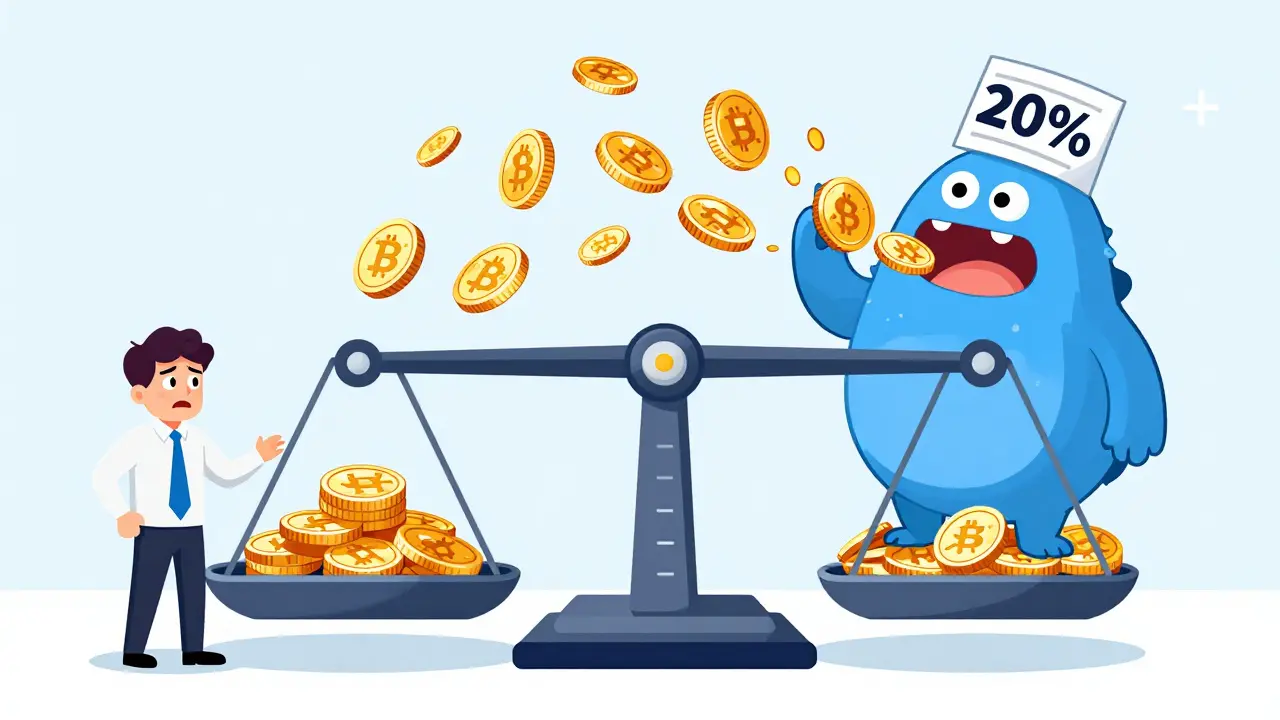
The core of South Korea’s crypto tax is a 20% capital gains tax. But here’s the catch: you only pay it if your total annual profit from selling or trading crypto hits 50 million Korean Won - roughly $35,900 USD. Below that? Zero tax. No reporting. No paperwork. This exemption is one of the highest in the world.
For example, if you bought 1 BTC for $40,000 and sold it for $70,000, your $30,000 profit doesn’t trigger tax. Even if you made three such trades in a year totaling $48,000 in gains, you still pay nothing. But if you hit $50,001 in gains? Now you owe 20% on the entire amount above the threshold - not just the extra $1.
That 20% becomes 22% when you add local taxes. It’s not a choice. It’s automatic. This rate applies whether you held your crypto for 10 days or 10 years. South Korea doesn’t reward long-term holding like Germany does. A quick flip? Same tax as a long-term hold. No discounts. No exceptions.
Income Tax on Staking, Mining, and Airdrops
Here’s where the real pain starts. If you earn crypto as income - from staking rewards, mining, airdrops, or getting paid in Bitcoin for freelance work - it’s not taxed as capital gains. It’s taxed as other income. That means it gets slotted into your personal income tax bracket.
South Korea’s income tax ranges from 6.6% to a staggering 49.5% when you include local taxes. So if you’re a high earner making $200,000 a year and you get $15,000 in staking rewards, that $15,000 could be taxed at 45% or more. That’s the 45% figure people talk about. It’s not a crypto-specific rate. It’s your top marginal income tax rate hitting your crypto earnings.
Compare that to the U.S. or Canada, where staking rewards are usually taxed as ordinary income too - but South Korea’s top bracket is higher. If you’re earning crypto as income, you’re in the same boat as someone getting paid in cash. The government doesn’t care what form it comes in.
What’s Not Taxed - And What People Get Wrong
There’s no VAT on crypto trades in South Korea. Buying Bitcoin with won? No tax. Swapping Ethereum for Solana? That’s a taxable event, but not because of VAT. It’s because you sold one asset to buy another. The profit (or loss) gets calculated and counted toward your 50 million KRW threshold.
Here’s a common mistake: people think small transactions under 2.5 million KRW ($1,800) are tax-free. That’s not true. That number comes from a different rule - the one for reporting cash transactions over 10 million KRW. Crypto has no such small-transaction exemption. Only the 50 million KRW annual gain threshold matters.
Also, holding crypto in a wallet, not selling? No tax. Transferring between your own wallets? No tax. Only when you convert to fiat, trade for another coin, or use crypto to buy goods or services does the tax clock start ticking.

Who’s Affected and Who Isn’t
Most retail investors won’t hit the 50 million KRW threshold. A study by the Korea Blockchain Association in 2024 found that 78% of individual crypto holders in South Korea have annual gains under 20 million KRW. For them, the tax is irrelevant. They can ignore it until 2027 - and even then, they may never need to file.
But active traders? DeFi users? Those who run multiple exchanges or do frequent swaps? They’re in the crosshairs. One trader on Reddit reported doing 87 crypto-to-crypto trades in a single year. Each one is a taxable event. Even if each trade made only 500,000 KRW profit, that’s 43.5 million KRW - almost at the limit. Add one big sale and they’re over.
Foreigners living in South Korea? Same rules apply. If you’re a tax resident - meaning you live there more than 183 days a year - you report worldwide crypto income. Non-residents only pay tax on gains from sales made inside Korea. And if you get paid in crypto by a Korean company? That’s 11% withholding tax right off the top.
How to Track Everything - And Why It’s a Nightmare
The National Tax Service doesn’t care if you used Binance, Upbit, or a decentralized exchange. You have to track every transaction. Date. Amount. Value in KRW at the time. Purpose. That’s the law.
Here’s what you need to record:
- Buy: When you got crypto, how much you paid in won, and the exchange rate
- Sell: When you sold, how much you got, and what you bought with it
- Trade: Every swap - ETH for SOL, BTC for DOGE - is a sale and a purchase
- Staking: Date you received rewards, value in KRW at receipt
- Airdrops: Same as staking - value on the day you received it
Most people use tools like Koinly, CoinTracker, or local Korean apps like TaxBit Korea. But even those tools struggle with DeFi. If you lent crypto on Aave, got liquidity tokens, and later swapped them back - that’s a chain of taxable events. No app can auto-calculate that without manual input.
Tax professionals say active traders need 10 to 20 hours just to set up their records. Then another 2-5 hours per month to update them. That’s not a hobby. That’s a part-time job.

Why the Delay to 2027? And Will It Stick?
The tax was supposed to start in 2022. Then 2025. Then, in December 2024, the National Assembly pushed it to January 2027. Why? Because the crypto industry pushed back hard. The Korea Blockchain Association warned that forcing compliance too early would drive investors offshore. Exchanges like Upbit and Bithumb lobbied for more time to build reporting tools.
Politicians were split. The ruling party wanted revenue. The opposition feared driving out innovation. The compromise? Delay, but don’t cancel. The government knows crypto is here to stay. They just want to tax it properly.
Will it stick this time? Probably. The National Tax Service has already started issuing guidance. In July 2025, they clarified that crypto received from foreign corporations must be reported as income - closing a major loophole. They’re preparing. The system is being built. The 2027 deadline feels real.
What Happens If You Don’t File?
Blockchain is public. Every transaction is traceable. The government doesn’t need your bank statements. They can look at the blockchain.
Penalties are steep. Late filing? 20% of unpaid tax. Underreporting? Up to 40%. Fraud? Criminal charges. In 2024, South Korea fined 1,200 individuals for unreported crypto gains - and that was before the official tax even started.
The message is clear: if you made gains above 50 million KRW since 2022, you’re on the radar. The tax office has the tools. They’re waiting for 2027 to start auditing.
What You Should Do Now
Don’t wait until 2027 to start.
- If you’ve traded or earned crypto since 2022: start collecting records now. Export your transaction history from every exchange.
- Use a crypto tax tool. Even if you’re below the threshold, it’ll help you know where you stand.
- If you’re a high earner and earn crypto as income: talk to a tax advisor. Your 49.5% bracket is real.
- If you’re a casual holder: you’re probably fine. But keep your records anyway. The rules could change.
South Korea isn’t trying to kill crypto. It’s trying to bring it into the light. The tax isn’t about punishment. It’s about fairness. If you’re making money, they want their share. But they’ve given you room to breathe - if you’re not a high-volume trader, you won’t feel the pinch. Just don’t ignore it. The clock is ticking.

20 Comments