- 23 Jan 2026
- Elara Crowthorne
- 13
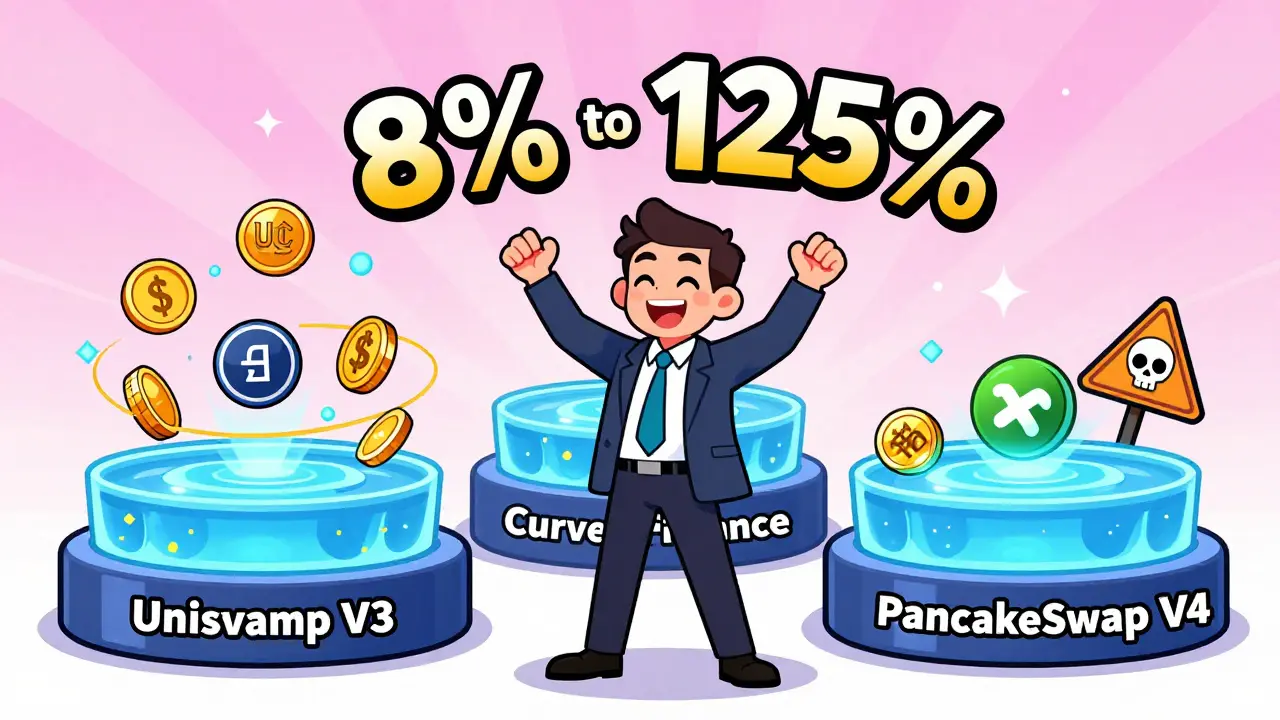
Want to earn passive income from your crypto without selling it? Liquidity pools let you do exactly that-by locking up token pairs in smart contracts and earning fees every time someone trades them. But not all pools are created equal. Some pay tiny yields. Others can give you 50%, 100%, even 125% APY-if you know where to look and what risks you’re taking.
In 2026, the top liquidity pools aren’t just about swapping tokens. They’re about capital efficiency, fee multipliers, and smart risk management. The best ones don’t just give you returns-they help you keep them.
Uniswap V3: The Gold Standard for Blue-Chip Pairs
If you’re holding ETH, USDC, WBTC, or other major tokens, Uniswap V3 is still the most reliable place to earn fees. Launched in 2021, it revolutionized liquidity provision by letting you set custom price ranges. Instead of spreading your money across $1,000 to $5,000 for ETH/USDC, you can concentrate it between $3,200 and $4,000-where the price is likely to stay. This boosts your fee earnings by up to 4,000x compared to older versions.
As of December 2025, Uniswap V3 held $42.3 billion in total value locked (TVL), making up nearly 59% of all Ethereum DEX volume. Professional liquidity providers report average annual yields between 8% and 18% on stable pairs like ETH/USDC, depending on how tightly they manage their ranges. That’s not flashy-but it’s steady.
Here’s the catch: if the price moves outside your range, you stop earning fees. During the March 2025 ETH crash, one trader lost $142,000 because he didn’t adjust his range in time. Tools like Tokenomik’s impermanent loss calculator and setting price alerts are non-negotiable. Uniswap V3 rewards precision. It punishes laziness.
Curve Finance: The Stablecoin Powerhouse
Stablecoins like USDC, DAI, and FRAX don’t swing wildly. That makes them perfect for low-risk, high-efficiency pools-and Curve Finance is the undisputed king here. Built with a special algorithm called Stableswap, Curve minimizes slippage and impermanent loss for stable pairs. For USDC/USDT swaps, slippage is 97% lower than on Uniswap.
Curve’s Tricrypto pool (FRAX/USDC/DAI) delivered 42% APY in late 2025 after factoring in trading fees and CRV rewards. That’s not a fluke. It’s engineered. Curve’s design reduces the risk of losing value when prices shift-because stablecoins barely move. In fact, Curve cut impermanent loss for stable LPs by 89% compared to standard AMMs, according to Messari’s Q4 2025 report.
But don’t expect to add SOL or DOGE here. Curve only supports stablecoins and wrapped assets. If you want yield on volatile tokens, look elsewhere. Curve’s strength is safety. Its weakness is variety. Still, if you’re holding stablecoins and want to earn without sleepless nights, this is your best bet.
PancakeSwap V4: High Yield, High Risk
Want 125% APY? PancakeSwap V4 on BNB Chain might give it to you-but only if you’re okay with the volatility. Launched in March 2024, it’s the most aggressive player in the yield game. Its “Starter Pools” for new tokens often offer insane returns, sometimes over 100% APY, fueled by CAKE token emissions.
That’s why 73% of all trading volume on BNB Chain flows through PancakeSwap. It’s fast, cheap ($0.0003 per swap), and beginner-friendly. You can set up a liquidity position in under 10 minutes. But here’s the reality: many of these high-yield pools are short-lived. Tokens pump, rewards drop, and you’re left with worthless tokens and a big loss.
Trustpilot reviews show 42% of negative feedback points to “high volatility in farming pools.” In Q2 2024, a smart contract glitch wiped out $18 million in user funds. PancakeSwap fixed it-but the incident stuck in users’ minds. Use it for short-term yield grabs, not long-term holdings. And never stake more than you can afford to lose.

Raydium: Speed and Efficiency on Solana
If you hate waiting for transactions, Raydium is your match. Built on Solana, it settles trades in under a second and charges $0.00025 per swap-roughly 1/5,000th the cost of Ethereum. It processed 1.2 million daily transactions in December 2025, making it the fastest major DEX.
Raydium’s liquidity pools combine AMM mechanics with Serum’s order book, giving you the best of both worlds: low fees and deep liquidity. APYs for SOL/USDC pools hover around 15-25%, but the real draw is speed. If you’re day-trading or scalping, Raydium lets you enter and exit positions faster than any Ethereum-based pool.
But Solana isn’t perfect. It had four network outages in Q4 2025, totaling over 170 minutes of downtime. If your liquidity is locked when the chain goes down, you can’t move it. That’s a real risk. Raydium is ideal for users who prioritize speed over absolute stability-and who trust Solana’s long-term roadmap.
Balancer V2: For the Portfolio Builder
Most liquidity pools require two tokens. Balancer lets you use up to eight. That’s a game-changer if you want to replicate an index fund. Want to stake 40% ETH, 30% WBTC, 20% LINK, and 10% UNI? Balancer lets you do that in one pool.
It’s not the highest-yielding option. Volume is 38% lower than Uniswap’s for similar pairs. But it’s the only one that lets you automate portfolio rebalancing. If ETH rises and your allocation shifts to 50%, Balancer automatically sells some ETH and buys the others to restore balance-earning fees along the way.
It’s perfect for long-term holders who want passive, diversified exposure without manually managing multiple positions. But it’s complex. You need to understand token weights, rebalancing triggers, and fee tiers. It’s not for beginners. But if you’re serious about structured DeFi investing, Balancer is the only tool that gives you true portfolio control.
What You Need to Know Before You Start
High returns come with high stakes. Here’s what no one tells you before you deposit your first dollar:
- Impermanent loss is real-63% of providers lose value when prices swing. Use calculators, set alerts, and avoid volatile pairs unless you know what you’re doing.
- Gas fees matter-Ethereum can cost $3.50 per transaction. Use BNB Chain or Solana for frequent trades.
- Don’t chase APY alone-A 120% APY on a new token might vanish in 48 hours. Look at trading volume, team history, and tokenomics.
- Smart contracts aren’t bulletproof-PancakeSwap had a $18M exploit. Curve has never been hacked. Choose based on track record, not just yield.
- Regulation is coming-The SEC now classifies some pools as securities exchanges. Avoid pools that don’t disclose governance or compliance status.
Start small. Test one pool. Learn how your position behaves when prices move. Then scale.
Which Pool Should You Use?
Here’s a simple decision tree:
- Stablecoins only? → Curve Finance
- ETH, BTC, USDC? → Uniswap V3 (with tight price range)
- Want max yield and don’t mind risk? → PancakeSwap V4 (short-term only)
- Fast trades, low fees? → Raydium
- Want a diversified portfolio? → Balancer V2
Most successful providers split their capital across two or three pools. For example: 50% in Uniswap ETH/USDC, 30% in Curve Tricrypto, and 20% in Raydium SOL/USDC. That balances safety, yield, and speed.
What’s Next in 2026?
Uniswap V4 is launching in Q1 2026 with customizable “hooks” that let developers build custom logic into pools-think auto-compounding or insurance features. Curve is cutting gas costs by 40% with its V2 redeployment. PancakeSwap’s “Blast Off” initiative now lets you stake single assets and earn boosted yields without providing liquidity.
The trend is clear: liquidity provision is getting smarter. The days of just depositing tokens and forgetting about them are over. The winners in 2026 will be those who treat liquidity like a portfolio-not a savings account.
What is the safest liquidity pool for beginners?
The safest option for beginners is Uniswap V3 with ETH/USDC or USDC/DAI pairs. These are high-volume, well-tested, and have lower impermanent loss than volatile tokens. Avoid new or obscure tokens. Start with $100-$500 to learn how price ranges work before scaling up.
Can you lose money in liquidity pools?
Yes. Impermanent loss happens when the price of one token in your pair moves significantly compared to the other. For example, if you provide ETH/USDC and ETH drops 30%, your share of the pool may be worth less than if you’d just held the tokens. This isn’t a hack-it’s how AMMs work. Use tools to estimate this risk before depositing.
How do I get started with a liquidity pool?
Connect a wallet like MetaMask or Phantom. Go to the pool’s website (e.g., uniswap.org, curve.fi). Select the token pair, enter the amount of each token (they must be equal in USD value), approve the transaction, then deposit. The whole process takes 8-12 minutes. Always check the slippage tolerance and price range settings before confirming.
Do I need to monitor my liquidity position?
Yes-if you’re using Uniswap V3, Balancer, or any concentrated liquidity pool. Prices move. If your range is breached, you stop earning fees. Set price alerts on DeFi tools like DeFi Saver or Zapper. Check your position weekly. For stablecoin pools like Curve, daily monitoring isn’t needed.
Are liquidity pools regulated?
Some are. The SEC’s 2025 Liquidity Pool Framework classifies certain pools-especially those offering token rewards-as securities exchanges. Pools on Ethereum and BNB Chain are mostly unregulated, but that could change. Avoid pools with no public governance or legal disclaimers. Stick to well-known platforms with transparent teams.
What’s the difference between APY and actual returns?
APY is the advertised rate, but your actual return is APY minus impermanent loss, minus gas fees, minus any token price drops. For example, a pool shows 80% APY, but your ETH drops 20% and you pay $15 in gas. Your real return might be negative. Always calculate net profit, not just APY.


13 Comments
Okay but can we just take a second to appreciate how Curve’s Stableswap algorithm is basically magic? I’ve been in the Tricrypto pool since late 2024 and my impermanent loss has been less than 1.2% even when FRAX dipped to $0.97. It’s not sexy, but it’s the closest thing to a crypto savings account that doesn’t get raided by rug pulls.
Uniswap V3 is for degens who think they’re traders. If you can’t set a price range properly you deserve to lose. I’ve seen people cry because they locked ETH between $3k and $4k and it went to $5k. That’s not risk management that’s laziness.
125% APY on PancakeSwap? Yeah and I’ve got a bridge to sell you. I jumped into a new token pool last month and got 180% APY for 72 hours. Then the token went to zero and my CAKE rewards stopped. The only thing higher than the APY is the risk. Don’t be that guy.
There’s a deeper philosophical question here: are we providing liquidity or are we becoming financial engineers for decentralized markets? The shift from passive yield to active range management reflects a broader evolution in how we relate to capital. It’s no longer about holding-it’s about orchestration.
Raydium on Solana? Cute. You’re trusting a chain that goes down more than your ex’s DMs. And you call that innovation? Real investors use Ethereum. Everything else is a glorified meme farm with faster gas.
I started with $200 in Curve and now I’m reinvesting every week. It’s not glamorous but I sleep better. Also, I love that I can do this from my phone while waiting for chai at the local stall. DeFi shouldn’t be intimidating-it should be accessible.
For beginners: start small, start stable. I taught my mom how to use Uniswap V3 with ETH/USDC. She’s got $500 in and checks it once a month. No stress, no drama. Just steady growth. You don’t need to chase 100% APY to win.
balancer? lmao. 8 tokens? who even uses that? sounds like some nerd trying to replicate vanguard on blockchain. just stick to one pair and stop overcomplicating it.
just wanna say i tried uniswap v3 last week and totally forgot to adjust my range. lost 12% in 3 days. lesson learned. set alerts. i use zapper now. its a lifesaver.
It’s funny how we treat liquidity pools like they’re some kind of sacred ritual. We obsess over APY, range boundaries, and slippage-but we never ask why we’re doing this. Are we building a decentralized economy? Or just gambling with better UI?
Curve is the only one that doesn’t make me feel like I’m holding a live grenade. I’ve seen too many people get wrecked chasing yield on new tokens. The real alpha isn’t in the 120% APY-it’s in the 15% APY that lasts 12 months without you having to check your wallet every hour.
As someone who has managed institutional liquidity portfolios across both centralized and decentralized systems, I must emphasize that the evolution from Uniswap V2 to V3 represents not merely a technical upgrade, but a paradigmatic shift in capital allocation mechanics. The concentration of liquidity introduces a new dimension of active portfolio management previously absent in AMM design, effectively transforming liquidity providers from passive participants into dynamic market-makers. This requires not only technical proficiency but also behavioral discipline-a trait increasingly rare in retail DeFi participants. The future of yield generation lies not in chasing the highest APY, but in mastering the equilibrium between risk exposure, capital efficiency, and temporal commitment.
Honestly? I use three pools. 50% Curve for safety, 30% Uniswap V3 for ETH exposure, 20% Raydium for the speed. I don’t care about the hype-I care about not losing sleep. And I’ve been doing this since 2021. The ones who win are the ones who stay consistent, not the ones who chase the next big thing.