- 22 Jan 2026
- Elara Crowthorne
- 15
When you hold a governance token, you’re not just owning a piece of crypto-you’re holding a vote. That vote can decide whether a protocol raises fees, allocates millions in treasury funds, or even removes a core developer. But here’s the catch: governance token value doesn’t come from how much it costs on an exchange. It comes from whether that vote actually means something.
What Governance Tokens Actually Do
Governance tokens give holders the power to shape the future of a blockchain protocol. Unlike regular tokens that might earn you staking rewards or let you trade, these tokens let you vote on real decisions. Think of them like shares in a company, but instead of dividends, you get influence over how the rules change. Take MakerDAO, for example. Its MKR token holders vote on things like how much debt the system can issue, what collateral types are accepted, and how much users pay in stability fees. These aren’t minor tweaks-they directly affect the price stability of DAI, a $5 billion stablecoin used worldwide. If MKR holders vote to allow real estate as collateral, that’s a massive shift in risk. And it happens automatically through smart contracts once the vote passes. This system was built to replace top-down control. Instead of a CEO or board making decisions, the community does. But that only works if the community is actually involved.Why Governance Tokens Are Hard to Value
Most people look at a governance token’s price and assume it reflects its usefulness. It doesn’t. Right now, the value of tokens like AAVE, UNI, or COMP is mostly driven by speculation. Traders buy them hoping the price will go up, not because they plan to vote on proposals. That’s a problem. If you’re holding a token just to flip it, you don’t care if the protocol gets better. You care if the next person will pay more. This disconnect leads to bad outcomes. A proposal that improves long-term sustainability might get rejected because the majority of voters are short-term speculators. Experts call this the “value gap.” Governance tokens have no direct revenue stream. They don’t pay dividends. They don’t automatically burn tokens to reduce supply. Their value is entirely secondhand-based on what others think the voting power might be worth someday. That’s why prices swing wildly based on headlines, not real governance activity.Who Really Controls the Vote?
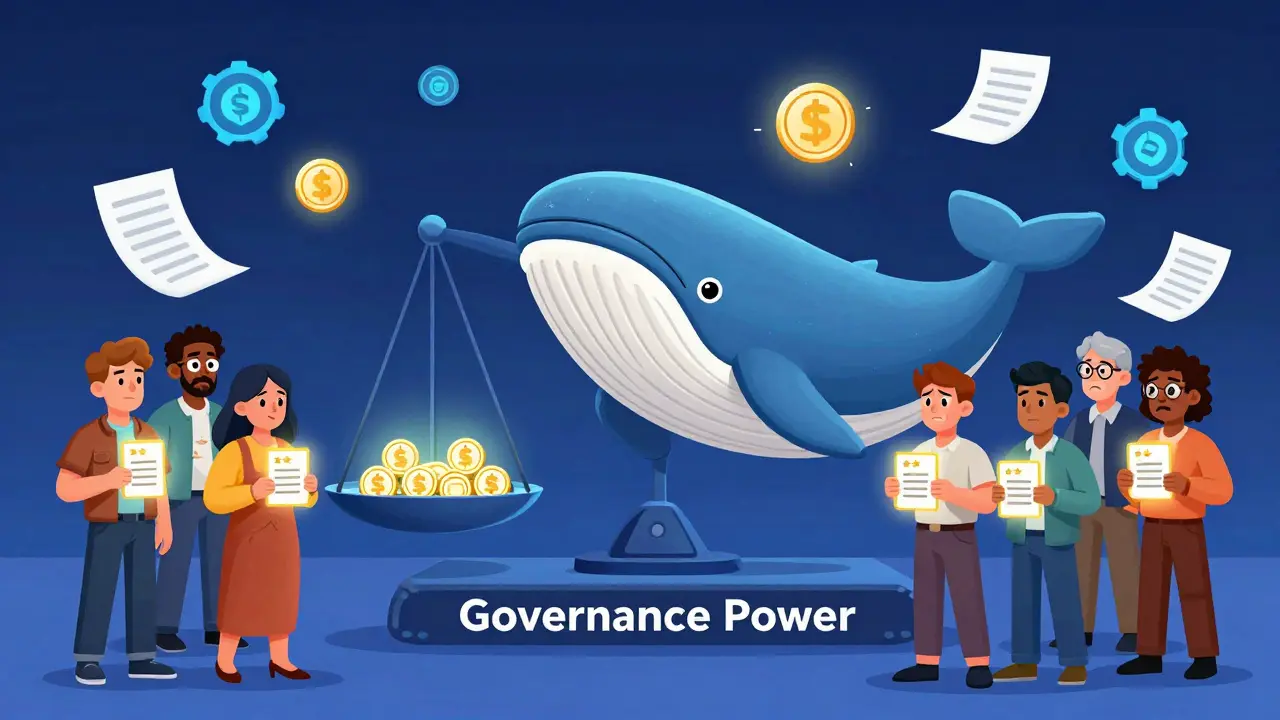
Governance is supposed to be democratic. But in practice, it’s often controlled by a few large holders-what the community calls “whales.” A single wallet holding 5% of the total supply can sway votes on critical issues. In 2023, a single entity voted down a proposal to increase liquidity mining rewards because it would’ve reduced their own token emissions. The community was split 70-30 in favor, but the whale’s vote tipped the scale. No one could override it. This isn’t a glitch-it’s built into the system. Most protocols use “one token, one vote.” So if you hold 10,000 tokens, you get 10,000 votes. Someone with 1 million tokens gets 100 times more influence. That’s efficient for decision-making, but it’s not fair. Small holders often feel powerless. Many stop voting altogether.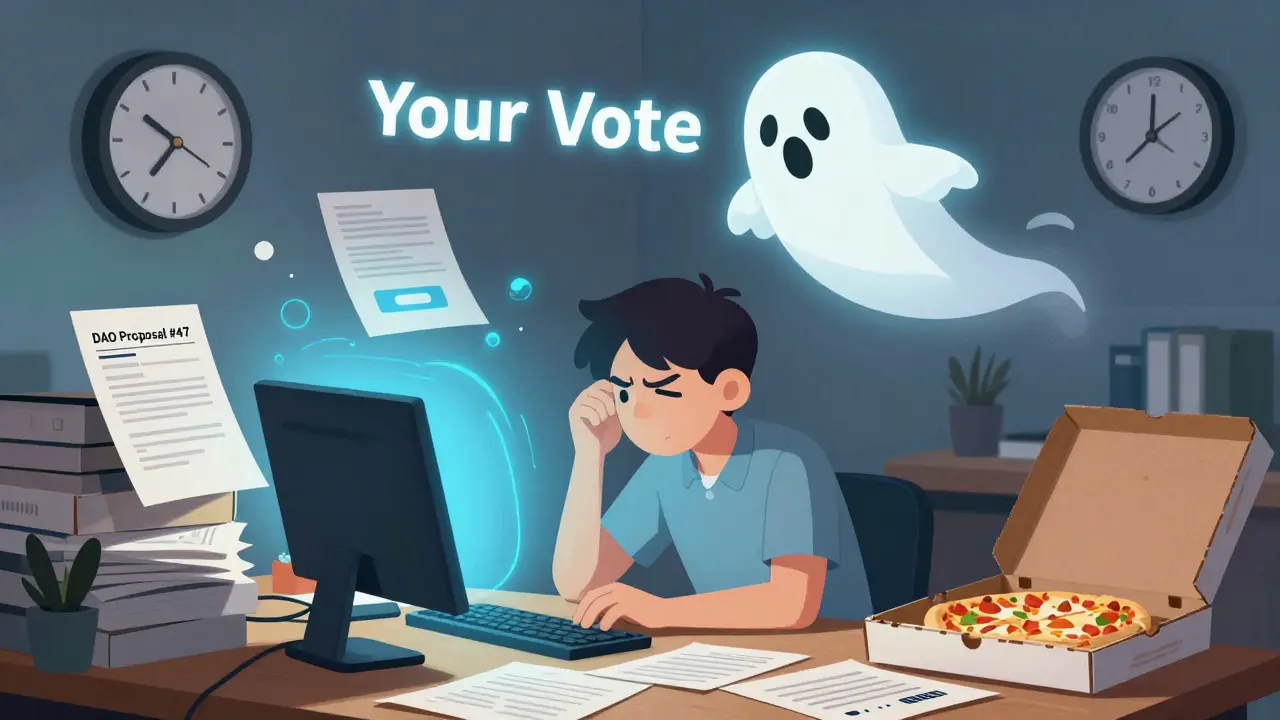
Governance Fatigue Is Real
Voting on governance proposals isn’t easy. You need to understand complex technical documents, assess economic impacts, and track voting timelines. Most users don’t have the time-or the expertise. A 2024 study of 12 major DAOs found that fewer than 8% of token holders participated in any vote. In some cases, proposals passed with only 0.5% of the total supply voting. That’s not democracy. That’s a handful of people making decisions for thousands. Even when people try to participate, the process is confusing. Proposals are written in dense legal and technical jargon. Voting interfaces are clunky. There’s no clear guide on how to research a proposal. Many users just delegate their vote to a trusted entity-like a crypto fund or influencer-without understanding what they’re endorsing.How Some Protocols Are Fixing This
The best projects aren’t waiting for users to get smarter. They’re changing the system to make participation more valuable. One approach is revenue-sharing. Instead of letting governance tokens sit idle, some protocols now distribute a portion of protocol fees directly to active voters. For example, a DeFi lending protocol might give 20% of its interest income to users who voted in the last three proposals. That turns voting from a chore into a reward. Another innovation is quadratic voting. Instead of one token = one vote, quadratic voting uses a formula where the cost of each additional vote increases exponentially. So if you want to cast 10 votes, it costs you 100 tokens (10²). That makes it expensive for whales to dominate, while giving small holders more relative power. Some protocols are also using progressive decentralization. They start with the founding team controlling votes, then gradually hand over control over months or years. This gives the team time to build the protocol before handing it off-avoiding the chaos of early-stage governance.
What Happens When Governance Works
It’s rare, but when it works, it’s powerful. In 2025, the Curve DAO community voted to reallocate $120 million in treasury funds from speculative yield farming to long-term liquidity incentives. The proposal was backed by detailed economic modeling and community discussions over three weeks. Over 40% of token holders voted-unusually high. The result? Daily trading volume on Curve jumped 60% in the next month, and protocol revenue increased by 35%. That’s the kind of outcome governance tokens were meant to enable. Not speculation. Not hype. Real, measurable improvement driven by coordinated community action.The Future of Governance Tokens
The next wave of governance tokens won’t just be about voting. They’ll be about earning. We’re already seeing prototypes of multi-token systems. One token might be for voting, another for staking, and a third for accessing premium features. This separates influence from ownership, reducing the risk of whales controlling everything. AI tools are also starting to help. Some DAOs now use AI to summarize proposals, flag risks, and even predict voting outcomes based on past behavior. Imagine getting a plain-English summary of a complex smart contract upgrade, with a confidence score on whether it’ll succeed. And then there’s cross-protocol governance. What if you could vote on a proposal for a lending protocol and a DEX at the same time? That’s being tested in experimental frameworks where governance rights can be transferred between related chains. The goal isn’t to make governance perfect. It’s to make it worth participating in.Is Your Governance Token Worth Anything?
Ask yourself these questions:- Do I understand the last three proposals voted on by this protocol?
- Has the protocol improved since I bought the token-or just the price?
- Do I get any benefit for voting, or am I just holding in hopes it goes up?
- Are the top 10 wallets holding more than 50% of the supply?
Are governance tokens the same as regular crypto tokens?
No. Regular crypto tokens might let you trade, stake, or pay for services. Governance tokens give you voting rights on protocol decisions-like changing fees, allocating funds, or updating code. You can hold both types at once, but only governance tokens give you influence over how the system evolves.
Can I make money just by holding a governance token?
You might, but not because of the token’s governance function. Most governance tokens don’t pay dividends or interest. Any profit comes from price speculation-buying low and selling high. Some newer protocols now reward active voters with fees or tokens, but that’s still the exception, not the rule.
Why do whales have so much control over governance?
Because most systems use “one token, one vote.” If someone holds 10% of all tokens, they have 10% of the votes. That’s mathematically efficient, but it gives disproportionate power to large holders. Even if 90% of users oppose a decision, a whale can override them. That’s why some protocols are testing quadratic voting and revenue-sharing to balance influence.
What happens if I don’t vote?
Your vote doesn’t disappear-it just isn’t counted. The proposal passes or fails based on the votes that are cast. In many cases, proposals pass with less than 5% of total supply voting. That means your inaction lets others decide for you. Some protocols now penalize non-voters by reducing future rewards, but most still treat voting as optional.
Are governance tokens regulated like securities?
It’s unclear. Regulators in the U.S., EU, and elsewhere are still deciding. Some argue that because governance tokens give holders control over a project, they act like equity and should be regulated as securities. Others say they’re utility tokens because they’re used for protocol participation. The answer varies by jurisdiction and how the token is structured. Many projects now avoid marketing tokens as investments to reduce legal risk.
How can I start participating in governance?
First, make sure you hold the token in a wallet that supports voting (not on an exchange). Then, visit the project’s governance forum or dashboard-usually linked on their website. Read the proposal summaries, check community discussions, and vote before the deadline. Start small: vote on one proposal per month. Over time, you’ll learn how decisions are made and what matters most to the community.

15 Comments
Yo this is actually one of the clearest breakdowns of governance tokens I’ve seen. Most people think it’s just another coin to HODL, but no-it’s about power. And power without participation is just a fancy NFT.
Been voting on AAVE proposals for a year now. Most are still unreadable, but I’ve started using AI summaries and it’s a game changer.
Protocol fee redistribution via governance participation is a non-trivial mechanism for aligning incentive structures in permissionless systems. The economic externality of voter apathy creates a negative-sum equilibrium where whale dominance becomes the Nash equilibrium unless mitigated via quadratic voting or reputation-based weighting.
USA built the internet and now we’re letting some dude in India vote on our DeFi rules?? 😂
One token one vote is fine if you’re not a socialist trying to redistribute power. If you want democracy go vote for mayor not some DAO with 02% turnout
Also why is everyone using AI to summarize? Just read the damn thing. 🤷♂️
If you're holding a governance token and not voting you're basically a free rider on someone else's civic duty. You don't get to complain about whales when you won't even click a button. This isn't a game. This is your future being decided by people who care more than you do.
Stop pretending you're an investor when you're just a spectator.
Ugh I just feel so seen 😭
Like why does it feel like every time I try to vote I’m reading a legal textbook written by a robot on acid? And then some guy with 200k UNI just clicks ‘yes’ and everyone’s like ‘oh cool’?
I just want to feel like my tiny 0.3% matters… but it doesn’t. And I’m tired.
Also can we talk about how the UI looks like it was designed in 2017? 🥲
It’s not even about the votes anymore. It’s about the *vibe*. If your DAO feels like a cult with a Discord server and a whitepaper written by someone who read too much Nietzsche… you’re already doomed.
Real governance doesn’t need 40% turnout. It needs soul. And most of these projects? They’re just crypto bros with spreadsheets.
Also I wore a dress to my first DAO meeting. No one else did. I felt like a unicorn in a Bitcoin ATM.
Respected author, your analysis is profoundly insightful. Governance token participation remains a critical challenge in decentralized ecosystems due to asymmetric information and low voter turnout. In India, we observe that technical literacy and language barriers significantly reduce engagement. However, community-led translation initiatives and simplified voting dashboards have shown promising results in pilot DAOs. It is imperative that protocols prioritize accessibility over efficiency.
Thank you for highlighting quadratic voting-this mechanism deserves wider adoption.
I love how this post doesn’t just complain-it shows solutions! Revenue sharing? Quadratic voting? AI summaries? YES PLEASE.
Let’s stop treating governance like a chore and start treating it like a superpower. You don’t need to be a coder to care about where your money goes. You just need to show up.
And hey-if you’re reading this, go vote on one thing this week. Just one. You’ve got this 💪
Another crypto utopian fantasy. You think whales are the problem? No. The problem is that you let amateurs vote on complex financial systems. That’s not democracy. That’s a fucking zoo.
Real governance is done by people with skin in the game. Not some guy who bought 0.1 ETH worth of COMP because he saw a meme.
Stop romanticizing incompetence.
Actually this is very important topic in Nigeria too. Many people here buy governance tokens thinking they will get rich quick but they dont understand the voting system. Some even sell their tokens after one week because they think voting is too hard. I have started a small group in Lagos to help people understand proposals in simple English. We meet every Saturday. If you want to join message me. We need more mentors like this in Africa
What if the real value of governance isn’t in the vote itself, but in the conversation it forces? The act of reading a proposal, debating it, even disagreeing with it-that’s the hidden infrastructure. The vote is just the punctuation mark.
Maybe we’re measuring the wrong thing.
Maybe the token’s worth isn’t in how many votes it gets, but how many minds it changes.
curve dao had 40% turnout? lmfao no way. that’s like saying 70% of people in the us voted for pizza over tacos. it’s fake. someone paid voters. always is.
also who the fuck cares about liquidity incentives? i just wanna know if my yeld farm is gonna get rekt next week
Thank you for this comprehensive and beautifully structured overview. The section on quadratic voting is particularly compelling as it addresses the inherent inequality in token-weighted systems. I would add that cross-protocol governance, while still experimental, holds immense potential for interoperability and systemic resilience. For institutions and individuals alike, understanding governance mechanics is no longer optional-it is foundational to digital sovereignty.
May I suggest a follow-up piece on governance in multi-chain ecosystems?
Wow. So basically you’re saying governance tokens are just crypto’s version of a fake democracy where the rich get to pick the president and the rest of us just get to watch the livestream?
Thanks for the 101. I thought I was investing in the future. Turns out I’m just the guy holding the banner at the parade.
Also, who wrote this? It’s way too coherent to be real. Did you hire a ghostwriter?
So let me get this straight… we’re supposed to care about voting rights in a system where 92% of people don’t vote, the interface looks like a Windows 95 screensaver, and the proposals are written like PhD theses on LSD?
Oh and the whales? They’re just ‘efficient’.
Right. Sure. I’ll just go back to buying Dogecoin. At least that’s honest.