
- 5 Feb 2026
- Elara Crowthorne
- 25
Imagine a system where new money is created and distributed without banks or governments. That’s exactly what block reward economics does for cryptocurrencies like a decentralized digital currency created by Satoshi Nakamoto in 2009. But how does this work, and why does it matter? Let’s break it down.
What Exactly Is a Block Reward?
A block reward is the payment miners or validators receive for adding a new block to the blockchain. It has two parts: newly minted coins (called the block subsidy) and transaction fees from transactions included in the block. This system was designed by Satoshi Nakamoto in the 2008 Bitcoin whitepaper to incentivize network security without central control. For example, when you send Bitcoin, a small fee is added to your transaction. Miners collect these fees along with new coins as their reward for securing the network.
Bitcoin’s Block Reward Model: Halvings and Scarcity
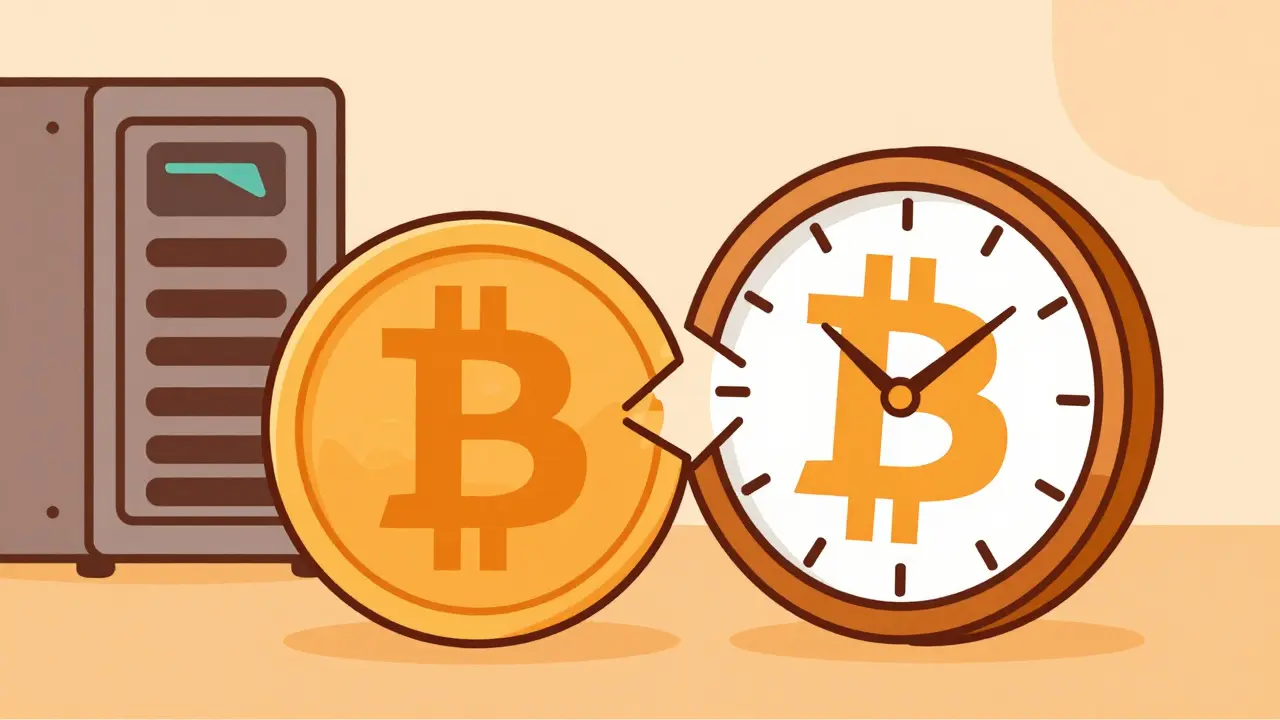
Bitcoin uses proof-of-work (PoW), where miners compete to solve complex puzzles. The block reward started at 50 BTC per block in 2009. Every 210,000 blocks (about every four years), the subsidy is cut in half-a process called a halving. The last halving happened in May 2020, dropping the reward to 6.25 BTC. The next one, in April 2024, will reduce it to 3.125 BTC. With a hard cap of 21 million coins, the final Bitcoin will be mined around 2140. Today, block subsidy makes up 98.5% of miner revenue, but this will drop sharply after halvings. By 2140, miners will rely solely on transaction fees for income.
These halvings create predictable scarcity. Bitcoin’s annual issuance rate fell from 3.7% at launch to 1.7% today. This scarcity is a key reason investors see Bitcoin as a "digital gold." But there’s a catch: as subsidies shrink, miners need higher transaction fees to stay profitable. During the NFT boom in December 2021, Bitcoin fees spiked to $55.23 per transaction. Many users delayed transactions until fees dropped below $2 in February 2022. This shows how block reward economics directly impact real-world usage.
Ethereum’s Shift to Proof-of-Stake
Ethereum made a major change in September 2022 with The Merge. It switched from PoW to proof-of-stake (PoS), where validators stake ETH instead of using energy-intensive mining. In PoS, rewards depend on how much ETH is staked across the network. Current annual issuance is between 0.2% and 0.5%, far lower than Bitcoin’s pre-halving rates. Unlike Bitcoin, Ethereum has no hard supply cap, but EIP-1559 (launched in August 2021) burns a portion of transaction fees, creating deflationary pressure when the network is busy.
Validators earn rewards for proposing and attesting to blocks. For example, with 30.5 million ETH staked (as of September 2023), annual returns for stakers hover around 3.8%, down from 10.1% at launch. This lower issuance rate saves energy-Ethereum’s energy use dropped by 99.95% post-Merge-but it also means less direct funding for security. Critics argue this makes Ethereum less resilient than Bitcoin, while supporters say PoS creates a more sustainable economic model.
Comparing Blockchain Reward Models
| Blockchain | Consensus Mechanism | Current Block Reward | Supply Cap | Key Feature |
|---|---|---|---|---|
| Bitcoin | Proof-of-Work | 6.25 BTC + fees | 21 million | Halvings every 4 years |
| Ethereum | Proof-of-Stake | Variable (0.2%-0.5% annual issuance) | No hard cap | EIP-1559 fee burning |
| Litecoin | Proof-of-Work | 12.5 LTC | 84 million | 2.5-minute block time |
| Monero | Proof-of-Work | 0.6 XMR (tail emission) | No hard cap | Constant reward after 2022 |
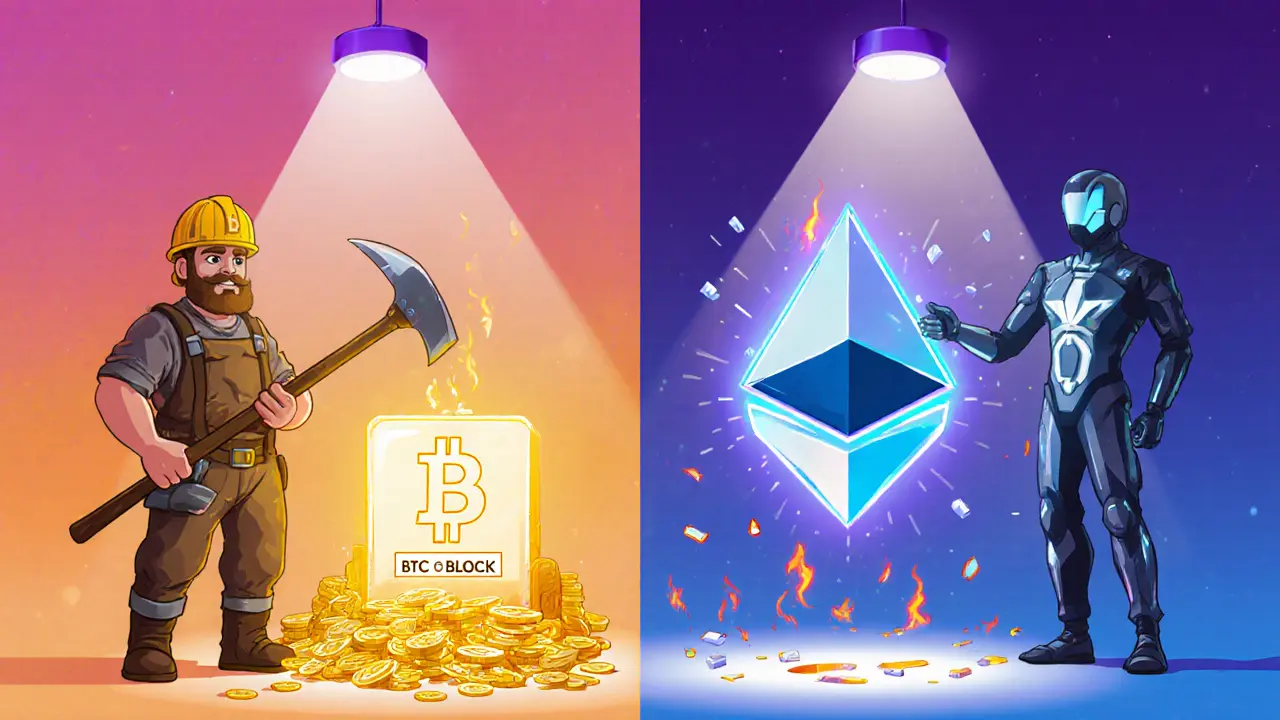
Bitcoin’s fixed supply and halvings create predictable scarcity, while Ethereum’s dynamic model adjusts based on network activity. Litecoin mimics Bitcoin but with faster blocks and higher supply, while Monero’s "tail emission" ensures ongoing rewards even after initial coins are mined. Each approach balances security, scalability, and decentralization differently.
Security Costs and Real-World Impact
Block rewards directly fund network security. Bitcoin’s miners spend about $35 billion annually on electricity and hardware to earn rewards (based on 2023 data). Ethereum’s validators spend far less-around $500 million-thanks to PoS efficiency. But this doesn’t mean Bitcoin is more secure; it just has a different economic model. In fact, Bitcoin has never suffered a 51% attack despite its $578 billion market cap.
However, challenges exist. When Bitcoin’s subsidy drops to 3.125 BTC in 2024, transaction fees will need to rise significantly to compensate miners. A 2023 CoinDesk report warned that "miners with high electricity costs could exit the network," leading to centralization. On Reddit, miners like u/BitcoinMinerPro shared that only those with electricity under 4 cents per kWh could profit after the 2020 halving. This shows how block reward economics create real-world pressure on participants.
Future Challenges and Innovations
The biggest question is: can transaction fees replace block subsidies long-term? For Bitcoin, MIT researchers estimate fees would need to average $50 per transaction to maintain security once subsidies vanish. But innovations like the Lightning Network (a layer-2 solution) could help by handling micropayments off-chain. Meanwhile, Ethereum’s Dencun upgrade (scheduled for Q1 2024) will cut layer-2 fees by 90% through "proto-danksharding," indirectly boosting validator rewards.
For now, block reward economics remain a balancing act. Bitcoin’s model prioritizes scarcity and predictability, while Ethereum’s focuses on flexibility and sustainability. As Dr. Philipp Sandner of the Frankfurt School Blockchain Center says: "Whether fee markets can scale sufficiently to provide adequate security is the central unresolved question."
What happens when Bitcoin’s block subsidy reaches zero?
When Bitcoin’s block subsidy reaches zero around 2140, miners will rely entirely on transaction fees for income. Analysts debate whether fees will be high enough to maintain security. MIT researchers estimate fees would need to average $50 per transaction. However, innovations like the Lightning Network could handle small payments off-chain, reducing pressure on on-chain fees. The network’s security will depend on how much users value Bitcoin’s transaction history and are willing to pay for it.
Why does Ethereum have no hard supply cap?
Ethereum’s design intentionally avoids a hard supply cap to allow flexibility. Instead of capping total coins, it uses EIP-1559 to burn transaction fees, which can create deflationary pressure during high activity. This approach lets the network adjust issuance based on demand-more security needs mean higher rewards for validators, while less demand reduces inflation. Critics argue this makes Ethereum less predictable than Bitcoin, but supporters say it creates a more adaptable economic model.
How do transaction fees affect Bitcoin mining profitability?
Transaction fees are crucial for miner profits, especially as block subsidies shrink. Currently, fees make up just 1.5% of miner revenue on Bitcoin, but this will rise after the 2024 halving. When fees spike (like during the 2021 NFT boom), miners earn more-but users often delay transactions if fees are too high. For example, fees reached $55.23 in December 2021, causing many to wait until fees dropped below $2. Miners must balance high fees (for profit) with user-friendly costs (to keep transactions flowing).
Is proof-of-stake more secure than proof-of-work?
Security depends on the economic model. Bitcoin’s PoW requires massive hardware and energy investments, making 51% attacks prohibitively expensive. Ethereum’s PoS uses staked ETH as collateral; validators who act maliciously lose their stake. While PoW has a longer track record, PoS is more energy-efficient and has never been successfully attacked. However, PoS introduces new risks, like "nothing-at-stake" attacks, which are mitigated by slashing penalties. Both models are secure when properly implemented, but they approach security differently.
What’s the difference between block subsidy and transaction fees?
The block subsidy is newly minted coins awarded for mining a block. It’s the primary reward for Bitcoin miners today but decreases over time. Transaction fees are payments users add to their transactions to prioritize them. Miners collect these fees along with the subsidy. For Bitcoin, fees currently make up just 1.5% of miner revenue, but this will grow as subsidies halve. Fees are the future of miner incentives, while subsidies drive initial currency distribution.


25 Comments
Block rewards are essential for blockchain security. They incentivize miners to validate transactions without central control. Bitcoin's halving schedule creates scarcity, which is why it's often called digital gold. As subsidies decrease, transaction fees will need to rise. It's important to ensure miners stay profitable while keeping fees affordable for users. This balance is crucial for the network's long-term health.
block reword is a scam. bitcoin is a ponzi scheme. people are just buying into hype. the network is insecure. but whatever. lol
Let me tell you, the whole concept of block rewards is fundamentally flawed. Bitcoin's halving schedule is a joke. The network can't possibly stay secure with such a low subsid. Miners will just quit once the fees aren't high enough. It's obvious to anyone who knows anything about economics. But no one listens to me. I've been saying this for years. The system is doomed. Just look at the data. The transaction fees are already too high during peak times. And when the subsidy drops further, it's going to be a disaster. But hey, what do I know? I'm just a nobody. 😒
Block rewards are a government ploy to control money. The whole blockchain system is a scam. They're using it to track you. Every transaction is monitored. The 'security' is just an illusion. Bitcoin is a tool for the elite. Don't fall for it. They're watching you.
block rewards are interesting. they create scarcity but also rely on fees. it's a balance between security and usability. maybe there's a better way. but who knows? maybe it's all part of a larger system we don't see. either way, it's fascinating.
block reward economics more like block reward nonsense. bitcoin is a failure. ethereum is better. but whatever. people don't get it. it's all about control. the network is insecure. period.
Block rewards are the backbone of blockchain security, but they're not perfect. Bitcoin's halvings create scarcity, sure, but users may need to pay higher fees. The Lightning Network might help, but it's not a silver bullet. Ethereum's shift to PoS is interesting, but it's still unproven long-term. Either way, the system's future is uncertain. But hey, that's the fun of crypto, right? 😏
Block rewards? More like a joke. The entire concept is flawed. Bitcoin's model is unsustainable, and Ethereum's PoS is even worse. Miners will fail, validators will be hacked, and the whole thing will collapse. It's obvious to anyone with half a brain. But I guess most people don't care. They just want to get rich quick. Pathetic.
Block rewards are a scam. Bitcoin is a tool of the West. India should not adopt this. The network is insecure. Miners are just pawns. The whole system is rigged. But whatever. It's not my problem.
Block reward economics are fascinating. They create a decentralized system where security is maintained through incentives. Bitcoin's scarcity is beautiful, but Ethereum's flexibility is also impressive. It's exciting to see how different blockchains approach this challenge. The future of finance is being built right now. Let's stay hopeful and keep learning!
Block rewards are indeed a crucial component of blockchain security. The transition from block subsidies to transaction fees is a natural evolution. It is important to recognize that each blockchain has its own unique economic model. Ethereum's approach with EIP-1559 is particularly innovative. However, the long-term sustainability of these models remains to be seen. We must continue to monitor and adapt as necessary.
block rewards are cool. but let's be real. the whole thing is a bit of a mess. bitcoin is like digital gold, but what about the environmental impact? ethereum is trying to fix it, but is it enough? maybe we need a new system altogether. who knows? probably not me. i'm just here for the memes.
Block rewards are essential for blockchain security! They incentivize miners to validate transactions without central control. Bitcoin's halving schedule creates scarcity, which is why it's often called digital gold. As subsidies decrease, transaction fees will need to rise. It's important to ensure miners stay profitable while keeping fees affordable for users. This balance is crucial for the network's long-term health. Let's keep supporting the ecosystem!
block rewards are cool. they keep the network secure. but what happens when fees get too high? people will stop using it. we need better solutions. maybe layer 2. who knows? it's complicated.
When transaction fees skyrocket, the average user gets priced out. This isn't sustainable. We need innovative solutions like the Lightning Network to handle micropayments off-chain. Otherwise, Bitcoin could become a luxury for the wealthy. The stakes are high, but the future is bright if we innovate wisely. Let's keep pushing for progress!
Block rewards are the foundation of blockchain security. They incentivize miners to secure the network. Bitcoin's halving schedule creates scarcity. Ethereum's PoS is more efficient. Both models have pros and cons. The future is promising.
Block rewards are a cornerstone of blockchain security. However, the current models are inadequate. Bitcoin's halvings create artificial scarcity but neglect transaction fee sustainability. Ethereum's PoS is a step forward but lacks the robustness of PoW. We need a hybrid approach that combines the best of both worlds. Only then can we ensure long-term security and scalability.
The transition from block subsidies to transaction fees represents a critical phase in blockchain evolution. For Bitcoin, the current fee market dynamics are insufficient to sustain security post-subsidy. Ethereum's EIP-1559 provides a more adaptive model. However, the fundamental challenge remains: can fee markets scale to meet security requirements? This question is central to the future of decentralized networks.
block rewards are a scam. bitcoin is controlled by the government. they want to track you. the whole thing is a conspiracy. but whatever. 😂
conspiracy theories aside, block rewards are essential for blockchain security. Bitcoin's halving schedule creates scarcity which drives adoption. The network's security relies on miners being incentivized. Without block rewards, the system would collapse. So stop the paranoia and focus on the facts.
block rewards are a scam.
Block rewards are the lifeblood of blockchain networks. They create a decentralized incentive structure that's both elegant and complex. Bitcoin's halving mechanism is a masterpiece of economic design. However, as we approach the final supply cap, the transition to fee-based security is fraught with challenges. The future of blockchain hinges on whether the market can adapt. It's a fascinating journey.
Block rewards are important for security, but we need to consider the long-term sustainability. Transaction fees need to be high enough to incentivize miners without alienating users. Layer-2 solutions might help, but it's still uncertain. Let's hope for the best.
The transition from block subsidies to transaction fees represents a critical phase in blockchain evolution. For Bitcoin, the current fee market dynamics are insufficient to sustain security post-subsidy. Ethereum's EIP-1559 provides a more adaptive model. However, the fundamental challenge remains: can fee markets scale to meet security requirements? This question is central to the future of decentralized networks.
Block rewards are essential for blockchain security. They incentivize miners to validate transactions without central control. Bitcoin's halving schedule creates scarcity, which is why it's often called digital gold. As subsidies decrease, transaction fees will need to rise. It's important to ensure miners stay profitable while keeping fees affordable for users. This balance is crucial for the network's long-term health.