- 21 Feb 2026
- Elara Crowthorne
- 22
Iranian citizens face some of the strictest financial restrictions in the world. International banking channels are largely cut off due to sanctions, making it hard to send or receive money across borders. For millions of people, cryptocurrency isn’t a luxury-it’s a lifeline. In 2026, over 11 million Iranians use digital assets to save, trade, and access global markets. But not all exchanges are created equal. Some work well. Others vanish overnight. And some get shut down by regulators without warning.
Domestic Exchange: Nobitex-The Giant with a Crack in the Foundation
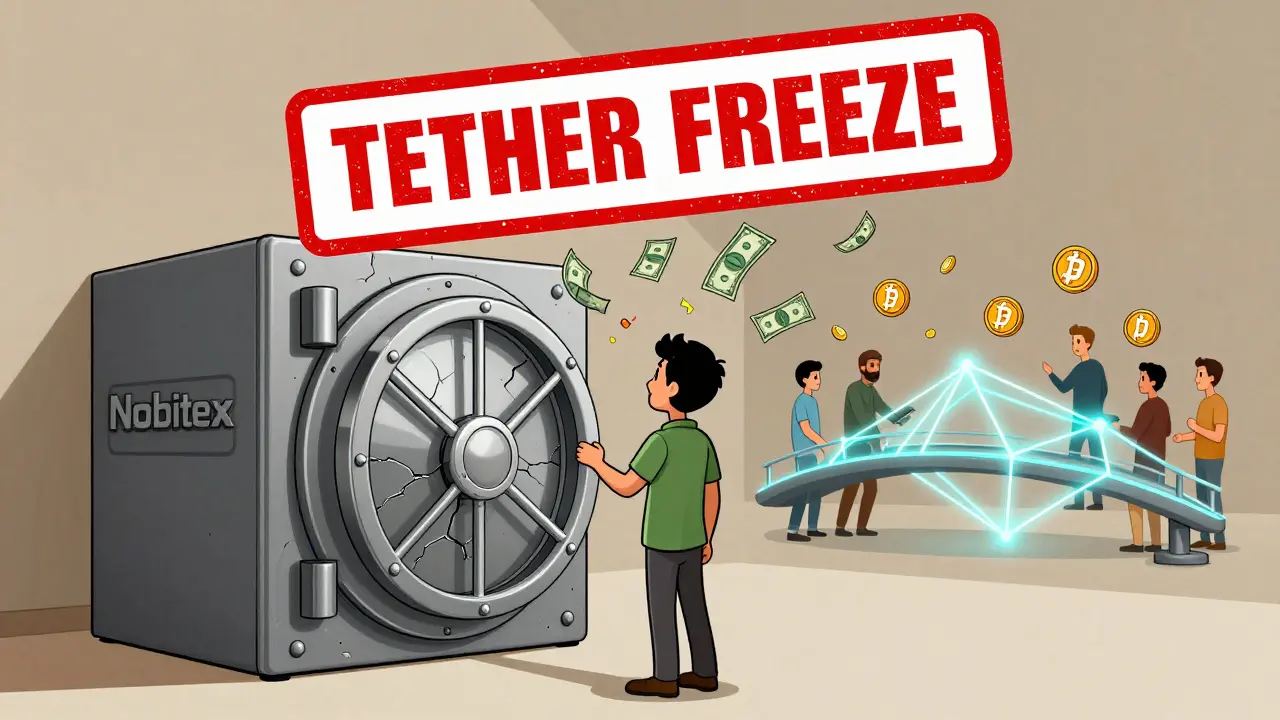
Nobitex handles over 87% of all cryptocurrency trading inside Iran. It’s the go-to platform for everyday users: simple interface, Persian language support, and direct bank links. But behind the scenes, it’s a house of cards. In June 2025, hackers stole more than $90 million from Nobitex. That’s not just a loss-it’s a system failure. The exchange didn’t have proper security layers. No multi-sig wallets. No cold storage backups. Just a single point of failure.
And then came the sanctions. In July 2025, Tether froze 42 Iranian-linked wallet addresses. More than half of them were connected to Nobitex. Suddenly, users couldn’t withdraw USDT. Prices for stablecoins spiked. Panic spread. The government responded by urging people to swap USDT for DAI on the Polygon network-faster, cheaper, and harder to freeze. Nobitex still operates, but trust is gone. Many users now avoid it entirely.
Top International Exchanges Accepting Iranian Users
If you’re outside Iran’s borders, you have more options. Here are the five most reliable international exchanges that still let Iranians trade in 2026, based on real user reports and platform performance.
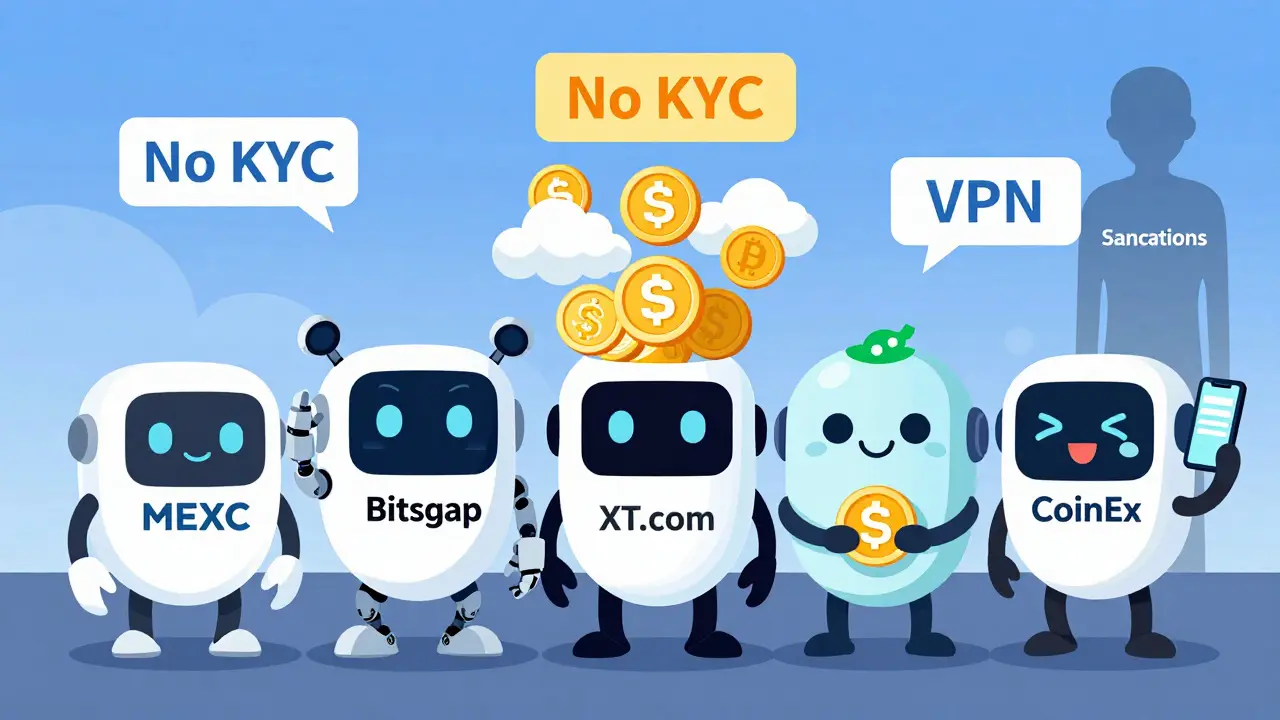
- MEXC - Score: 9.1/10. Minimum deposit: $30. Supports 196 cryptocurrencies. Spot maker fee: 0.2%. MEXC is the most stable for Iranian users right now. It doesn’t block accounts based on location alone. The interface is clean, customer support responds in English and Persian, and it offers staking and futures trading. Many Iranians use it as their primary exchange after the Nobitex hack.
- Bitsgap - Score: 8.4/10. No minimum deposit. Supports 673 cryptocurrencies. Fee structure depends on connected exchanges. Bitsgap isn’t a direct trading platform-it’s a trading bot and automation tool that connects to other exchanges like Binance, KuCoin, and MEXC. For advanced users who want to automate trades, it’s invaluable. No KYC required for basic use, which makes it popular among Iranians avoiding strict identity checks.
- XT.com - Score: 8.3/10. Minimum deposit: $10. Supports 1,010 cryptocurrencies. Spot maker fee: 0.2%. This one surprises people. XT.com offers more coins than almost any other exchange. You can trade obscure tokens, stablecoins, and even NFTs. It has a Persian-language help section and accepts bank transfers from Iranian banks via third-party payment processors. Security is solid, with two-factor authentication and withdrawal whitelisting.
- LATOKEN - Score: 8.0/10. Minimum deposit: $1. Supports 475 cryptocurrencies. Maker fee: 0.49%. LATOKEN is one of the few exchanges that still allows Iranians to deposit fiat through non-bank channels like Payeer and Perfect Money. It’s slower to respond to support tickets, but it doesn’t freeze accounts arbitrarily. Many Iranians use it to convert crypto into other digital assets before moving funds to safer platforms.
- CoinEx - Score: 7.9/10. Minimum deposit: $1. Supports 475 cryptocurrencies. Maker fee: 0.49%. CoinEx has been around since 2018 and still runs smoothly. It offers a simple mobile app, staking rewards, and a savings account that earns interest in crypto. It doesn’t have Persian support, but the interface is intuitive enough for beginners. Withdrawals usually clear in under 30 minutes.
Alternative Picks: KuCoin, BingX, and Others
Some exchanges rank differently depending on who you ask. CexFinder’s user ratings show a different picture:
- KuCoin - Rated 4.4/5. Easy fiat deposits, beginner-friendly design, and great for new users. It offers savings accounts, staking, and airdrops. You can deposit via Paxful or MoonPay. It’s one of the few exchanges where Iranians report consistent access over the past year.
- BingX - Rated 4.0/5. Strong on copy trading and futures. Good for traders who want to follow expert portfolios. It has a mobile app with Persian translation, which is rare.
- Tapbit - Rated 2.7/5. Avoid. It’s been flagged for slow withdrawals and unresponsive support. Several Iranian users lost funds after deposits failed to reflect.
What Changed in 2025? The USDT Crash and the DAI Shift
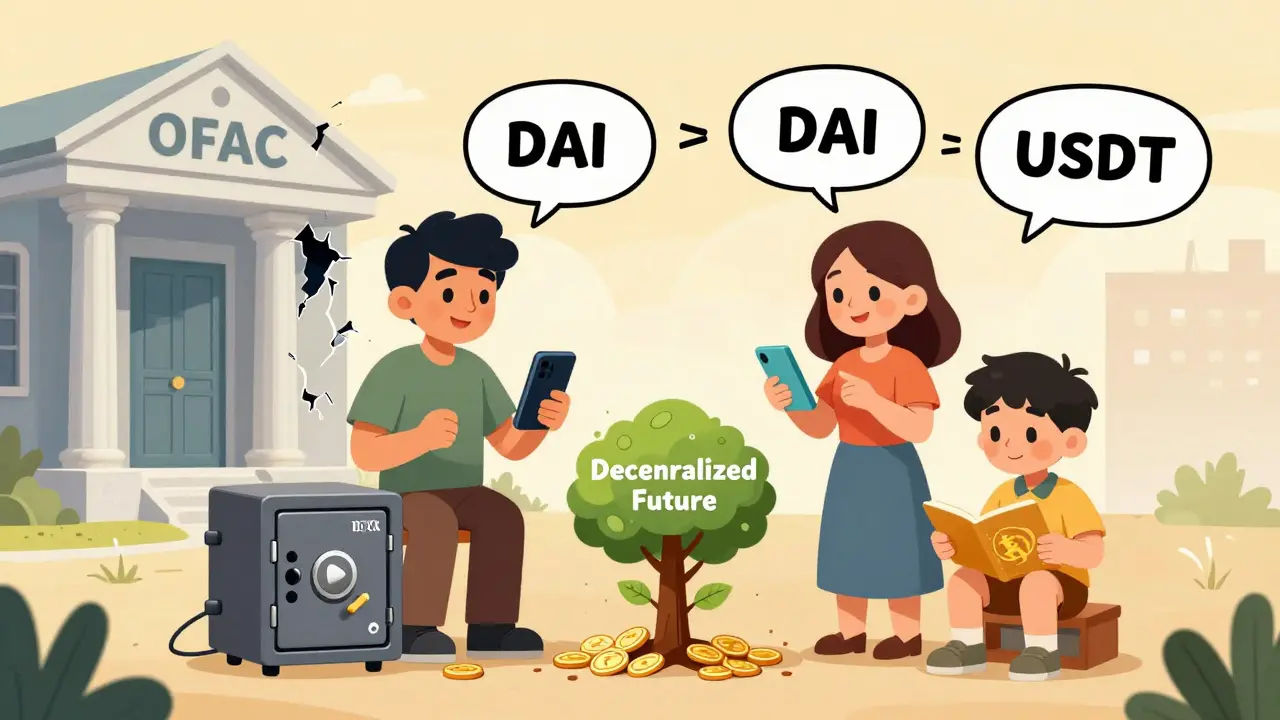
Before July 2025, almost every Iranian trader used USDT. It was the default stablecoin-easy to buy, easy to send, easy to sell. Then Tether froze dozens of Iranian-linked wallets. Overnight, $200 million in USDT became locked. People couldn’t move it. Prices for USDT inside Iran jumped to 12% above market value.
The response was fast. Crypto influencers, Telegram channels, and even government-aligned media told people: “Swap USDT for DAI on Polygon.” Why Polygon? Because it’s cheap, fast, and not controlled by any single company. DAI is a decentralized stablecoin. It doesn’t have a central authority that can freeze your funds. Within weeks, over 60% of Iranian crypto transactions shifted from USDT to DAI. That’s not just a trend-it’s a survival tactic.
Regulation: Iran Now Taxes Crypto
In August 2025, Iran passed its first crypto tax law: the Law on Taxation of Speculation and Profiteering. It treats crypto like gold or real estate. If you make a profit, you pay 10-15% in capital gains tax. The government isn’t trying to ban crypto anymore. It’s trying to control it. They want to track transactions. They want to collect revenue. This means exchanges that don’t report to Iranian authorities are now under more pressure. Some users are moving to decentralized platforms to avoid the tax net.
What You Need to Know Before You Trade
- Use a VPN - Some exchanges block Iranian IPs. A reliable VPN can help you access platforms that aren’t geo-restricted.
- Enable 2FA - Always. Use an authenticator app like Authy or Google Authenticator. Never rely on SMS.
- Withdraw to a personal wallet - Don’t leave large amounts on exchanges. Use a non-custodial wallet like Trust Wallet or MetaMask. Store your recovery phrase offline.
- Watch for fake apps - Scammers create fake versions of MEXC or KuCoin. Always download from official websites. Check the URL carefully.
- Start small - Test with $10-$20 first. See how long withdrawals take. See if support replies. Then go bigger.
Why This Matters Beyond Iran
Iran’s crypto ecosystem isn’t an outlier. It’s a preview. As more countries face sanctions, financial isolation, or banking restrictions, their citizens will turn to crypto too. The tools Iranians use now-DAI on Polygon, decentralized bots, non-KYC platforms-will become standard for others. What’s happening here isn’t about evasion. It’s about resilience. It’s about building a financial system that doesn’t depend on banks that won’t serve you.
The world is moving toward fragmented financial networks. Iran is just ahead of the curve. The question isn’t whether crypto will survive sanctions. The question is: how long will the rest of the world take to catch up?
Can Iranian citizens legally trade cryptocurrency?
Yes. Iran doesn’t ban cryptocurrency. In fact, the government has taxed it since August 2025. Trading is legal, but using it to bypass sanctions is not. Most users trade for personal savings, not illegal transfers. Exchanges that allow Iranians operate under their own rules-not Iranian law.
Why can’t Iranians use Binance or Coinbase?
Binance and Coinbase block Iranian users due to U.S. sanctions. They comply with OFAC regulations, which require them to prevent transactions with sanctioned jurisdictions. Even if you have a VPN, these platforms use IP detection, bank routing data, and device fingerprinting to identify Iranian accounts. Most attempts to access them result in immediate account freezes.
Is Nobitex safe to use in 2026?
No. After the $90 million hack and the Tether freeze, Nobitex lost most of its trust. While it still operates, it has no insurance, poor security, and no transparency about how it handles user funds. Most experienced traders avoid it. If you must use it, keep only small amounts and withdraw quickly.
Which stablecoin should Iranians use instead of USDT?
DAI is the top choice. It’s decentralized, runs on Polygon (low fees, fast), and isn’t controlled by a single company like Tether. After July 2025, over 60% of Iranian crypto activity shifted to DAI. Other options include USDC (if accessible) and FRAX, but DAI is the most reliable.
Do I need KYC to trade on these exchanges?
Some require it, some don’t. MEXC, XT.com, and LATOKEN ask for ID verification. Bitsgap and KuCoin allow trading without KYC for small amounts. If you’re avoiding strict identity checks, use non-KYC platforms first. But be warned: no-KYC means no chargebacks, no support, and higher risk.
Can I deposit Iranian Rial (IRR) directly?
No international exchange accepts IRR directly. Iranians use third-party payment processors like Payeer, Perfect Money, or Paxful to convert IRR into crypto. Some users trade peer-to-peer on LocalBitcoins or Paxful, then transfer funds to their exchange account. It’s slower and riskier, but it’s the only way.
Are there any Iranian crypto exchanges that are secure?
Currently, no domestic exchange meets international security standards. Nobitex is the largest but has proven vulnerable. International exchanges like MEXC and XT.com have better security, encryption, and insurance practices. For safety, use international platforms with strong reputations and keep funds in personal wallets.

22 Comments
And DAI? Really? You think decentralization saves you when the whole system's built on trust? The same people who preached 'don't trust, verify' are now begging a smart contract to be their new bank. Irony level: godmode.
I use Trust Wallet too. I keep my recovery phrase on paper in a fireproof box. It’s wild to think that for so many, this isn’t a hobby-it’s survival. Sending love and solidarity to everyone trading in silence. You’re not alone. 💛
DAI on Polygon isn’t just a workaround-it’s a quiet revolution. No banks. No borders. No middlemen. Just code and courage. I hope the rest of the world wakes up before it’s too late. We’re all one crisis away from needing this.
but then they use nobitex which got hacked and then they use mexc which still asks for id
sooo... what exactly did they win here?
also why is everyone so nice to crypto like its magic pixie dust when its just gambling with more steps
Bitsgap’s non-KYC integration with KuCoin and MEXC is essentially a decentralized routing layer. This isn’t evasion. It’s protocol-level adaptation. The real innovation isn’t the tech-it’s the behavioral shift in trust architecture.
I’ve been using MetaMask for years. I never thought it’d be someone’s lifeline. But here we are. Keep going, Iran. You’re showing us what real financial freedom looks like. 🌱
Also, ‘no KYC’? That’s not freedom. That’s just a casino with no security cameras. Enjoy your 10% tax and your untraceable losses.
And DAI? Please. It’s backed by collateral that’s just as volatile as the Rial. You’re not escaping the system-you’re just wearing its chains in a different color.
One would do well to consider that the architecture of financial sovereignty is being rewritten not in Zurich or Silicon Valley, but in Tehran, through the quiet persistence of everyday users.
Also, who’s auditing the DAI reserves? I’m not saying it’s fake. I’m saying… I’d like to know.
also dais on polygon? lol who made this up a 14 year old in a basement? its just crypto bros being cute again
I started with $5 on KuCoin. Now I help my cousin in Tehran send money to her mom. No bank. No fees. Just a QR code and a prayer.
You don’t need a PhD to change the world. Just a wallet and a will.
Also, no one talks about how these ‘non-KYC’ platforms are probably laundering money for IRGC fronts. You think DAI is pure? Wake up.
This is not an exception to global norms-it is a refinement of them. The state’s taxation policy confirms recognition of crypto as a legitimate asset class, thereby legitimizing its role in economic resilience.
That’s the real lesson. No one’s coming to save you. So you build your own safety net. With code. With wallets. With DAI. And that’s more powerful than any government guarantee.
So yeah, DAI on Polygon. Why? Because it’s the only thing that can’t be turned off. Not by Tether. Not by the Fed. Not by your uncle who says ‘crypto is a scam.’
They’re not hackers. They’re engineers of survival.
I keep my crypto in a cold wallet. I don’t know if I’ll ever need it like they do. But I’m glad it’s there. For them. For me. For anyone who needs a backup plan.
This is what Web3 looks like when it’s not a startup pitch. It’s a grandmother sending money to her grandson. A student buying textbooks. A farmer getting paid for his saffron. This isn’t tech. This is life.
One might posit that Iran, in its constrained state, has inadvertently become a living laboratory for post-sanction financial architecture.
And then what? Back to Nobitex? With $90M gone? Yeah. That’s a plan.
They want you to think you’re free. But you’re just being watched… with more gas fees.