
- 28 Jan 2026
- Elara Crowthorne
- 14
When you think of a company, you picture a CEO, a boardroom, and employees following a chain of command. But what if the company had no CEO? What if every decision was made by a vote of its users - not shareholders - and enforced by code? That’s the promise of a DAO - a Decentralized Autonomous Organization. No hierarchy. No middlemen. Just rules written in code and voted on by people around the world.
DAOs aren’t theory anymore. They’ve bought basketball teams, raised tens of millions in days, governed billion-dollar DeFi protocols, and funded public goods like open-source software. But they’ve also failed spectacularly - hacked, paralyzed by bureaucracy, or crushed by legal red tape. This isn’t a futuristic fantasy. It’s happening right now. Here are the most important DAO examples and what they teach us about the future of organizations.
Uniswap: The DAO That Runs a $1.2 Trillion Exchange
Uniswap is the largest decentralized exchange on Ethereum. In 2023 alone, it handled over $1.2 trillion in trades. And yet, it has no CEO. No customer service team. No corporate office. It’s run by a DAO.
Uniswap’s governance token, UNI, gives holders voting power. To pass a proposal, you need at least 40 million UNI votes in favor. That’s not easy. Only 3.2% of token holders typically vote on any given proposal, according to Defiant’s 2023 analysis. Most people just hold their tokens, hoping the price goes up.
But when it matters, the DAO moves. In 2022, the community voted to allocate $100 million to incentivize liquidity on new chains like Arbitrum and Polygon. That decision helped Uniswap stay ahead of competitors like SushiSwap. The DAO didn’t wait for approval from investors - it acted, instantly, globally.
Still, the system has flaws. The top 10 wallet addresses control over 30% of UNI tokens. That means a handful of whales can sway votes. Critics call it plutocracy. Supporters say it’s the price of scale. Either way, Uniswap proves a DAO can manage massive financial infrastructure - if you accept its imperfections.
The LAO: Venture Capital Without VCs
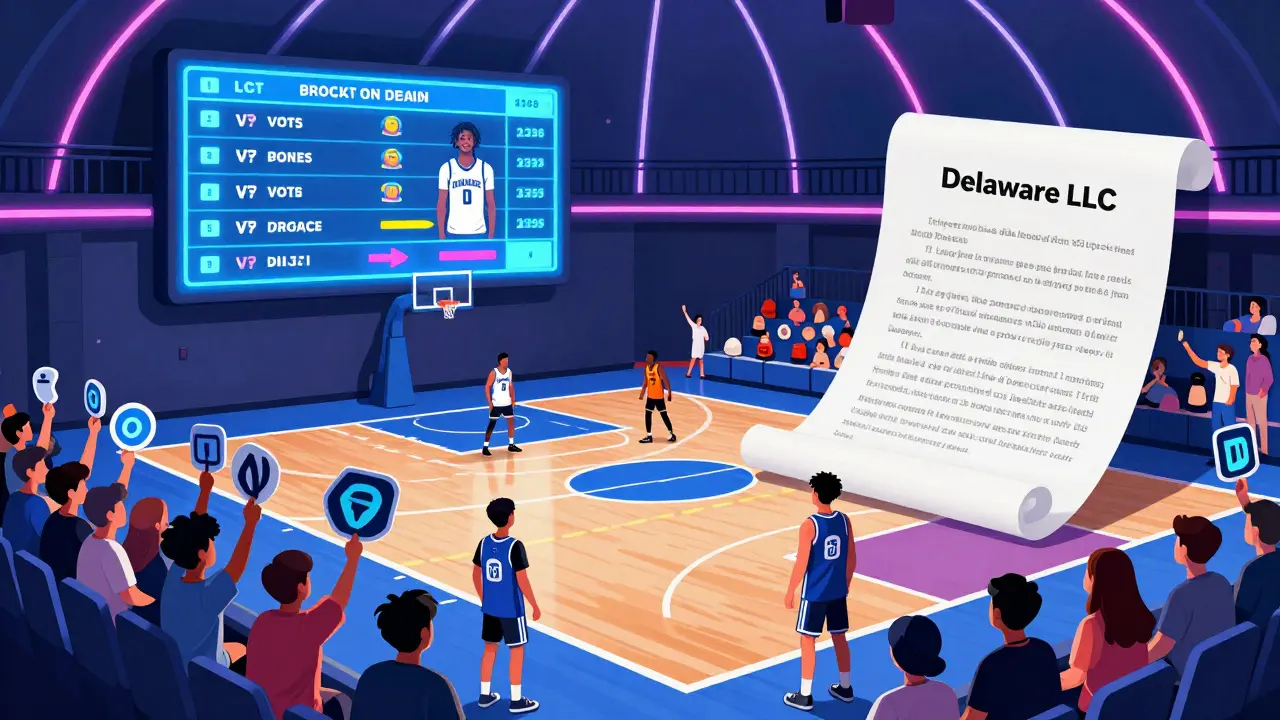
Imagine a fund that lets anyone invest in early-stage blockchain startups - but only if they’re accredited investors under U.S. law. That’s The LAO. Founded in 2019, it’s one of the first legal DAOs structured as a Delaware LLC. That’s key. It’s not purely on-chain. It uses traditional law to protect members, while using blockchain for voting and fund distribution.
The LAO has invested in 67 startups, including Chainlink, Aave, and Arbitrum - all before they blew up. Members vote on each investment using a simple yes/no ballot. If 75% approve, the DAO sends funds directly to the startup. No paperwork. No delays.
As of Q2 2023, its treasury held $32 million. That’s impressive for a group of anonymous internet users. But there’s a catch: only accredited investors can join. That means you need to prove you have $1 million in net worth or $200,000 in annual income. It’s a DAO, but not a free-for-all. The LAO shows how DAOs can blend old-world legal structures with new-world collaboration.
ConstitutionDAO: The $47 Million That Couldn’t Buy a Document
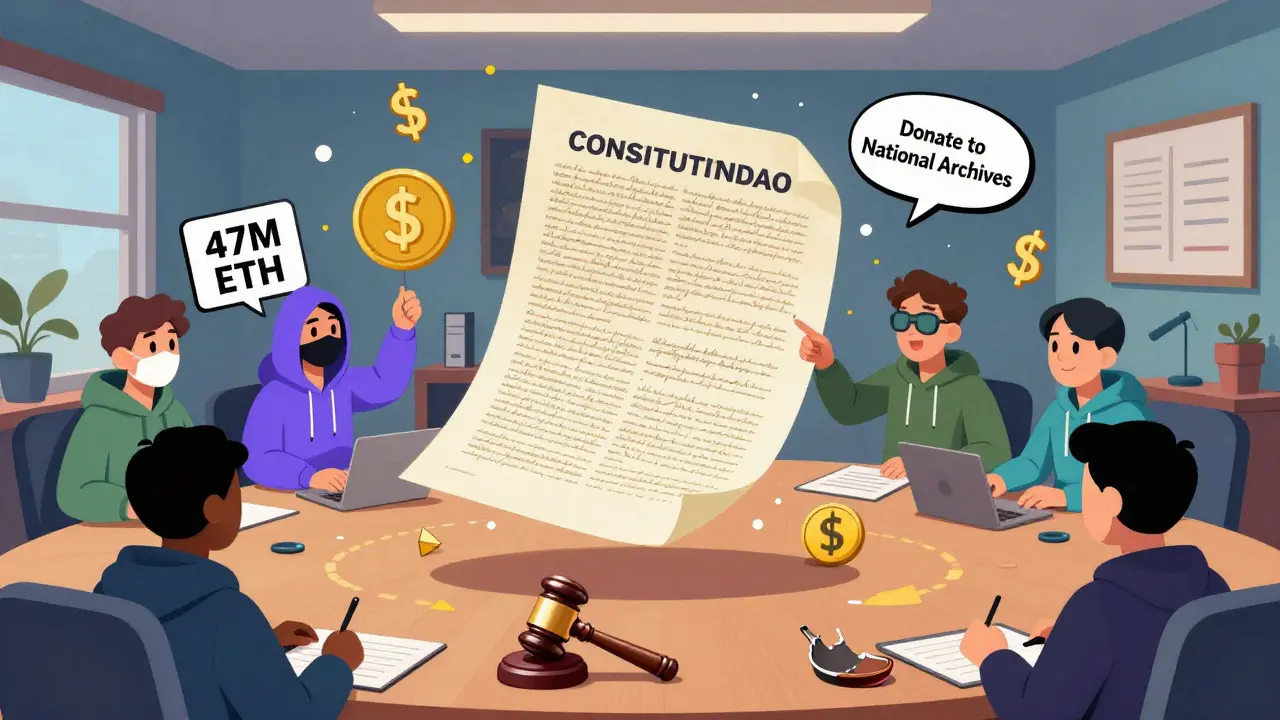
In November 2021, a group of strangers on Reddit decided to raise $40 million to buy one of the 13 surviving copies of the U.S. Constitution at a Sotheby’s auction. They called it ConstitutionDAO. No one knew who was running it. No one had a website. Just a Discord server and a smart contract.
72 hours later, they raised $47 million in ETH - from over 17,000 contributors. People donated $10. Others gave $10,000. It was the largest crowdfunding effort in crypto history.
They lost the auction. The document went to a billionaire collector. But here’s the twist: they didn’t fail. They proved something far more powerful - that a DAO can mobilize global trust faster than any corporation or government.
After the auction, contributors voted on what to do with the leftover $39 million. Most chose to donate it to the National Archives Foundation. The DAO disbanded. No lawsuits. No lawsuits. No CEO to blame. Just a group of people who came together, did something wild, and walked away cleanly.
Friends With Benefits (FWB): The DAO That’s a Social Club
FWB isn’t about money. It’s about belonging. With over 12,000 members, it’s the largest social DAO in the world. You don’t need to be rich. You just need to hold its token, FWB, and contribute to the community.
Members get access to private Discord channels, IRL meetups in New York and Berlin, exclusive NFT drops, and even a weekly podcast. To join, you need to buy at least 20 FWB tokens - around $400 as of 2023. But that’s not the point. The point is participation.
FWB runs like a co-op. Members propose events, vote on new members, and even design the tokenomics. It’s a digital clubhouse with real-world vibes. But it’s not profitable. FWB doesn’t sell products. It sells culture. And that’s hard to scale. Many members say they love the community but struggle to see how it sustains itself long-term. FWB shows DAOs aren’t just for finance. They can be for friendship, art, and identity.
Krause House DAO: The DAO That Bought a Basketball Team
In 2021, a group of NBA fans decided to buy a minor league basketball team - the Memphis Grizzlies’ G League affiliate. They raised $4.2 million in ETH from over 10,000 contributors. They called it Krause House DAO, named after the legendary Grizzlies owner, Jerry Krause.
They won the bid. They became the first DAO to own a professional sports team. Now, members vote on team merch, fan events, and even player development programs. They’ve hosted watch parties, launched NFT collectibles, and partnered with local artists.
This isn’t a gimmick. It’s proof that DAOs can own and operate real-world assets. No lawyers needed to sign paperwork - the team’s ownership was transferred on-chain. The Grizzlies organization even gave them official recognition. Krause House DAO proves that blockchain isn’t just for digital stuff. It can change how we own physical things too.
PleasrDAO: When Unity Breaks
PleasrDAO is known for buying rare digital art - like the Wu-Tang Clan album "Once Upon a Time in Shaolin," which they tried to buy for $10 million in 2022. They raised the funds in days. But then, they couldn’t agree on what to do next.
Some members wanted to release the album to the public. Others wanted to keep it locked away as a digital artifact. The debate dragged on for months. Eventually, the bid expired. They lost the album.
The fallout was messy. Members accused each other of bad faith. Some left. The DAO’s reputation took a hit. This wasn’t a hack. It wasn’t a scam. It was human conflict - amplified by decentralized governance.
PleasrDAO’s failure is one of the most important lessons in DAO history. Technology doesn’t solve disagreement. It just makes it visible. If you can’t agree on what to do with a $10 million album, how will you run a company? This DAO didn’t fail because of code. It failed because of people.
LexDAO: Automating the Law
Most DAOs focus on money or community. LexDAO focuses on law. Founded in 2020, it’s a collective of lawyers, developers, and blockchain enthusiasts who build smart contracts that automate legal processes.
They’ve created DAO templates for founding a legal entity, drafting service agreements, and even handling intellectual property rights - all on-chain. Over 200 legal workflows are now automated through their open-source tools.
LexDAO doesn’t replace lawyers. It makes them more efficient. A startup can use a LexDAO template to form a DAO LLC in Wyoming in under an hour. No lawyer fees. No waiting. That’s the future of legal infrastructure.
Why Most DAOs Fail - And How the Survivors Do It Differently
According to Consensys, 78% of enterprise DAOs die within 18 months. Why?
- Too many votes, too little action. If every decision needs a 14-day vote, you can’t move fast.
- Token hoarding. A few wallets control the votes. Democracy becomes oligarchy.
- No legal shield. If someone sues your DAO, who pays? Most have no legal identity.
- Bad onboarding. 67% of new members quit because they can’t figure out how to vote or join a proposal.
The survivors fix these problems. The LAO uses a Delaware LLC. Uniswap uses Snapshot for gasless voting. Gitcoin uses quadratic voting to prevent rich members from dominating. Krause House DAO partnered with a traditional sports org to handle legal paperwork.
The real winners? Hybrid DAOs. They’re part blockchain, part legal entity. They use code for transparency, and lawyers for protection. That’s the future.
What’s Next for DAOs?
By 2025, Gartner predicts 10% of large companies will experiment with DAO structures. The Ethereum Foundation is preparing EIP-5805 - a new standard to make governance tokens easier to use. Snapshot 3.0 lets you vote without paying gas fees. More people are joining.
But the biggest shift isn’t technical. It’s cultural. People are tired of top-down companies. They want ownership. They want a say. DAOs give that - even if they’re messy, slow, and imperfect.
DAOs won’t replace corporations tomorrow. But they’re already replacing parts of them. The next CEO might not be a person. It might be a vote.
What is a DAO in simple terms?
A DAO is an organization run by code and its members, not by bosses. Members vote on decisions using tokens, and rules are enforced automatically through smart contracts on a blockchain. No central authority - just collective control.
Can anyone join a DAO?
Technically, yes - you just need a crypto wallet and some tokens. But many DAOs have rules. Some, like The LAO, only allow accredited investors. Others, like FWB, require you to buy a minimum number of tokens. There’s no universal access - participation depends on the DAO’s design.
Are DAOs legal?
It depends. As of 2023, only a few U.S. states - Wyoming, Tennessee, and Utah - have laws recognizing DAOs as legal entities. Elsewhere, they exist in a gray zone. Many DAOs, like The LAO, form legal structures (like LLCs) to protect members from liability. Without that, members could be personally liable for the DAO’s actions.
How do you make money from a DAO?
There are a few ways. Some DAOs distribute profits from fees or investments - like Uniswap’s revenue-sharing model. Others give token rewards for contributing work, like writing code or moderating forums. You can also profit by buying governance tokens early and selling them later if the DAO succeeds. But there’s no guarantee - many DAOs never generate income.
What’s the biggest risk in joining a DAO?
The biggest risk is losing money - either from bad votes, hacks, or token crashes. But there’s also legal risk. If a DAO breaks a law and has no legal structure, members could be held personally responsible. And if you’re not active, your vote might be drowned out by whales who control large token holdings.

14 Comments
Uniswap’s governance model is wild but real. I’ve held UNI since 2021 and honestly, I only vote when there’s a big liquidity push. Most people are just HODLing, waiting for the next pump. But when it matters, like when they pushed into Arbitrum, the DAO moved faster than any VC fund I’ve seen. The whales? Yeah, they’re a problem-but that’s capitalism with a blockchain veneer. At least it’s transparent.
DAOs are just crypto bros playing dress up. The LAO? Accredited investors only. So much for decentralization. And ConstitutionDAO? You spent 47 mil on a piece of paper? America’s constitution isn’t for sale to some rich dudes with ETH wallets. This is a joke. We need real institutions, not Discord mobs with smart contracts.
Let’s be honest-DAOs are a solution in search of a problem. Uniswap runs on a centralized team behind the scenes. The ‘governance’ is performative. The LAO? A legal shell. FWB? A rich person’s private club. And PleasrDAO? A narcissistic art auction gone wrong. The only thing decentralized here is the delusion. Real organizations need leadership, accountability, and hierarchy. Not 17,000 people voting on whether to release a Wu-Tang album.
I’ve been deep in DAOs since 2020, and I’ve seen the pattern: the ones that survive are the ones that hybridize. Uniswap uses Snapshot for gasless voting, Krause House partnered with a real sports org, LexDAO built actual legal templates-these aren’t just ‘crypto experiments.’ They’re evolving governance models. The failures? They’re the ones that tried to be pure on-chain. No legal structure? No onboarding? No clear incentive? Of course they collapse. DAOs aren’t about replacing corporations-they’re about augmenting them with transparency, speed, and collective ownership. The future isn’t ‘DAO or company.’ It’s ‘DAO + company.’ And that’s powerful.
ConstitutionDAO didn’t fail. It won. You think the National Archives got $39 million because a billionaire bought a document? Nah. They got it because a bunch of strangers on the internet decided to do something beautiful. And then they walked away. No lawsuits. No drama. Just… integrity. Meanwhile, the guy who bought the Constitution? He’s probably keeping it in a vault with a security guard and a private jet. Who’s really the revolutionary here? 🤔
Interesting read. The key takeaway for me is that DAOs work best when they have a clear purpose and limited scope. FWB is about community. Krause House is about sports. LexDAO is about legal tools. The ones that try to do everything-like PleasrDAO-end up paralyzed. Simplicity wins. Also, the token hoarding issue is real. Voting power shouldn’t be proportional to wealth. Quadratic voting is the only fair way forward.
DAOs are a scam. Full stop. You think people are voting? No. They’re gambling. Uniswap’s ‘governance’ is controlled by whales who bought tokens during the ICO. The LAO? Only for rich people. ConstitutionDAO? A PR stunt. And now you’re telling me this is the future of work? Wake up. This isn’t innovation-it’s financialized chaos. And when it collapses, the little guys lose everything. Again.
I’m skeptical, but I’ve got to admit-Krause House DAO is the most compelling example. Owning a sports team? On-chain? With official recognition? That’s not theoretical anymore. It’s happening. And the fact that they partnered with a traditional organization to handle legal logistics? That’s smart. DAOs don’t need to be pure. They need to be practical. This is the model others should copy.
For everyone calling DAOs a failure-have you ever tried to get a vote passed in a traditional company? It takes months. Lawyers. Meetings. Emails. DAOs move fast. They’re messy, yes. But they’re alive. FWB isn’t profitable, but it’s a home for creatives. ConstitutionDAO didn’t buy a document, but it proved trust can scale globally without a CEO. The real question isn’t ‘can DAOs work?’ It’s ‘why are we still clinging to 19th-century org structures?’
LexDAO? Cute. But if you’re a startup and you use their template to form a DAO LLC, and then get sued? Who pays? The members? Because the legal system doesn’t recognize ‘DAO’ as a person. You think a judge cares that you voted on Discord? Nope. You’re personally liable. This isn’t empowerment-it’s a legal trap. And people are falling for it.
DAOs are the future of human collaboration. Forget corporations. They’re dinosaurs. FWB gave me my first real community in crypto. I met people who felt like me-artists, writers, weirdos. We made a podcast. We hosted a party in Berlin. That’s not money. That’s belonging. And you can’t buy that with a CEO’s salary. DAOs aren’t perfect. But they’re human. And that’s rare.
I’ve been part of three DAOs and honestly the biggest hurdle isn’t the tech or the voting-it’s the emotional labor. People get attached. They feel like their vote matters. Then a whale pushes through a proposal they hate and suddenly it’s not about governance anymore-it’s about betrayal. PleasrDAO didn’t fail because of code. It failed because people expected harmony in a system designed for disagreement. We need better conflict resolution tools. Not more votes. More empathy.
DAOs are the future 🚀 I mean, think about it-no CEO, no board, just people voting on what matters. Uniswap’s $1.2T volume? All from a community. ConstitutionDAO? 17k people came together for a cause. And Krause House? A basketball team owned by fans. This isn’t crypto bro nonsense. This is democracy on steroids 😎🔥
Let’s not romanticize this. DAOs are beautiful in theory but exhausting in practice. I’ve spent 30 hours trying to understand how to vote on a Gitcoin grant proposal. The interface is clunky. The docs are outdated. And half the people voting don’t even read the proposal-they just click yes because someone they follow said to. That’s not democracy. That’s mob mentality with a blockchain logo. The real winners? The ones who treat DAOs like a startup-with clear roles, onboarding, and a damn roadmap. Not just a token and a Discord server. We need structure, not chaos. And we need to stop pretending this is some utopian revolution. It’s a messy, beautiful experiment. Let’s treat it like one.