
- 1 Nov 2025
- Elara Crowthorne
- 20
Vietnam Remittance Cost Calculator
Send Money to Vietnam
Based on Vietnam's $91 billion annual crypto flow data. Compare costs for sending $500+
Every year, over $91 billion in cryptocurrency flows into Vietnam - not through banks, not through official channels, but through apps, wallets, and peer-to-peer networks. And yet, the government still doesn’t allow crypto as legal tender. No exchanges are fully licensed. No banks touch it. So how is this possible?
It’s not about legality - it’s about access
Vietnam doesn’t ban owning crypto. It bans using it to pay for goods, ban banks from handling it, and bans regulated exchanges from operating like traditional financial institutions. But it doesn’t ban people from buying, selling, or holding it. That loophole? It’s been exploited hard.Over 21 million Vietnamese adults - nearly a quarter of the adult population - have owned or traded crypto. That’s more than the entire population of Australia. They’re not just speculating. They’re using it to send money home, hedge against inflation, and earn income through play-to-earn games like Axie Infinity. The country’s crypto market value hit $220 billion in 2025, making it the third-largest in Asia-Pacific, behind only India and Pakistan.
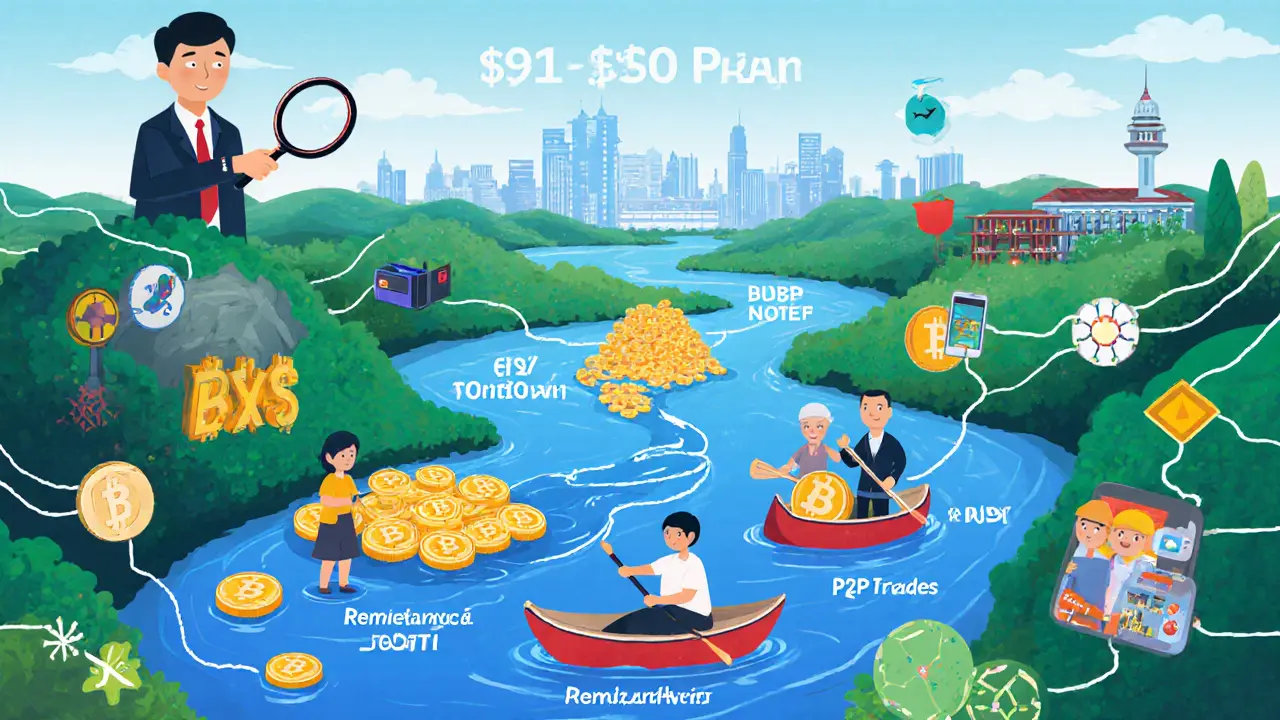
What’s driving this isn’t Wall Street hype. It’s necessity. Inflation in Vietnam has hovered above 4% for years. The dong has lost value against the dollar. Many families rely on remittances from overseas workers - and crypto offers faster, cheaper transfers than Western Union or bank wires. A $500 transfer via crypto can cost under $2. Via traditional methods? $20 or more.
The $600 million daily trade engine
Daily crypto trading volume in Vietnam exceeds $600 million. That’s not small-time trading. That’s institutional-level activity - happening mostly on decentralized platforms and peer-to-peer (P2P) apps like Binance P2P, Bybit, and local Vietnamese platforms like SushiSwap and PancakeSwap clones.There are no official crypto exchanges in Vietnam. But there are hundreds of thousands of P2P traders. People meet in Facebook groups, Telegram channels, and even local coffee shops to swap cash for Bitcoin or USDT. You show up with 20 million VND (about $800), hand it over, and get crypto sent to your wallet. No ID. No paperwork. No bank involvement. It’s informal, but it works.
Chainalysis data shows Vietnam’s crypto adoption grew 55% between July 2024 and June 2025 - one of the highest growth rates globally. This isn’t a bubble. It’s infrastructure. People are building on it. Local developers created Ronin, the blockchain behind Axie Infinity, which now processes over 10 million daily transactions. Vietnamese teams built wallet apps used by millions outside Vietnam. The country has over 560,000 IT professionals - most under 35 - who are coding the next wave of DeFi and GameFi tools.
Why the government tolerates it
The Vietnamese government has been clear: crypto isn’t money. But it also hasn’t shut it down. Why? Because trying to stop it would backfire.Crack down too hard, and you drive activity underground. You lose tax revenue. You alienate a tech-savvy youth population that sees crypto as the future. You risk a brain drain - developers leave for Singapore or Thailand where the rules are clearer.
Instead, in September 2024, Vietnam launched a five-year pilot program for crypto asset trading. It’s not legalization. It’s controlled observation. The government wants to understand how it works before regulating it. They’re watching transaction patterns, tracking wallet flows, and studying how people use it. The goal? To build a system that captures the benefits - financial inclusion, tech innovation, foreign investment - while minimizing risks like money laundering or speculative crashes.
It’s a balancing act. On one side, the State Bank of Vietnam warns about volatility and fraud. On the other, the Ministry of Finance sees crypto as a tool to digitize the economy - which is projected to hit $45 billion by 2025. The country already has one of the highest smartphone penetration rates in Southeast Asia. Crypto fits.

Who’s really using it?
It’s not just traders. It’s students. Farmers. Factory workers. Grandparents.In Hanoi, a 19-year-old student earns USDT by playing Axie Infinity for 3 hours a day - enough to cover tuition. In Da Nang, a fisherman uses crypto to sell his catch to exporters who pay in stablecoins to avoid currency delays. In Ho Chi Minh City, a family sends monthly remittances to relatives in the U.S. using USDT, saving $150 a month in fees.
Even older generations are getting involved. Local community centers in rural provinces now run free crypto literacy workshops. The focus? Not trading. Not getting rich. Just learning how to store value safely. “I don’t want to gamble,” one 62-year-old woman told a local news outlet. “I just want my savings to keep their value.”
The $91 billion isn’t magic - it’s movement
The $91 billion in annual crypto value received isn’t just trading volume. It’s the sum of:- $38 billion in P2P cash-to-crypto trades
- $29 billion in remittances sent via crypto
- $12 billion in earnings from play-to-earn games
- $9 billion in DeFi lending and yield farming
- $3 billion in cross-border business payments
These numbers aren’t estimates. They’re derived from on-chain analytics, wallet clustering, and transaction pattern analysis by firms like Chainalysis and Chainalysis Intelligence. The data shows clear, repeatable flows - not random speculation.
Compare this to Thailand, where crypto adoption is high but mostly concentrated in urban elites. Or Indonesia, where adoption is growing fast but lacks local development. Vietnam’s edge? It’s both wide and deep. Millions use it. And thousands build on it.
What happens next?
The pilot program ends in 2029. By then, Vietnam could be the first Southeast Asian country to fully integrate crypto into its financial ecosystem - not as currency, but as a trusted asset class.Expect licensed crypto custodians. Regulated P2P platforms. Tax reporting rules. Maybe even crypto-backed loans from state-linked fintech firms. But don’t expect banks to suddenly start accepting Bitcoin deposits. That’s not the goal. The goal is control without suppression.
The $91 billion isn’t going away. It’s growing. Forecasts show Vietnam’s crypto market hitting $22 billion by 2033 - more than double today’s size. The real question isn’t whether Vietnam will regulate crypto. It’s whether the world will finally catch up to what’s already happening there.
Why this matters globally
Vietnam’s story isn’t unique - it’s a preview. Countries with unstable currencies, underbanked populations, and young tech talent are heading the same way. Nigeria. Philippines. Argentina. Brazil.Vietnam is proving you don’t need permission to build a financial future. You just need a phone, an internet connection, and a willingness to bypass broken systems. The government may not approve. Banks may not help. But the people? They’re already doing it.
If you think crypto is just for speculators in New York or San Francisco, you’re missing the real revolution - happening in Hanoi coffee shops, rural Vietnamese villages, and on the screens of millions who don’t care about regulations. They just care about value.

20 Comments
This is insane but makes total sense. People don't need banks to move value - just a phone and trust. Vietnam’s real innovation isn't crypto, it's bypassing broken systems entirely. 💪
Let’s not romanticize this. $91 billion flowing through unregulated P2P networks? That’s a money laundering paradise masked as financial inclusion. Chainalysis data doesn’t prove legitimacy - it proves scale of risk.
Of course the government 'tolerates' it 😏 They're waiting for the bubble to pop so they can swoop in and nationalize the wallets. Classic. Capitalism is just feudalism with better UI. 🤡
wait so theyre using binance p2p like its a flea market? no id? no paperwork? that sounds like a total free for all lmao. i thought crypto was supposed to be secure???
It is important to recognize that the underlying phenomenon here is not merely technological but sociological. The Vietnamese population, particularly the youth, are demonstrating a remarkable capacity for adaptive financial behavior in the absence of institutional support. This is not rebellion - it is resilience.
Love this. People are building real solutions with what they have. No handouts, no permission slips - just hustle and tech. This is the future of finance, and it’s happening in coffee shops, not boardrooms.
so many people think crypto is just gambling but this? this is survival. farmers using usdt to get paid faster, grandmas protecting their savings - this isn't hype, it's human. 🙌
It is fascinating to observe how decentralized systems can emerge organically in environments where formal financial infrastructure is inadequate. The absence of regulation does not equate to chaos - rather, it fosters informal norms that are often more adaptive than top-down mandates.
Wait… this whole thing is a CIA psyop to destabilize Southeast Asian economies. You think they let this fly because they’re clueless? Nah. They’re using it to track every wallet, build biometric profiles, and eventually freeze assets when they need to. This isn’t freedom - it’s surveillance with a smile.
The data presented is compelling and substantiated by credible third-party analytics. The convergence of demographic, economic, and technological factors in Vietnam presents a unique case study in financial autonomy. One must acknowledge the sophistication of the user base and the emergent infrastructure built atop decentralized protocols.
Y’all acting like this is some revolutionary breakthrough. Bro, it’s just people using crypto because the government is lazy and the banks are crooked. I’ve seen this in Argentina, Nigeria, Turkey - same script, different country. Wake up.
I’ve been following this for a while and honestly, what’s wild is how much of this is community-driven. It’s not just trading - it’s education. Local groups teaching grandmas how to use wallets, kids earning USDT playing games to pay for school, fishermen avoiding currency delays. This isn’t speculative frenzy - it’s a quiet revolution. And yeah, the government knows it. That’s why they’re watching instead of shutting it down. They know they can’t win this fight - so they’re trying to co-opt it.
ok but like… who even has 20 million vnd to hand over at a coffee shop?? like… i thought vietnam was poor??
This is the most hopeful thing I’ve read all year. People aren’t waiting for permission to build a better system - they’re just doing it. I wish more countries would look at this and say, ‘How can we support this?’ instead of ‘How can we stop it?’
So they use crypto to send money home? But isn't that what remittance apps do? This feels like a stretch.
OMG I cried reading this. I have a cousin in Hanoi who’s been playing Axie for two years now - she paid off her student loans with it. No loans, no credit score drama, just play and earn. This is what real financial empowerment looks like. We need more stories like this, not more fear-mongering.
One must consider the philosophical implications: if value is determined by consensus rather than state decree, then the legitimacy of the state’s monetary monopoly is inherently challenged. This is not merely an economic shift - it is an epistemological rupture in how society assigns worth.
And yet, the government still hasn't arrested a single P2P trader. Coincidence? Or are they quietly collecting data to weaponize later? Remember what happened in China - they banned it, then launched their own digital currency. This is the same playbook.
wait so if i send usdt to my friend in vietnam do i need to meet them in person?? or can i just send it through an app??
How quaint. The ‘people’s crypto revolution’ - so… what, now we’re supposed to admire the fact that people are using tech to escape the consequences of their own government’s incompetence? I mean, bravo, I guess. 🙄