
- 29 Dec 2025
- Elara Crowthorne
- 24
How Venezuela Took Control of Crypto Mining
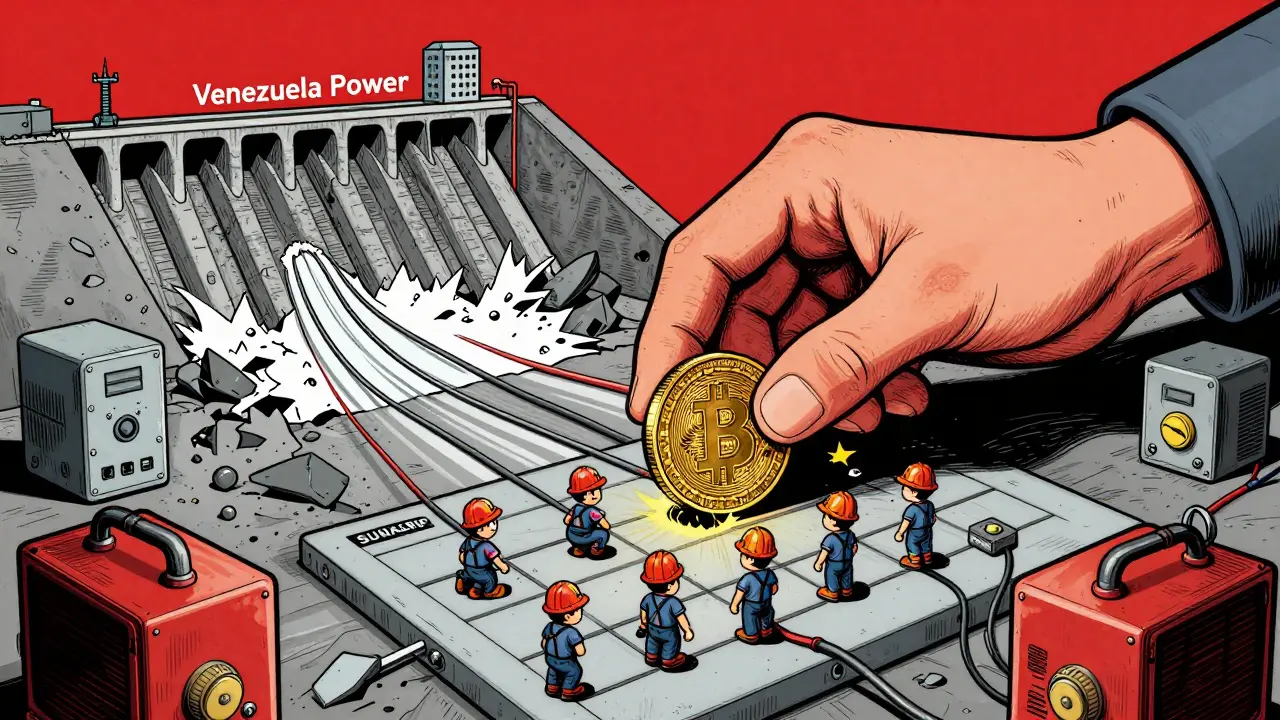
In 2018, Venezuela didn’t just allow crypto mining-it tried to own it. While most countries either ignored or banned cryptocurrency mining, Venezuela created one of the most unusual systems in the world: a state-run mining monopoly. The government didn’t just tax it or regulate it. It demanded that every miner, big or small, operate under its direct control. The goal? Use Venezuela’s cheap electricity to mine Bitcoin and other coins-and keep the profits in government hands.
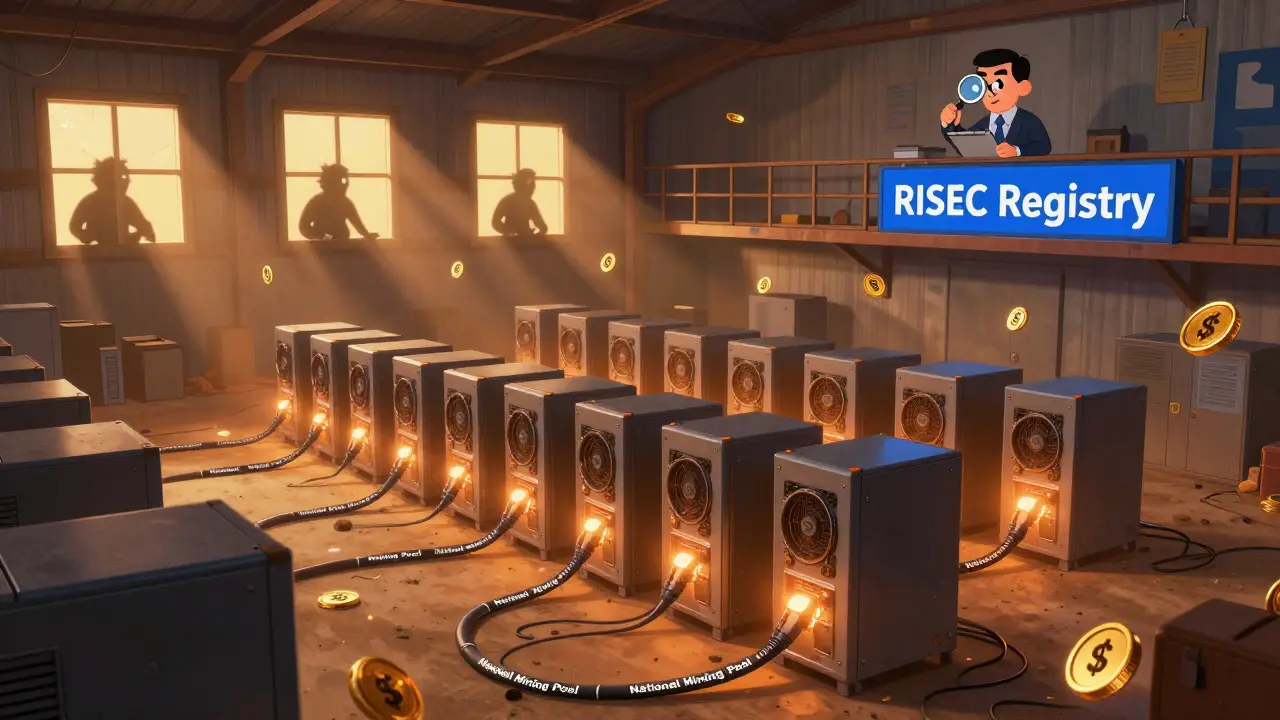
The engine behind this plan was SUNACRIP, the National Superintendence of Cryptocurrencies. Created by presidential decree in 2019, SUNACRIP replaced an earlier agency and became the sole authority over all crypto mining activities. Every miner had to register with them, get a license, and plug into the National Mining Pool (NMP), a government-controlled network that distributed mining rewards and tracked every hash rate. If you mined outside the NMP, you were breaking the law.
The Rules: What Miners Had to Follow
The requirements weren’t simple. To get licensed, miners had to prove they had access to at least 500 kilowatts of electricity-a huge barrier for individuals. They had to submit detailed equipment lists, personal identification, and proof of legal power contracts. The approval process took between three and four months. Most small miners never made it through.
Once approved, miners were locked into RISEC (Comprehensive Registry of Cryptoactive Services) or RIM (Comprehensive Registry of Miners), two government databases that tracked every transaction. They also had to follow Ruling No. 044-2021, which forced them to implement strict anti-money laundering checks, report all transactions, and store user data for audit. For many, this felt less like regulation and more like surveillance.
The government also claimed ownership over the Petro, its own cryptocurrency launched in 2017. Though the Petro never gained real value, it was tied to Venezuela’s oil reserves and used as a tool to bypass U.S. sanctions. Miners were encouraged-but not required-to convert some of their earnings into Petro, which the state could then use to pay public employees or fund projects.
Energy: The Big Promise and the Bigger Problem
Venezuela’s biggest advantage? Electricity. Thanks to state subsidies, miners paid as little as $0.03 per kilowatt-hour-far below the global average of $0.08 to $0.12. That made Venezuela one of the cheapest places on Earth to mine Bitcoin.
But here’s the catch: the power grid was falling apart. In 2023, miners reported 40 to 60 hours of blackouts every month. To keep machines running, many had to buy diesel generators. That added 25% to their operating costs. Some operations shut down entirely.
The government claimed that licensed mining centers used about 10% of the country’s total electricity. That sparked panic. In May 2024, SUNACRIP suddenly banned all mining operations, citing energy overuse. But the ban didn’t last. By August, it was quietly lifted-not because the grid improved, but because the government needed the revenue.
The Collapse of Control
By March 2023, SUNACRIP stopped functioning. Its head was arrested in a corruption probe tied to oil industry contracts. The agency’s offices were shuttered. No new licenses were issued. Existing miners were left in limbo. Some kept mining quietly. Others sold their rigs and left the country.
Even when SUNACRIP was revived in March 2024, it wasn’t the same. The government handed part of the oversight to a private group called CAVEMCRIP. But without trust, enforcement, or clear rules, the system became a mess. One analyst called it “chaotic.” Another said it was “a legal fiction.”
Reports conflicted. Some said over 500 licensed mining centers were still active. Others said only 150 remained, and many were running on borrowed time. The National Mining Pool, meant to be the backbone of the system, was unreliable. Miners reported delayed payouts, system crashes, and lost rewards. Efficiency dropped by 15-20% compared to mining outside the state system.
Why People Still Mine-Despite the Risk
Here’s the irony: most Venezuelans don’t care about the government’s rules. They mine-or use crypto-not because they support the regime, but because they have no choice.
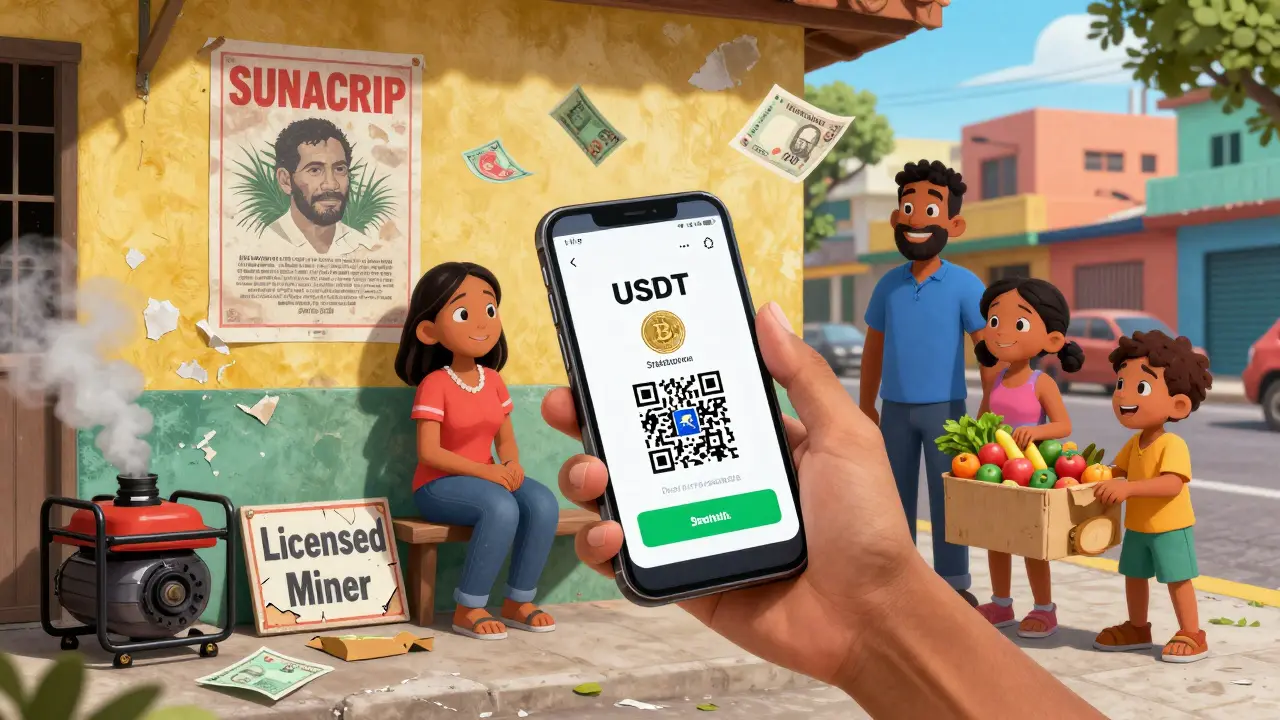
With inflation hitting 200% in 2024, the bolívar is nearly worthless. Seven out of ten people now use stablecoins like USDT or USDC to buy groceries, pay rent, or send money to family abroad. Crypto isn’t a luxury here-it’s survival.
That’s why, even as the state cracked down, blockchain transactions grew by 35% in 2024. The government’s own digital payment platform, Conexus, now handles 40% of electronic transfers. And by December 2025, Venezuelan banks will be allowed to offer Bitcoin and stablecoin services directly to customers-a move that could make Venezuela the first country where crypto is woven into the banking system.
The Real Winners and Losers
Who benefits from this mess? Not the miners. Not the people. Mostly, it’s the government and its allies.
Large mining centers linked to military or state-owned companies got priority access to power and licenses. Independent miners were squeezed out. The $10.75 million in crypto investments Venezuela attracted in 2024 went mostly to startups with political connections, like El Dorado and Yeet. Most small operators never saw a cent.
And yet, the system still pulls in revenue. Mining contributed an estimated 4% to Venezuela’s GDP in 2025-more than oil exports in some months. That’s why the government keeps it alive, even when it doesn’t work.
What’s Next? A System Built on Sand
Venezuela’s state-controlled mining model is a paradox. It’s the only country in the world that tried to turn crypto mining into a state monopoly. But it’s also one of the least functional.
The rules exist on paper. The infrastructure is crumbling. The regulator is broken. And the people? They’re using crypto anyway-through private channels, peer-to-peer apps, and unlicensed miners who work in the shadows.
By the end of 2025, Venezuela might officially allow banks to handle Bitcoin. But without a functioning regulator, without reliable power, and without public trust, it’s hard to see how this system will last. The government didn’t just try to control crypto mining. It tried to control money itself. And in a country where the currency has failed, that’s a battle no one can win.

24 Comments
The sheer absurdity of a state trying to monopolize crypto mining is almost poetic. It’s like trying to own the wind-you can build fences, but the air still slips through. Venezuela’s experiment reveals a fundamental truth: decentralization isn’t just a tech feature, it’s a human instinct. When people need to survive, they’ll find a way to transact, regardless of bureaucracy.
So the government cranks up the heat with SUNACRIP, then the grid collapses, then they ban mining… then they un-ban it because they need cash? 😂 This isn’t policy-it’s a sitcom written by a drunk economist. At least the people are winning by using USDT to buy rice. The state? Still trying to control money like it’s 1973. 🤦♀️💸
Let me get this straight: you force miners to register, track every hash, demand anti-money laundering compliance, and then give them blackouts 40 hours a month? And you wonder why people ignore you? This isn’t regulation-it’s a hostage situation with electricity. The fact that crypto usage grew 35% despite this? That’s not a win for the state. That’s a middle finger to the entire system.
They turned Bitcoin into a state-sponsored scam and still wonder why the world laughs? 🤡 The Petro? A digital paperweight. The NMP? A glitchy spreadsheet with a fancy logo. And yet-people are still mining. Not because they love the regime, but because the bolívar is a punchline. The government didn’t fail at controlling crypto… they failed at understanding human desperation.
Venezuela didn’t try to regulate crypto. They tried to turn it into a Soviet collective farm for digital miners. And somehow, it’s still alive? I’m half-convinced the whole thing is a performance art piece titled ‘How to Ruin a Nation with Good Intentions and Bad Tech.’ The only thing more tragic than the grid? The fact that the regime still thinks they’re in charge.
Let’s be real: the only thing more ironic than a socialist state trying to control Bitcoin is the fact that it’s the only thing keeping the economy from total collapse. The government didn’t create a mining regime-they accidentally built Venezuela’s only functioning financial infrastructure. Congrats, you turned a revolution into a utility.
Oh honey, you think this is chaos? Wait till you see the IRS trying to tax USDT in 2026. At least Venezuela’s just trying to steal crypto in broad daylight. Meanwhile, the U.S. is doing it through tax forms and compliance paperwork. One’s a banana republic. The other’s a bureaucratic nightmare with better Wi-Fi. 🤷♀️
It’s not that the state failed-it’s that it never understood the nature of the beast. Bitcoin doesn’t care about licenses. It doesn’t care about power grids. It doesn’t care if your president is in exile. It just runs. And in Venezuela, people are running with it-not because they love the system, but because they’ve given up on the system. That’s the real tragedy.
Wow. So Venezuela’s solution to hyperinflation is… to make mining harder? Genius. I bet they also banned water because it was too cheap. Next they’ll require a permit to breathe. This isn’t policy. It’s performance art for people who think authoritarianism is a business model.
One must acknowledge the perverse elegance of Venezuela’s approach: by attempting to monopolize a decentralized system, they have inadvertently exposed the futility of centralized control over emergent, peer-to-peer networks. The very architecture of blockchain-immutable, transparent, and resistant to coercion-renders the SUNACRIP framework not merely ineffective, but ontologically incompatible with its object of regulation. The resulting paradox, wherein state actors demand compliance from actors who operate outside the state’s epistemological framework, constitutes a textbook case of institutional misalignment. The fact that crypto usage has increased despite this is not an anomaly-it is a logical consequence of systemic failure.
They banned mining because of blackouts… then un-banned it because they needed cash? Classic. So what’s next? A tax on sunlight? A permit to use Wi-Fi? At this point, the government isn’t regulating crypto-they’re just trying to steal it while pretending they’re in charge. And the people? They’re just using it to buy milk.
Y’all know what’s wild? The government’s trying to control crypto like it’s a TV channel… but people are using it to pay rent. 💪 That’s not rebellion-that’s just survival. And honestly? I’m lowkey impressed. Even with the blackouts and the broken grid, they’re still mining. That’s grit. That’s real life. 🙌
It’s beautiful how technology finds a way. Even when governments try to lock the door, people build windows. Venezuela’s story isn’t about crypto-it’s about hope. People aren’t mining for profit. They’re mining for dignity. And that’s something no decree can take away. 🌱
One thing no one’s talking about: the fact that Venezuela’s crypto usage is growing despite the state’s interference proves that decentralized systems don’t need permission to thrive. The real innovation here isn’t the blockchain-it’s the people who bypassed every rule and kept going. That’s the lesson for every country trying to control crypto: you can’t regulate what you can’t control.
So the government created a monopoly… then gave people blackouts? And they’re still mining? I’m not mad, I’m impressed. If you can mine Bitcoin with a diesel generator and a busted grid, you don’t need a license-you need a medal. 🏅
THIS IS WHY THE WORLD HATES VENEZUELA!!! THEY’RE STEALING OUR ENERGY!!! AND MAKING US PAY FOR IT!!! AND NOW THEY WANT TO CONTROL OUR MONEY TOO???!?!?!?!?!?!?!? THE GOVERNMENT IS A ROBOT FROM THE FUTURE THAT WANTS TO TURN EVERYTHING INTO A DICTATORSHIP!!!
They’re using crypto to pay for food? That’s not freedom-that’s a sign the U.S. is winning. This is all part of the deep state’s plan to collapse the bolívar so they can take over. You think this is about money? It’s about control. They want you to depend on digital chains so they can track you. Wake up!
Man… the fact that people are still mining with blackouts and diesel generators? That’s next level hustle. 💯 The government’s got rules on paper but the people got grit in their bones. Keep going, Venezuela. You’re doing better than the system that’s supposed to help you.
The resilience demonstrated by Venezuelan citizens in the face of institutional collapse is a profound testament to human adaptability. The state’s attempt to impose centralized control over a decentralized technology has resulted in an unintended consequence: the empowerment of individuals through financial autonomy. While the regulatory apparatus remains dysfunctional, the organic adoption of stablecoins and peer-to-peer transactions signals a quiet revolution-one that does not require permission, only necessity.
Wait-so the government made a mining pool… but it kept crashing? And people still used it? That’s like building a highway with potholes the size of cars and then wondering why people walk. I love how tech just… works anyway. The state didn’t control crypto. Crypto just outlasted them.
ok so like… the government is trying to be the boss of bitcoin but the people are just using usdt to buy tacos?? that’s so funny and also kinda beautiful?? like… the system is broken but the people are still living?? 🤭 i love it. also i just learned what sunacrip is and now i’m obsessed. also why is everyone still mining???
The Venezuelan experience underscores a universal truth: when formal institutions fail, informal networks rise to fill the void. The state’s attempt to monopolize cryptocurrency mining is a classic case of institutional overreach, yet the persistence of private, decentralized transactions reveals the enduring power of human agency. This is not a failure of technology-it is a triumph of community over coercion.
It’s wild how the more the government tries to control it, the more people use it. Like… they made it harder to mine, so now people are just trading crypto on Telegram. No licenses. No paperwork. Just vibes. The state’s not in charge. The people are.
And now the government’s letting banks handle Bitcoin? 😭 After all this? The same banks that froze accounts for years? The same ones that charged 20% to send money abroad? Now they want in? It’s like a thief showing up at your door after stealing your TV… and saying, ‘Hey, wanna buy a new one?’