
- 16 Jun 2026
- Elara Crowthorne
- 22
You’ve probably seen headlines about buying land in the metaverse. It sounds like science fiction until you realize people are actually trading digital plots for real money. Enter EarthMeta (EMT), a cryptocurrency that promises to turn our entire planet into a tradable, decentralized digital map. But here is the catch: while the concept of owning a piece of virtual New York or Tokyo is flashy, the reality behind this specific token is far more complex and risky than most marketing materials suggest.
If you are wondering whether EarthMeta is the next big thing in crypto or just another speculative bubble waiting to burst, you need to look past the hype. This guide breaks down what EarthMeta actually is, how its technology works, and why experts are currently viewing it with extreme caution. We will cover the tokenomics, the technical infrastructure on the Polygon network, and the stark contrast between its ambitious goals and its current market performance.
The Core Concept: A Digital Twin of Earth
At its heart, EarthMeta aims to create a "digital twin" of our physical world. Unlike other metaverse projects that build abstract, fantasy-based worlds from scratch, EarthMeta focuses on replicating existing geographical locations. The idea is simple but ambitious: every city, landmark, and street corner on Earth gets a corresponding virtual representation. Users can buy these virtual parcels as Non-Fungible Tokens (NFTs), effectively claiming ownership of a digital version of a real-world location.
This approach differentiates it from giants like The Sandbox or Decentraland. Those platforms create their own universes with their own rules and aesthetics. EarthMeta tries to anchor itself in reality by using actual coordinates. If you own a plot in virtual Paris, it corresponds to the real Paris. The utility token, $EMT, acts as the fuel for this ecosystem. You use it to buy land, trade assets, stake for rewards, and participate in governance decisions.
However, a concept is only as good as its execution. For a project claiming to map the entire planet, the user experience needs to be seamless. Currently, that seamlessness is missing. The core value proposition relies on the idea that virtual land has intrinsic value because it mirrors real-world prestige or utility. But without active users building on that land or businesses renting it out, it remains just an image file on a blockchain.
Technical Infrastructure: Why Polygon?
To make millions of land transactions feasible, EarthMeta runs on the Polygon blockchain. This is a critical technical choice. Ethereum mainnet, where many early NFT projects launched, suffers from high gas fees and slow transaction speeds. Buying a $50 plot of virtual land shouldn’t cost $50 in network fees. Polygon, a Layer-2 scaling solution, solves this by offering near-instant transactions at a fraction of the cost.
Here is how the tech stack fits together:
- Token Standard: $EMT is an ERC-20 compatible token on Polygon. This means it works with standard wallets like MetaMask, provided you switch your network settings to Polygon.
- NFT Land Deeds: Each parcel of land is minted as a unique NFT. These tokens contain metadata linking them to specific geographic coordinates.
- Governance Structure: The project introduced roles like "Governors" and "Presidents." These aren't just titles; they are designed to earn passive income through tax rewards generated by asset management activities within the platform.
While the Polygon integration makes sense technically, the absence of detailed security audits or public vulnerability reports raises eyebrows. In the crypto world, code is law, but buggy code can lead to drained funds. Without transparent documentation from the development team, users have to trust the underlying Polygon security rather than EarthMeta’s specific smart contracts.
Market Reality: Liquidity and Volatility
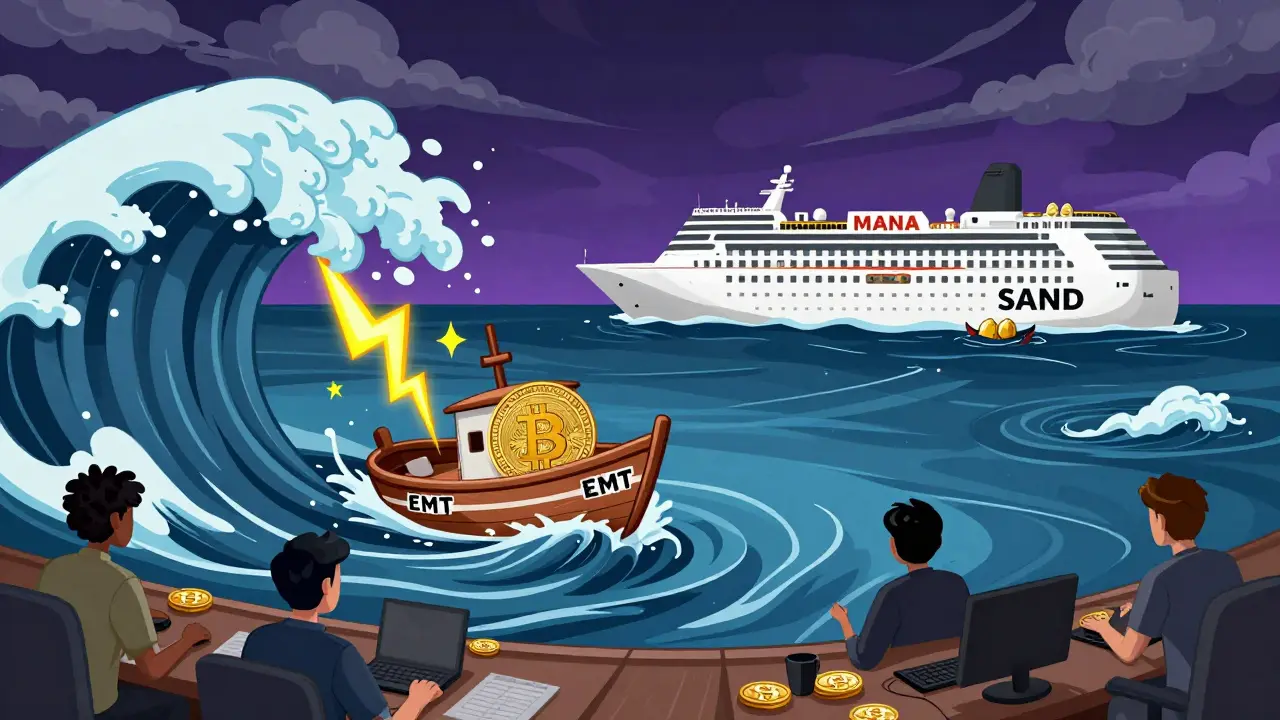
Let’s talk numbers, because this is where the romantic idea of virtual real estate meets the cold hard truth of market dynamics. As of late 2025, EarthMeta operates in a precarious financial state. The total supply of $EMT is capped at 2.1 billion tokens, with roughly 1.44 billion currently in circulation. Despite this large supply, the market capitalization hovers around $15 million.
Compare that to Decentraland, which often boasts a market cap exceeding $1 billion. EarthMeta is a micro-cap player in a room full of whales. This size difference has profound implications for traders. Micro-cap tokens are notoriously volatile. A small buy order can spike the price, and a small sell-off can crash it. CoinCodex data from September 2025 showed EarthMeta with an RSI (Relative Strength Index) of 16.86, indicating it was deeply oversold but still trending downward.
Liquidity is the biggest red flag. Liquidity refers to how easily you can buy or sell an asset without affecting its price. EarthMeta’s 24-hour trading volume was reported at a mere $4,250 on some platforms. To put that in perspective, major exchanges handle billions in daily volume. With such low liquidity, if you tried to sell a significant amount of $EMT, you might not find enough buyers, causing your exit price to plummet due to slippage. Most trading happens on smaller venues like BitMart and XT, not on tier-1 exchanges like Binance or Coinbase.
| Feature | EarthMeta (EMT) | Decentraland (MANA) | The Sandbox (SAND) |
|---|---|---|---|
| Blockchain | Polygon | Ethereum | Ethereum / Polygon |
| Market Cap (Approx.) | $15 Million | $1.1 Billion+ | $1.5 Billion+ |
| Core Focus | Real-world Geolocation | User-generated Virtual World | User-generated Gaming World |
| Exchange Presence | Low (BitMart, XT) | High (Binance, Coinbase) | High (Binance, Coinbase) |
| Risk Level | Very High | Medium-High | Medium-High |
The "Vaporware" Concern: Website and Development Status
Perhaps the most alarming aspect of EarthMeta right now isn't the price-it's the silence. For a project promising a global digital twin, accessibility should be paramount. Yet, as of recent checks, the official website, earthmeta.ai, frequently returns 500 Internal Server Errors. When a company's front door is broken, customers stop trusting the house.
This technical instability fuels the "vaporware" narrative. Vaporware refers to software or products that are announced but never released or fail to deliver on their promises. Community sentiment on forums like Reddit reflects this skepticism. Users report difficulty navigating the supposed digital twin, citing server crashes and lack of functionality. There are no active GitHub repositories showing regular code commits, nor are there vibrant developer forums discussing new features.
In the crypto space, momentum is everything. Projects like CityDAO or GeoWeb may also be niche, but they maintain visible development activity. EarthMeta’s lack of updates since its launch creates a vacuum of information. Analysts like Elena Rodriguez from CryptoCompare have flagged this absence of development activity as a critical risk factor. Without a working product, the token has no utility, making it purely a speculative bet on whether the team will eventually fix the site and launch the platform.
Who Should Avoid EarthMeta?
Not every crypto investment is suitable for every investor. Based on the current data, EarthMeta presents significant risks that certain groups should strictly avoid:
- Beginners: If you are new to crypto, the complexity of bridging assets to Polygon, managing NFTs, and dealing with low-liquidity exchanges is a recipe for loss. Stick to established assets first.
- Long-term Holders Seeking Stability: With a bearish technical outlook and potential regulatory scrutiny over its "tax reward" structure (which could be classified as a security by bodies like the SEC), this is not a stable store of value.
- Users Looking for Immediate Utility: If you want to build, play, or rent virtual land today, EarthMeta’s non-functional website prevents you from doing so. You are buying a promise, not a product.
Conversely, who might consider it? Only high-risk tolerance traders who specialize in micro-cap gems and believe strongly in the "geospatial metaverse" thesis. Even then, position sizing must be minimal-money you are fully prepared to lose entirely.
Regulatory and Future Outlook
The regulatory landscape for crypto is tightening globally. EarthMeta’s model of offering passive income through governance roles triggers questions about whether $EMT constitutes a security. The Blockchain Legal Group noted this concern in their 2025 analysis. If regulators classify it as an unregistered security, the token could face delisting from exchanges or legal action, further crushing its value.
Price predictions vary wildly, but the consensus leans negative in the short term. Algorithmic models forecast a potential drop of over 25% by the end of 2025. While some optimistic projections suggest a rebound to $0.02 by 2026 if the platform launches successfully, these scenarios require a complete turnaround in development activity, user adoption, and marketing-a massive lift for a team that hasn't been able to keep their website online.
The broader metaverse industry is projected to grow, reaching hundreds of billions of dollars by 2030. However, growth does not benefit every player equally. Consolidation is happening. Big players are integrating mapping features directly into their ecosystems, potentially rendering specialized, standalone geospatial tokens like EarthMeta obsolete before they even get started.
Is EarthMeta (EMT) a scam?
There is no definitive proof that EarthMeta is a fraudulent scheme designed solely to steal funds, but it exhibits many warning signs of a failing project. These include a non-functional official website, extremely low liquidity, lack of transparent development updates, and anonymous team details. In crypto, a project that cannot deliver its basic product is functionally risky regardless of intent.
How do I buy EarthMeta (EMT) tokens?
You can currently purchase EMT on select cryptocurrency exchanges like BitMart and XT. Since it is a Polygon-based token, you will need a wallet that supports the Polygon network, such as MetaMask. Be aware that due to low liquidity, you may experience significant price slippage when buying or selling larger amounts.
What is the use case for the EMT token?
Theoretically, EMT is used to purchase virtual land NFTs, pay for transaction fees within the EarthMeta ecosystem, stake for passive rewards, and vote on governance proposals. However, because the main platform is currently experiencing technical issues, these utilities are largely inaccessible to users at this time.
Why is EarthMeta cheaper than Decentraland?
EarthMeta is significantly cheaper due to its much smaller market capitalization, lower user adoption, and higher perceived risk. Decentraland has years of development, a working platform, major brand partnerships, and high liquidity. EarthMeta is a nascent, high-risk micro-cap project with limited functionality.
Is EarthMeta safe to invest in?
No investment in micro-cap cryptocurrencies is considered "safe." EarthMeta carries exceptionally high risk due to its technical instability, lack of exchange listings on major platforms, and uncertain regulatory status. Experts advise extreme caution and recommend only allocating funds you can afford to lose completely.

22 Comments
This whole thing is just a scam to steal your money. The elites want you to buy fake land so they can control everything. I see right through it. It is evil.
you guys are missing the point completly. i have analyzed the whitepaper and its obvious this is a rug pull waiting to happen. why do people fall for these things? its so stupid. the code is trash and nobody checks it. stop being dumb and read the technical specs before you waste time here.
hey there i think you might be looking at the wrong side of things. polygon is actually pretty good for gas fees. if you use metamask make sure you switch networks first or you will get confused. its not that hard really just take your time and check the docs. hope this helps you out buddy
Hello friends :) From India, we often see many such projects come and go. Please be very careful with your savings. If the website is down, it is a big red flag. Do not trust blindly. Check the team first. Stay safe everyone !! :-)
Oh look at us buying pixels in a broken world. How original. I bet the founders are already on a yacht while you wait for the site to load. Keep dreaming folks, it’s cute.
The lack of regulatory compliance is unacceptable. This project fails to meet basic standards of transparency required by international financial bodies. It is irresponsible to promote such an unstable asset without proper oversight.
I suspect this is part of a larger surveillance grid. They map the earth to track our movements under the guise of virtual ownership. Wake up. The government wants to know where you sleep. Do not give them your data.
Is it real if no one is there? We are creating ghosts in machines. The soul of the metaverse is dead because we forgot to put humanity in it. Just a hollow shell of code and greed. So sad really.
I just feel like everyone is getting too worked up. Let it breathe. Maybe it works later. No need to be so aggressive about it. Chill out.
Hey man i know it looks rough but maybe give it another chance? sometimes devs are just busy. dont give up on crypto yet. we all learn from mistakes. you got this!
THIS IS A DISASTER. The liquidity is non-existent. You cannot exit. It is a trap. Everyone who bought in is holding a bag of trash. Stop pretending it has value. It is zero. Zero. Get out now before you lose everything.
Haha nice try selling air. I would rather eat my shoe than buy this token. Good luck with that disaster. lol
Why do you care so much? It makes me sad when people argue about fake land. Life is short. Why spend it fighting over digital dirt? It feels empty. Like talking to a wall.
I think we should all consider the broader implications of decentralized governance models and how they intersect with traditional property rights frameworks which have evolved over centuries to provide stability and predictability for citizens and investors alike ensuring that our economic systems remain robust against speculative bubbles and fraudulent activities that undermine public trust in financial institutions.
Everyone says its a scam but what if its the only honest thing left? The mainstream media lies about everything. Maybe this is the truth they don't want you to see. Think about it. Are you sheep or are you free?
Listen up. If you want to succeed you need to move fast. This market waits for no one. Be aggressive in your research. Don't let fear stop you from making moves. Dominate or die trying.
The smart contract architecture on Polygon offers significant scalability advantages compared to Ethereum mainnet however the lack of formal verification methods introduces critical vulnerabilities in the execution layer that could lead to catastrophic fund loss for early adopters who fail to perform due diligence on the underlying bytecode integrity.
It is imperative that one considers the legal ramifications before engaging with unregistered securities. The SEC has been clear on this matter. Proceed with extreme caution.
I agree with the analysis here. The risks are clearly outlined. We must proceed with caution and verify all claims independently. Collaboration is key to safety.
I understand the excitement around new technologies but we must also acknowledge the potential downsides. It is important to ask difficult questions and seek answers from reliable sources. Let us foster a community of informed decision makers.
This is garbage made by scammers. American values are being undermined by these foreign tech schemes. Buy gold instead. Real stuff. Not this digital junk. 🇺🇸
Boring. Another failed project. I expected better from this space. Typical.