- 14 Oct 2025
- Elara Crowthorne
- 15
ZKSwap Airdrop Eligibility Calculator
How Your ZKB Holdings Relate to the Airdrop
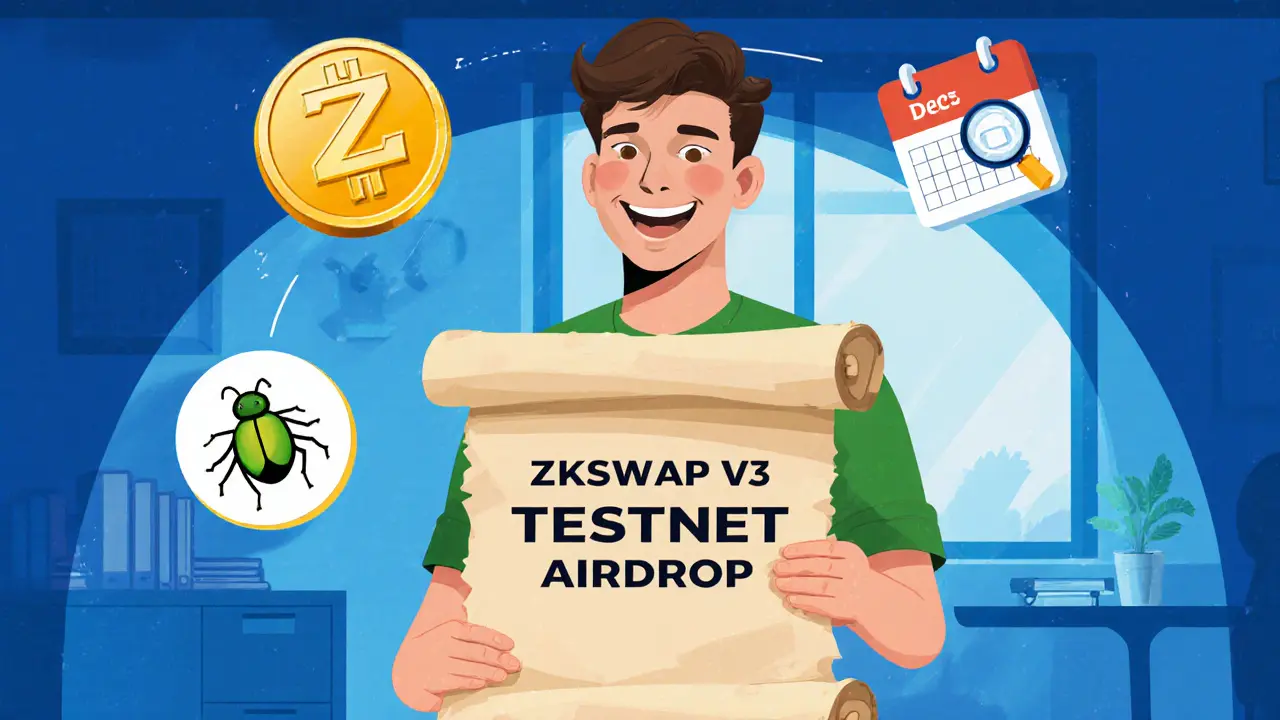
The ZKSwap V3 testnet airdrop distributed ZKS tokens (not ZKB). This calculator shows how much ZKS you might have received based on your historical ZKB holdings during the December 2021 testnet period.
Estimated ZKS Rewards
Based on the historical distribution:
Key Takeaways
- The original ZKSwap airdrop (Feb2021) used ZKS tokens, not ZKB.
- The V3 testnet airdrop in Dec2021 rewarded 50,000 ZKS for bug‑reports and reviews.
- ZKBase runs the ZKB token; it has not launched a dedicated airdrop.
- Confusion stems from ZKSwap being a component of the ZKBase ecosystem.
- Keep records of any airdrop you received for tax and verification purposes.

What Is ZKSwap and How Does It Fit Inside ZKBase?
When crypto fans talk about ZKSwap is a layer‑2 decentralized exchange (DEX) that uses ZK‑Rollup technology to deliver near‑zero gas fees and high throughput, they are describing a product, not a token. ZKSwap was launched by the team behind ZKBase is a broader blockchain platform that hosts ZKSwap, the payment service ZKSquare, and additional infrastructure tools. In other words, ZKSwap is the trading engine; ZKBase is the umbrella project that also issues the ZKB token an ecosystem token with a 600million total supply, of which about 197million circulate.

15 Comments
Hey folks, if you’re trying to figure out whether your ZKB holdings qualified for the testnet airdrop, start by checking the snapshot date in December 2021. The calculator on the post does a decent job of estimating your ZKS share based on that balance. Remember that only ZKB holders at that time were eligible for ZKS rewards, not a separate ZKB token. Also keep an eye on the official ZKSwap announcements for any future distribution updates :)
It is noteworthy that many participants have been misled by the superficial similarity between ZKB and ZKS, assuming a direct airdrop would materialize. In reality, the testnet distribution was meticulously orchestrated, rewarding only those who possessed ZKB during the specified window. The underlying protocol architecture deliberately excluded a ZKB‑only airdrop, a fact that appears to escape the casual observer. Consequently, any expectation of a windfall absent the requisite historical balance is, regrettably, unfounded. One must therefore reconcile ambition with empirical data, lest disappointment ensue.
For those who maintain a scholarly approach to tokenomics, the distinction between ZKB and ZKS is paramount. The testnet snapshot was conducted on December 15th, 2021, and any holdings after that date were not considered. Please verify your ledger entries accordingly; a simple oversight could lead to an incorrect estimate. Definately review the on‑chain data before drawing conclusions.
When dissecting the ZKSwap V3 testnet airdrop mechanics, one must first acknowledge the bifurcation of token utility within the ecosystem. ZKB functioned as a governance and liquidity provision token during the testnet phase, whereas ZKS served as the reward token incentivizing participation. The snapshot methodology employed a block‑height reference at the close of the December 2021 testing window, thereby capturing a static ledger state for allocation calculations. Participants who staked or simply held ZKB in their wallets at that precise moment accrued proportional slices of the 50,000 ZKS distribution pool. The proportionality factor was derived from the aggregate ZKB balance across all eligible addresses, which acted as the denominator in the reward equation. Consequently, a holder with 100.5 ZKB would be entitled to roughly (100.5 / total ZKB) × 50,000 ZKS, a formula that the provided calculator abstracts for user convenience. It is crucial to recognize that the protocol’s smart‑contract logic excluded any retroactive claims, cementing the immutable nature of the snapshot. Moreover, the airdrop architecture was deliberately designed to foster liquidity depth, rewarding not merely token accumulation but active participation in the testnet’s decentralized exchange functionalities. This design ethos aligns with ZKSwap’s broader ambition to democratize access to zero‑knowledge rollup solutions while maintaining a token‑economic equilibrium. Users who engaged in frequent swaps, provided liquidity, or participated in governance votes may have indirectly amplified their effective stake, as ancillary metrics were incorporated into the reward weighting. The distribution schedule, however, adhered to a single‑phase release, mitigating the risk of token price manipulation post‑snapshot. From a risk‑management perspective, this single‑epoch approach curbed speculative accumulation that could destabilize market dynamics upon mainnet launch. For the meticulous analyst, the on‑chain transaction logs reveal the exact block numbers intersecting with the snapshot, enabling independent verification of eligibility. It is advisable to cross‑reference your wallet address with the official ZKSwap explorer to ascertain the recorded balance at the cut‑off point. Should discrepancies arise, the community forums provide a transparent avenue for dispute resolution. Finally, stay attuned to forthcoming governance proposals, as future airdrops may hinge upon ZKB holdings or activity metrics beyond the testnet scope, ensuring sustained engagement with the platform’s evolving ecosystem.
The notion of an airdrop transcends mere token distribution; it embodies the collective trust between a protocol and its early adopters. In the quiet ledger of December 2021, each ZKB balance whispers a story of belief in a nascent technology. When that whisper is quantified as ZKS, the abstract becomes tangible, yet the philosophical underpinnings remain.
Thanks for breaking that down so thoroughly, Jennifer. The calculator definitely makes it easier to see where we stand.
Wow, that’s a solid recap. Good to know the snapshot was that strict.
The reality is stark: if you weren’t holding ZKB then, you get nothing. No loopholes, no second chances.
Hey everyone! 🎉 If you’ve got any ZKB from that era, you’re probably sitting on a nice chunk of ZKS. The airdrop could be a pleasant surprise for many. Keep an eye on the official channels for claim instructions! 😊
Indeed, one must remain vigilant; the forthcoming claim process shall undoubtedly be delineated with ample clarity. However, occasional typographical errors may obfuscate the intended message within official communiqués.
I appreciate the thorough explanations shared here. For newcomers, it might help to double‑check their wallet’s historical balance using a block explorer.
Man the drama never stops the crypto world is like a rollercoaster ride the hype builds the tension then boom a new token drops everyone loses their mind it’s wild
Oh, absolutely! The *excitement* is just *overwhelming*-can’t you feel the intensity? 😏
Great, another token to track, because we needed that.
Nice.