
- 21 Jun 2026
- Elara Crowthorne
- 0
Have you ever wondered if the digital asset world is actually getting safer? For years, the narrative was simple: crypto equals chaos. But the numbers from 2024 and 2025 tell a much more complex story. We are witnessing a pivotal shift where global regulators are no longer just watching; they are actively hunting. The landscape of crypto enforcement is the coordinated effort by governments and private entities to combat financial crimes involving digital assets through legal action, fines, and technical cooperation has matured rapidly. It’s not just about slapping fines on exchanges anymore. It’s about freezing funds, tracking illicit flows across blockchains, and holding bad actors accountable in real-time.
If you clicked this title, you’re likely looking for hard data, not hype. You want to know where the money is going, who is getting caught, and what this means for your portfolio or business. The short answer? Crime is down in some areas, but the methods are evolving. Let’s break down the actual statistics that define this era.
The Great Discrepancy: How Much Money Is Actually Illicit?
When we talk about "crypto crime," we first need to agree on what that number looks like. Here is where things get tricky. Two major industry leaders, TRM Labs and Chainalysis, released their 2025 reports with vastly different figures for 2024. Why? Because they count differently.
TRM Labs is a blockchain analytics company that provides software and services to detect and prevent financial crime in cryptocurrency reported that illicit crypto activity sent to fraud addresses amounted to at least USD 10.7 billion in 2024. This represented a significant 40% drop from 2023. Their focus is tight: they look specifically at fraud-related activity. If it doesn’t fit their strict definition of fraud, it might not make the cut.
On the other hand, Chainalysis is a leading blockchain analysis firm that offers data and insights into the use of cryptocurrencies painted a broader picture. They reported that $40.9 billion was received by illicit cryptocurrency addresses in 2024. Chainalysis includes darknet markets, scams, ransomware, and sanctions evasion in their net. They also note a crucial caveat: these figures typically grow by about 25% between annual reports as analysts identify more hidden illicit addresses. In fact, the 2023 figure grew from an initial $24.2 billion to $46.1 billion within a year.
So, which number is right? Both are, depending on how you define "illicit." For investors and regulators, the trend matters more than the absolute number. The downward trend in pure fraud (per TRM) suggests that basic scam tactics are becoming less effective against educated users. However, the high total volume (per Chainalysis) indicates that sophisticated criminal enterprises are still moving massive amounts of value.
| Source | Estimated Volume (2024) | Methodology Focus | Trend vs. Previous Year |
|---|---|---|---|
| TRM Labs | $10.7 Billion | Fraud-specific transactions | -40% decrease |
| Chainalysis | $40.9 Billion | Broad illicit activity (darknet, scams, ransomware) | Stable/Slight increase (pre-adjustment) |
Where the Criminals Hide: Blockchain Preferences
You might assume Bitcoin is the king of crime because it’s the most famous. The data says otherwise. Criminals are pragmatic. They care about speed, low fees, and privacy features. This is why TRON is a blockchain platform designed for decentralized applications and smart contracts, known for high throughput and low transaction costs dominated the illicit landscape in 2024.
According to TRM Labs, TRON hosted 58% of all global illicit crypto volume. Ethereum followed with 24%, and Bitcoin trailed at just 12%. Binance Smart Chain and Polygon each held 3%. The reason is clear: TRON supports USDT (Tether), the world’s largest stablecoin. Criminals love stablecoins because they offer the volatility-free store of value of fiat currency with the borderless transfer capabilities of crypto.
However, 2024 was also the year TRON got hit hard. The formation of the T3 Financial Crime Unit is a collaborative initiative between TRON Foundation, Tether, and TRM Labs aimed at combating financial crime on the TRON network changed the game. Launched in August 2024, this public-private partnership allowed for the rapid freezing of funds. As a result, TRON saw its illicit volume drop by USD 6 billion, effectively halving its share of total illicit activity. Over USD 130 million in illicit proceeds were frozen and returned to victims or government accounts. This proves that when platforms cooperate with law enforcement, the impact is immediate and measurable.

The Regulatory Gap: Paper Laws vs. Real Enforcement
Having laws on paper is one thing. Enforcing them is another. The Financial Action Task Force (FATF) is an independent intergovernmental organization that develops policies to protect the global financial system from money laundering, terrorist financing, and proliferation financing set the global standard with its Travel Rule, which requires exchanges to share customer information during cross-border transfers. By March 2024, 84% of assessed jurisdictions had implemented the Travel Rule. Sounds good, right?
Not so fast. A follow-up report revealed significant implementation gaps. According to PwC’s 2025 Global Crypto Regulation Report, 75% of surveyed jurisdictions remain only partially compliant or non-compliant with FATF requirements. Nearly 30% still fail to implement the Travel Rule effectively. This creates "regulatory havens" where criminals can easily move funds between poorly regulated regions.
In 2024, over 60% of the 24 major jurisdictions analyzed introduced new crypto policies. But quantity does not equal quality. The U.S. Department of Justice took a more aggressive stance, focusing on specific crime vectors. In October 2024, the District of Massachusetts charged 17 individuals for using bots to manipulate alt and meme coin prices through wash trading. This signals a shift from punishing exchanges for lack of KYC (Know Your Customer) to prosecuting individual traders for market manipulation.
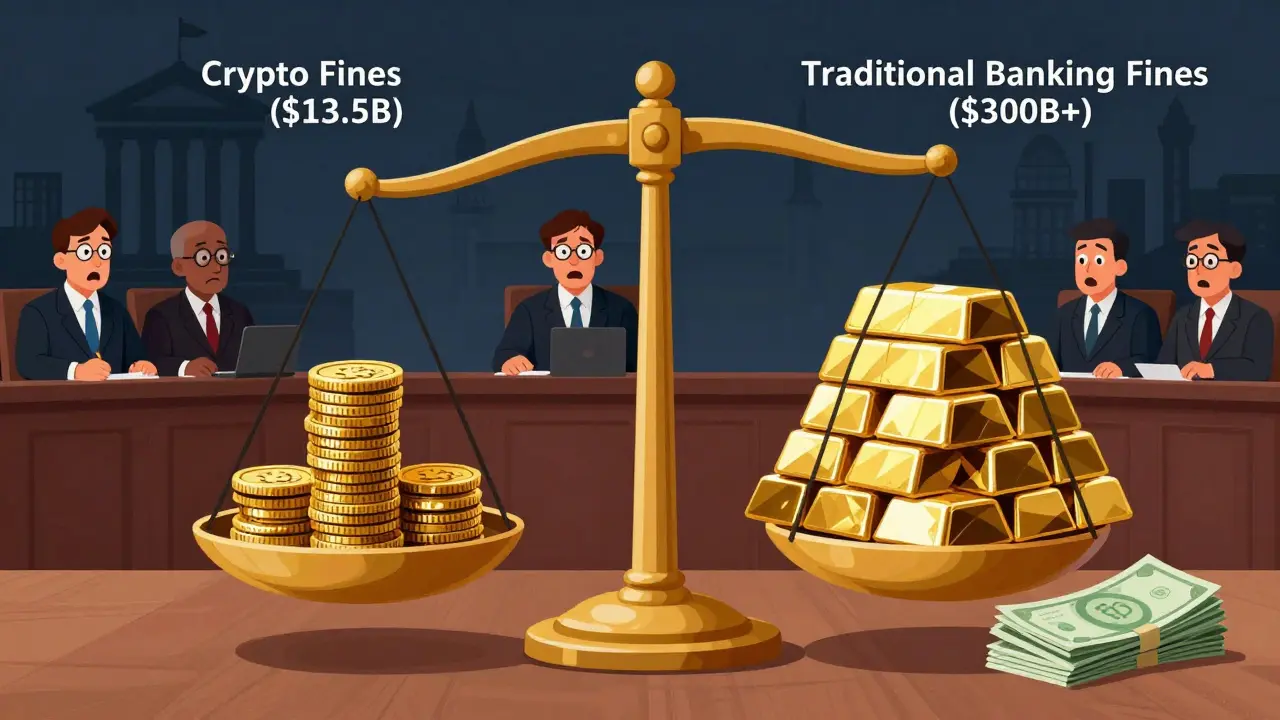
Crypto Fines vs. Traditional Banking Penalties
It’s easy to feel overwhelmed by the news headlines about crypto bans and fines. But let’s put it in perspective. Are crypto companies really being punished harder than traditional banks?
The Coincub Crypto Asset Risk Report 2025 provides a sobering comparison. Between 2020 and early 2025, the crypto industry faced aggregate penalties totaling $13.5 billion. While that sounds huge, compare it to traditional finance. Bank of America and JPMorgan Chase alone have faced penalties exceeding $97 billion collectively. The broader financial services sector has incurred over $300 billion in fines for mortgage abuses and sanctions breaches.
The pattern in crypto is different. There are more frequent regulatory actions (72% of enforcement records are compliance-related), but the monetary penalties are lower per incident. Regulators are currently focused on building the framework rather than inflicting existential financial damage. They want compliance, not collapse. This is a critical distinction for anyone operating in the space: the goal is to fix your processes, not necessarily to shut you down, unless you are willfully ignoring the rules.
What to Expect in Late 2025 and Beyond
We are halfway through 2025, and the trends are pointing toward greater sophistication. The Kroll Cyber Threat Intelligence team reported that nearly $1.93 billion was stolen in crypto-related crimes in the first half of 2025 alone. This suggests that while broad fraud may be declining, high-value, targeted attacks are persisting.
Regulators are shifting their gaze. With 68% of regulatory bodies planning specific guidance for stablecoins, DeFi protocols, and NFTs by Q3 2025, the "wild west" era is officially over. International cooperation is also improving. The Norton Rose Fulbright outlook suggests that cross-border asset recovery mechanisms will become significantly more effective in 2025, thanks to shared intelligence networks.
As the global user base grows from 560 million to a projected 950 million by the end of 2025, the sheer scale of enforcement challenges will increase. But the tools are getting better too. Public-private partnerships like the T3 FCU model show that collaboration can reduce platform-specific illicit activity by up to 50% within a year. The future of crypto enforcement isn’t just about police work; it’s about technology, transparency, and teamwork.
Did crypto crime increase or decrease in 2024?
It depends on how you measure it. TRM Labs reported a 40% decrease in fraud-specific activity ($10.7 billion). However, Chainalysis reported a higher total of $40.9 billion in illicit activity, including darknet markets and ransomware, which remained relatively stable compared to previous adjusted figures. The consensus is that basic scams are down, but sophisticated crime persists.
Which blockchain has the most illicit activity?
In 2024, TRON hosted the majority of illicit crypto volume at 58%, primarily due to its support for USDT and low transaction fees. Ethereum followed with 24%, and Bitcoin accounted for only 12%. However, TRON's share dropped significantly after the launch of the T3 Financial Crime Unit.
Are crypto fines higher than traditional banking fines?
No. The crypto industry faced $13.5 billion in penalties between 2020 and early 2025. In contrast, major traditional banks like JPMorgan and Bank of America have faced over $97 billion in collective penalties, with the wider financial sector exceeding $300 billion. Crypto enforcement is more frequent but less financially punitive per case.
What is the FATF Travel Rule?
The Travel Rule is a regulation set by the Financial Action Task Force (FATF) requiring virtual asset service providers to share customer information during cross-border transactions. Despite 84% of jurisdictions implementing it, PwC reports that 75% remain only partially compliant, creating enforcement gaps.
How effective are public-private partnerships in stopping crypto crime?
They are highly effective. The T3 Financial Crime Unit, a partnership between TRON, Tether, and TRM Labs, helped freeze over $130 million in illicit funds and reduced TRON's illicit volume by $6 billion in 2024. Such collaborations can reduce platform-specific illicit activity by up to 50% within 6-12 months.
