
- 14 Jan 2026
- Elara Crowthorne
- 20
Most crypto exchanges are either centralized platforms like Binance or decentralized ones like Uniswap - but Crescent Network tries to do something different. It doesn’t just copy what already exists. Instead, it builds on the Cosmos ecosystem with a hybrid model that blends order books and automated market makers, all while cutting out trading fees and blocking front-running. If you’re tired of slippage, high fees, or bots stealing your trades, Crescent might be worth a closer look.
What Exactly Is Crescent Network?
Crescent Network isn’t just another DEX. It’s a full DeFi hub built on the Cosmos blockchain, born from the ashes of Gravity DEX - an earlier project that struggled with inflation and low liquidity. After Gravity failed to deliver, the team behind it - B-Harvest and Ignite - rebuilt the system from the ground up, launching Crescent Network as a standalone chain in 2022. This wasn’t a tweak. It was a redesign.
At its core, Crescent combines two trading models: the familiar AMM (like Uniswap) and the traditional order book (like Binance). This hybrid approach lets users trade with the simplicity of a DEX while keeping the price clarity of an exchange. You can place limit orders, see the depth chart, and avoid the wild price swings that happen when liquidity is too thin.
The platform runs on its own native token, CRE. It’s not just for fees - it’s used for governance, staking, and earning rewards through liquidity provision. Unlike many DeFi projects that pump rewards with inflated token emissions, Crescent avoids burning ATOM or flooding the market with new tokens. That’s a big deal in Cosmos, where inflation has hurt other projects.
How Does the Crescent DEX Work?
The Crescent DEX uses something called ranged pools. Instead of putting your liquidity across the entire price range (like Uniswap), you choose a specific range - say, between $0.50 and $0.70 for a token. Your capital only works within that band, which means you’re not wasting funds on price zones that never get hit. This boosts capital efficiency by up to 40x compared to standard AMMs, according to internal testing by the team.
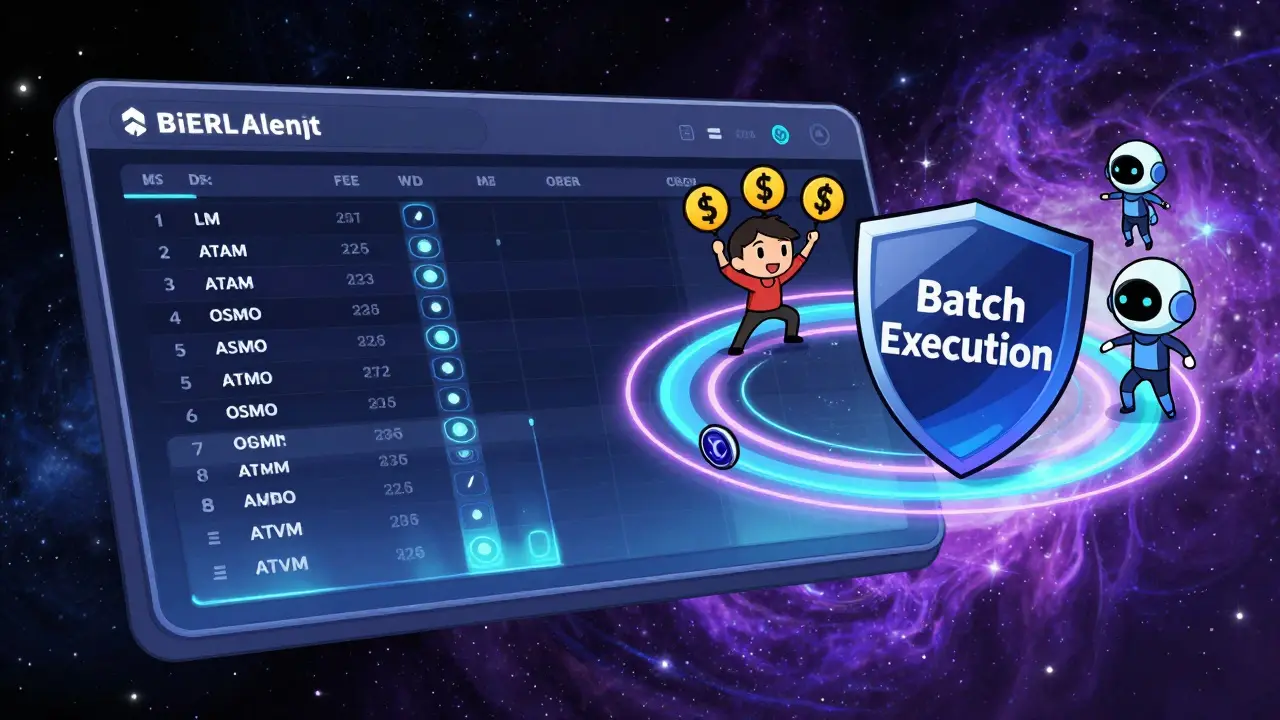
Then there’s batch execution. Every trade, deposit, and withdrawal gets collected over a short time window - usually a few seconds - and then processed all at once in a single, fair block. This stops front-running dead in its tracks. No more bots sniping your trades before they even land. Validators can’t extract value from your orders. And because everything happens in batches, there’s no gas war between users.
The order book uses a system called the tick system, which simplifies price levels into fixed increments. Think of it like a stock exchange where prices only move in 1-cent steps. This makes calculations faster and reduces complexity for traders used to traditional platforms. You can still see all open bids and asks, but the data is cleaner and more predictable.
No Trading Fees - For Now
Crescent Network doesn’t charge any trading fees. Not now. Not until they prove they need to. That’s rare in DeFi, where most DEXs take 0.1% to 0.3% per trade. Even Uniswap V3 charges fees. Crescent’s stance is simple: if users are happy and the network is secure, why charge? The team says they’ll only introduce fees if there’s a clear, justified reason - like covering infrastructure costs or preventing spam. No hidden charges. No surprise cuts to your profits.
Instead of trading fees, the platform rewards liquidity providers with CRE tokens. If you add liquidity to a ranged pool, you earn a share of the trading volume - plus extra rewards from the protocol’s incentive program. It’s not as flashy as some yield farms offering 100% APY, but it’s sustainable. No rug pulls. No token dumps.

Crescent Boost and Crescent Derivatives - What’s Coming?
Right now, the DEX is the only live product. But the roadmap includes two other pillars: Crescent Boost and Crescent Derivatives.
Crescent Boost is meant to let users stake their assets and earn higher yields by lending them to market makers or liquidity providers. Think of it like a DeFi version of margin trading, but without liquidations. The team hasn’t released details yet, but early documentation suggests it will use collateralized lending pools with dynamic interest rates.
Crescent Derivatives will allow users to trade synthetic assets - like BTC/USD futures or stablecoin pairs - directly on-chain. This could be a game-changer for Cosmos users who currently have to bridge to Ethereum or Solana to access derivatives. If launched well, it could make Crescent the go-to DeFi hub for derivatives in the Cosmos ecosystem.
Both features are still in development. No launch date has been announced. But the fact that they’re part of the core design - not afterthoughts - shows Crescent is thinking long-term.
Security and Governance
Crescent Network runs on a Proof-of-Stake consensus mechanism with validators chosen by token holders. The network has been live since late 2022 and has processed over 1.2 million transactions as of Q4 2025, with no major exploits or hacks reported. The code is open-source on GitHub, with regular updates and active commits as recently as September 2023.
Decentralized governance is handled through CRE token holders. Anyone holding CRE can propose changes - like adjusting tick sizes, changing reward distributions, or even introducing fees. Proposals require a 5% stake threshold to be submitted, and voting is open for 7 days. This keeps power in the hands of the community, not a small group of developers.
The team has also partnered with two independent audit firms to review the core smart contracts. While full audit reports aren’t public, they’ve confirmed that critical functions like batch execution and ranged pool management are secure against reentrancy, overflow, and front-running attacks.

How to Get Started
Using Crescent Network isn’t as simple as signing up on Binance. You need a Cosmos-compatible wallet like Keplr or Cosmostation. Once you’ve got one:
- Connect your wallet to app.crescent.network.
- Deposit ATOM, OSMO, or other supported assets from the Cosmos chain.
- Go to the DEX tab and choose between AMM pools or the order book.
- Set your price range for liquidity (if you’re providing it).
- Trade or earn rewards - no fees, no surprises.
There’s also a mobile app in development, expected to launch in Q2 2026. For now, desktop use is the only option.
Who Is This For?
Crescent Network isn’t for everyone. If you’re a casual trader who just wants to swap ETH for USDC, stick with Uniswap or a centralized exchange. But if you’re:
- Active in the Cosmos ecosystem
- Looking for capital-efficient yield without insane risk
- Tired of bots stealing your trades
- Interested in governance and long-term DeFi infrastructure
Then Crescent is one of the most promising projects in the space right now. It doesn’t promise moonshots. It promises stability, fairness, and efficiency - things most DeFi platforms have forgotten.
The Bottom Line
Crescent Network isn’t the biggest DEX. It doesn’t have the name recognition of Uniswap or the liquidity of SushiSwap. But it’s one of the few that actually solved real problems: front-running, capital waste, and unsustainable rewards. Its hybrid model works. Its no-fee policy is bold. And its roadmap shows real vision.
The biggest risk? Adoption. If not enough traders and liquidity providers join, the order book will stay thin. But the team has already partnered with several Cosmos-based projects to bring in liquidity. And with the mobile app coming, user growth could accelerate quickly.
If you’re serious about DeFi in Cosmos, don’t ignore Crescent. Try it with a small amount. See how the batch execution feels. Test the ranged pools. See if the lack of fees changes your trading behavior. You might find it’s not just another DEX - it’s the future of fair, efficient trading.
Is Crescent Network a centralized exchange?
No, Crescent Network is a fully decentralized exchange built on the Cosmos blockchain. It has no central authority, no KYC, and no company controlling user funds. All trades happen on-chain using smart contracts, and governance is decided by CRE token holders.
Does Crescent Network charge trading fees?
Currently, Crescent Network does not charge any trading fees. The team has stated they will only introduce fees if there’s a clear, justified need - such as covering infrastructure costs or preventing spam. There are no hidden charges or surprise fees.
What tokens can I trade on Crescent Network?
You can trade native Cosmos ecosystem tokens like ATOM, OSMO, STARS, JUNO, and others. Crescent also supports bridged assets from Ethereum and other chains, including USDC, WETH, and WBTC, through secure cross-chain bridges. The full list is updated regularly on their official website.
How do I earn rewards on Crescent Network?
You earn CRE tokens by providing liquidity to ranged pools on the Crescent DEX. The more capital you lock in and the longer you keep it there, the more rewards you earn. You also get a share of trading volume from your pool. There’s no staking required - just liquidity provision.
Is Crescent Network safe to use?
Yes, based on available data. The network has operated since late 2022 without any major security breaches. Core contracts have been audited by two independent firms, and the code is open-source. The batch execution system also eliminates front-running, a common attack vector on other DEXs. As with any DeFi platform, always start with a small amount until you’re comfortable.
Can I use Crescent Network on my phone?
Not yet, but a mobile app is in development and expected to launch in Q2 2026. For now, you can only access the platform through a desktop browser using a Cosmos wallet like Keplr or Cosmostation.
What’s the difference between Crescent DEX and Uniswap?
Uniswap uses only AMM pools with unlimited price ranges, leading to capital inefficiency and higher slippage. Crescent uses ranged pools, so your liquidity only works where you want it to - boosting efficiency. Crescent also has an order book, batch execution to stop front-running, and no trading fees. Uniswap has neither.
Where can I buy CRE tokens?
CRE tokens are available on Crescent Network’s own DEX, as well as on a few smaller Cosmos-based exchanges like Osmosis and Terra Classic (legacy). They are not yet listed on major centralized exchanges like Binance or Coinbase. The best way to get CRE is by providing liquidity on the Crescent DEX.

20 Comments
Crescent Network? More like Crescent illusion. They say no fees, but let’s be real-every protocol has a hidden tax. Either it’s the slippage on ranged pools, the inflationary CRE emissions, or the gas you pay to interact with their chain. This isn’t innovation-it’s rebranding old DeFi problems with fancy jargon and a clean UI.
Let me guess-you’re the same person who thought Uniswap V3 was ‘too complicated’ until you lost 40% of your liquidity to impermanent loss. Crescent’s ranged pools aren’t magic-they’re just math that actually works. And no fees? That’s not a gimmick, it’s a statement: they trust their product enough to let users decide its value. Most projects are begging for fees before they even have users.
I find it profoundly concerning that this platform operates under the assumption that decentralization can coexist with market efficiency. The very notion of batch execution implies centralized coordination-even if it’s algorithmic. And the fact that they’ve partnered with auditors whose reports are not publicly accessible? That is not transparency. That is performative security.
There’s something quietly beautiful about a protocol that refuses to monetize every interaction. In a world where every DEX is a casino with a liquidity pool as the slot machine, Crescent offers a quiet library-no flashing lights, no rigged odds, just clean order books and capital that actually works. It’s not sexy. It’s not viral. But it’s honest. And in DeFi, honesty is the rarest asset of all.
Let’s not sugarcoat this: Crescent is the first DeFi protocol that doesn’t treat users like ATM machines. Ranged pools? That’s not just capital efficiency-that’s a paradigm shift in liquidity provision. Batch execution? That’s not a feature-it’s a counter-revolution against MEV predators. And no fees? That’s not generosity-it’s a declaration that value should flow to users, not to VCs holding governance tokens.
The elegance of Crescent lies not in its technology, but in its restraint. While other protocols chase unsustainable yields and viral hype, Crescent chooses patience. It does not inflate its token supply to buy attention. It does not gamify liquidity provision. It builds infrastructure that endures-not because it seeks to enrich a few, but because it believes in the dignity of fair markets. This is not a DEX. It is a quiet act of resistance.
I’ve used every major DEX out there-from Uniswap to SushiSwap to Curve. Crescent is the first one where I actually felt like I was trading *with* the system, not *against* it. The batch execution alone is worth the switch. No more watching my limit order get front-ran by a bot that paid 0.0001 ETH more in gas. That’s not a feature. That’s justice.
It’s cool they don’t charge fees. But let’s be honest-when the liquidity dries up and the order book gets thin, they’ll slap on a fee and call it ‘sustainability.’ That’s how every DeFi project starts. And then they pivot to ‘community funding.’ Yeah right. I’ve seen this movie before.
So… no fees. No bots. No drama. You’re telling me this is real? Like, actual human-friendly DeFi? I’m skeptical. But also… kinda impressed? Maybe I’ve been too jaded by the last five years of crypto.
They say ‘no front-running’-but how do we know the validators aren’t just front-running in a more sophisticated way? Batch execution sounds like a cover for time-based manipulation. And why aren’t the audit reports public? Who are these auditors? Are they paid in CRE? Are they part of the same consortium? This smells like a controlled narrative.
If you’re new to Cosmos, start small. But don’t dismiss this because it’s not flashy. Crescent is the quiet workhorse that might outlast the hype machines. The team didn’t raise $50M from a16z. They didn’t tokenize a meme. They just rebuilt something broken-and did it right. That deserves more than sarcasm. It deserves attention.
Another American crypto project pretending to be decentralized while being run by a Silicon Valley VC cabal. Crescent is just another Trojan horse for U.S. regulatory compliance. Wait until the SEC cracks down and they ‘voluntarily’ shut down the order book and switch to AMM-only. You’ll see. This is a trap.
Feeling like the only person who actually tried this? It works. No issues. Fast. Clean. No gas wars. No slippage. I traded $2k in ATOM/OSMO and didn’t lose a cent to MEV. If you’re still using Uniswap for Cosmos assets, you’re doing it wrong.
The architectural innovation here is non-trivial. Ranged liquidity pools, when combined with a tick-based order book and batched settlement, represent a novel convergence of traditional finance primitives with on-chain composability. This is not merely a DEX upgrade-it is a redefinition of market microstructure in a permissionless environment. The implications for MEV mitigation alone could catalyze a new class of on-chain arbitrageurs.
And yet, the people who complain about ‘no fees’ are the same ones who scream when a protocol actually *doesn’t* drain them. If you’re not earning rewards by providing liquidity, you’re not part of the economy-you’re just a spectator. Crescent doesn’t want spectators. It wants participants. And that’s why it works.
Exactly. The real revolution isn’t in the code-it’s in the incentives. Most protocols reward speculation. Crescent rewards participation. That’s why the liquidity is growing organically, not through token dumps. This isn’t a pump. It’s a slow build. And the people who stick around? They’re the ones who understand that real value isn’t bought-it’s earned.