

- 25 Jan 2026
- Elara Crowthorne
- 19
The UK government isn’t waiting for crypto to settle down-it’s stepping in with clear rules. As of January 2026, the HM Treasury crypto policy and regulations are no longer proposals. They’re law. And if you’re trading, issuing, or holding crypto in the UK, you need to understand what changed and how it affects you.
What Exactly Is Regulated Now?
Before April 2025, crypto firms in the UK operated in a gray zone. Some registered with the FCA for anti-money laundering checks. But there was no real oversight of how they operated. That ended with the Financial Services and Markets Act 2000 (Regulated Activities and Miscellaneous Provisions) (Cryptoassets) Order 2025. This isn’t a minor tweak. It’s the first time crypto activities are treated like traditional financial services under UK law. Five core activities now require FCA authorization:- Operating a cryptoasset trading exchange
- Issuing qualifying stablecoins
- Dealing in qualifying cryptoassets
- Providing custody services for cryptoassets
- Arranging transactions in qualifying cryptoassets
What Counts as a ‘Qualifying’ Cryptoasset?
Not all crypto is treated the same. The law draws a line between two types:- Qualifying cryptoassets: These are tokens that aren’t stablecoins but still have economic value tied to market demand-like Bitcoin, Ethereum, or Solana. They’re regulated when traded, held in custody, or arranged for others.
- Qualifying stablecoins: These are tokens pegged to a stable asset like the pound or euro. Only stablecoins issued by UK-based entities fall under this category. So if you’re using Tether or USDC, you’re still protected under consumer rules-but the issuer isn’t regulated unless they’re based in the UK.
What’s Not Regulated (And Why It Matters)
The Treasury didn’t try to control everything. Decentralized finance (DeFi) protocols that truly have no central team or controlling entity are excluded. If there’s no company, no CEO, no headquarters-you’re not regulated. This isn’t a loophole. It’s a deliberate design choice. Regulators know you can’t force a smart contract to apply for a license. So instead, they focus on the human actors: exchanges, issuers, custodians. If you’re using Uniswap or Aave from your wallet, you’re not breaking any rules. But if a UK firm builds a DeFi platform with a central team managing fees or upgrades, they’re now in scope. This distinction helps the UK stay competitive. While the EU tried to regulate all DeFi under MiCA, the UK’s approach lets innovation happen outside the system-while still protecting consumers from centralized intermediaries.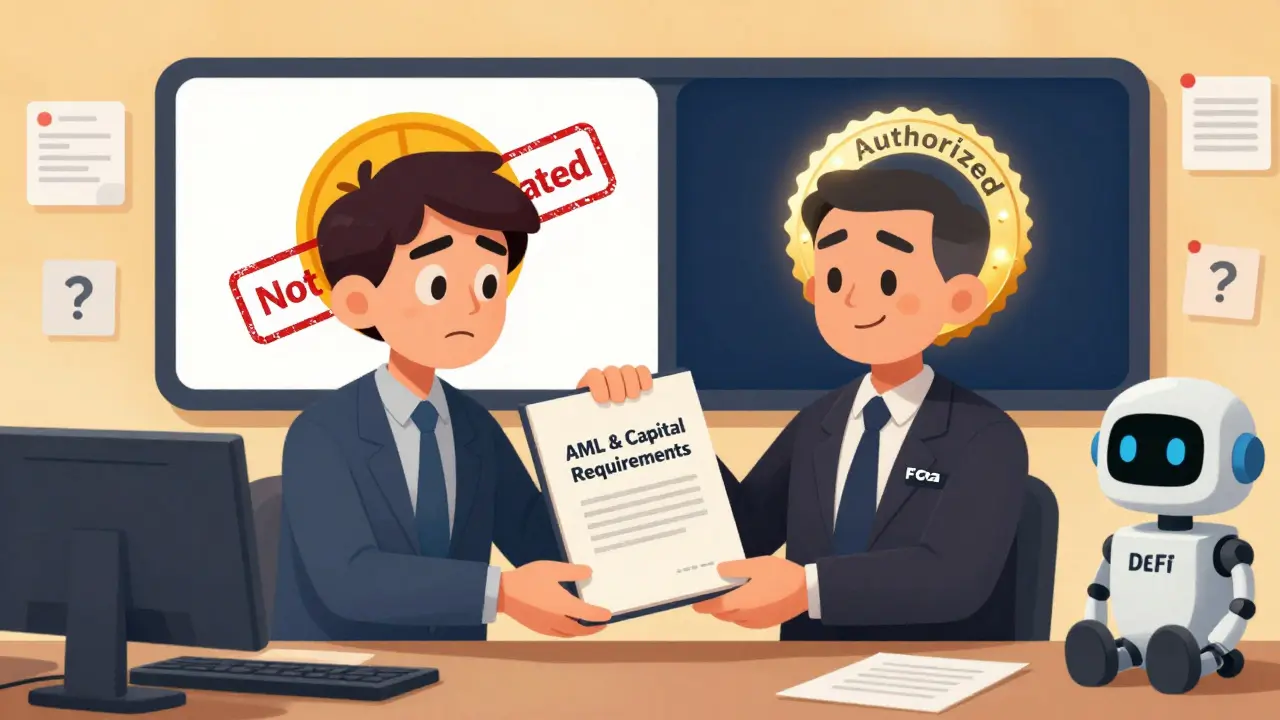
How This Compares to Other Countries
The UK didn’t start from scratch. It borrowed heavily from the EU’s MiCA regulation. The structure of regulated activities, the focus on stablecoins, and the requirement for authorization are all similar. But there are key differences:| Feature | UK (HM Treasury 2025) | EU (MiCA) |
|---|---|---|
| Stablecoin Issuers | Only UK-based issuers regulated | All stablecoins sold in EU regulated, regardless of origin |
| DeFi Exclusion | Explicitly excluded if truly decentralized | No clear exclusion; some DeFi services may fall under scope |
| Regulatory Body | FCA (extends existing framework) | New EU-wide authority + national regulators |
| Implementation Timeline | Phased, with FCA rulebooks rolling out through 2026 | Full rollout by 2026, with strict deadlines |
What Firms Need to Do Now
If you run a crypto business in the UK, here’s your checklist:- Identify which of the five regulated activities your firm performs.
- Check if you’re a UK-based issuer of a stablecoin. If yes, you’re in scope.
- Review whether your operations involve non-UK customers. Even foreign firms must comply if they target UK users.
- Start preparing your FCA application. You’ll need proof of financial resilience, AML procedures, and consumer protection policies.
- Update your terms of service and disclosures to reflect new regulatory status.
Anti-Money Laundering Just Got Tighter
In September 2025, HM Treasury released draft amendments to the Money Laundering Regulations. These now require crypto firms to:- Perform enhanced customer due diligence on high-risk clients
- Report suspicious activity using the same systems as banks
- Keep records of pooled client accounts for up to five years
- Register trusts holding crypto assets with the UK Trust Registration Service

What’s Coming Next?
The 2025 Order is just the first step. Two more major pieces are on the way:- Market Abuse Rules: These will ban insider trading and market manipulation in crypto markets. Think of it like the rules that prevent stock traders from dumping shares after a secret merger.
- Admissions and Disclosures: Firms will need to publish clear, standardized information about their tokens-risk warnings, fees, redemption policies-before listing them.
Why This Matters for You
If you’re a retail investor: You’re safer now. Crypto firms must hold your assets separately from their own. They can’t lend them out without your consent. If a firm goes bust, you have a clearer path to recover your holdings. If you’re a business: The rules are harder-but they’re clear. No more guessing. You know what’s allowed and what’s not. That’s good for long-term planning. But it also means the cost of entry has risen. Smaller firms may struggle. Some may leave the UK market. If you’re a developer or DeFi user: You’re largely unaffected. As long as you’re not running a centralized platform, you can still use wallets, smart contracts, and decentralized apps without interference.Bottom Line
The UK isn’t banning crypto. It’s bringing it into the financial system-with rules that match traditional banking. The goal isn’t to kill innovation. It’s to stop fraud, protect consumers, and make London a credible hub for compliant crypto businesses. The clock is ticking. Firms have until the end of 2026 to get fully authorized. If you’re waiting for a delay, you’re risking your business. The Treasury isn’t backing down. The rules are final. Now it’s up to you to adapt.Are Bitcoin and Ethereum regulated under HM Treasury’s new rules?
Yes, but not directly. Bitcoin and Ethereum are classified as qualifying cryptoassets. That means if a UK firm trades them, holds them for clients, or arranges transactions involving them, that firm must be FCA-authorized. You, as an individual holding Bitcoin in your wallet, aren’t regulated. But the exchanges and custodians you use are.
Can I still use USDC or Tether in the UK?
Yes. The UK’s rules only regulate stablecoin issuers based in the UK. USDC (issued by Circle) and Tether (issued by Tether Limited) are foreign-issued, so they’re not directly regulated under the 2025 Order. However, UK-based exchanges that list them must be authorized, and they must warn users about risks. You’re protected indirectly through exchange rules, not the stablecoin issuer itself.
Do I need to register with the FCA if I trade crypto as a hobby?
No. Individual retail investors are not required to register with the FCA. The regulations target businesses that provide services to the public-exchanges, custodians, issuers, and dealers. If you’re buying and selling crypto for yourself, you’re not affected by the new rules.
What happens if a crypto firm doesn’t get FCA authorization?
They can’t legally operate in the UK. The FCA can issue fines, freeze assets, or refer cases to criminal prosecutors. Any firm advertising services to UK customers without authorization is breaking the law. Consumers are warned to avoid unregistered firms-many are now listed on the FCA’s warning list.
Is DeFi completely unregulated in the UK?
Only if it’s truly decentralized. If a DeFi protocol has no central team, no headquarters, and no one who can make changes to the code, it’s exempt. But if a company operates a DeFi platform with a team managing fees, upgrades, or customer support, that company must get FCA authorization. The law targets the people behind the code, not the code itself.
When will the full rules be published?
The core regulations took effect in late 2025. The FCA is releasing detailed rulebooks throughout 2026. Market abuse rules and disclosure requirements are expected by September 2026. Firms are advised to monitor FCA updates closely-changes are being published quarterly.

19 Comments
The new HM Treasury rules are a step in the right direction. Clarity helps everyone-investors, businesses, even developers. No more guessing games. If you're running a crypto business in the UK, you know exactly what’s expected. That’s good for long-term growth.
Simple rules, strong enforcement. That’s how you build trust.
Keep it steady, keep it fair.
Finally! Someone in government actually got it right for once-no half-measures, no vague promises, no ‘we’ll see how it goes’ nonsense. This isn’t about crushing innovation, it’s about making sure the people who want to play fair don’t get steamrolled by the crooks and con artists who’ve been hiding behind ‘decentralization’ like it’s a magic shield. The UK isn’t scared of crypto, it’s smart enough to know that real innovation doesn’t need to be lawless. And if you’re still crying about ‘freedom’ while your wallet gets drained by a sketchy exchange that never filed paperwork? Honey, you were already playing Russian roulette with your savings. This law? It’s the safety net you didn’t know you needed.
Bring on the next phase. I’m ready.
Im so glad the UK is taking this seriously not just for the economy but for ordinary people like me who just want to hold bitcoin without worrying some random platform will vanish overnight with my funds
the fact that they focus on the humans behind the code not the code itself is brilliant because you cant regulate a smart contract but you can hold a CEO accountable
and yes i use usdc daily and i know its not regulated here but at least the exchange i use is so i feel safer
hope other countries follow this model not the eu overreach
also please make sure the fca publishes those rulebooks fast because waiting is stressing me out lol
Regulation is just another word for control. The moment you put a human in charge of defining what ‘qualifying’ means, you’ve already lost the essence of what crypto was supposed to be-permissionless, borderless, resistant to hierarchy. The FCA isn’t protecting consumers; it’s protecting the old system from being disrupted.
But here’s the paradox: if you regulate the intermediaries, you create a new kind of dependency. The user isn’t free anymore-they’re just trading one gatekeeper for another. Is that really progress? Or just rebranding feudalism with blockchain logos?
This is one of the most thoughtful, balanced crypto regulatory frameworks I’ve seen in years. The UK didn’t try to regulate everything-it focused on where the real risk lies: centralized entities that handle other people’s money. That’s not just smart, it’s ethically sound.
The exclusion of truly decentralized DeFi is genius. You can’t regulate a protocol that has no CEO, no office, no legal entity. Trying to would be like trying to regulate gravity.
And the territorial approach to stablecoins? Brilliant. It allows foreign issuers to serve UK users while ensuring domestic ones play by the same rules as banks. That’s how you foster competition without sacrificing safety.
London is positioning itself as the capital of compliant innovation. And frankly? It’s working.
LOL the UK thinks they’re so smart with their ‘narrow scope’ and ‘decentralization exceptions’ but guess what? Everyone’s just gonna use USDC and Tether anyway and the FCA’s gonna be sitting there with their rulebooks like ‘oh no we didn’t regulate the issuer’
and meanwhile real users are getting rug-pulled by exchanges that ‘met compliance’ but still had a backdoor to their hot wallet
regulation is theater. The only thing that protects you is self-custody and knowing your own keys. Everything else is just a fancy tax on innovation. 🤡
So the UK regulated the middlemen but left the actual stablecoin issuers alone? Classic. So if I’m a UK citizen and I use USDC… who’s responsible when it depegs? The exchange? The US government? My therapist?
Also ‘qualifying cryptoassets’? Sounds like a fancy way of saying ‘we like Bitcoin but only if it’s traded through a licensed broker’
At this point I just want to move to Switzerland and forget all this nonsense
Also can we stop calling it ‘crypto’? It’s just money now. Get over it.
I really appreciate how this avoids the EU’s overreach. I’ve watched friends in Germany get crushed by MiCA’s bureaucracy. Here, if you’re just using DeFi from your wallet? You’re fine. If you’re running a business? You pay your dues. That’s fair.
And the fact that they’re not trying to regulate code? That’s the most mature thing I’ve seen from any regulator in years.
Hope the US takes notes before they mess it up worse.
For anyone new to this: if you’re holding crypto in a wallet you control, you’re not regulated. The rules only apply to companies offering services. So if you’re buying ETH on Coinbase or storing it in MetaMask, you’re good.
But if you’re running a platform that lets people trade or custody assets? You better be talking to your lawyer. The FCA isn’t playing around anymore.
TL;DR: Individuals = free. Businesses = licensed or out.
It’s about time the UK showed some leadership. Canada? We’re still stuck in ‘consultation mode’ while our banks get left behind. The UK didn’t wait for consensus-they made a decision. That’s what real governance looks like.
And yes, I’m glad they excluded true DeFi. If you can’t identify who’s in charge, you can’t regulate them. Smart.
Now if only we could get the same clarity in Toronto…
As someone who’s been trading since 2017, this is the first time I feel like the system actually has my back. No more shady exchanges promising ‘20% staking returns’ and vanishing. Now if they’re regulated, they have to hold assets separately. That’s huge.
Also the stablecoin thing? Perfect. I use USDC every day. I don’t need the issuer to be UK-based-I just need the exchange to be legit. And now they are.
Finally, some sense.
Wait so if I’m a developer building a DeFi app but I have a Discord server and a Twitter account… does that count as a ‘central team’? Because I answer DMs and post updates…
Also can someone explain to me why Tether isn’t regulated but Circle is? Is it because one’s in the Caymans and one’s in the US? Or is this just a power move?
Also why do I feel like this is just the beginning and they’ll come for us next?
They’re not regulating crypto-they’re regulating your freedom. This is step one. Next they’ll track your wallet addresses. Then they’ll freeze accounts for ‘suspicious activity.’ Then they’ll ban private transactions. This is how they turn Bitcoin into a government-approved currency. You think you’re safe because you’re not a business? Wait till they make it illegal to hold more than 1 BTC without a permit.
They’re building the system now. Don’t be fooled.
Regulation is just a tax on innovation. These rules will kill small startups. Only big players can afford the legal fees. That’s not protection-that’s monopoly creation.
And don’t even get me started on the ‘qualifying’ nonsense. Who decides what’s ‘qualifying’? The same people who got us into the 2008 crisis.
Bitcoin was supposed to be the antidote. Now it’s just another regulated asset.
Thanks, UK.
Interesting approach. The UK didn’t try to control the technology. They controlled the people using it. That’s smart. You can’t regulate a smart contract but you can regulate a CEO.
And the fact that they left DeFi alone? That’s the right call. Innovation doesn’t need permission.
Now if only the rest of the world could learn this lesson.
Peace out.
Let’s be honest-this isn’t about protecting consumers. It’s about protecting the legacy financial system from being disrupted by decentralized alternatives. The FCA doesn’t want to regulate crypto; they want to absorb it. They want to make sure that every dollar flowing through crypto eventually flows through a bank, through a broker, through a regulated entity that pays taxes and follows their rules.
And the worst part? They’re selling it as ‘innovation.’ No. This is colonization. The UK isn’t letting crypto evolve. They’re forcing it to conform to 19th-century banking structures.
And you call that progress? I call it surrender.
I just think it’s funny how everyone’s freaking out about regulation but no one’s talking about the fact that this is the first time crypto has been treated like real finance.
Like… we’re not in the Wild West anymore.
And honestly? I’m kind of proud of that.
Maybe we’re finally growing up.
Of course the UK gets it right. They always do. While the US is still arguing about whether Bitcoin is a commodity or a security, the UK just… decided. And now they’re setting the global standard. Honestly, I’m not surprised. London’s always been the smart one in the room.
Other countries should just copy this and save themselves years of confusion.
But isn’t the real question whether regulation creates moral hazard? If people believe the state will protect them from bad actors, they stop doing their own due diligence. They stop reading the whitepaper. They stop checking the code. They assume ‘FCA-approved’ means ‘safe.’
That’s not safety. That’s complacency. And complacency is the real risk in finance.
Maybe the best protection is not regulation-but education.