- 19 Feb 2026
- Elara Crowthorne
- 0
The crypto world moves fast. Exchanges rise, fade, and vanish without warning. CryptalDash was one of them - a Ukrainian platform that tried something different, then quietly shut down in 2020. If you're hearing about it now, you’re probably wondering: was it any good? Or was it just another short-lived experiment? Here’s the real story.
What Was CryptalDash?
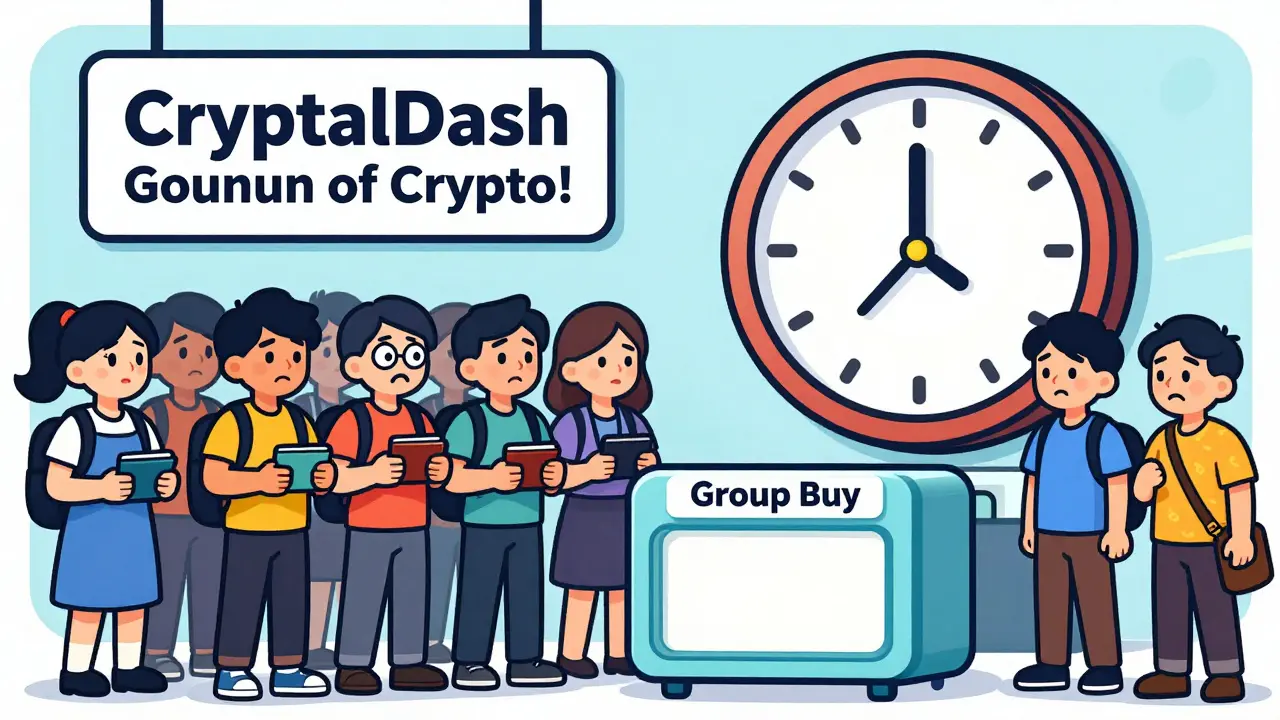
CryptalDash wasn’t another copycat exchange. It pitched itself as the "Groupon of crypto" - pooling small buyers together to get better prices. The idea was simple: if enough people bought Bitcoin or Ethereum at the same time, the exchange could negotiate bulk discounts from liquidity providers. You’d get a better rate than if you bought alone. Sounds smart, right? But here’s the catch: no one ever clearly explained how it worked in practice. What was the minimum group size? How long did you wait? Did you actually save money? There were no case studies, no user breakdowns, no transparent data. Just a claim.
It supported Bitcoin, Ethereum, USDT, Dimecoin, and its own token - CryptalDash (CDASH). That’s a limited selection, even for 2020. Compared to Binance or Kraken, which offered hundreds of coins, CryptalDash felt like a niche player trying to carve out space with a gimmick instead of depth.
Fees: The One Thing That Actually Worked
If you judged CryptalDash by its fees alone, it looked impressive. It charged a flat 0.10% on every trade - whether you were making or taking liquidity. That was half the industry average at the time, which hovered around 0.25%. For comparison, Coinbase charged 0.5% back then. Even Kraken’s standard fee was 0.16% for takers. So yes, on paper, CryptalDash was cheaper.
Withdrawal fees were also low. Bitcoin withdrawals cost just 0.0005 BTC. Most exchanges charged 0.0008 BTC or more. That might not sound like much, but for frequent traders, it added up. If you moved Bitcoin weekly, you’d save nearly 15% on withdrawal fees over a year. That’s real value.
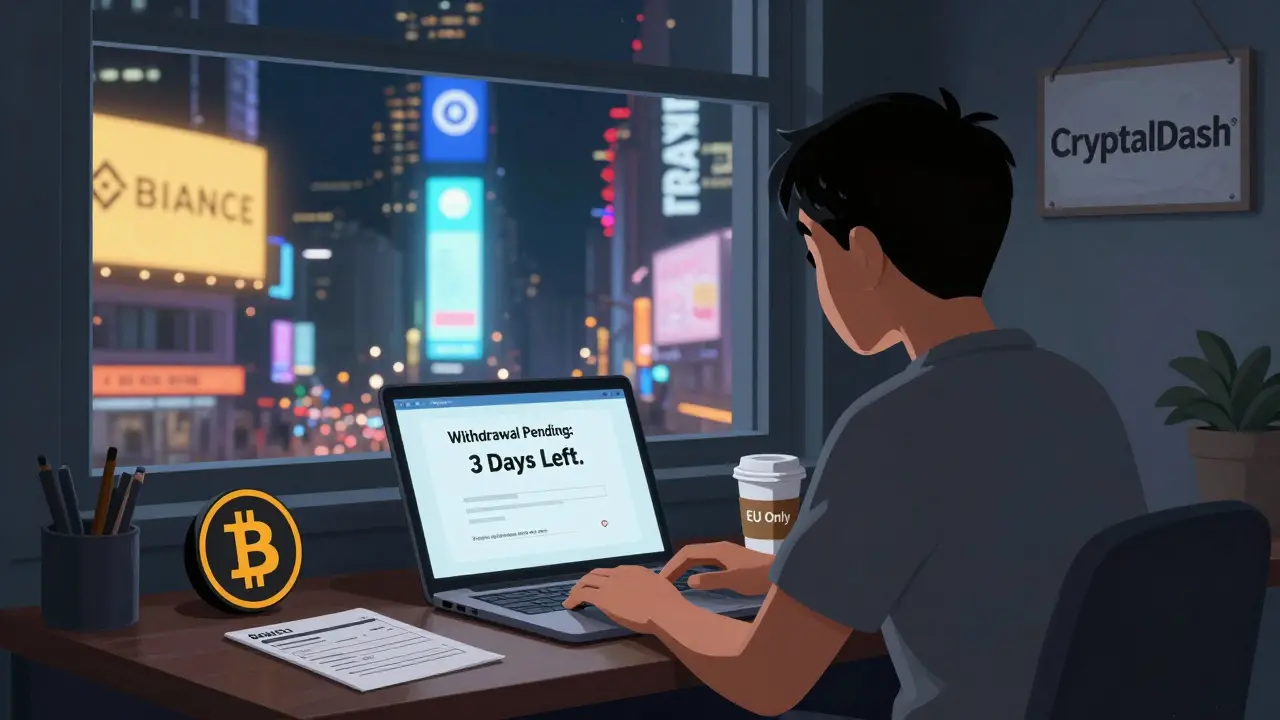
But here’s the problem: low fees don’t mean much if you can’t fund your account. CryptalDash accepted only bank wire transfers. No credit cards. No PayPal. No Apple Pay. Nothing instant. That’s a dealbreaker for most new users. In 2020, crypto adoption was booming, and new buyers wanted to buy with a card in under 60 seconds. CryptalDash forced them into banking delays - often 2 to 5 business days. That’s not just inconvenient. It kills momentum.
Why Did It Fail?
There’s no single reason CryptalDash died. But its failure tells a bigger story about crypto exchanges in that era.
First, the collective buying model was too vague. People didn’t trust it. How do you know you’re getting a real discount? Was it just a marketing tactic? Without transparency, users walked away. Trust is everything in crypto - especially for a platform asking you to wait for a group buy.
Second, there was zero community. You couldn’t find reviews. Forums didn’t talk about it. Reddit threads were empty. Only one user review existed on any comparison site - and it was a perfect 5.0. That’s not a sign of popularity. It’s a sign of near-zero adoption. If 10,000 people used it, you’d expect hundreds of reviews. You’d see complaints about slow withdrawals, bad customer service, or app crashes. Nothing. Just silence.
Third, it was Ukrainian. That meant it operated under EU regulations, which were tightening in 2020. While that’s not inherently bad, it also meant no U.S. users could access it easily. No licensing. No compliance roadmap. That’s risky in crypto. Exchanges that survived - like Binance and Coinbase - spent millions on legal teams. CryptalDash didn’t even have a public FAQ page.
What Happened to It?
On December 28, 2020, CryptalDash shut down. Not because of a hack. Not because of regulators. It voluntarily closed and rebranded to DLTify. No announcement. No fanfare. Just a silent transition.
DLTify was supposed to be the next chapter - a blockchain infrastructure company focused on enterprise solutions. No trading. No wallets. No retail users. The team pivoted away from the exchange model entirely. That tells you everything: they realized the collective buying idea didn’t scale. It was a proof of concept that never found its market.
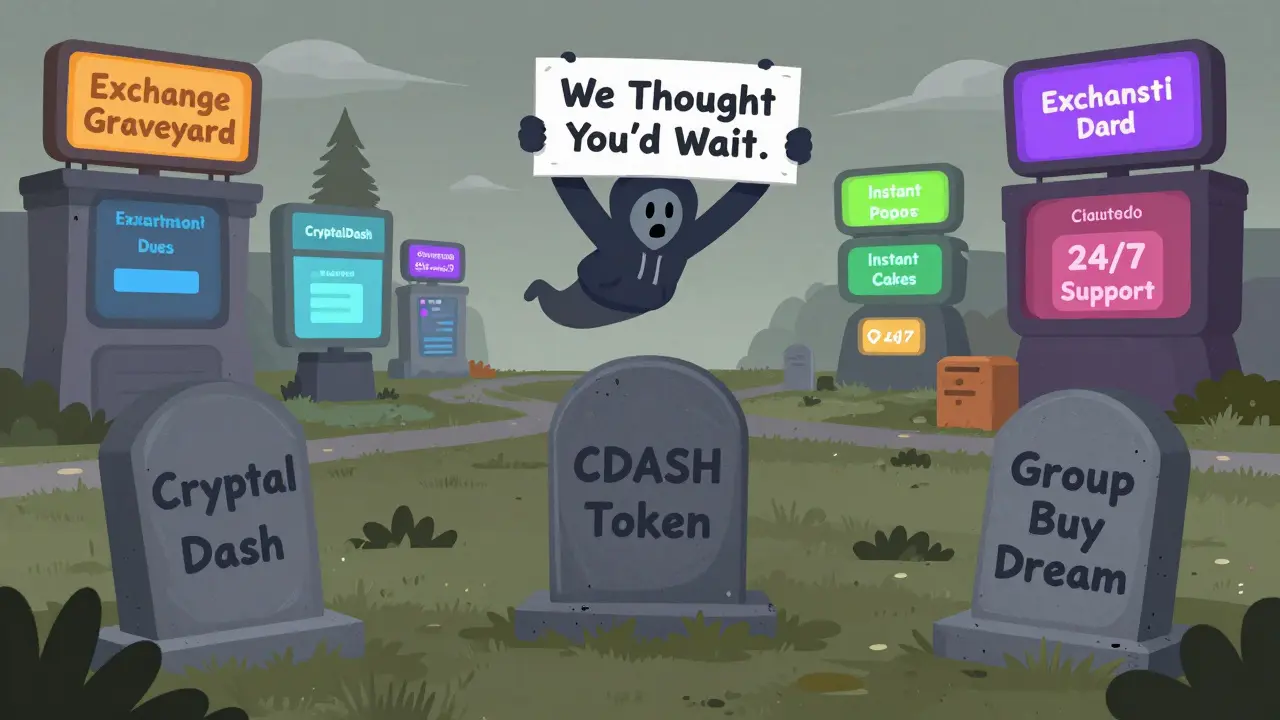
Today, CryptalDash’s website is gone. Its domain redirects to nothing. Its social media accounts are inactive. Its token, CDASH, is dead - no trading pairs, no liquidity. It’s in the "Exchange Graveyard," a category industry trackers use for platforms that vanished without a trace.
Who Should Have Used It?
If you were a tech-savvy trader in Europe, comfortable with wire transfers, and willing to wait days for a trade to execute - maybe CryptalDash was worth a look. Its low fees made sense for high-volume traders who didn’t mind the friction.
But if you were new to crypto? If you wanted to buy Bitcoin with a credit card and start trading immediately? Then it was never for you. The platform didn’t just lack features - it lacked understanding of its audience.
What’s the Lesson?
CryptalDash’s story isn’t about bad technology. It’s about bad timing and bad assumptions. The crypto market in 2020 was exploding - but only for exchanges that made things simple. Coinbase made buying easy. Binance made trading deep. Kraken made compliance clear. CryptalDash tried to be clever, not convenient.
It’s easy to look back and say, "Why didn’t they just add credit cards?" But the deeper issue was this: they didn’t listen. They assumed users would care more about bulk discounts than speed, security, or ease of use. They were wrong.
Today, you’ll find dozens of exchanges with 0.10% fees or lower. Many offer instant buys, 24/7 support, and mobile apps. You don’t need to wait for a group to form. You don’t need to hope for a discount. You just click, buy, and go.
CryptalDash tried to innovate. But innovation without user empathy doesn’t last. It’s a lesson written in digital dust.
Is CryptalDash still operating as a crypto exchange?
No. CryptalDash ceased all trading operations on December 28, 2020. Its platform was shut down and rebranded into DLTify, which now focuses on blockchain infrastructure for businesses - not retail crypto trading. The CryptalDash website and app are no longer accessible.
Can I still trade or withdraw my CryptalDash (CDASH) tokens?
No. CDASH tokens are no longer listed on any active exchange. Liquidity pools were dissolved after the shutdown, and there are no trading pairs available. Even if you still hold CDASH in a wallet, it has no market value or utility today.
Why did CryptalDash have such low trading fees?
CryptalDash used a flat 0.10% fee to stand out in a market where most exchanges charged 0.25% or more. The idea was to attract volume by undercutting competitors. But without enough users, the model didn’t generate enough revenue to cover costs. Low fees alone can’t sustain an exchange - you need volume, security, and trust.
Was CryptalDash safe to use?
There’s no public evidence of hacks or fraud. But safety isn’t just about being hacked - it’s about stability. With no clear regulatory status, limited user base, and no transparency around fund storage, users had no way to verify security practices. Most experts advise against using any exchange without public audits, insurance, or clear jurisdiction.
What are some good alternatives to CryptalDash today?
For low fees and wide coin selection, Binance and Bybit offer 0.10% or lower trading fees with instant deposits via card or bank transfer. Kraken is strong for U.S. users with solid compliance. For beginners, Coinbase’s simple interface and instant buy feature make it the easiest option. All three have millions of active users, 24/7 support, and transparent security audits - things CryptalDash never delivered.
