
- 14 Dec 2025
- Elara Crowthorne
- 14
Crypto Exchange Comparison Tool
Choose the Best Exchange for You
Compare the 6 international exchanges still accepting Russian citizens in 2025 based on your specific needs.
Important Note: The Russian Central Bank's "highly qualified investor" requirements (100M+ rubles or 50M+ annual income) mean only a small percentage of Russians can trade on licensed domestic platforms. This tool helps you find the best international options.
Comparison Features
Exchange Comparison
| Exchange | Language Support | RUB Deposits | Trading Fees | Staking | Copy Trading | Derivatives | A7A5 Support |
|---|---|---|---|---|---|---|---|
| Bybit | Yes | Bank transfer Card payments |
0.1% | Yes | Yes | No | Yes |
| Gate.io | No | Bank transfer Card payments |
0.2% | Yes | No | No | Yes |
| KuCoin | No | Third-party processors | 0.15% | Yes | No | No | Yes |
| MEXC | No | Bank transfer P2P |
0.2% | Yes | No | No | Yes |
| Bitget | Yes | Bank transfer Card payments |
0.1% | Yes | Yes | No | Yes |
| Phemex | No | Bank transfer | 0.1% | No | No | Yes | Yes |
How to Choose the Right Exchange
For Beginners
Bybit is recommended for beginners due to Russian language support, straightforward UI, and low trading fees of 0.1%. It's the closest thing to a local exchange.
For Altcoin Traders
Gate.io has over 3,600 cryptocurrencies, making it ideal for trading obscure altcoins. It's particularly useful for A7A5 trading pairs.
For Passive Income
MEXC offers the highest staking rewards with some tokens providing over 600% APY, though these are extremely risky investments.
For Active Traders
Phemex is best for futures trading with up to 125x leverage on Bitcoin and Ethereum, making it ideal for experienced traders.
Important Reminder
Remember that A7A5 is the ruble-backed stablecoin designed to bypass Western sanctions. It's the backbone of Russia's crypto economy, with over $68 billion in transactions since 2023. All exchanges listed support A7A5 trading pairs.
When you're in Russia and want to buy or trade cryptocurrency, you're not blocked by law-but you're blocked by reality. The Russian government doesn't outlaw owning crypto. But it makes it incredibly hard to use it legally. Banks won’t process crypto deposits. Major global exchanges like Coinbase and Binance have cut off Russian users. And the few domestic platforms that once worked have been shut down or sanctioned. So where can Russian citizens actually trade crypto in 2025? The answer isn’t simple, but it’s not impossible either.
Why Russian Crypto Access Is So Restricted
The Central Bank of Russia (CBR) doesn’t allow cryptocurrency as payment. That’s clear. But the bigger barrier isn’t about spending-it’s about access. In March 2025, Russia rolled out its "experimental legal regime" (ELR), which only lets "highly qualified investors" trade crypto on licensed platforms. To qualify, you need either:- Over 100 million rubles ($1.2 million) in securities or bank deposits, or
- An annual income of more than 50 million rubles ($600,000)
The Ministry of Finance has hinted they might lower these thresholds in 2026. But for now, the system is designed to keep crypto trading out of reach for ordinary Russians. That’s why most people turn to international exchanges that still accept RUB deposits-and why stablecoins like A7A5 have exploded in use.
6 Crypto Exchanges That Still Accept Russian Citizens
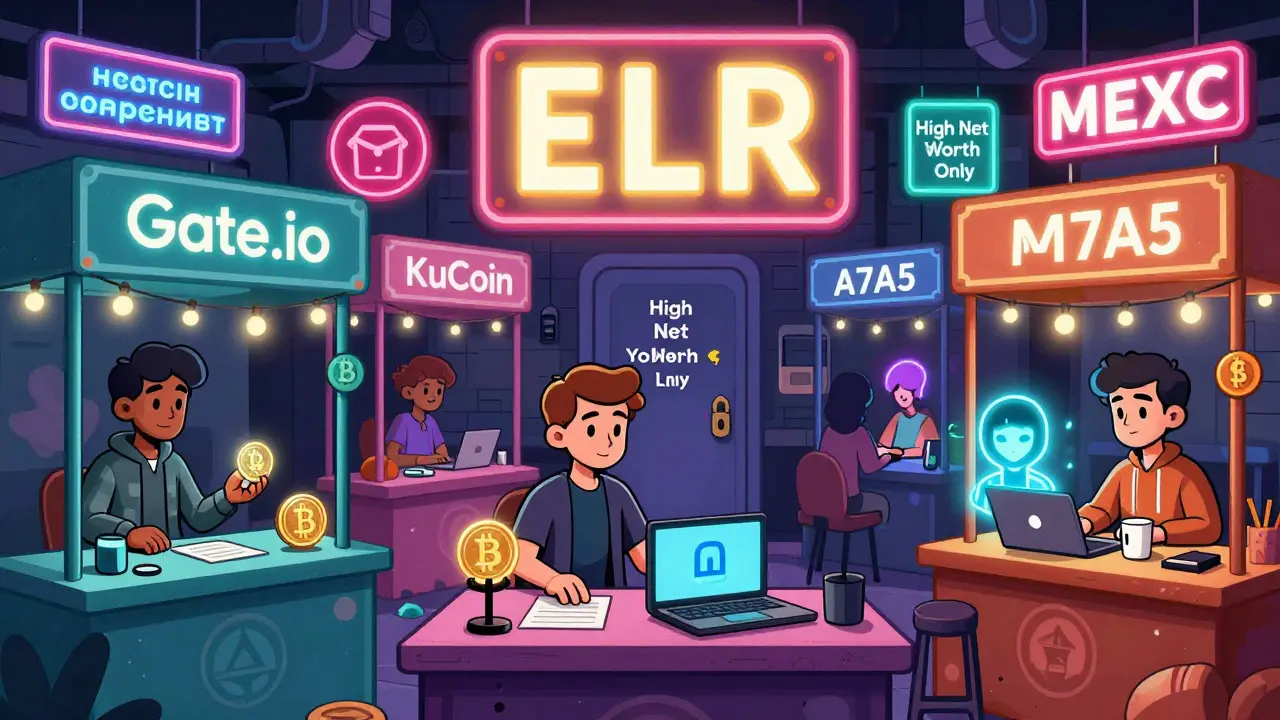
As of December 2025, six international exchanges remain accessible to Russian users. They’re not officially endorsed by Russia, but they don’t block RUB deposits or Russian IP addresses. Here’s who’s still working-and why.1. Bybit - Best Overall for Russian Users
Bybit is the top choice for Russian traders in 2025. It’s the only major exchange that offers full Russian language support, including customer service. You can deposit RUB directly via bank transfer, Sberbank, Tinkoff, or debit/credit cards. Trading fees are just 0.1% for spot trades. You get access to over 2,000 cryptocurrencies, futures contracts, staking, and even copy trading where you mirror the moves of top performers.Unlike other platforms, Bybit actively markets to Russian users. Their app has Russian UI, localized promotions, and even RUB-denominated staking rewards. It’s the closest thing to a local exchange left.
2. Gate.io - Most Crypto Options
If you want to trade obscure altcoins or memecoins, Gate.io is your best bet. It offers over 3,600 cryptocurrencies-more than any other exchange globally. That includes tokens you won’t find on Binance or Kraken. RUB deposits work via bank transfer and card payments. The platform doesn’t have Russian support built in, but the interface is simple enough to navigate without it.Gate.io also supports A7A5 trading pairs, making it a key bridge between the ruble-backed stablecoin and global markets.
3. KuCoin - Best for Memecoins and Altcoins
KuCoin has become the go-to for Russian traders chasing high-risk, high-reward tokens. It’s especially popular for trading new memecoins like Dogecoin variants and Shiba Inu clones. The platform allows RUB deposits through third-party payment processors. While it doesn’t have Russian language support, its mobile app is intuitive and fast.KuCoin also lists A7A5 on both Ethereum and TRON chains, letting users convert between stablecoins and crypto without leaving the platform.
4. MEXC - Highest Staking Rewards
MEXC is where Russian investors go when they want to earn serious passive income. On certain tokens, staking APYs exceed 600%. That’s not a typo. Some assets offer 600%+ annual returns. Of course, these are ultra-risky tokens-often new or low-liquidity. But for traders who understand the risk, MEXC is unmatched.RUB deposits are accepted via bank transfer and P2P. MEXC also supports A7A5 trading and has partnered with Russian-speaking influencers to promote its platform locally.
5. Bitget - Best for Copy Trading
Bitget has surged in popularity because of its copy trading feature. You can follow top Russian traders and automatically replicate their buys and sells. This is huge for people who don’t have time to analyze charts or don’t trust their own decisions.Bitget accepts RUB via cards and bank transfers. It also offers crypto loans in RUB and has a dedicated Russian support team. The platform is especially popular among younger traders under 35.
6. Phemex - Best for Derivatives
If you’re trading futures, leverage, or options, Phemex is your only real option. It supports up to 125x leverage on Bitcoin and Ethereum. RUB deposits are accepted, and the platform has Russian-language tutorials on its YouTube channel.Phemex doesn’t offer staking or copy trading, but its low fees and deep order books make it ideal for active traders. It’s also one of the few exchanges that still allows Russian users to open margin accounts.
The Rise of A7A5 - Russia’s Secret Crypto Weapon
While global exchanges are the main access point, there’s another layer: A7A5. This isn’t just another stablecoin. It’s a ruble-backed digital currency built to bypass Western sanctions.Each A7A5 token is backed 1:1 by Russian rubles held in Promsvyazbank (PSB) accounts. The backing is managed by Old Vector LLC, a Kyrgyz company. Unlike USDT or USDC, A7A5 can’t be frozen by U.S. authorities. That’s why it’s become the backbone of Russian crypto trade.
As of 2025:
- 41.6 billion A7A5 tokens are in circulation ($496 million)
- Total transaction volume since launch: $68 billion
- Trading is almost entirely Monday-Friday, matching Russian business hours
This pattern proves it’s not used by random retail traders. It’s used by businesses-importers, exporters, freelancers-who need to move money across borders without SWIFT. A7A5 trades on Bybit, Gate.io, KuCoin, and MEXC. It’s the hidden glue holding Russia’s crypto economy together.
What About Garantex and Bitpapa?
Garantex was Russia’s largest local exchange until March 2025, when the U.S. Secret Service shut it down. It was accused of laundering money for the Hydra darknet market. Its users didn’t disappear-they moved to Grinex, a new platform registered in Kyrgyzstan. Grinex now handles most of Garantex’s former traffic.Bitpapa is a peer-to-peer (P2P) marketplace. It’s not an exchange-it’s a classified ad board for crypto. You can buy Bitcoin or USDT directly from Russian sellers using Sberbank or Tinkoff. Bitpapa was sanctioned by OFAC in 2024 for facilitating payments to Garantex and Hydra. But it’s still widely used because it’s easy and fast.
Meer, another Kyrgyz-based platform, launched alongside A7A5 and now supports direct RUB-to-A7A5 swaps. It’s smaller but growing fast.
What You Can’t Do in Russia (And Why)
Even if you use these platforms, you’re still restricted:- You can’t use crypto to pay for goods or services in Russia. It’s illegal.
- You must declare all crypto holdings to the tax authorities. Failure to do so can lead to fines.
- Your bank can monitor your transactions. If you send large sums to crypto exchanges, they may freeze your account.
- You can’t use Western payment processors like PayPal or Stripe to buy crypto.
The Russian government doesn’t want you to avoid sanctions. It wants you to use crypto-but only in ways that serve state interests. That’s why A7A5 is encouraged. That’s why personal trading is ignored. And that’s why the elite get to trade, while everyone else works around the system.

How to Get Started in 2025
If you’re a Russian citizen looking to trade crypto, here’s how to do it safely:- Choose one of the six exchanges listed above (Bybit is recommended for beginners).
- Verify your identity with a Russian passport or ID. Most platforms accept these.
- Deposit RUB via bank transfer, card, or P2P (Bitpapa).
- Trade on spot markets or use staking to earn passive income.
- If you want to move money internationally, convert part of your holdings to A7A5.
- Keep records of all transactions for tax purposes.
Don’t use VPNs to access blocked platforms like Binance. They’re actively blocking Russian IPs now. Stick to the exchanges that openly accept RUB.
What’s Next for Russian Crypto?
The Ministry of Finance is considering lowering the "highly qualified investor" threshold. If they cut it in half, millions of new traders could enter the market. But that would also attract more scrutiny from the U.S. and EU.Meanwhile, A7A5 is expanding. It’s now supported by Elliptic, a major compliance tool used by banks worldwide. That means A7A5 is becoming more visible-not less. It’s no longer just a loophole. It’s becoming a system.
For now, Russian crypto users are stuck in a gray zone. They’re not breaking the law-they’re working around it. And as long as sanctions stay in place, they’ll keep finding ways to trade, earn, and move value outside the system.
Can Russian citizens legally buy cryptocurrency in 2025?
Yes, Russian citizens can legally own and trade cryptocurrency-but only on certain international exchanges that accept RUB deposits. Domestic exchanges are banned, and the government only allows high-net-worth individuals to trade on licensed platforms. For most people, using offshore exchanges like Bybit or Gate.io is the only practical option.
Can I use Binance or Coinbase if I’m in Russia?
No. Both Binance and Coinbase blocked Russian users in 2022 and have not reopened access. Even with a VPN, these platforms actively detect and ban Russian IP addresses. Attempting to bypass this can lead to account freezes or permanent bans.
What is A7A5, and why is it important for Russian traders?
A7A5 is a ruble-backed stablecoin issued by the Russian company A7. Each token is backed 1:1 by rubles held in Promsvyazbank accounts. Unlike USDT, it can’t be frozen by Western authorities. It’s used by businesses to move money internationally and is traded on Bybit, Gate.io, KuCoin, and MEXC. Over $68 billion has been transacted in A7A5 since 2023.
How do I deposit RUB into a crypto exchange?
You can deposit RUB via bank transfer, debit/credit card, or P2P trading. Bybit, Gate.io, and Bitget accept direct RUB deposits from Sberbank and Tinkoff. For others, use Bitpapa to buy crypto with RUB from individual sellers, then transfer it to your exchange account.
Are Russian crypto exchanges safe?
Domestic exchanges like Garantex were shut down due to sanctions and money laundering concerns. International exchanges like Bybit and KuCoin are more secure, with better security protocols and insurance. However, since they operate outside Russia, there’s no legal protection if something goes wrong. Always use two-factor authentication and never store large amounts on exchanges.
Will Russia ever allow free crypto trading again?
Possibly-but only under strict state control. The Ministry of Finance is reviewing the "highly qualified investor" rules. If thresholds are lowered, more Russians could access licensed platforms. But full freedom is unlikely. The government wants to control crypto-not eliminate it. Expect more state-backed stablecoins and regulated exchanges, not open markets.


14 Comments