

- 6 May 2026
- Elara Crowthorne
- 13
Have you ever stared at a wallet screen, watching your transaction sit in "pending" while the suggested fee jumps from $2 to $50 in minutes? You aren't just paying for speed; you are participating in a high-stakes auction. This is the fee market, the invisible economic engine that decides whose data gets written into history and whose waits.
In blockchain networks, space inside each block is scarce. Blocks have size limits and arrive on fixed schedules. When thousands of people try to move money or deploy code simultaneously, they compete for that limited space. The fee market is the mechanism that sorts this competition. It ensures the network doesn't crash under spam and rewards the validators who keep the lights on. But as these systems grow more complex, the way we pay-and why we pay-is changing faster than most users realize.
The Basic Economics of Block Space
To understand fees, you first need to accept one hard truth: blockchains are bottlenecked by design. Bitcoin, for instance, produces a new block roughly every ten minutes. Each block can only hold about 1 megabyte of data. If demand exceeds that supply, someone has to lose out. The fee market solves this allocation problem using basic supply and demand principles.
When the network is quiet, plenty of block space sits empty. Validators pick up transactions with low fees because it costs them nothing extra to include them. But when demand spikes-say, during a popular NFT mint or a market panic-the mempool (the waiting area for unconfirmed transactions) fills up. Validators then act like rational merchants: they prioritize the transactions that pay the most per byte of data.
This creates a self-regulating system. High prices discourage non-urgent transactions, clearing the backlog for those willing to pay a premium. Low prices encourage usage when the network is idle. It’s similar to surge pricing on ride-sharing apps, but instead of cars, you’re bidding for digital immortality on a global ledger.
Bitcoin: The First-Price Auction
Bitcoin uses the oldest and simplest model: the first-price auction. In this system, you set your own fee, and miners select the highest bids. There is no base fee that burns away; every satoshi you pay goes directly to the miner who includes your transaction.
This simplicity comes with volatility. Because there is no automated adjustment mechanism, fees can swing wildly based on sudden changes in demand. For years, this wasn’t a huge issue. Bitcoin was primarily used for value transfer. But everything changed in early 2023 with the rise of Ordinals and BRC-20 tokens.
Ordinals allow users to inscribe unique data, like images or text, directly onto satoshis within Bitcoin blocks. Suddenly, artists and speculators were competing with everyday users for block space. An inscription might use nearly the entire capacity of a block, pushing regular payment transactions to the sidelines. Fees spiked dramatically, often exceeding $5 or even $10 per transaction during peak periods. This event proved that fee markets are not static; they react violently to new use cases that consume resources differently.
Users learned to use features like Replace-by-Fee (RBF), which allows them to bump up their bid if their transaction gets stuck. But the experience remains stressful. You either guess right and pay fair value, or you overpay significantly because you couldn’t wait.
Ethereum: The EIP-1559 Revolution
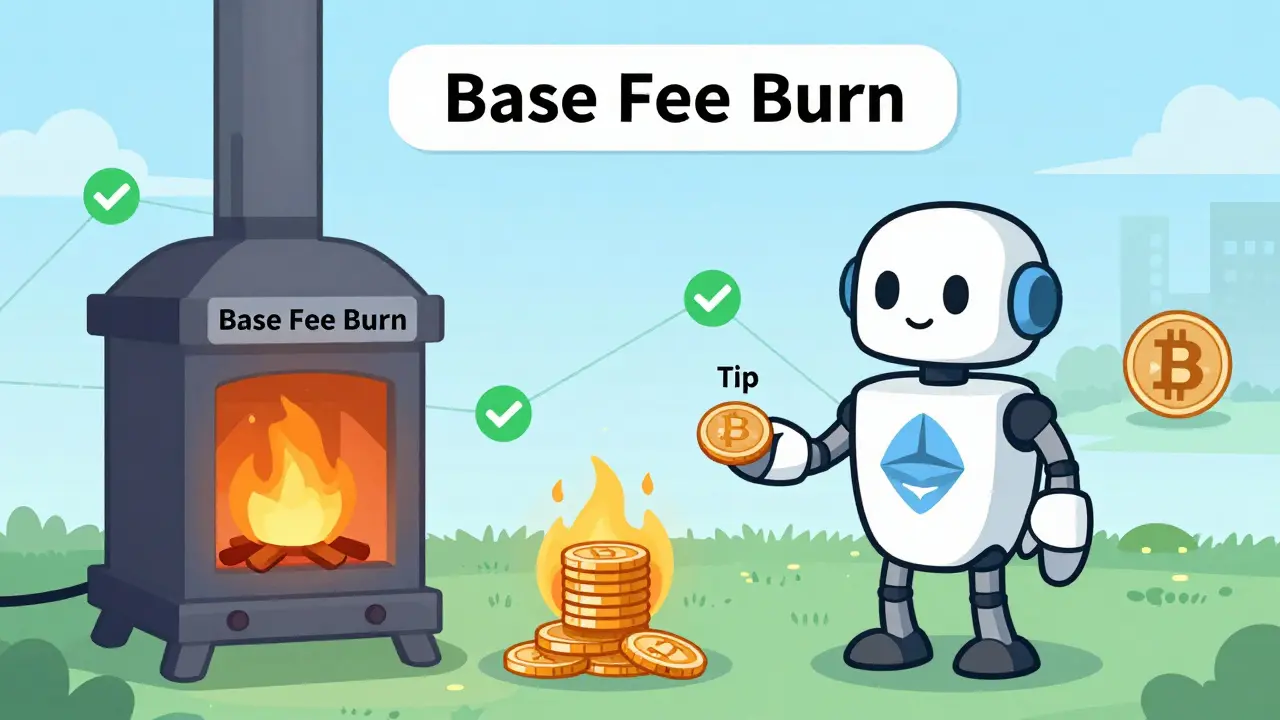
Ethereum recognized the flaws in the first-price auction and introduced EIP-1559 in August 2021. This upgrade fundamentally changed how fees work. Instead of a single bid, Ethereum now splits the fee into two parts: the base fee and the priority fee (or tip).
The base fee is determined by the protocol itself. If a block is full, the base fee for the next block increases by up to 12.5%. If the block is half-empty, the base fee decreases. Crucially, this base fee is burned-destroyed forever. It does not go to validators. This makes Ethereum deflationary during busy times and provides price stability for users. You know exactly what the minimum cost will be before you send your transaction.
The priority fee, however, still goes to the validator. This is your bribe to get picked up quickly among other transactions paying the same base fee. During normal conditions, the priority fee is negligible. But during extreme congestion, users may add larger tips to ensure inclusion.
This hybrid model reduces anxiety. Wallets can predict fees accurately hours in advance. However, it introduces complexity. Users must understand that part of their payment vanishes into thin air (the burn) while the rest incentivizes security (the tip). For many, this feels less transparent than Bitcoin’s straightforward "you pay, miner keeps" model.
Fixed Fees and High Throughput Models
Not all blockchains rely on auctions. Solana and Polygon take a different approach. Solana charges a flat fee of 0.000005 SOL per transaction, regardless of network congestion. Polygon, as a Layer 2 sidechain, also maintains very low, relatively stable fees around $0.001 USD.
Why can they do this? Capacity. Solana aims for thousands of transactions per second (TPS). Because its throughput is so high, block space rarely becomes scarce. There is always room for another transaction, so there is no need to auction off slots. This results in a predictable user experience but raises questions about long-term sustainability. If demand eventually outstrips supply, these networks will face a crisis unless they raise fees or scale further.
| Network | Fee Model | Average Cost (USD) | Key Characteristic |
|---|---|---|---|
| Bitcoin | First-Price Auction | $1 - $10+ | Highly volatile, miner-centric |
| Ethereum | Base Fee + Tip (EIP-1559) | $2 - $15 | Predictable base, deflationary burn |
| Solana | Fixed Fee | < $0.01 | High throughput, no congestion pricing |
| Polygon | Low Fixed/Dynamic | ~$0.001 | Layer 2 scalability focus |
The Rise of Multidimensional Fee Markets
Traditional fee models treat all resources as equal. They charge you for "gas" or "bytes," assuming computation, storage, and bandwidth are interchangeable. But they aren’t. A transaction that requires heavy calculation might clog the CPU without using much memory. Another might store large data blobs without taxing the processor.
This mismatch leads to inefficiency. To protect the weakest resource, networks must limit overall usage conservatively. Enter multidimensional fee markets. These advanced systems price transactions along multiple axes: computation, storage, bandwidth, and even application-specific constraints.
EIP-4844, implemented on Ethereum, is a prime example. It introduced "blob gas," a separate resource type specifically for temporary data storage used by Layer 2 rollups. By pricing blob space separately from standard computation, Ethereum allows Layer 2s to post large amounts of data cheaply without congesting the main execution layer. This is a form of multi-asset pricing that improves efficiency and lowers costs for end-users.
Research suggests these multidimensional approaches are theoretically optimal. They maximize social welfare by aligning prices with true resource scarcity. However, they come with trade-offs. Implementing them requires more complex software, slower adjustments, and greater computational overhead. For now, only the most sophisticated networks are adopting these nuanced models.

Challenges and User Friction
Despite these advancements, fee markets remain a major barrier to adoption. The primary complaint is unpredictability. A user trying to send $5 worth of crypto shouldn’t need a degree in economics to calculate the optimal fee rate. Yet, that is often the reality.
High fees also create centralization risks. When transactions cost $50, only wealthy users or large institutions can afford to use the network. Small holders are priced out, effectively losing their voice in governance or their ability to transact freely. This contradicts the decentralized ethos of blockchain technology.
Complexity is another hurdle. Terms like "gwei," "sat/vB," "base fee," and "tip" confuse newcomers. Wallet interfaces help by suggesting "slow," "medium," and "fast" speeds, but these labels are often arbitrary estimates that can fail during unexpected congestion events.
Future Trends: Layer 2s and Dynamic Economies
The future of fee markets lies in abstraction. Most users won’t interact with Layer 1 fee dynamics directly. Instead, they will use Layer 2 solutions like Arbitrum, Optimism, or zkSync. These networks batch thousands of transactions together and settle them on the main chain once. This drastically reduces the cost per transaction.
As Layer 2s mature, they will develop their own fee markets. Some may adopt dynamic pricing similar to Ethereum, while others might stick to fixed models. The key trend is interoperability. Users will expect seamless movement between chains without manually adjusting fees for each network’s quirks.
We may also see the rise of automated fee optimization tools. AI-driven wallets could analyze real-time mempool data across multiple chains and automatically route transactions through the cheapest path, negotiating tips and base fees behind the scenes. For the average user, fees would simply disappear as a conscious decision point.
What causes blockchain fees to spike?
Fees spike when demand for block space exceeds supply. This happens during high-traffic events like NFT launches, token sales, or market volatility. Since blocks have size limits, users compete by offering higher fees to validators, driving prices up.
Why does Ethereum burn the base fee?
Ethereum burns the base fee to make the network deflationary and stabilize prices. By removing ETH from circulation during busy times, it creates scarcity. This also prevents validators from manipulating fees, as they only receive the optional priority tip.
Are Bitcoin fees going to stay high?
Bitcoin fees fluctuate based on usage. With the introduction of Ordinals and BRC-20 tokens, demand for block space increased, leading to higher average fees. While fees drop during quiet periods, the baseline has risen due to diverse use cases competing for space.
What is a multidimensional fee market?
A multidimensional fee market prices transactions based on multiple resources like computation, storage, and bandwidth separately. This allows for more efficient resource allocation compared to traditional models that use a single generic unit like gas.
How do Layer 2 solutions reduce fees?
Layer 2 solutions process transactions off the main chain and bundle them into a single settlement transaction. This drastically reduces the amount of data stored on Layer 1, lowering costs for individual users while maintaining security.

13 Comments
I really appreciate how this breaks down the difference between Bitcoin and Ethereum fees. It's easy to get overwhelmed by all the jargon like 'gwei' or 'sat/vB', but explaining it as an auction makes so much sense. I've definitely felt that anxiety when sending a transaction during a busy time.
Everyone keeps praising EIP-1559, but let's be real, burning the base fee is just a marketing gimmick to make ETH look deflationary. The priority fees still go wild and you end up paying more than you thought anyway. It's not simpler, it's just more confusing.
Great point about the complexity though! I think the issue isn't the mechanism itself but how wallets present it. If we could have better interfaces that abstract away the 'base vs tip' distinction for average users, adoption would skyrocket. We need inclusive design in crypto UX.
the notion that fixed fees are sustainable is fundamentally flawed because it ignores the economic reality of resource scarcity which inevitably leads to network congestion and subsequent degradation of service quality for all participants who fail to understand the inherent limitations of such simplistic models
you guys are overcomplicating this. solana works fine with fixed fees because they have enough capacity. bitcoin is slow and expensive because people want to hoard satoshis instead of using them. its a user error problem not a tech problem.
i feel you on the frustration. it's tough when you just want to send money and suddenly you're doing economics homework. hopefully layer 2s will fix this soon so we don't have to worry about these spikes anymore
This whole decentralized narrative is falling apart when only rich Americans can afford to transact. The rest of the world gets priced out while US investors profit from the volatility. It's a scam wrapped in technical jargon.
I wonder if the multidimensional fee markets mentioned here will actually solve the CPU bottleneck issue. It seems like a smart approach to price resources separately rather than lumping everything into gas. Do you think other chains will adopt this?
The blob gas implementation in EIP-4844 is a game changer for L2 rollups. By decoupling data availability from execution, we finally see efficient pricing for storage-heavy transactions. Most devs still don't grasp the nuance of multi-dimensional resource allocation.
Indian users know the pain of high fees :P But honestly, Polygon is saving us right now. Cheap and fast. Why complicate things when simple works? Keep it simple folks!
Bitcoin ordinals ruined the network for payments. That's just fact. Now regular transfers are impossible without paying absurd fees. The ecosystem collapsed into speculation and everyone knows it.
I tried to send some crypto last week and got stuck for hours. The wallet said 'medium' speed but it never confirmed. I ended up paying double later just to get it through. It's so stressful and I hate feeling like I'm being ripped off every time I use my wallet.
It is truly remarkable how blockchain technology evolves to meet market demands. The transition towards Layer 2 solutions offers hope for greater accessibility and reduced costs for everyday users worldwide. We must remain optimistic about these technological advancements.