
- 7 Feb 2026
- Elara Crowthorne
- 16
When the Financial Action Task Force (FATF) placed Iran on its blacklist in 2019, few predicted it would become the single biggest driver of cryptocurrency adoption in the world. But here we are in early 2026, and Iran’s 18.7 million crypto users-nearly half the adult population-are using Bitcoin and Ethereum not for speculation, but for survival. The FATF blacklist didn’t just limit access to global banking. It cut off Iran from SWIFT, froze correspondent banking relationships from 28 to just 3, and forced millions into a digital underground where crypto is now the only reliable way to send money, buy food, and pay for medicine. This isn’t a trend. It’s a necessity.
How the FATF Blacklist Works-and Why Iran Can’t Escape It
The FATF blacklist, officially called the ‘Call for Action,’ isn’t a suggestion. It’s a global shutdown order. When a country lands on it, every bank, exchange, and payment processor worldwide is required to treat any transaction linked to that country as high-risk. That means automatic freezes, mandatory reporting, and outright blocking. Iran has been on this list since October 2019, and as of October 2025, it’s still there-alongside North Korea-as one of only two countries under full FATF countermeasures.
Why? Because Iran never fully implemented the 12-point action plan it agreed to in 2016. Even after ratifying two international conventions in 2024 and 2025, FATF says it’s not enough. The agency doesn’t publicly explain why, but insiders say it’s about political leverage, not compliance. The result? Iranian banks can’t process international payments. Iranian businesses can’t receive foreign invoices. Iranian families can’t get paid from abroad. And that’s where crypto stepped in.
Iran’s Crypto Surge: $9.2 Billion in 2024 Alone
In 2024, Iran received $9.2 billion in cryptocurrency transactions-more than any other country on the FATF blacklist, and more than Russia despite Russia’s larger economy. That’s according to Chainalysis’ January 2025 report. Overall, sanctioned countries received $15.8 billion in crypto that year, and Iran made up over half of it. That’s a 22% jump from 2023.
This isn’t random. It’s systematic. Iranians aren’t buying Bitcoin because they think it’ll hit $100,000. They’re buying it because they need to move money out of the country. The data shows clear patterns: 78% of all crypto inflows to Iran are in Bitcoin. Ethereum makes up 14%. Privacy coins like Monero? Just 5%. Why? Because Bitcoin is the most recognizable, the most liquid, and the hardest for any single government to shut down.
On Iranian centralized exchanges like Nobitex and Wallex, transaction volume jumped 63% between January and December 2024. Monthly outflows went from $290 million to over $480 million. That’s not trading. That’s capital flight.
The Paradox: Compliance Increases Risk
Here’s the cruel twist: to send crypto internationally, Iranians need to use global exchanges like Binance or Bybit. But those platforms follow FATF’s Travel Rule, which requires them to collect and share personal data on every transaction over $1,000. So Iranians upload their ID, link their bank, and verify their phone number-only to have their accounts frozen later.
A September 2025 survey of 14,200 Iranian users on Nobitex found that 33% of those using global exchanges had their accounts frozen. One Reddit user, @TehranTrader, lost $8,200 after three small transfers under $1,500. Why? Because Binance’s system flagged the pattern-multiple small transactions from Iran-as ‘suspicious activity.’
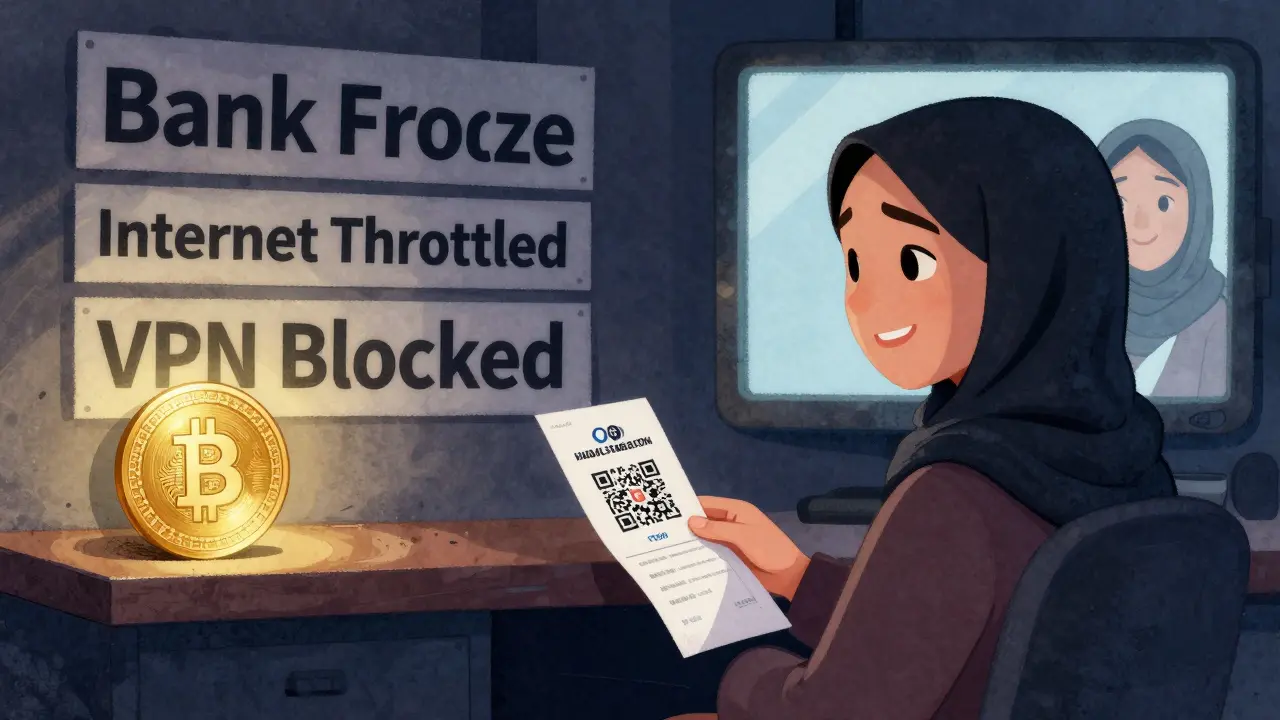
Meanwhile, Iranian authorities are watching too. The government requires SIM card registration for internet access. It monitors mobile apps. It blocks VPNs. So when you use Trust Wallet or Exodus to move crypto, you’re not just risking FATF detection-you’re risking arrest.
How Iranians Are Bypassing the Blockade
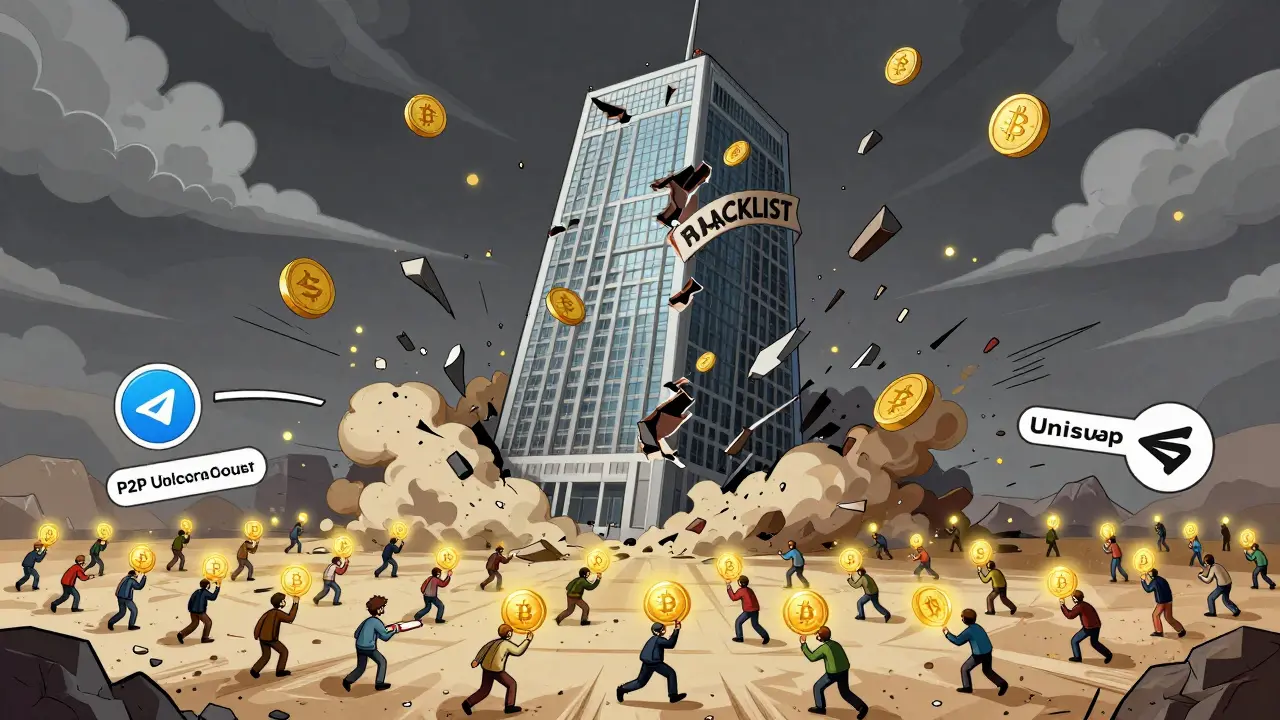
Most Iranians don’t use centralized exchanges anymore. They’ve moved to decentralized methods:
- Peer-to-peer (P2P) trading: Platforms like LocalBitcoins and Telegram-based groups let users trade directly. Success rate? 78%. But premiums? 22% on average. You pay more, but you keep control.
- Decentralized exchanges (DEXs): PancakeSwap and Uniswap are popular, but liquidity is thin. Slippage hits 15% on average. Still better than losing everything in a bank freeze.
- Atomic swaps: A few tech-savvy users are using multi-hop atomic swaps to move Bitcoin directly from Iran to Turkey or the UAE without any intermediary. One user on Bitpin reported moving 2.3 BTC to Turkey in 17 minutes-no KYC, no bank, no interference.
- Halal Stablecoin (HSC): In August 2025, Iran’s Central Bank launched a gold-backed stablecoin. Over 4 million users traded $280 million in its first month. But here’s the catch: it only works inside Iran. No global exchange accepts it. So it’s useful for domestic inflation protection, not international survival.
These methods aren’t perfect. They’re slow, expensive, and risky. But they’re the only options left.
The Human Cost: Frozen Accounts, Failed Transfers, and Lost Savings
Behind the numbers are real people. A July 2025 case documented by Iran’s Crypto Association showed 317 users losing $4.1 million when a UAE-based exchange called Rain suddenly froze all Iranian accounts after FATF’s June 2025 public statement. No warning. No explanation. Just silence.
Telegram channels like @IranCryptoAlert have 58,000 subscribers. Every day, users post: “Exchange down.” “Transaction failed.” “Wallet locked.” Peak hours-8 to 10 PM Tehran time-are the worst. The Central Bank throttles internet bandwidth to limit crypto traffic. Outages are routine.
And then there’s the psychological toll. Reddit’s r/CryptoIran has 12,400 members. In a May-September 2025 sentiment analysis, 68% of posts were negative-mostly about unreliable exchanges and frozen funds. But 82% said crypto was “the only viable option.” That’s not optimism. That’s resignation.
Infrastructure Challenges: SIM Cards, Firewalls, and Security Risks
Using crypto in Iran isn’t just about knowing how to send a transaction. It’s about surviving the system that tries to stop you.
- SIM card registration: You need a government-registered phone number to access the internet. That means every crypto user is tied to their real identity.
- Internet throttling: During peak hours, speeds drop to dial-up levels. This isn’t a technical glitch-it’s intentional.
- Anti-surveillance apps: 89% of users rely on apps like Soroush+ to bypass government firewalls. But 41% of these apps have been compromised, leaking private keys.
- Seed phrase management: 61% of new users need help storing their recovery phrases. Lose it? Lose everything. No customer service. No reset button.
GitHub repositories like ‘IranCryptoKit’ have 2,300 stars. They offer code to bypass national firewalls. But 37% of users who downloaded these tools reported security breaches. The community is helping-but it’s also dangerous.
What’s Next? A System on the Edge
FATF predicts Iran’s crypto adoption will hit 25 million users by 2027. Dr. Emad Kiyaei, a sanctions expert, warns that if the blacklist stays in place past Q2 2026, Iran’s crypto infrastructure could collapse. Why? Because liquidity is vanishing. Exchanges are pulling out. Iranian users can’t find reliable counterparties anymore. The system is becoming too fragmented to sustain.
Meanwhile, global regulators are tightening. In Q1 2025, Singapore suspended 17 exchanges for failing to screen Iranian users. The UAE saw a 212% increase in Iranian-linked accounts. The U.S. added 13 new cryptocurrency addresses to its OFAC sanctions list in September 2025-mostly Iranian crypto mixers.
The irony? The FATF’s goal was to stop illicit finance. Instead, it forced millions into a system where crypto is now the primary channel for humanitarian imports-food, medicine, even medical equipment. According to Dr. Reza Vafadari’s October 2025 testimony, 61% of Iran’s crypto transactions fund these essential goods.
So who’s really benefiting from this blacklist? Not the international financial system. Not the regulators. It’s the black market traders, the offshore exchanges, and the hackers who profit from the chaos.
Final Reality: Crypto Isn’t an Alternative-It’s the Only Option
If you’re an Iranian citizen today, you don’t have a choice. Your bank account is useless. Your salary is worth less every month. Your access to the global economy? Gone. Crypto isn’t a luxury. It’s oxygen.
People aren’t using it to get rich. They’re using it to survive. And until FATF rethinks its approach-until it sees that punishing a nation’s people doesn’t stop their government, it only pushes them further into the shadows-this cycle will keep growing. The blacklist didn’t stop crypto in Iran. It built it.
Why is Iran still on the FATF blacklist?
Iran remains on the FATF blacklist because it hasn’t fully implemented all 12 items of its 2016 action plan. While Iran ratified two international conventions in 2024 and 2025, FATF says these don’t meet the full requirements for removing countermeasures. FATF hasn’t publicly detailed which specific gaps remain, but experts believe political factors play a role. As of October 2025, Iran is still listed alongside North Korea as one of only two jurisdictions under full FATF ‘Call for Action’ status.
How much crypto did Iran receive in 2024?
Iran received $9.2 billion in cryptocurrency transactions in 2024, according to Chainalysis’ Crypto Crime Report (January 2025). This accounted for 58% of all crypto received by sanctioned jurisdictions worldwide that year, which totaled $15.8 billion. Iran’s volume surpassed Russia’s $4.1 billion despite Russia’s larger economy, making it the top crypto recipient among sanctioned nations.
What percentage of Iranians use cryptocurrency?
As of October 2025, Statista estimates that 18.7 million Iranians-42% of the adult population-use cryptocurrency. This number has grown steadily since 2019, driven by banking isolation, inflation, and the collapse of international payment channels. The majority use Bitcoin and Ethereum to send and receive money, pay for imports, and protect savings from currency devaluation.
Can Iranians use Binance or other global exchanges?
Yes, but with extreme risk. Global exchanges like Binance and Bybit technically allow Iranian users to sign up, but they are required by FATF’s Travel Rule to monitor and report transactions. As a result, 33% of Iranian users report having their accounts frozen without warning. Exchanges also block Iranian IP addresses with 99.8% accuracy. Many users rely on VPNs, but this increases surveillance risk from Iranian authorities. Account freezes, KYC mismatches, and sudden policy changes make using global exchanges unreliable and dangerous.
What’s the Halal Stablecoin, and does it help Iranians?
The Halal Stablecoin (HSC) is a gold-backed digital currency launched by Iran’s Central Bank in August 2025. Over 4.2 million users transacted $280 million in its first month, primarily to hedge against inflation. However, it operates only within Iran’s domestic network. No global exchange accepts it, and FATF restrictions prevent it from connecting to international liquidity pools. So while it helps with local price stability, it doesn’t solve the core problem: accessing global markets.
Is crypto in Iran used for illegal purposes?
While Chainalysis classifies Iran as a top source of illicit crypto activity, most transactions are not criminal. Dr. Reza Vafadari’s 2025 analysis found that 61% of crypto flows in Iran fund humanitarian imports like medicine and food. Only 17% are linked to sanctions evasion for restricted goods. The rest are personal remittances, savings protection, and small business payments. The label ‘illicit’ is misleading-it’s often a reflection of sanctions, not criminal intent.

16 Comments
Also, 61% of transactions are for medicine? Yeah. That’s the real story. Not ‘illicit finance.’ Humanitarian lifeline.
Also, ‘Halal Stablecoin’? That’s not a currency. That’s a PR stunt with gold backing and zero global liquidity. Cute.