

- 5 Mar 2026
- Elara Crowthorne
- 16
China doesn't just restrict cryptocurrency mining-it criminalizes it. As of May 31, 2025, any form of crypto mining, trading, or even holding digital assets is illegal under Chinese law. This isn't a gray area. It's a full shutdown. If you're caught running a mining rig in your basement, garage, or data center, you could face fines, asset seizure, or even arrest. The government doesn't just shut down operations-it goes after the people behind them.
How China Got Here: A Timeline of the Ban
It didn't happen overnight. China's war on crypto mining started in 2013, when banks were told not to process Bitcoin transactions. That was just the beginning. In 2017, the government banned Initial Coin Offerings (ICOs) and shut down all domestic crypto exchanges. By 2019, mining farms were being raided across provinces like Xinjiang and Inner Mongolia. The real turning point came in 2021, when the People's Bank of China declared all cryptocurrency transactions illegal and ordered a nationwide shutdown of mining operations. That move alone knocked China off the top spot as the world's largest mining hub. But the crackdown didn't stop there. In 2022, courts refused to recognize crypto-related financial claims in civil lawsuits. In 2023, blockchain tech was allowed-but only if it was controlled by the state. By 2024, authorities were making arrests and seizing mining equipment, servers, and even bank accounts tied to crypto activity. Then, on May 31, 2025, everything changed. The government announced a comprehensive ban-not just on mining, but on owning, trading, or using any cryptocurrency. This wasn't a policy tweak. It was the final nail in the coffin.Why China Banned Crypto Mining
The reasons aren't mysterious. They're clearly laid out by government officials and policy documents. Four main concerns drove the ban:- Energy use: Bitcoin mining alone consumed more electricity than entire countries like Argentina or the Netherlands. That clashed with China’s 2060 carbon neutrality goal. Power grids in provinces like Inner Mongolia and Sichuan were strained during peak mining seasons.
- Financial control: Cryptocurrencies operate outside the banking system. The government doesn’t like that. It wants to control every yuan that moves through the economy. Crypto bypasses capital controls and makes it harder to track money.
- Illegal activity: Crypto has been used for money laundering, tax evasion, and moving funds out of China illegally. Authorities found cases where miners used crypto to transfer billions in capital abroad.
- Digital yuan (e-CNY): This is the big one. China has spent billions developing its own central bank digital currency. It’s not just a tech project-it’s a geopolitical tool. Allowing decentralized coins like Bitcoin or Ethereum would undermine the digital yuan’s adoption and authority.
How the Ban Is Enforced
You can’t just hide a mining rig under a blanket and expect to get away with it. China uses a multi-agency system to catch violators:- Electricity monitoring: Power companies track unusual spikes in consumption. A home that suddenly uses 15,000 kWh per month? That’s not a gaming PC. That’s mining. Authorities get alerts and send inspectors.
- Banking checks: Banks are required to flag any transactions linked to crypto exchanges or mining pools. If you deposit money from a known crypto platform, your account gets frozen.
- Cyberspace Administration: This agency scans the internet for mining pool addresses, wallet links, and mining software downloads. If you’re using a Chinese IP to access a mining pool, they know.
- State Administration of Foreign Exchange: They track cross-border transfers. If someone tries to send crypto out of China, it’s flagged as illegal capital flight.

What Happens if You Get Caught?
There’s no “fine and let it go.” The penalties are harsh:- Asset seizure: All mining equipment-GPUs, ASICs, servers-is confiscated. No exceptions.
- Fines: Fines can reach up to 500% of the value of the mined crypto or the cost of the equipment.
- Criminal charges: Repeat offenders or those involved in large-scale operations can face charges under Article 225 of China’s Criminal Law (illegal business operations). Jail time is possible.
- Bank account freeze: Any account linked to crypto activity gets locked indefinitely.
Is Any Mining Still Happening in China?
Yes-but it’s underground, risky, and shrinking. Despite the ban, some small-scale operations still exist. These are usually hidden in rural areas, inside abandoned factories, or disguised as data centers for legitimate businesses. Some miners use renewable energy sources like hydropower to avoid detection, since power usage patterns are less suspicious. But even these operations are under pressure. Power companies now use AI to detect anomalies. Electricity bills that spike during off-hours? That’s a red flag. Authorities are also using satellite imagery to spot heat signatures from server rooms. In 2025, over 70% of known underground operations were shut down within six months. Experts estimate China still holds about 8-10% of global Bitcoin hashpower, down from over 70% in 2020. That’s not because the ban failed-it’s because some miners are desperate enough to risk it. But the odds of staying undetected are getting worse every year.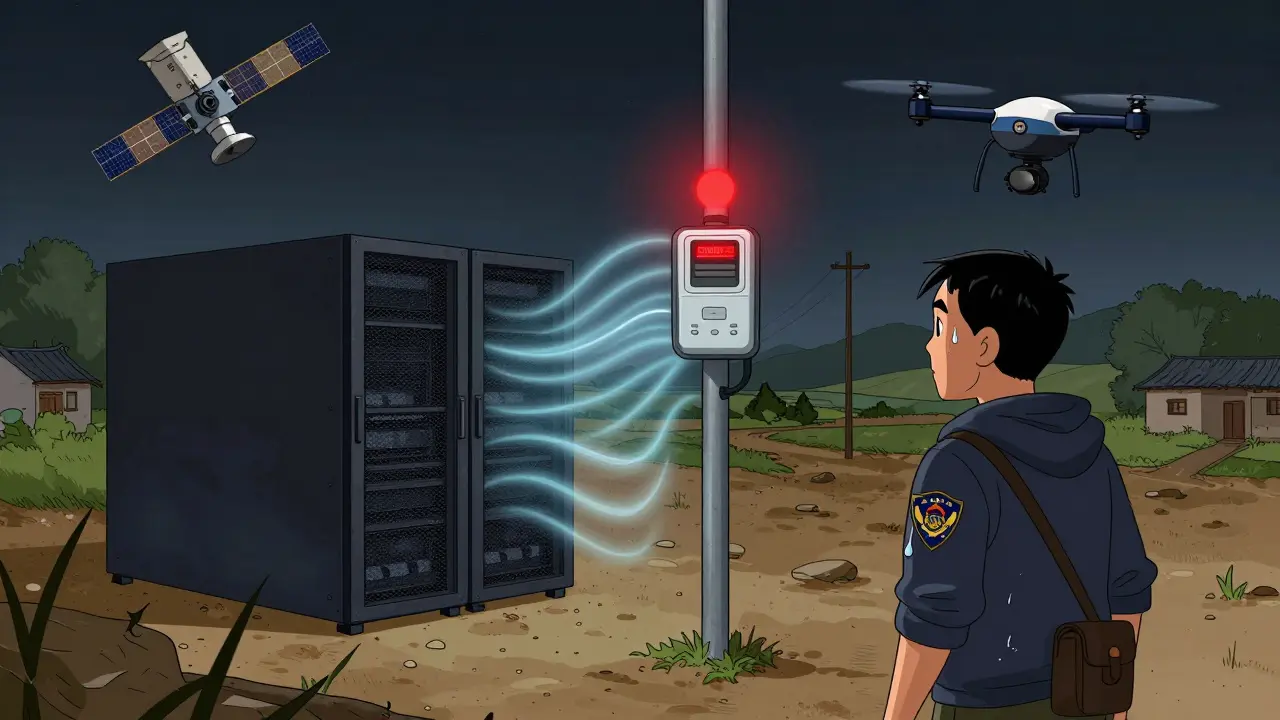
The Global Ripple Effect
When China banned mining in 2021, the crypto world didn’t collapse-it moved. Miners packed up their ASICs and headed to the U.S., Canada, Kazakhstan, and even Georgia. The U.S. became the new mining hub, with Texas and Georgia leading the way. Power plants in those regions saw new demand, and local economies benefited. But China’s ban didn’t just shift mining-it changed the whole industry. Hardware manufacturers like Bitmain and MicroBT had to restructure their supply chains. Mining pools had to relocate their servers. Investors started factoring in country risk. A mining operation in Kazakhstan today is worth less than one in Texas because of political instability. But at least it’s legal. The May 2025 ban sent shockwaves through markets. Bitcoin dropped from $111,000 to $104,500 in 24 hours. Ethereum and altcoins like Solana and Cardano fell even harder. Over $750 million in leveraged positions were liquidated. That’s the power of a single policy change in a country that once controlled the global mining network.What’s Next for China?
There’s no sign of reversal. The government is doubling down on the digital yuan. By 2026, over 600 million people are using e-CNY for everyday payments-from street vendors to public transit. The state wants full control over digital money. It won’t tolerate competition. Future enforcement will get smarter. AI-powered surveillance, facial recognition at mining equipment distribution points, and blockchain analysis tools are being rolled out. The goal isn’t just to stop mining-it’s to erase the idea that decentralized crypto has any place in China’s economy.What This Means for You
If you’re in China: don’t even think about mining crypto. The risk isn’t worth it. Even if you think you’re hidden, the systems are too advanced. Your electricity bill, your bank account, your internet traffic-all are monitored. If you’re outside China: understand that China’s policies can still affect you. The global crypto market is still sensitive to regulatory shifts in major economies. Any future move by China-even rumors-can trigger price swings. And if you’re wondering whether China will ever reverse course? Don’t hold your breath. The digital yuan is too central to China’s financial future. Crypto mining? It’s not just banned. It’s erased.Is cryptocurrency mining still legal in China in 2026?
No. As of May 31, 2025, all cryptocurrency mining, trading, and ownership are illegal in China. The ban is comprehensive and enforced by multiple government agencies. Violators face asset seizure, fines, and potential criminal charges.
Can you get arrested for mining crypto in China?
Yes. Since 2024, authorities have made arrests of individuals running mining operations, even small-scale ones. Under Article 225 of the Criminal Law, illegal business operations can lead to jail time, especially if the operation is large or involves cross-border transactions.
What happens to mining equipment if you’re caught?
All mining equipment-ASICs, GPUs, servers-is seized by authorities. There is no compensation. Equipment is often destroyed or auctioned off by the state. Courts do not recognize crypto mining as a legal business, so your gear has no legal protection.
Are there any underground mining operations still running in China?
Yes, but they’re rare and risky. Some miners operate in remote areas using hidden power sources, but enforcement has become far more sophisticated. AI-driven electricity monitoring, satellite heat detection, and financial tracking have made underground mining increasingly difficult to sustain. Over 70% of known underground operations were shut down in 2025.
Why did China ban crypto mining?
China banned crypto mining for four main reasons: 1) High energy use conflicted with carbon neutrality goals; 2) Crypto bypassed financial controls and enabled capital flight; 3) It was linked to money laundering and illegal transactions; and 4) It threatened the adoption of the state-backed digital yuan (e-CNY), which the government is aggressively promoting.
Can you use cryptocurrency in China at all?
No. The 2025 ban explicitly prohibits all cryptocurrency use, including trading, holding, and transferring. Even receiving crypto as payment or using it to buy goods is illegal. The only legal digital currency is the digital yuan (e-CNY), which is fully controlled by the People’s Bank of China.

16 Comments