
- 20 Aug 2026
- Elara Crowthorne
- 0
Running a crypto exchange in Nigeria used to feel like navigating a maze without a map. But the landscape shifted dramatically with the enactment of the Investments and Securities Act (ISA) 2025, signed by President Bola Ahmed Tinubu. This new law officially recognizes cryptocurrencies as securities, placing them firmly under the watchful eye of the Securities and Exchange Commission (SEC). If you are planning to launch or operate a digital asset exchange in Nigeria, understanding the strict licensing requirements is no longer optional-it is the price of entry.
The transition from an unregulated wild west to a structured market brings clarity but also heavy operational burdens. You need to know exactly what it takes to get licensed, how much capital you must lock up, and which rules will govern your daily operations. Here is what you need to know to stay compliant and competitive in Nigeria's evolving crypto ecosystem.
Key Takeaways
- Minimum Capital: You must have at least ₦500 million ($325,000 USD) in paid-up capital to apply for a license.
- Fidelity Bond: A bond covering 25% of your paid-up capital (minimum ₦125 million) is mandatory.
- Legal Basis: The ISA 2025 supersedes older laws, granting the SEC full authority over crypto exchanges and Virtual Asset Service Providers (VASPs).
- Accelerated Process: The Accelerated Regulatory Incubation Programme (ARIP) aims to fast-track approvals, though only a few licenses have been issued so far.
- Strict Oversight: Exchanges face heavy AML/KYC obligations and a ban on lending money to investors for trading.
The New Legal Landscape: ISA 2025
The game changer here is the Investments and Securities Act 2025. Before this, regulations were scattered and often contradictory. Now, the SEC has comprehensive power over all digital assets. Director-General Emomotimi Agama emphasized that this act is designed to build a resilient capital market while protecting investors. It doesn't just regulate; it tries to foster innovation within safe boundaries.
This means if you want to operate legally, you aren't just dealing with general business laws. You are subject to specific provisions for digital assets established through the SEC Rules on Issuance, Offering Platforms and Custody of Digital Assets from 2022, now reinforced by the 2025 Act. The goal is clear: move Nigeria from informal peer-to-peer trading to institutionalized, supervised services. For foreign operators targeting Nigerian users, this applies to you too. If you promote your service in Nigeria or email Nigerian addresses directly, you fall under these same rules.
Capital Requirements and Financial Health
Money talks, especially in regulatory compliance. To register as a Digital Asset Exchange (DAX), you need significant skin in the game. The minimum paid-up capital requirement stands at ₦500 million (approximately $325,000 USD). This isn't just about having the money in the bank; the SEC verifies the source of funds. Your capital can be held as bank balances, fixed assets, or investments in quoted securities, but it must be verifiable.
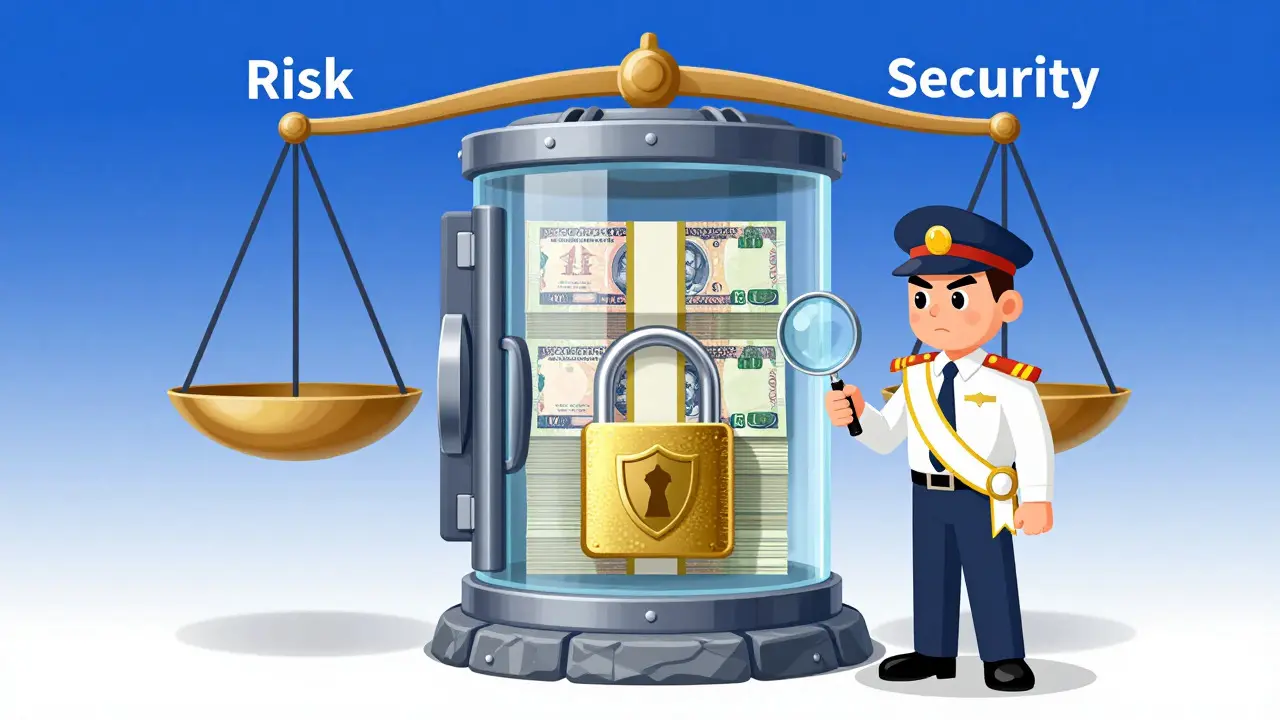
Beyond the base capital, you must secure a fidelity bond. This acts as insurance against misconduct. The bond must cover at least 25% of your paid-up capital, meaning a minimum of ₦125 million. Think of this as a safety net for your customers. If your exchange fails or engages in fraud, this bond helps recover losses. It’s a substantial upfront cost, but it signals stability to both regulators and investors.
| Requirement | Minimum Value | Notes |
|---|---|---|
| Paid-Up Capital | ₦500 Million (~$325k USD) | Must be verified by SEC; can include fixed assets or quoted securities. |
| Fidelity Bond | ₦125 Million | Covers 25% of paid-up capital; protects against operator misconduct. |
| Audited Financials | N/A | Required for existing entities; statement of affairs for new incorporations. |
Documentation and Corporate Structure
Before you even talk to the SEC about your tech stack, you need your corporate house in order. You must obtain a Certificate of Incorporation from the Corporate Affairs Commission (CAC). Crucially, your Memorandum and Articles of Association (MEMART) must explicitly include objectives related to cryptocurrency exchange operations. If your company was incorporated for general trading, you might need to amend these documents.
You’ll also need to submit specific CAC forms, including CAC 1.1 and Form 7. If you’re a newly incorporated entity, you won’t have audited financial statements yet, so you’ll provide a statement of affairs instead. These documents prove that your legal structure is sound and specifically designed for this high-risk industry. Skipping these details is a common reason for application delays.
Compliance: AML, KYC, and Operational Restrictions
Licensing is just the start. The real work happens in daily compliance. The ISA 2025 mandates robust Anti-Money Laundering (AML) and Combating the Financing of Terrorism (CFT) controls. While the Act doesn't list every single procedure, it places crypto firms under SEC oversight, which effectively enforces these standards. You must implement strong customer identification and verification processes. No more anonymous transactions. Every user must go through Know Your Customer (KYC) checks to prevent illicit activities, following guidance from the Central Bank of Nigeria (CBN).
One major operational restriction catches many off-guard: you cannot provide direct or indirect financial assistance to investors, officers, or employees for investing or trading on your platform. In other words, no margin lending or internal loans for trading. This rule aims to reduce leverage-related risks and protect retail investors from over-exposure.
Additionally, the "No Objection Rules" mean you can't just list any token you want. You need prior SEC approval before trading any virtual or digital asset. This creates a gatekeeping mechanism that ensures listed assets meet certain quality and transparency standards. It adds a layer of bureaucracy, but it also filters out some of the worst rug-pull scams that plague the market.
The Accelerated Regulatory Incubation Programme (ARIP)
Recognizing that strict regulation can stifle growth, the SEC launched the Accelerated Regulatory Incubation Programme (ARIP) in June 2024. This program is designed to fast-track the licensing process for serious players. It provides a clearer pathway for crypto businesses to get provisional licenses faster than the traditional route.
So far, the results are modest. Only two Nigerian crypto startups, Quidax and Busha, have received provisional licenses under ARIP. However, SEC officials indicated in late 2024 that they plan to "move a lot quickly" in issuing more licenses throughout 2025. This acceleration is a response to the reality of Nigeria's crypto market: people are already using crypto extensively to hedge against inflation and exchange rate volatility. The regulator wants to catch up with the market rather than lag behind it.

Challenges and Market Realities
While regulation brings security, it also introduces friction. Research by Busha showed that nearly half of 1,500 surveyed Nigerians cited security concerns as their main barrier to adopting crypto. The new framework addresses this fear by providing formal oversight. But it also increases costs and complexity for businesses. Stringent AML/KYC requirements can slow down payment processing. Mandatory licensing verification for local partners adds another hurdle for cross-border payments.
For international companies, this means doing your homework. If you target Nigerian users, you are liable under Nigerian law. The shift from unregulated peer-to-peer environments to supervised systems adds layers of compliance that may impact transaction speed. Yet, for legitimate operators, this creates a level playing field. Scammers and Ponzi scheme operators face stricter penalties under the 2025 Act, which should help clean up the market over time.
Future Outlook and Taxation
The SEC is not done. Plans are underway to expand the licensing framework further in 2025. There are also discussions around cryptocurrency taxation. The commission wants to monitor transactions for tax purposes, potentially amending rules to allow Nigerians to trade on centralized exchanges where data is easily trackable. Whether specific crypto tax amendments are included in the final ISA 2025 text remains a point of clarification, but the direction is clear: increased visibility and revenue generation for the state.
Nigeria is positioning itself as a competitive destination for crypto investment. By moving toward a structured, supervised market, it aims to attract both local and foreign capital while maintaining robust consumer protection. For exchanges, the message is simple: comply early, invest in compliance infrastructure, and prepare for a future where transparency is non-negotiable.
Frequently Asked Questions
What is the minimum capital required to open a crypto exchange in Nigeria?
The minimum paid-up capital is ₦500 million (approximately $325,000 USD). Additionally, you must secure a fidelity bond worth at least 25% of this amount, which is ₦125 million.
Do foreign exchanges need a license to serve Nigerian customers?
Yes. If a foreign operator actively targets Nigerian investors through agents, promotions, publications, or direct emails, they fall under the same regulatory requirements as local exchanges and must obtain proper licensing from the Nigerian SEC.
Can a licensed exchange lend money to its users for trading?
No. Licensed exchanges are prohibited from providing direct or indirect financial assistance to investors, officers, or employees for investing or trading in virtual assets on their platforms. This ban includes margin lending.
How long does it take to get a crypto exchange license in Nigeria?
The timeline varies, but the Accelerated Regulatory Incubation Programme (ARIP) aims to fast-track the process. As of mid-2025, only a few provisional licenses have been issued, suggesting the process is still being refined. Applicants should expect a rigorous review of their legal, technical, and financial capabilities.
What happens if I operate without a license?
Operating without a license exposes you to significant legal risks. The Investments and Securities Act 2025 introduced stricter penalties for non-compliance, particularly for Ponzi schemes and fraudulent activities. Unlicensed operators may face fines, asset seizures, or criminal prosecution.