
- 19 Jun 2026
- Elara Crowthorne
- 0
Imagine sending money across the ocean. You want it to arrive fast and cheap, but you also need absolute certainty that the bank won't lose it or steal it. That is exactly the dilemma facing Ethereum today. The network is secure, but it is slow and expensive for everyday use. Enter Rollups, a scaling technology that processes transactions off-chain but anchors their security to Ethereum's main chain. But here is the catch: if the work happens off-chain, how do we know the result is honest? This is where fraud proofs and validity proofs come in, acting as the digital watchdogs of the Layer 2 ecosystem.
You don't need a computer science degree to understand why this matters. If you are using Arbitrum, Optimism, or zkSync, you are trusting these proof systems with your assets. Understanding the difference between them helps you choose the right platform for your needs and understand the risks involved.
The Core Problem: Trust vs. Verification
At its heart, blockchain security is about verification. In traditional finance, you trust the bank. In Ethereum, you verify the code. When Vitalik Buterin introduced the concept of rollups in his January 2021 guide, he identified two primary ways to maintain this trust while scaling:
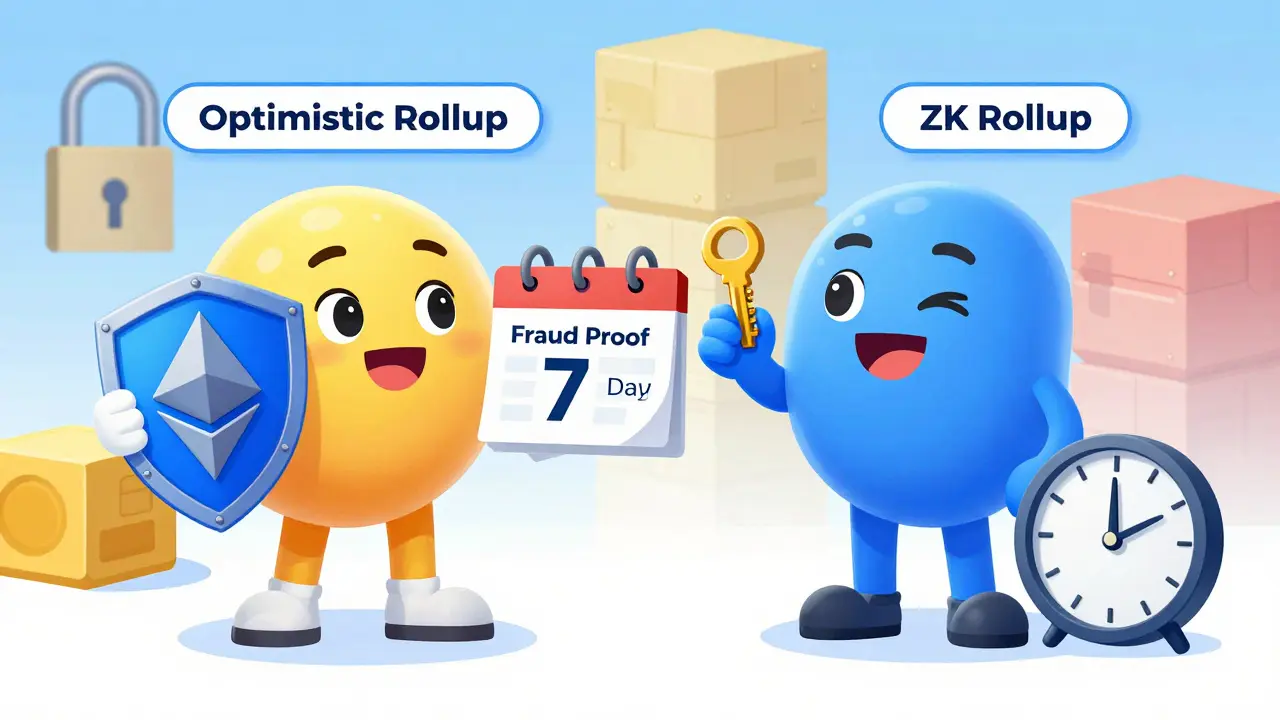
- Optimistic Rollups: Assume transactions are valid by default. They only check if someone accuses them of being wrong.
- ZK (Zero-Knowledge) Rollups: Prove mathematically that every transaction is valid before accepting it.
This distinction drives everything else-speed, cost, complexity, and security. Let’s break down how each approach works under the hood.
How Fraud Proofs Work in Optimistic Rollups
Projects like Optimism and a Layer 2 scaling solution using optimistic fraud proofs and Arbitrum rely on what is known as an "optimistic" assumption. The system assumes the sequencer (the entity processing transactions) is honest. It posts a summary of transactions to Ethereum, and everyone accepts it.
But what if the sequencer lies? What if they claim you sent them 10 ETH when you only sent 1?
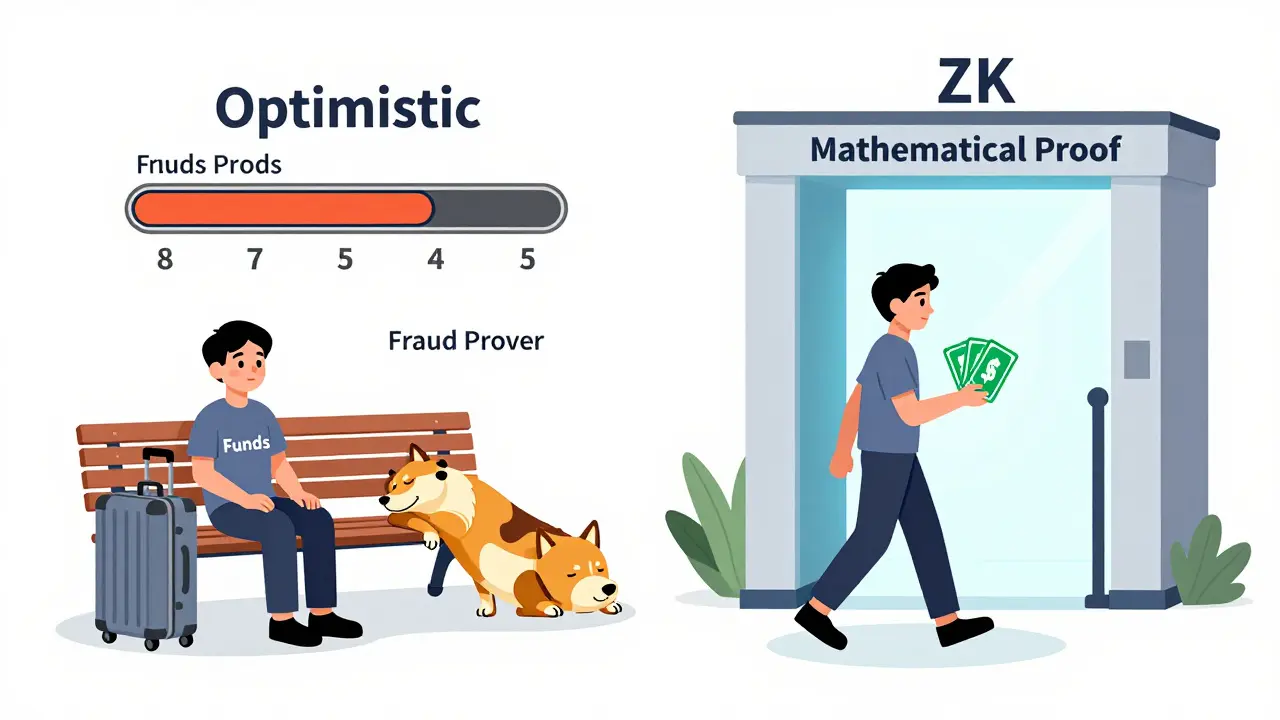
This is where the fraud proof mechanism kicks in. Any user can challenge the state transition within a specific window called the challenge period. Historically, this period was seven days for both Optimism and Arbitrum. During this time, if anyone detects an error, they submit a fraud proof to the Ethereum mainnet.
The process is essentially a replay. The manager contract on Ethereum replays the disputed transaction step-by-step to verify the outcome. If the proof shows the sequencer lied, the invalid state is reverted, and the malicious operator loses their stake. According to benchmarks from early 2024, submitting and verifying a single fraud proof consumes between 500,000 and 1,000,000 gas units on Ethereum. It is expensive, but it ensures that lying is economically unviable.
Recent developments have sped this up significantly. In September 2023, Optimism introduced a "Fault Proof Accelerator," reducing the challenge period from seven days to just two hours for certain operations. Similarly, Base, another optimistic rollup, reduced its window to two hours. However, experts like Barry Whitehat warn that shortening this period below 48 hours increases risk for low-value transactions, as validators have less time to detect subtle errors.
Validity Proofs and the ZK Rollup Advantage
On the other side of the spectrum are ZK Rollups such as scaling solutions using zero-knowledge cryptography, pioneered by projects like zkSync and StarkNet. Instead of assuming honesty, ZK rollups require mathematical proof of correctness for every batch of transactions.
These proofs, often based on technologies like ZK-SNARKs or PLONK, are tiny cryptographic signatures. A zkSync proof might be only 180-200 bytes in size and take about 1.1 seconds to verify on Ethereum. Because the proof guarantees validity, there is no need for a multi-day challenge period. Finality is near-instant, often under 10 minutes.
The trade-off? Complexity. Generating these proofs requires significant computational power. StarkWare’s 2023 infrastructure report noted that specialized servers for proof generation can cost between $5,000 and $15,000 per unit. For developers, building applications that interact with ZK circuits is harder than writing standard Solidity smart contracts. Yet, as Vitalik Buterin noted in early 2024, advancements in PLONK and Halo2 are making ZK rollups increasingly viable for general computation.
Security Trade-offs: Speed vs. Certainty
So, which is more secure? It depends on what you value more: immediate finality or decentralized verification.
| Feature | Optimistic Rollups (Fraud Proofs) | ZK Rollups (Validity Proofs) |
|---|---|---|
| Verification Method | Challenge-based (assume valid until proven false) | Cryptographic proof (prove valid immediately) |
| Withdrawal Time | 7 days (standard), 2 hours (accelerated) | Near-instant (< 10 minutes) |
| Data Cost on L1 | Higher (posts full transaction data) | Lower (posts only compressed proofs) |
| Hardware Requirements | Standard servers | Specialized high-performance hardware |
| Development Complexity | Low (EVM compatible) | High (requires custom circuit design) |
| Privacy Support | Add-on cost (~500-byte SNARK per tx) | Built-in (no extra overhead) |
Ethereum Research’s 2023 study highlighted that Optimistic Rollups achieve 3-8x scaling improvements with lower operational barriers, while ZK Rollups deliver 40-200x scaling but demand higher upfront investment. For a user withdrawing funds, the seven-day wait on an optimistic rollup can feel like an eternity, costing potential trading opportunities. One Reddit user reported losing $120 in missed trades due to this delay in late 2023. Conversely, ZK rollups offer peace of mind through instant finality, though users must trust the centralization of proof generators until decentralization matures.
Emerging Threats: Cross-Rollup Interoperability
As the ecosystem grows, new risks emerge. Most rollups operate in isolation, but users want to move assets seamlessly between them. This is where cross-rollup interoperability becomes critical.
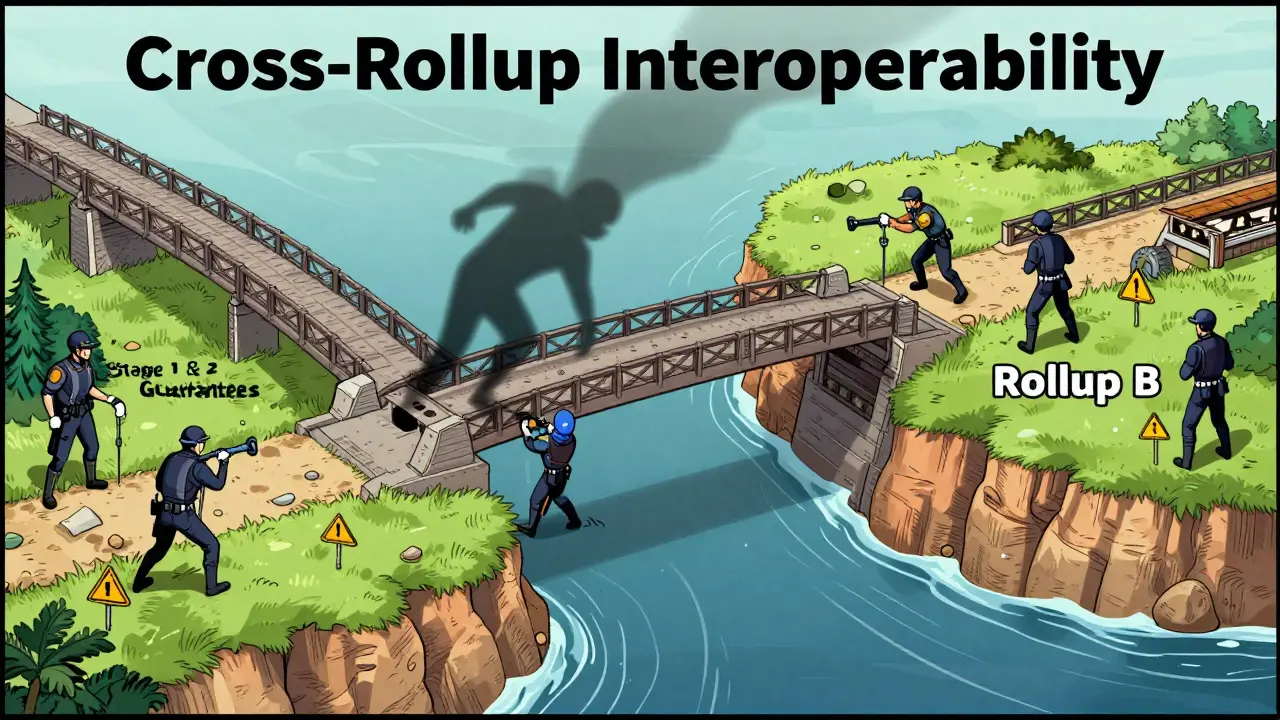
Ethereum researchers define three stages of security for this interaction:
- Stage 0: Validity guarantee only. Current protocols mostly operate here.
- Stage 1: Local ordering guarantee.
- Stage 2: Global ordering guarantee.
A Flashbots report from October 2023 warned of "cross-rollup attacks," where an attacker exploits timing differences between settlement layers. For example, if Rollup A settles faster than Rollup B, an attacker could drain funds from A before B has time to reject an invalid state. Polymer Hub, an interoperability protocol, addresses this by implementing Stage 1 security guarantees, reducing interop finality time from 24 hours to 45 minutes as of December 2023. However, achieving Stage 2 global ordering remains a complex challenge requiring coordinated security models across all major rollups.
Practical Implications for Developers and Users
If you are a developer, the choice between optimistic and ZK architectures affects your entire stack. Consensys Academy estimates that mastering secure rollup implementation requires 200-300 hours of specialized training. Tools like Hardhat’s Rollup plugin (v1.8.0, released January 2024) help reduce development time by 35%, but the learning curve remains steep.
For users, the key takeaway is awareness. When using an optimistic rollup, remember that your funds are technically locked during the challenge period. If you are moving large sums, consider the withdrawal time. When using a ZK rollup, you benefit from speed, but you should monitor the decentralization progress of the proof generator network to ensure long-term censorship resistance.
Security audits are non-negotiable. OpenZeppelin’s 2023 pricing data shows audits costing $75,000-$150,000 per project, with most requiring multiple rounds. Projects that skip thorough auditing risk catastrophic failures, as seen in various DeFi exploits over the years. Always check if a rollup has been audited by reputable firms and whether they have active bug bounty programs.
The Future: Post-Quantum and EIP-4844
Looking ahead, the landscape is shifting. The implementation of EIP-4844 (Proto-Danksharding) in mid-2024 is expected to reduce rollup data costs by 90%. This makes posting transaction data cheaper, potentially leveling the playing field between optimistic and ZK rollups regarding gas fees.
Furthermore, the threat of quantum computing looms. Current cryptographic assumptions may not hold against quantum attacks by 2030. The Ethereum Foundation allocated $15 million in late 2023 to post-quantum cryptography research specifically for rollup security models. Both fraud proofs and validity proofs will need to evolve to resist quantum decryption, ensuring that your assets remain safe even as computing power advances exponentially.
In the end, rollup security is not a binary choice between good and bad. It is a spectrum of trade-offs between speed, cost, and decentralization. By understanding how fraud proofs and validity proofs work, you can navigate the Layer 2 ecosystem with confidence, knowing exactly what safeguards protect your digital assets.
What is the main difference between fraud proofs and validity proofs?
Fraud proofs assume transactions are valid and only verify them if challenged, requiring a waiting period (typically 7 days). Validity proofs mathematically prove every transaction is correct before acceptance, allowing for near-instant finality but requiring more complex hardware.
Are optimistic rollups safe to use?
Yes, they are considered highly secure (rated 8.5/10 by the Ethereum Foundation) because any invalid state can be challenged and reverted. The main risk is the withdrawal delay, during which funds are locked on the mainnet pending the challenge period.
Why do ZK rollups have faster withdrawals?
ZK rollups include a cryptographic proof with every batch that verifies computational correctness instantly. Since the proof guarantees validity, there is no need to wait for a challenge period, enabling withdrawals in under 10 minutes.
What is the role of the challenge period in optimistic rollups?
The challenge period is a window of time (usually 7 days, recently reduced to 2 hours by some protocols) during which anyone can submit a fraud proof if they detect an invalid transaction. If no proof is submitted, the state is finalized.
How does EIP-4844 affect rollup security and costs?
EIP-4844 reduces the cost of posting data to Ethereum by 90%. This lowers the barrier for both optimistic and ZK rollups to post transaction data, making them cheaper to use and potentially improving the economic viability of decentralized verifiers.
