

- 16 Aug 2026
- Elara Crowthorne
- 0
Imagine holding a bag of tokens from an Initial Coin Offering (ICO) you bought in 2017. You might have watched the price crash not because the project failed, but because the team decided to dump their fully vested tokens on the market all at once. This is exactly why ICO vesting schedules exist. They are the financial guardrails that prevent insiders from flooding the market and crashing the price, ensuring that everyone-from the founders to early backers-has a stake in the project's long-term success.
If you are evaluating a new token launch or trying to understand why your existing holdings aren't tradable yet, understanding these release mechanisms is critical. These schedules dictate when tokens move from being locked up in a smart contract to becoming liquid assets you can sell. Getting this wrong can mean missing out on liquidity windows or getting caught off guard by supply shocks.
What Is an ICO Vesting Schedule?
An ICO vesting schedule is a structured plan that controls the timing and quantity of token releases to specific stakeholder groups. Unlike traditional equity where shares are issued upon purchase, crypto tokens are often pre-mined and held in escrow. The vesting schedule acts as a timer, gradually unlocking these tokens over months or years.
This mechanism serves two primary purposes. First, it aligns incentives. By locking up team tokens, the project signals that the developers intend to stay and build, rather than just raise funds and disappear. Second, it manages market supply. If 50% of a token's total supply became tradable overnight, basic economics suggests the price would plummet due to sudden oversupply. Gradual release keeps the order book stable.
These schedules are typically enforced through Smart Contracts is self-executing code deployed on a blockchain that automatically releases tokens according to predefined rules without human intervention. This removes counterparty risk; you don't have to trust the CEO to remember to send you your monthly unlock. The code simply does it.
The Three Core Structure Types
Most projects utilize one of three main frameworks, though many modern launches use a hybrid approach. Understanding the difference between these types helps you predict future price pressure.
- Linear Time-Based Vesting: This is the most straightforward model. Tokens are released in equal increments over a set period, usually monthly or quarterly. For example, if you have a four-year linear schedule, you receive 1/48th of your allocation every month. There is no initial waiting period, so you start receiving small amounts immediately after the ICO ends.
- Cliff Vesting: This introduces a waiting period, known as the "cliff," during which zero tokens are released. After the cliff expires, a significant portion vests at once, followed by regular intervals. A standard structure is a one-year cliff with a four-year total duration. This means nothing happens for 12 months, then 25% of the total allocation unlocks instantly, and the remaining 75% vests monthly over the next three years.
- Milestone-Based Vesting: Instead of relying solely on time, tokens unlock when specific development goals are met. Examples include launching a mainnet, hitting 100,000 active users, or securing a major partnership. This is rarer in pure ICOs but increasingly common in DAO-governed projects where the community votes on whether milestones have been achieved.
Standard Allocations by Stakeholder Group
Not everyone gets the same deal. The length of the vesting period depends heavily on who holds the tokens. Generally, the more central a person is to the project's survival, the longer their tokens remain locked.
| Stakeholder Group | Typical Supply Allocation | Vesting Duration | Cliff Period | Rationale |
|---|---|---|---|---|
| Core Team / Founders | 15% - 25% | 36 - 48 months | 12 months | Ensures long-term commitment; prevents rug pulls |
| Advisors | 3% - 7% | 12 - 24 months | 3 - 6 months | Shorter lock-up reflects consulting nature of role |
| Early Investors | Varies (often 10-20%) | 12 - 24 months | 0 - 6 months | Balances investor return needs with market stability |
| Public Sale Participants | Remaining Supply | Immediate or Short | None | Full liquidity provided to reward retail support |
Notice the pattern here. Founders face the harshest restrictions. Why? Because they control the roadmap. If they leave, the project likely fails. Advisors, while valuable, do not run the day-to-day operations, so their lock-up is shorter. Public buyers usually get immediate access to their tokens, which is a key selling point for retail investors who want exit liquidity.
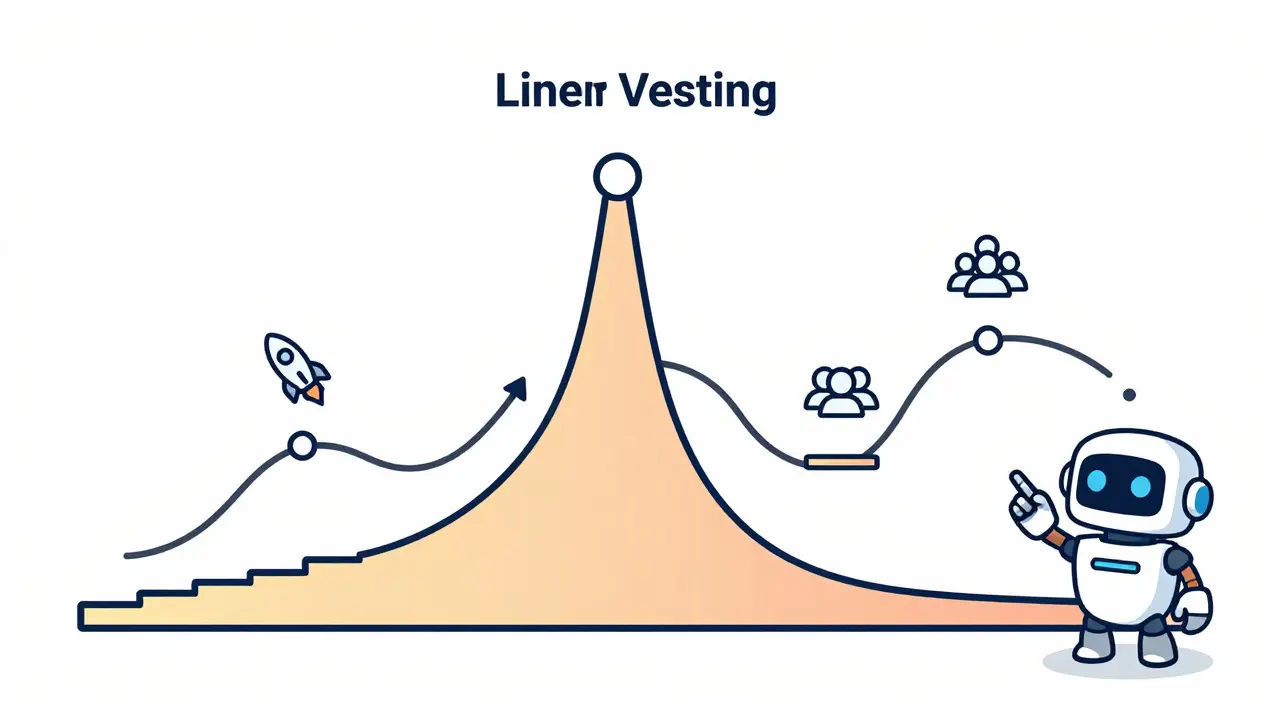
Front-Loaded vs. Back-Loaded Strategies
Within these standard structures, projects make strategic choices about *when* the bulk of the value is released. This distinction matters for price prediction.
Back-loaded vesting is the industry standard for teams. It mirrors traditional tech equity plans, such as those used by Amazon or other major corporations, where a large percentage of grants vest in the final years. In crypto, this means 50% or more of a founder's tokens might not unlock until year three or four. This protects the market from early dumping and signals confidence. If the team believes in the project, they are willing to wait.
Front-loaded vesting, conversely, releases larger chunks earlier. You might see this with advisors or in smaller, lower-risk projects. However, front-loading carries higher risk. If a large block of tokens unlocks in month six, and the market sentiment is negative, those holders will likely sell immediately, creating a price dip. Savvy investors watch the calendar for these "unlock events" to anticipate volatility.
The Role of Smart Contracts in Execution
The beauty of blockchain vesting is transparency. In traditional startups, you have to trust legal documents and bank transfers. In an ICO, the vesting logic lives on-chain. Most Ethereum-based projects use ERC-20 standards with custom logic to handle these releases.
This setup offers several advantages:
- Immutability: Once deployed, the schedule cannot be changed unilaterally by the team unless the contract includes a governance clause.
- Verifiability: Anyone can check the contract address on a block explorer to see exactly how many tokens are still locked and when the next batch releases.
- Automation: No administrative overhead. The tokens appear in wallets automatically on the specified date and time.
However, there is a catch. Some contracts include "admin keys" that allow the team to pause or modify the schedule. Before investing, always read the whitepaper and audit reports to determine if the vesting is truly immutable or if the team retains control. Immutable vesting is a stronger signal of integrity.

How Vesting Impacts Token Price
Vesting is not just a legal formality; it is a direct driver of market dynamics. When a large block of tokens unlocks, it increases the circulating supply. According to the law of supply and demand, if demand remains constant, an increase in supply leads to a decrease in price.
This phenomenon is often referred to as "vesting shock." Traders actively monitor upcoming unlock dates using data aggregators. Often, prices will dip slightly before a major unlock as traders hedge against potential selling pressure, and may rebound afterward if the dumped tokens are absorbed quickly by buyers. Understanding this cycle allows you to make better entry and exit decisions.
For example, if a project has a 12-month cliff for its team tokens, you should expect heightened volatility around the one-year anniversary of the ICO. That is when 25% of the team's holdings become tradable. If the project has gained significant traction by then, the market might absorb the sale easily. If not, the price could take a hit.
Evolving Trends: From ICOs to STOs and DAOs
The landscape is shifting. The wild west days of 2017-2018 ICOs are giving way to more regulated structures like Security Token Offerings (STOs) and Initial Exchange Offerings (IEOs). These newer models often adopt stricter, more standardized vesting practices that mirror venture capital norms.
Furthermore, the rise of Decentralized Autonomous Organizations (DAOs) has introduced community-driven vesting. In some projects, token holders vote to accelerate or delay vesting based on performance metrics. This adds a layer of democratic accountability that traditional corporate structures lack.
Regulatory bodies in jurisdictions like Switzerland and Malta are also influencing these designs. To avoid being classified as unregistered securities, projects are adopting clearer, documented vesting schedules that demonstrate long-term intent and reduce speculative trading behavior.
Practical Tips for Investors
When analyzing a new token, don't just look at the price. Look at the tokenomics. Here is what to check:
- Total Circulating Supply vs. Total Supply: If only 10% of tokens are circulating, the remaining 90% represents future selling pressure.
- Unlock Calendar: Identify the next major unlock event. Is it next week? Next year?
- Team Commitment: Does the team have a long cliff? A 12-month cliff is standard; less than 6 months might be a red flag.
- Contract Immutability: Can the team change the rules? Check the source code or audit report.
By treating vesting schedules as a fundamental part of your due diligence, you move beyond hype and into a data-driven assessment of risk. The tokens you hold are only as strong as the incentives behind them.
What is a typical cliff period for ICO team tokens?
A standard cliff period for core team members in an ICO is 12 months. During this time, no tokens are released. After the cliff, a significant portion (usually 25% of the total team allocation) vests immediately, followed by monthly or quarterly releases over the remaining vesting period, which typically totals 36 to 48 months.
Do public sale participants have vesting periods?
Often, no. Public sale participants typically receive full liquidity immediately after the ICO ends. However, some projects impose short lock-ups of 3 to 6 months for public buyers to stabilize the initial trading period. Always check the specific terms in the token sale documentation.
How does vesting affect token price volatility?
Vesting directly impacts volatility through supply changes. Major unlock events increase the circulating supply, which can lead to price drops if holders sell their newly freed tokens. Traders often anticipate these events, causing price dips before the unlock and potential rebounds if the market absorbs the supply efficiently.
Can a project change its vesting schedule after launch?
It depends on the smart contract design. If the contract is immutable, the schedule cannot be changed. However, many projects include admin functions that allow the team to pause or modify vesting parameters. Investors should verify the contract's immutability status via audit reports or block explorers before investing.
What is the difference between linear and cliff vesting?
Linear vesting releases tokens in small, equal increments from day one. Cliff vesting requires a waiting period (the cliff) before any tokens are released, after which a large chunk vests at once, followed by regular intervals. Cliff vesting provides stronger alignment incentives because stakeholders must survive the initial waiting period before gaining any liquidity.
