
- 25 Aug 2026
- Elara Crowthorne
- 0
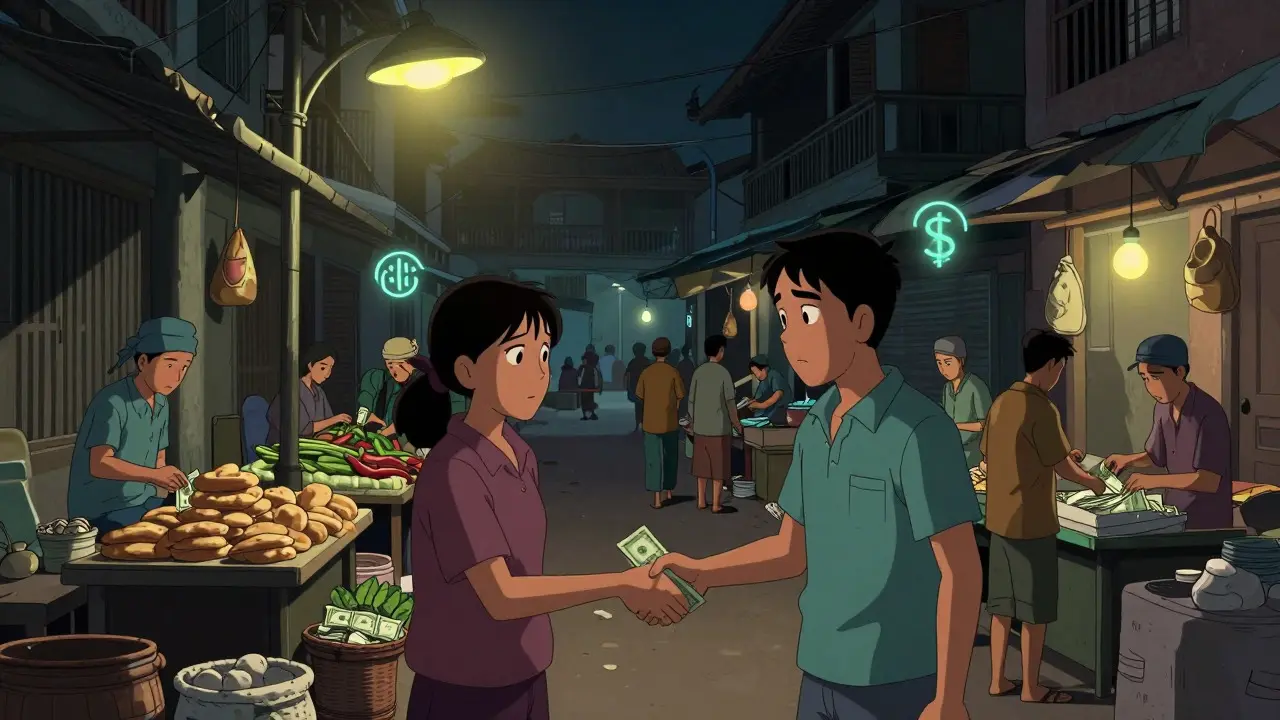
Imagine trying to buy a loaf of bread, but the currency you use is technically illegal. In Myanmar, that’s not just a hypothetical scenario; it’s daily reality for thousands of people navigating the underground cryptocurrency market operating in shadow due to government prohibitions. Since 2020, the Central Bank of Myanmar (CBM) has enforced a total ban on digital assets, treating them as unrecognized instruments under strict foreign exchange laws. Yet, despite these heavy restrictions, a resilient black market thrives, driven by necessity rather than speculation.
This isn't about getting rich quick. For many Burmese citizens, crypto is a survival tool. It’s how they send money home from abroad, how they protect savings from inflation, and how they bypass a banking system that often feels out of reach. But this freedom comes at a steep price: zero legal protection, extreme volatility, and the constant threat of criminal charges. Here’s how this hidden economy actually works, who’s running it, and what risks you need to understand if you’re looking at this unique corner of the global crypto landscape.
The Legal Landscape: Why Crypto Is Banned
To understand the underground market, you first have to grasp why it exists in the shadows. The Foreign Exchange Management Law is the primary weapon used by authorities. It defines the Kyat as the sole legal tender and treats any conversion between local currency and foreign assets-including Bitcoin-as an offense. The military regime views financial independence as a threat to its control, so the ban is less about economic policy and more about political power.
- Total Prohibition: Trading, mining, and holding major digital assets like Ethereum are all illegal.
- Enforcement Tools: Authorities can freeze bank accounts and initiate criminal proceedings against traders.
- Selective Policing: Enforcement often targets large-scale networks or high-profile cases, while small peer-to-peer deals sometimes slip through the cracks.
This creates a grey area. You won’t see a police officer checking your phone for a $50 swap, but if you run a large informal exchange or get caught with significant mining hardware, the consequences can be severe. Fines, imprisonment, and asset seizure are real risks. This legal vacuum means there are no consumer protections. If a deal goes wrong, there’s no court to turn to and no regulator to file a complaint with.
How the Underground Ecosystem Functions
Without legal exchanges, how do people trade? The infrastructure is surprisingly organic, built on trust and social media. Most activity flows through Telegram groups and Facebook pages. These platforms act as bulletin boards where buyers and sellers post rates and meet via video call or in person.
- Accessing Global Platforms: Many users connect to international giants like Binance using Virtual Private Networks (VPNs). However, liquidity is thin, meaning big trades can move prices significantly.
- Cash Dealers: A crucial part of the ecosystem is the network of trusted cash dealers. These individuals hold physical cash and stablecoins, facilitating off-record transactions. They are the backbone of the local market, bridging the gap between digital assets and physical currency.
- Stablecoin Dominance: While Bitcoin gets the headlines, USDT (Tether) is the workhorse of the Myanmar underground. It’s stable, easy to transfer, and widely accepted for remittances and daily commerce.
The lack of formal regulation leads to wild price swings. Because liquidity is low, a single large sale can crash the local rate compared to the global price. Traders have to be incredibly careful, often waiting for better opportunities rather than reacting instantly to market moves.

Community as Infrastructure: The Role of MCM
In a market without textbooks or official courses, community becomes the primary source of education. The Myan Crypto Masters Community (MCM) is the standout example. Founded by a figure known as Feliz, MCM has grown to over 23,000 members. It serves as the main hub for Burmese-language crypto knowledge.
MCM operates through weekly workshops and interactive forums. The goal is simple: make complex concepts digestible. "Many people are interested in crypto, but the information available in Burmese is limited," Feliz explains. "We break down complex concepts into digestible information, making crypto education accessible to everyone." This educational push is vital because misinformation is rampant. Without proper guidance, newcomers are prime targets for scams.
| Feature | Official Status | Underground Reality |
|---|---|---|
| Legal Standing | Illegal under Foreign Exchange Laws | Operates in grey/black market |
| Primary Assets | Kyat only | USDT, Bitcoin, Ethereum |
| Trading Platforms | None authorized | Telegram, Facebook, Binance (via VPN) |
| Risk Level | N/A | High (Scams, Seizure, Volatility) |
| Consumer Protection | None | None (Trust-based only) |
Regional Context: Why Miners Left
Myanmar’s ban didn’t just affect traders; it reshaped the regional mining landscape. Before 2020, Myanmar was a notable hub for Bitcoin mining due to cheap hydropower. When the ban hit, most miners packed up their rigs and moved next door to Thailand or Laos. These neighboring countries have adopted more favorable regulatory stances, creating a stark contrast.
This migration highlights a key difference in Southeast Asian policy. While Myanmar chose prohibition, its neighbors leaned toward integration. This has affected energy demands locally and shifted global hash rate distribution. For those still mining in Myanmar, operations are clandestine and small-scale, limited by persistent energy shortages and the constant fear of equipment confiscation. It’s a risky game, played mostly by tech-savvy entrepreneurs who know how to hide their operations.

Risks and Realities for Users
Let’s be clear: participating in the Myanmar underground crypto market is not for the faint of heart. The biggest risk isn’t the government-it’s the other humans involved. Scams are common. The 2022 collapse of a high-profile crypto scheme left thousands in ruin, proving that without regulation, victims have no recourse.
- Scams and Fraud: Newcomers often fall prey to fake exchanges or Ponzi schemes. Always verify counterparties.
- Liquidity Crunches: Trying to sell a large amount of crypto can result in getting a much lower price than the global average.
- Political Instability: The military regime’s stance may change, but currently, any crackdown could wipe out assets overnight.
- Tax Ambiguity: Profits are theoretically taxable, but practically impossible to report legally since the asset itself is banned.
Despite these dangers, crypto persists as a lifeline. For diaspora workers sending money home, stablecoins offer faster, cheaper transfers than traditional banks. For locals, it’s a way to save wealth outside the volatile Kyat. It’s a double-edged sword: essential for survival, yet fraught with peril.
Future Outlook and Resistance
As of 2025, there are no signs of regulatory relaxation. The military-led CBM maintains its strictly prohibitive stance. However, the underground scene continues to expand, driven by political resistance and financial necessity. One notable development is the Spring Development Bank of the National Unity Government (NUG), which operates on the Polygon blockchain. It offers diaspora remittances and gold-backed savings, directly challenging the military government’s financial monopoly.
The future remains uncertain. Any future civilian government will face a tough decision: harmonize with global standards and regulate, or extend the prohibition. Given the resilience of the underground market, it seems likely that cryptocurrency will continue serving as an underground lifeline and a tool of financial resistance, regardless of official policies. The lesson for outsiders is clear: in Myanmar, crypto isn’t just an investment; it’s a statement of autonomy.
Is it legal to own Bitcoin in Myanmar?
Technically, no. The Central Bank of Myanmar bans all cryptocurrency transactions, treating them as illegal under foreign exchange laws. However, enforcement is selective, and many individuals hold assets privately without facing immediate action unless they engage in large-scale trading or mining.
How do people in Myanmar trade crypto without exchanges?
Most trading happens through peer-to-peer networks on Telegram and Facebook. Users also access international platforms like Binance via VPNs. Cash dealers play a crucial role in facilitating off-record swaps between stablecoins and local currency.
What is the Myan Crypto Masters Community?
It is a large community of over 23,000 members founded by Feliz. It serves as the primary educational hub for cryptocurrency knowledge in Burmese, offering workshops and forums to help users navigate the risks of the underground market.
Why did miners leave Myanmar?
The 2020 ban made mining illegal. Most miners relocated to neighboring countries like Thailand and Laos, which have more favorable regulations. Those remaining in Myanmar operate on a small, clandestine scale to avoid detection.
Are stablecoins popular in Myanmar?
Yes, USDT is the most widely used asset. Its stability makes it ideal for remittances and saving value against the fluctuating Kyat, even though trading it is technically illegal.
