
- 18 Jun 2026
- Elara Crowthorne
- 0
Imagine buying a coin because it promises to use artificial intelligence to trade for you. It sounds like magic, right? That is exactly what AI Analysis Token sells. But when you peel back the marketing hype, what are you actually getting? As of mid-2026, AIAT sits in a tricky spot: it’s not a household name like Bitcoin, but it’s not dead either. It’s a micro-cap utility token trying to prove its worth in a crowded market.
If you’ve stumbled upon this title, you probably want to know if AIAT is a scam, a hidden gem, or just another forgotten project. The short answer? It’s a real ERC-20 token with a working ecosystem, but it comes with significant risks and limited transparency. Let’s break down what AIAT actually does, how much it costs, and whether it deserves a spot in your wallet.
The Basics: What Is AIAT?
AI Analysis Token (AIAT) is a utility cryptocurrency designed to power the AI Analysis ecosystem, which combines blockchain technology with AI-driven data analytics and trading tools. Think of it as the fuel for a specific machine. You don’t hold AIAT just to watch the price go up; you hold it to use their services.
The project was launched by the AI Analysis Group. Development started in 2022, and the token went public in early 2023. It runs on the Ethereum blockchain as an ERC-20 token. This means it uses the same infrastructure as thousands of other tokens. If you have a MetaMask wallet or use Atomic Wallet, you can already store it. No special hardware or weird software required.
The core idea is simple: use AI to find patterns in financial data that humans miss. The token facilitates transactions within three main pillars:
- AI Signals Service: Automated trading suggestions based on algorithmic analysis.
- AI Analysis Exchange: A platform where you can trade assets using these insights.
- AIA Mastercard: A payment card that lets you spend crypto in the real world.
Promoters often call AIAT the "Sherlock Holmes" of digital finance. Whether it lives up to that nickname is a different story, but the structure is clear: buy the token, access the tools, save on fees.
Tokenomics: Supply, Demand, and Inflation
One of the first things investors check is the supply model. Does the project print more coins every day, diluting your value? With AIAT, the answer is no. The maximum supply is capped at 500 million tokens. There is no minting function. Once all 500 million are in circulation, that’s it. Zero inflation.
This fixed supply is theoretically good for scarcity. If demand goes up and supply stays flat, price should rise. However, scarcity only matters if people actually want the token. Here is where the numbers get interesting.
| Metric | Value/Status |
|---|---|
| Blockchain | Ethereum (ERC-20) |
| Max Supply | 500,000,000 AIAT |
| Circulating Supply | ~110M - 146M (varies by exchange) |
| All-Time High | $0.920 (May 6, 2024) |
| Current Price Range | $0.30 - $0.37 |
| Daily Volume | $22k - $365k |
Notice the discrepancy in circulating supply? Binance reports around 146 million, while Bybit lists closer to 110 million. This isn’t necessarily a red flag, but it suggests reporting inconsistencies or timing differences in vesting schedules. For a serious investor, this lack of uniformity is a yellow light. Always check multiple sources before trusting a single number.
Price Performance: From Hype to Reality
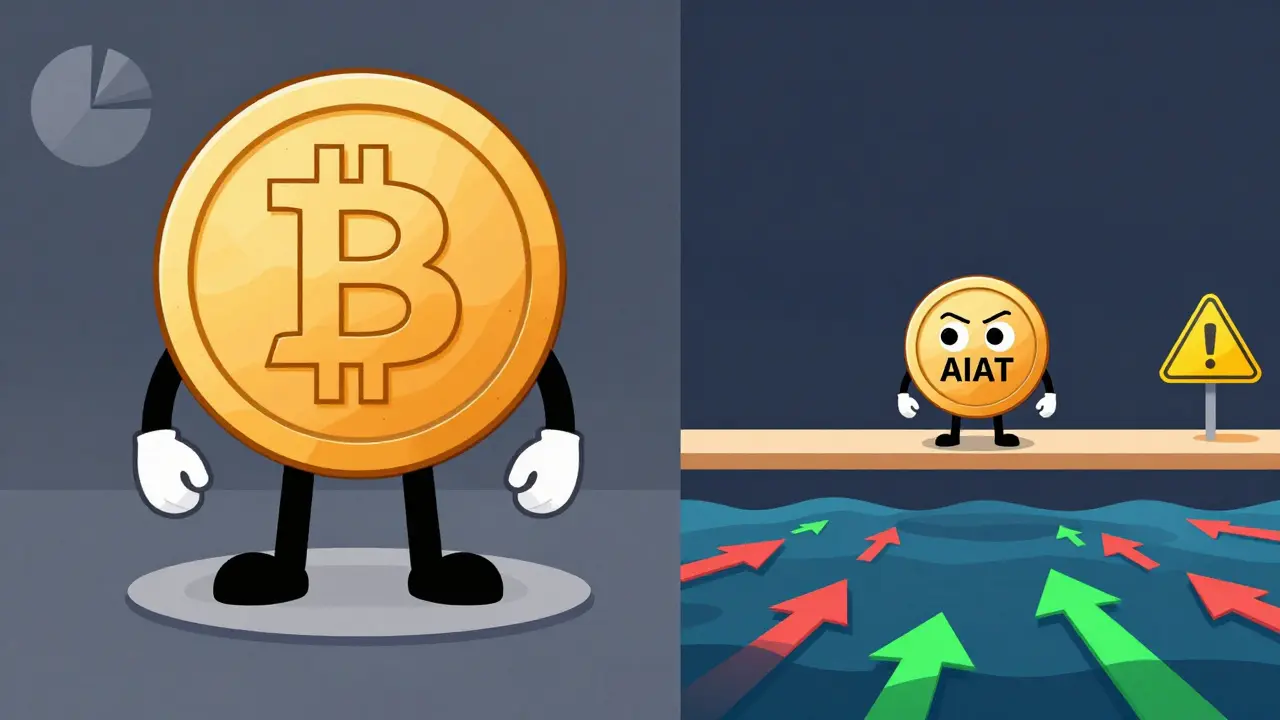
Let’s talk money. AIAT hit its peak in May 2024 at $0.92. Since then, it has settled into a range between $0.30 and $0.37. That’s a drop of over 60% from its high. Is this bad? Not necessarily. The entire crypto market has seen volatility. However, AIAT hasn’t outperformed the broader market during downturns.
In early 2026, while the global crypto market fell roughly 15%, AIAT dropped about 5%. So, it’s slightly more resilient than average, but it’s not leading the charge. The trading volume is modest-often under $500,000 daily. Compare that to giants like Fetch.ai, which sees over $100 million in daily volume. Low volume means low liquidity. If you try to sell a large amount of AIAT quickly, you might suffer from slippage, meaning you get less money than expected because there aren’t enough buyers at your desired price.
Market capitalization fluctuates between $33 million and $45 million depending on the data source. This places AIAT firmly in the "micro-cap" category. Micro-caps are risky. They can double overnight, or they can vanish. AIAT is currently surviving, but it’s not thriving.
How Do You Actually Use AIAT?
A utility token is only valuable if people use it. So, what happens when you hold AIAT? You gain access to the AI Analysis ecosystem. Here is how that looks in practice:
- Trading Signals: The AI Signals service analyzes market data and provides buy/sell recommendations. Users pay for premium access using AIAT. The claim is that these algorithms spot trends faster than human traders.
- Exchange Discounts: On the AI Analysis Exchange, holding AIAT may reduce trading fees. This is a common incentive to keep users locked into the ecosystem.
- Payment Card: The AIA Mastercard allows you to convert crypto to fiat instantly for purchases. Holding AIAT might offer a small fee discount (around 1.5%) on transactions.
But here is the catch: the benefits are marginal unless you are actively trading on their specific exchange. If you just hold the token in a wallet, you’re paying gas fees for nothing. The real value proposition requires active participation in their platform.
Risks and Red Flags
I’m going to be blunt: there are reasons to be cautious. While AIAT is not a scam-it has a website, a contract address, and listed exchanges-it lacks transparency in key areas.
- Unverified AI Claims: How good are the AI signals really? There is no independent audit of their success rate. CryptoQuant shows minimal on-chain activity beyond basic transfers, suggesting few people are actually using the advanced features.
- Limited Exchange Presence: You won’t find AIAT on Coinbase or Kraken. It’s mostly on MEXC, Bybit, and Binance. This limits accessibility for mainstream investors.
- Regulatory Uncertainty: Under the EU’s MiCA framework, utility tokens with unproven utility face scrutiny. Legal experts warn that if the AI services don’t deliver, regulators might reclassify AIAT as a security, which could freeze trading in certain regions.
- Developer Activity: GitHub repositories show limited public developer activity. Without visible code updates, it’s hard to verify if the tech is evolving or stagnant.
User reviews reflect this mixed bag. Trustpilot scores hover around 3.2/5. People praise the easy USDT pairs and customer support, but complain about vague AI performance metrics and low liquidity. One user noted, "The card works, but the fee discount isn't worth holding through a 50% price drop." That’s a sentiment shared by many.

Who Should Buy AIAT?
Not everyone needs this token. If you are looking for a safe, long-term store of value, look elsewhere. AIAT is for a specific type of trader:
- Active Traders: If you plan to use the AI Signals service daily, the token makes sense as a cost-saving tool.
- Speculators: If you believe the AI narrative will boom again in late 2026, the low entry price offers high-risk, high-reward potential.
- Ecosystem Believers: If you trust the AI Analysis Group’s roadmap for cross-chain expansion and institutional APIs, you might bet on future growth.
For passive investors who just want to "set and forget," AIAT is likely not the best choice. The lack of staking rewards or yield farming options means your only hope for profit is price appreciation, which relies entirely on market sentiment and adoption.
Final Thoughts
AI Analysis Token is a real project with a functional product, but it’s far from a guaranteed winner. It occupies a niche in the AI crypto space, competing against much larger players like Fetch.ai and SingularityNET. Its fixed supply and integrated ecosystem are strengths, but low liquidity, unverified AI performance, and regulatory risks are significant hurdles.
If you decide to buy, treat it as a small speculative position. Do your own research, check the current price on multiple exchanges, and never invest more than you can afford to lose. The AI hype cycle is powerful, but only projects with proven utility survive the winter.
Is AI Analysis Token (AIAT) a scam?
No, AIAT is not considered a scam. It is a legitimate ERC-20 token listed on major exchanges like Binance and Bybit, with a verifiable smart contract address. However, it carries high investment risk due to low liquidity and unverified claims about its AI capabilities.
Where can I buy AIAT?
You can purchase AIAT on centralized exchanges such as Binance, Bybit, and MEXC. As of 2026, it is not available on Coinbase or Kraken. You will need an Ethereum-compatible wallet to store your tokens securely.
What is the total supply of AIAT?
The maximum supply of AIAT is capped at 500 million tokens. There is no inflationary mechanism, meaning no new tokens can be created after this limit is reached.
Does AIAT have staking rewards?
Currently, AIAT does not offer prominent staking rewards or yield farming opportunities. Its primary utility is accessing discounted services within the AI Analysis ecosystem, such as trading signals and exchange fees.
How does AIAT compare to Fetch.ai?
Fetch.ai is a much larger project with a significantly higher market cap and trading volume. AIAT is a micro-cap token focused specifically on integrated trading signals and payments, whereas Fetch.ai has broader enterprise partnerships and infrastructure applications.