
- 27 Apr 2026
- Elara Crowthorne
- 25
Most people think all decentralized exchanges are basically the same-you connect a wallet, swap a token, and hope the slippage doesn't eat your profits. But if you've ever tried to move a large amount of capital on a DEX, you know the pain of "price impact." This is where Fraxswap is a fully decentralized onchain Automated Market Maker (AMM) protocol operating on the Polygon blockchain changes the game. Instead of just dumping a huge order into a pool and crashing the price, it uses a specialized tool called TWAMM to drip-feed your trade over time. Whether you're a whale looking to avoid slippage or a casual trader exploring the Polygon network, this review breaks down if Fraxswap is actually the right tool for your kit.
What makes Fraxswap different from the crowd?
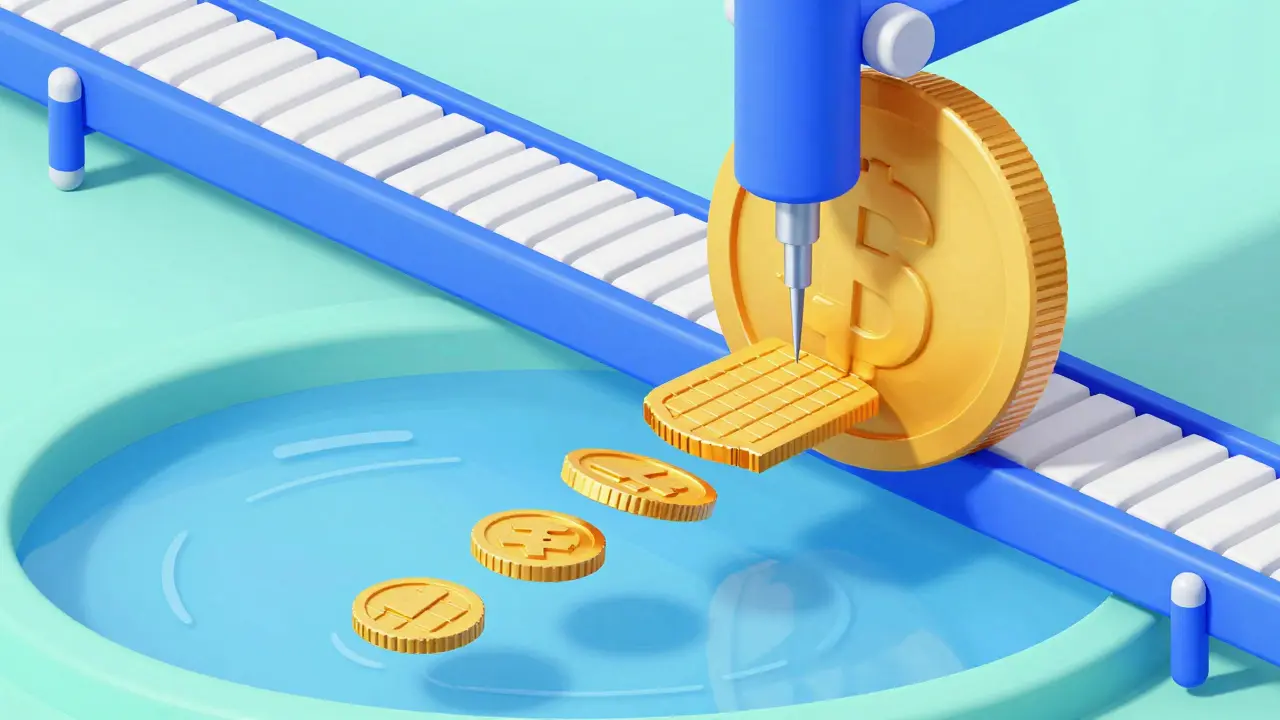
If you've used QuickSwap or Uniswap, you're used to the standard "constant product" model. Fraxswap does that too, but it adds a layer called Time-Weighted Average Market Maker (TWAMM). Think of it like a scheduled payment for your trades. Instead of executing a $50,000 swap in one second, TWAMM breaks it into smaller pieces and executes them over a set period. This prevents the massive price swings that usually happen with big orders.
Built by the team behind Frax Finance , the protocol is deeply integrated with the FRAX stablecoin. This means if you're trading into or out of FRAX, you're getting some of the best stability in the business. In late 2025, data showed FRAX maintained a 99.87% peg to the USD, making it a rock-solid base for trading pairs on the network.
The Trade-Offs: Liquidity vs. Precision
Here is the honest truth: Fraxswap isn't the "biggest" player on Polygon. While it has a killer feature in TWAMM, it doesn't have the raw volume of a giant like QuickSwap. If you're swapping a few tokens for a meme coin, you might find more liquidity elsewhere. But if you're doing professional-grade moves, the precision of Fraxswap is a massive advantage.
| Feature | Fraxswap (Polygon) | QuickSwap | SushiSwap |
|---|---|---|---|
| Main Edge | TWAMM Execution | Massive Liquidity | Yield Farming |
| Daily Volume | ~$2.7 Million | ~$85.3 Million | Moderate |
| Ideal For | Large-order stablecoin swaps | Fast, small retail trades | Liquidity providers |
| Avg Gas Fee | < $0.01 | < $0.01 | < $0.01 |
Is it safe? Looking at the technicals
When you're handing your assets over to a smart contract, "trust me" isn't a good enough answer. Fraxswap's architecture has been put through the ringer. An audit by OpenZeppelin in mid-2025 confirmed the code is robust. They didn't find any critical holes, though they did flag some medium-severity risks regarding front-running. In the DeFi world, front-running is common, but it's something to be aware of if you're trading high-volatility pairs.
Because it's a non-custodial exchange, you keep your keys. Unlike Coinbase or Kraken, where you're trusting a company to hold your money, Fraxswap just facilitates the trade. If the website goes down, your funds are still safe on the blockchain; you'd just need to interact with the contract directly. This "regulatory insulation" is a double-edged sword-you get privacy and control, but there's no customer support hotline to call if you send tokens to the wrong address.
The User Experience: A bit of a climb
If you're a DeFi veteran, you'll feel at home here. If you're new, be prepared for a slight learning curve. Some users have complained that the interface isn't as intuitive as the big names. Setting up TWAMM orders takes a bit more thought than a simple "Swap" button. In fact, surveys suggest it takes about an hour for new users to feel comfortable here, compared to just 20 minutes on QuickSwap.
The most common hiccups usually come from three things:
- Slippage Settings: About 32% of failed trades happen because the slippage tolerance was set too low for the current market volatility.
- Gas Money: Since this is on Polygon, you need MATIC (or POL) to pay for transaction fees. If your wallet is empty of the native gas token, your trade won't go through.
- TWAMM Confusion: Understanding that a TWAMM order is a "process" over time, not an instant click, trips up beginners.
How to get started (Step-by-Step)
If you want to try it out, don't just jump in. Follow these steps to make sure you don't lose funds to a mistake.
- Get a Wallet: Install MetaMask or a similar non-custodial wallet.
- Configure Polygon: Add the Polygon Mainnet. Use the RPC URL
https://polygon-rpc.comand ChainID 137. - Fund with Gas: Send a small amount of MATIC to your wallet. You won't need much-usually less than a few dollars for dozens of trades.
- Connect and Swap: Head to the Fraxswap interface, connect your wallet, and select your pair (e.g., USDC to FRAX).
- Set Your Order: For small amounts, use a standard swap. For larger amounts, explore the TWAMM settings to minimize price impact.
Final Verdict: Who is this for?
Fraxswap (Polygon) isn't trying to be everything to everyone. It's a specialized tool. If you are a retail trader swapping $50 for a new project, you're probably better off with a higher-volume DEX. However, if you are moving significant capital-especially into the Frax ecosystem-the TWAMM functionality is a lifesaver. It's the difference between losing $200 to slippage and getting the actual market price.
Does Fraxswap require KYC?
No. Because it is a fully decentralized exchange (DEX), there are no sign-up forms, email verifications, or identity checks. You only need a compatible crypto wallet to start trading.
What is the average cost of a trade on Fraxswap Polygon?
Thanks to the Polygon network, gas fees are incredibly low. Most swaps cost less than $0.01, though this can fluctuate slightly based on network congestion.
What happens if my transaction fails?
Most failures are due to low slippage tolerance or insufficient MATIC for gas. Check your wallet balance and try increasing your slippage tolerance in the settings menu if the market is volatile.
How does TWAMM actually save me money?
In a standard AMM, a huge buy order pushes the price up instantly (slippage). TWAMM breaks that one big order into many small ones executed over time, allowing the pool to rebalance and keeping your average entry price much closer to the actual market rate.
Is Fraxswap available on other chains?
Yes, Fraxswap is a multi-chain protocol. While this review focuses on Polygon, it is also deployed on other networks like Ethereum and Avalanche, though liquidity and fees vary by chain.
Next Steps and Troubleshooting
If you're an advanced trader, your next move should be exploring the liquidity provider (LP) side. While the yields are slightly lower than QuickSwap (around 1.8% vs 2.5%), the stability of FRAX pairs can make for a more predictable income stream.
If you're a beginner and you're feeling stuck, head over to the Frax Finance Discord. With over 48,000 members, it's the fastest way to get a real person to help you troubleshoot a failed transaction or a wallet connection issue.

25 Comments
TWAMM is a game changer for anyone moving serious size on Polygon, avoids the slippage traps like a charm
The assertion that the interface is a "climb" is an understatement. The UX is fundamentally lacking compared to modern standards, and the learning curve is an unnecessary barrier to entry for an otherwise robust protocol.
Typical retail-centric drivel. The sheer audacity of comparing a specialized tool like TWAMM to the bloated, mindless liquidity of QuickSwap is just laughable. It is a precision instrument for the enlightened, not some playground for those chasing the latest dog-themed token with their pocket change. Honestly, the lack of sophistication in the general trading public is a tragedy of the highest order. One must possess a modicum of intellectual rigor to even appreciate the elegance of time-weighted execution. Why do we even bother explaining these concepts to people who probably still think a seed phrase is for gardening? It's absolutely pathetic. The mediocrity of the average swap is just an insult to the blockchain's potential. I find it tedious to even engage with this level of discourse. Just go back to your meme coins and leave the actual engineering to the adults. It's truly an exercise in futility to hope for a higher standard of financial literacy in this space. Pathetic. Truly.
Imagine the liberation of finally not losing your shirt to a single bad trade! It's like a deep breath for your portfolio. Let's all hold hands and learn how to drip-feed our assets into the future together! ✨
Liquidity is just a mirror reflecting your own desperation 🙄 If you need the "biggest" player, you're just chasing shadows. Real growth happens in the niche. 🌀
I believe the distinction between professional-grade precision and retail volume is an important one to maintain for the health of the ecosystem.
the audit was fine but front running is still a problem and people need to stop ignoring it
Oh, look at the "professional-grade moves" crowd. So brave of you to use a tool that basically just says "I'm too scared to trade all at once." Truly a masterpiece of cowardice disguised as strategy. 🙄
I totally get why the TWAMM part is confusing at first. It's okay to take it slow and maybe ask for help in the Discord if you feel lost!
just gota make sure u got that matic for gas or it wont work lol. happened to me once and i was so mad!!
Who cares about TWAMM? It's just another way to wait longer for your money. Total waste of time.
The gas fees on Polygon really make this accessible for those of us who don't want to spend more on the transaction than the trade itself.
the stability of FRAX is a bit of a myth in the long run
It is wonderful to see more tools becoming available for the community to grow safely!
There is a certain poetic balance in trading over time rather than in a single moment of impulse.
You guys can do this! Just take it one step at a time with the wallet setup! 🚀💪
I agree that a specialized tool is often better than a general one.
Make sure to check the slippage settings... always... before you hit confirm!!!
BRO THE SLIPPAGE IS ACTUALLY INSANE ON SOME PAIRS!! I almost got rekt trying to swap a low cap token!! Total nightmare fuel!!
Quality over quantity, always. :)
this is a vibe for the whales wanting a quiet exit
It is quite fascinating to see how TWAMM mitigates the impact of large orders. Truly an elegant solution to a persistent problem in AMMs! 🌟
Wonder if the TWAMM settings can be automated via API for those of us doing high-frequency balancing
just keep practicing with the interface and it gets easier i promise
We must ask ourselves if the convenience of a "Swap" button has eroded our patience and our soul in the process of financial liberation.