
- 1 Aug 2026
- Elara Crowthorne
- 21
Have you ever wondered why gas fees spike exactly when you need them least? Or why building a decentralized app often feels like paying rent to a landlord who doesn't care about your project's success? Enter Vitreus (WVTRS), a layer-0 blockchain and Decentralized Physical Infrastructure Network (DePIN) designed to fix these exact problems through transparency and a unique dual-token economy. Launched with a focus on AI integration and sovereign identity, Vitreus isn't just another meme coin hoping for viral attention. It’s an infrastructure play aiming to sit beneath traditional blockchains, offering a stable foundation for next-gen apps.
If you’ve seen the ticker WVTRS popping up on exchanges or heard whispers about its "glassy" ethos, you’re likely asking: what actually makes this network different? The short answer lies in how it separates money from mechanics. By splitting governance and transaction costs into two distinct tokens, Vitreus tries to keep fees low even during high traffic. But before you buy or build, let’s break down what Vitreus really is, how its technology works, and whether it fits your portfolio or development stack in 2026.
The Core Concept: What is Vitreus?
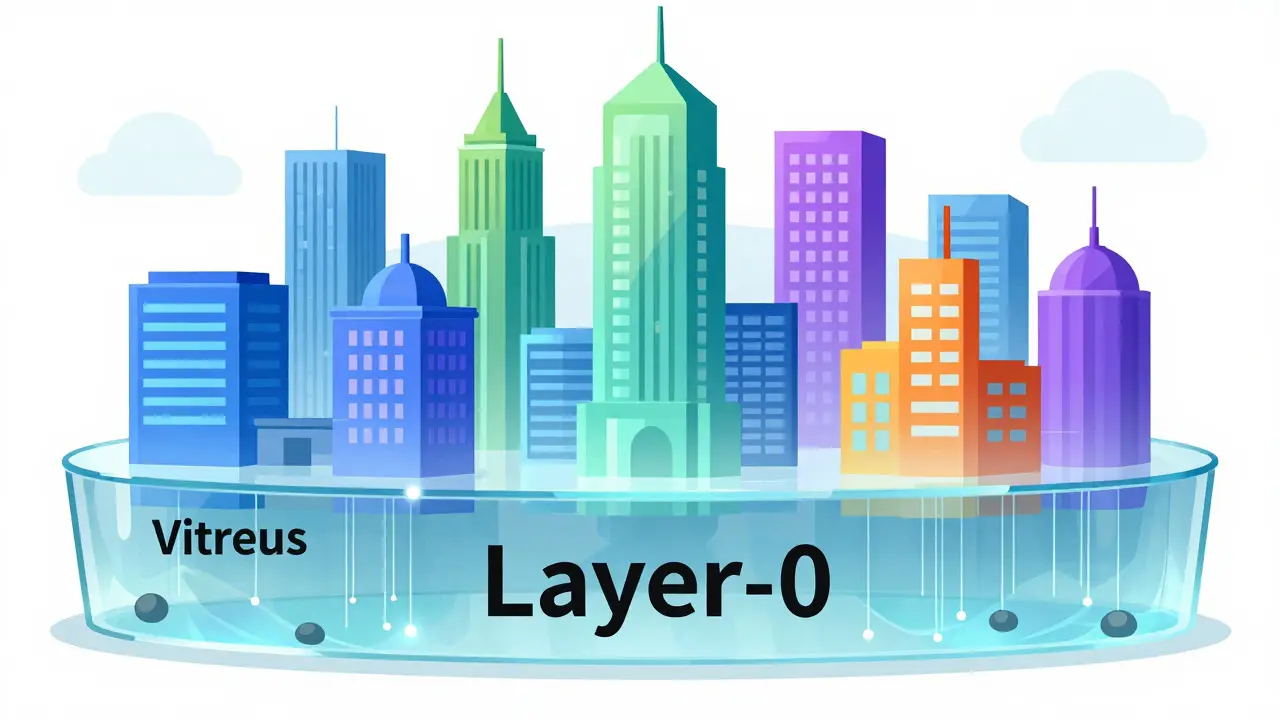
At its heart, Vitreus is a Layer-0 Blockchain. To understand that, imagine a skyscraper. Most people know Layer-1 blockchains like Ethereum or Solana-they are the ground floor, handling transactions directly. Layer-2 solutions are like apartments built on top of that ground floor to handle more speed. Vitreus, however, positions itself as the bedrock beneath the ground floor. It provides the fundamental infrastructure services-like consensus mechanisms and data availability-that multiple Layer-1 blockchains can plug into.
The name Vitreus comes from Latin, meaning "transparent" or "glassy." This isn’t just poetic branding; it reflects the project’s core promise of radical transparency. Operating as a Decentralized Autonomous Organization (DAO), Vitreus requires community voting for all treasury spending. There are no hidden corporate accounts or silent founders moving funds. Every dollar spent is proposed, debated, and voted on by the holders of the governance token.
Furthermore, Vitreus belongs to the growing category of DePIN (Decentralized Physical Infrastructure Networks). Unlike pure financial networks, DePINs incentivize real-world resources. In Vitreus’s case, this means rewarding participants who contribute computational power for AI tasks or help verify sovereign digital identities. You aren’t just shuffling numbers around; you’re helping power a network that connects physical reality with digital intelligence.
The Dual-Token System: Why Two Tokens?
This is where Vitreus gets technical-and interesting. Most blockchains use one token for everything: paying for transactions (gas) and voting on changes (governance). This creates a conflict. If you want to vote, you need to hold the token. If you need to pay for gas, you need to sell the token. During high demand, gas prices skyrocket, forcing users to burn their governance stake just to interact with the network. It’s a vicious cycle.
Vitreus breaks this cycle with a dual-token model:
- VTRS (Governance Token): This is the primary asset. Holding VTRS gives you voting rights in the DAO. It secures the network through staking and rewards active participation. Think of this as your "share" in the company.
- VNRG (Gas Token): This secondary token pays for transaction costs. Because it’s separate from VTRS, developers can scale their projects without worrying that high gas fees will drain their treasury or force them to dump their governance stakes.
This separation is crucial for long-term sustainability. Imagine a developer building an AI app on Vitreus. They can pay for compute and storage using VNRG, which might have a stable, low cost, while retaining their VTRS holdings to influence network upgrades. It minimizes friction and encourages building rather than speculating on fee spikes.
Market Reality: Price, Volume, and Volatility
Let’s talk numbers, because hype means nothing without liquidity. As of early 2026, Vitreus trades across major platforms including Uniswap V3, Coinbase, Binance, and Crypto.com. However, it remains a small-cap project. According to CoinMarketCap, the market capitalization hovers around $2.19 million, with a fully diluted valuation (FDV) of approximately $6.34 million.
The trading activity is modest but growing. Daily volume sits near $80,000, primarily driven by the WVTRS/USDC pair on Ethereum-based DEXs. Prices vary slightly between aggregators due to update delays, but generally trade in the range of $0.009 to $0.011 USD.
| Metric | Value | Note |
|---|---|---|
| Current Price Range | $0.009 - $0.011 | Varies by exchange |
| Market Cap | ~$2.19M | CoinMarketCap data |
| Fully Diluted Valuation | ~$6.34M | Based on max supply |
| Total Supply | 608.75 Million | WVTRS tokens |
| Circulating Supply | 210.38 Million | ~35% of total supply |
| All-Time High (ATH) | ~€0.0989 | Current price is ~89% below ATH |
A critical detail here is the supply structure. Only about 210 million tokens are currently circulating, meaning roughly 65% of the total supply is still locked or unallocated. For investors, this is a double-edged sword. On one hand, limited circulating supply can drive price efficiency. On the other, future unlocks could increase selling pressure if not managed carefully by the DAO. Always check the vesting schedules before buying.
Technical Architecture: AI and Sovereign Identity
Why would a developer choose Vitreus over established chains? The answer lies in its specialized modules. Vitreus integrates Artificial Intelligence (AI) capabilities directly into its layer-0 architecture. This isn’t just marketing fluff; it allows smart contracts to access off-chain AI models securely. For example, an insurance dApp could automatically verify claims using AI analysis without trusting a centralized oracle.
Another pillar is Sovereign Identity. In a world where data breaches are common, Vitreus offers tools for users to own and control their digital identity. Instead of logging in with Google or Facebook, users can authenticate via the Vitreus network, keeping their personal data private while proving their age, creditworthiness, or membership status. This aligns perfectly with the Web3 ideal of self-sovereignty.
The modular design ensures scalability. Since Vitreus operates at Layer-0, it can support multiple custom Layer-1 chains tailored for specific industries-like healthcare, logistics, or finance-each benefiting from the shared security and AI infrastructure of the base layer.
Risks and Considerations
No investment is risk-free, especially in crypto. Here’s what you need to watch out for with Vitreus:
- Liquidity Risk: With daily volumes under $100k, large buys or sells can significantly impact the price. Slippage may be higher than on major coins like Bitcoin or Ethereum.
- Supply Dilution: Remember that 65% of tokens are not yet circulating. Future unlocks could dilute value if demand doesn’t grow proportionally.
- Competition: The Layer-0 and DePIN spaces are crowded. Projects like Filecoin, Render, and various Cosmos ecosystem chains compete for similar mindshare and developer talent.
- Regulatory Uncertainty: As a DAO with governance tokens, Vitreus navigates evolving global regulations regarding securities and decentralized organizations.
However, the recent price momentum-a 59% increase over seven days according to some trackers-suggests growing interest. Whether this translates to long-term adoption depends on the quality of applications built on the platform.
How to Get Started with Vitreus
If you’re ready to explore Vitreus, here’s a practical checklist:
- Buy WVTRS: Use reputable exchanges like Coinbase, Binance, or Uniswap. Ensure you’re buying the correct contract address to avoid scams.
- Stake Your Tokens: Participate in the network’s security by staking VTRS. This earns you rewards and strengthens the chain.
- Join the DAO: Visit vitreus.io to find governance proposals. Vote on treasury spends and protocol upgrades. Your voice matters.
- Explore Developers Docs: If you code, check out the SDKs for integrating AI and identity features into your apps.
Vitreus represents a shift toward transparent, community-owned infrastructure. It’s not trying to be the fastest chain or the cheapest coin. It’s aiming to be the most reliable foundation for the next wave of AI-driven, identity-aware decentralized applications. Whether that vision succeeds depends on the builders who join it and the voters who guide it.
Is Vitreus (WVTRS) a good investment?
Like any small-cap crypto, Vitreus carries high risk and high reward potential. Its innovative dual-token model and focus on AI/DePIN are promising, but its low liquidity and significant upcoming token unlocks mean volatility is expected. Do your own research (DYOR) and never invest more than you can afford to lose.
What is the difference between VTRS and VNRG?
VTRS is the governance token used for voting and staking. VNRG is the gas token used to pay for transaction fees. This separation helps keep costs stable for developers and prevents governance holders from being forced to sell their assets to pay for basic network interactions.
Where can I buy WVTRS tokens?
You can purchase WVTRS on centralized exchanges like Coinbase, Binance, and Crypto.com, as well as on decentralized exchanges like Uniswap V3 on the Ethereum network. Always verify the contract address before swapping.
What does Layer-0 mean in blockchain?
Layer-0 refers to the foundational infrastructure that supports Layer-1 blockchains. While Layer-1 handles transactions directly, Layer-0 provides core services like consensus, data availability, and interoperability, allowing multiple Layer-1 chains to run efficiently on top of it.
How does Vitreus integrate AI?
Vitreus incorporates AI capabilities into its layer-0 architecture, enabling smart contracts to securely access off-chain AI models. This allows for advanced use cases like automated claim verification, predictive analytics, and intelligent decision-making within decentralized applications.

21 Comments
It is absolutely scandalous how these projects promise 'radical transparency' while simultaneously locking up 65% of their supply in the shadows. It reeks of a classic rug-pull setup disguised as innovation. We are told to trust the DAO, yet the founders retain enough power to dilute our holdings into oblivion at any moment. This isn't decentralization; it is feudalism with better branding. The moral decay of this industry is palpable when people cheer for such obvious conflicts of interest.
The dual-token model is actually quite clever if you look past the hype. Separating gas from governance solves the death spiral problem that plagues most L1s. I've been looking into how VNRG stabilizes costs for developers running heavy AI workloads. It allows for predictable budgeting which is crucial for enterprise adoption. The technical architecture seems robust enough to handle the computational demands of decentralized AI inference without choking the main chain.
layer-0 is just marketing jargon for another failed attempt to fix ethereum scalability issues they created themselves. the real agenda is surveillance capitalism wrapped in blockchain tech. sovereign identity means they want your biometrics and behavioral data under the guise of privacy. wake up sheeple. the ai integration is likely just centralized models calling out to a smart contract to verify nothing. typical web3 grift.
Looks promising but the liquidity is scary low 📉
One must consider the philosophical implications of separating money from mechanics. In doing so, Vitreus attempts to decouple value storage from utility execution. This mirrors classical economic theories where currency serves distinct roles. However, does this separation create a bifurcation in community interest? Will governance holders care about network efficiency if their token doesn't pay the bills? It is a fascinating experiment in digital sociology.
I really like the focus on DePIN and AI. It feels like we are finally moving beyond speculative trading into actual infrastructure building. The idea of rewarding people for contributing compute power is brilliant. It democratizes access to high-performance computing resources. Let's hope the community grows and supports these builders! 🚀
Just sitting here watching the charts go sideways. The 'glassy' ethos sounds nice but I need to see more volume before I jump in. It's quiet out there.
the concept of sovereign identity is deeply flawed because true sovereignty requires isolation not connectivity. by linking identity to a blockchain you are creating a permanent record of your existence that cannot be erased. this is the opposite of privacy. furthermore the ai integration relies on black box algorithms that no one understands. we are handing over our digital souls to opaque systems controlled by unelected technocrats.
THEY ARE WATCHING YOU. Every transaction, every vote, every interaction is recorded forever. This is not freedom; it is a panopticon. The 'DAO' is a front for centralized control by venture capitalists who will dump their tokens once retail investors pump the price. Do not fall for the propaganda. The only way to win is not to play. Stay off the grid.
From a structural perspective, the Layer-0 designation implies a foundational role in the interoperability stack. If Vitreus can successfully abstract consensus mechanisms for multiple Layer-1 chains, it could become a critical piece of infrastructure. The challenge lies in achieving sufficient security guarantees without centralizing validation power. Time will tell if the theory holds up against practical implementation.
You guys are missing the point. The dual token system is standard now. What matters is the team behind it. If they have a track record, then maybe. Otherwise it's just another coin. I've seen too many projects fail despite having good tech. Execution is everything. Don't get married to the narrative.
another scam waiting to happen. the elites always find a way to take your money. they use big words like 'sovereign' and 'autonomous' to fool you. but look at the tokenomics. most tokens are locked for insiders. they will sell when you buy. simple as that. don't be a sucker.
Honestly, I feel drained just reading all these negative comments. Why can't we appreciate the effort to build something new? The project has potential. Yes, there are risks, but every investment has risks. Let's support the builders instead of tearing them down. Positive vibes only please! ✨
I think both sides have valid points. The tokenomics do raise some red flags regarding future dilution. However, the technical approach to separating gas and governance is sound. Maybe we should wait for more data on their developer activity before forming a final opinion. Balance is key in crypto.
I hear your concerns about the supply unlock schedule. It is definitely a risk factor that needs careful monitoring. But let's not forget that early adopters often face volatility. If you believe in the long-term vision of AI and DePIN, this might be a small price to pay. Just ensure you diversify your portfolio.
Everyone says it's risky but nobody admits they're FOMO-ing hard. You claim to hate the grift but you're still checking the price every five minutes. The irony is palpable. Meanwhile, the real innovators are working in silence while you argue about tokenomics on Reddit. Keep telling yourself it's transparent though, sure thing buddy.
i think its cool but i dont know much about ai stuff. seems complicated tho.
Great breakdown of the technology. The explanation of Layer-0 versus Layer-1 was particularly helpful for those of us who aren't deep into the tech. It clarifies why Vitreus positions itself as infrastructure rather than just another app chain. Keep sharing these educational posts!
In India we are seeing a lot of interest in DePIN projects because hardware resources are becoming cheaper. This could be a good fit for local developers. Hope to see more integrations soon. 😊
The philosophy behind Vitreus is interesting but the execution is what matters. Too many projects talk about 'transparency' without delivering it. I'll believe it when I see the treasury votes happening in real time. Until then, skepticism is warranted. Also the typo in my previous comment was intentional lol.
Cool project! Love the emoji usage in the docs too 😂 Makes it feel less corporate. Good luck to the team!