

- 13 Mar 2026
- Elara Crowthorne
- 16
Running a cryptocurrency exchange in Canada isn’t like setting up a website and starting to trade. If you’re trying to operate in Canada-whether you’re based there or not-you’re dealing with one of the strictest, most detailed regulatory systems in the world. And it’s not going away. As of 2026, the rules are tighter than ever. The Canadian crypto exchange licensing requirements have evolved into a two-layer system that leaves little room for guesswork. If you’re not compliant, you’re not allowed to serve Canadian users. Period.
Two Paths, One Goal: MSB vs FMSB
All crypto exchanges that touch Canadian customers must register with FINTRAC, Canada’s financial intelligence unit. But how you register depends on where you’re based. If your company is legally incorporated in Canada, you apply as a Money Services Business (MSB). If you’re based overseas but serve Canadian clients, you register as a Foreign Money Services Business (FMSB). Both paths require the same level of compliance-no shortcuts, no exceptions.The key difference? MSBs have to be legally registered in Canada, meaning a Canadian business number, a local address, and often a physical office. FMSBs don’t need a Canadian incorporation, but they must prove they’re actively targeting Canadian users-through advertising, customer support in Canadian time zones, or CAD-denominated transactions. If you’re marketing to Canadians, FINTRAC considers you in scope.
What FINTRAC Demands
Registration isn’t a form you fill out and forget. It’s a full operational overhaul. Here’s what every applicant must deliver:- A designated Compliance Officer: This person can’t be an afterthought. They need direct authority over AML/CFT policies, must be available to regulators, and are personally accountable for reporting failures.
- Customer identification (KYC): You must verify every user’s identity with government-issued ID, proof of address, and facial recognition where possible. No anonymous trading. No exceptions.
- Transaction monitoring: Your system must flag unusual activity-large deposits followed by rapid withdrawals, multiple small transfers to avoid thresholds, or funds moving through high-risk wallets. Automated tools are mandatory.
- Record keeping: Every transaction, every KYC document, every internal review must be stored for at least five years. Digital archives aren’t enough; they must be searchable and auditable.
- Cybersecurity proof: You need to show encryption standards, multi-factor authentication for staff, cold storage for 95%+ of assets, and a tested disaster recovery plan. A hack isn’t just bad PR-it’s a regulatory violation.
These aren’t suggestions. FINTRAC can shut you down on the spot if your systems don’t meet these standards. And they don’t just check paperwork-they audit your live operations.
The CSA Layer: When Crypto Becomes Securities
FINTRAC handles money laundering. But if your exchange lists tokens that qualify as securities under Canadian law, you’re now under the thumb of the Canadian Securities Administrators (CSA). This is where things get serious.Back in February 2023, the CSA rolled out the Pre-Registration Undertakings (PRU). Only exchanges that agreed to these new rules could continue operating. The requirements include:
- No pledging customer assets: You can’t lend out users’ crypto to earn interest. Not even a little. All custodied assets must be fully segregated.
- Stronger Chief Compliance Officer: The CCO must have direct reporting lines to the board and real authority-not just a title.
- Enhanced financial reporting: Quarterly audits of reserves and liquidity, submitted directly to CSA.
- Stablecoin restrictions: You can’t list or trade value-referenced cryptoassets (like USDT or USDC) without written approval from the CSA. Even then, you must prove you hold 1:1 reserves in regulated banks.
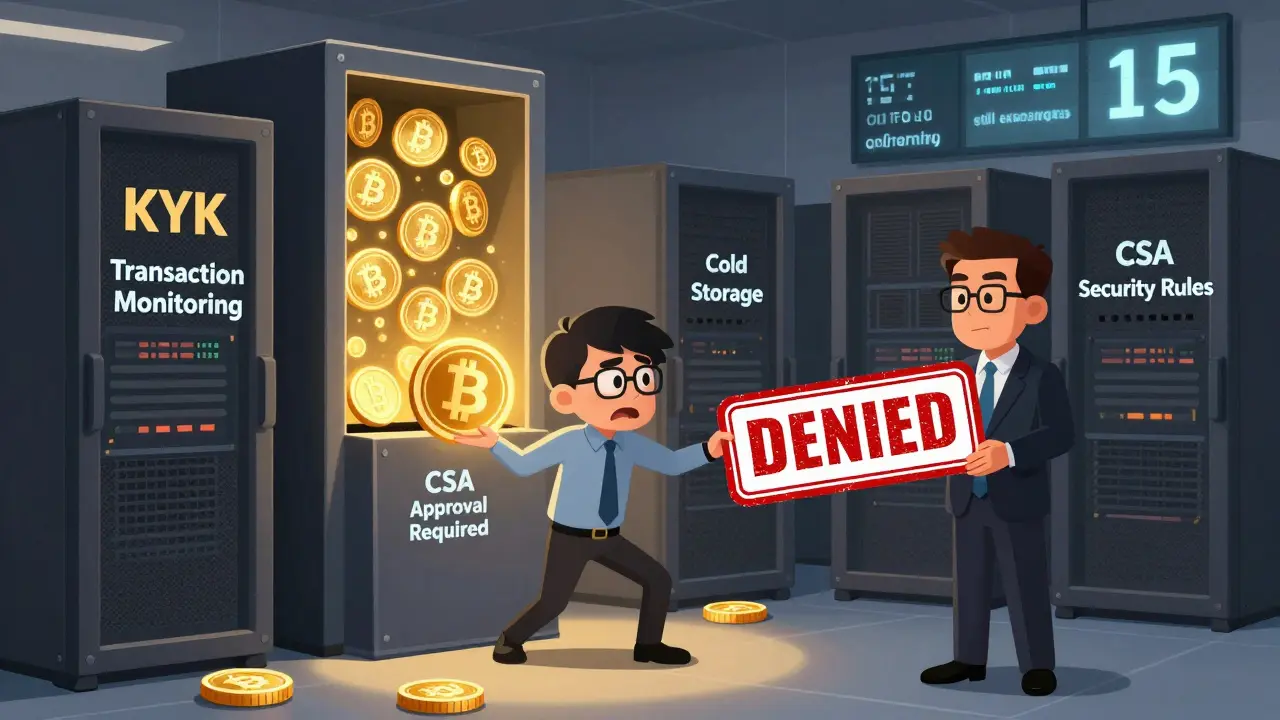
These rules killed dozens of platforms. Before 2023, over 40 exchanges served Canadian users. By late 2024, only 15-20 remained. The ones that stayed had deep pockets, legal teams, and years of compliance experience.
Costs and Timelines: It’s Not Cheap or Fast
If you think you can file online and get approved in weeks, you’re wrong. The process takes 6 to 12 months-assuming you submit everything perfectly the first time. Most applicants get rejected on their first try. Common mistakes? Incomplete ownership disclosures, vague AML policies, or failing to show how transaction monitoring actually works in practice.The upfront cost? Between CAD $50,000 and $200,000 for legal help, compliance software, audits, and documentation. That’s just to get the application submitted. Then there’s the ongoing cost: $100,000 to $500,000 per year depending on volume. That includes staff, software licenses, audits, and regulator fees.
Smaller exchanges can’t afford this. Many simply left the Canadian market. The result? A cleaner, more professional landscape-but fewer choices for users.
What’s Coming Next: Stablecoins, DeFi, and NFTs
Canada isn’t done tightening rules. In 2025, expect new requirements for stablecoin issuers: mandatory monthly reserve audits, public reporting of asset holdings, and restrictions on how those reserves are invested (only in highly liquid, low-risk instruments).DeFi protocols and NFT marketplaces are next on the radar. The CSA and FINTRAC are already drafting guidance that could treat decentralized lending platforms as unlicensed money services businesses. If you’re running a DeFi app that lets Canadians swap tokens or lend crypto, you may soon need a license-even if you’re a DAO with no legal entity.
Canada is moving toward a model where any service that touches Canadian money, even indirectly, must be regulated. It’s not about stopping innovation. It’s about forcing innovation to play by clear rules.

Why This Matters for Users and Operators
For users, this means fewer shady exchanges. The platforms still operating in Canada are the ones with real audits, real compliance teams, and real accountability. Your crypto is safer. Your personal data is better protected.For operators, it’s a barrier-but also a shield. Canada’s rules are tough, but they’re clear. Unlike jurisdictions where regulations shift overnight, Canada gives you a roadmap. If you follow it, you get legitimacy. And legitimacy means access to institutional investors, bank partnerships, and long-term growth.
Canada didn’t become a leader in crypto regulation by accident. It did it by refusing to compromise on investor protection. If you’re serious about operating here, you need to treat compliance like your core product-not a cost center.
Do I need a Canadian business number to register as an MSB?
Yes. To register as an MSB, your company must be legally incorporated in Canada and hold a Canadian Business Number (CBN) issued by the Canada Revenue Agency. Foreign companies cannot apply as MSBs-they must register as FMSBs instead.
Can I operate a crypto exchange in Canada without a license if I don’t have Canadian customers?
Yes-if you actively avoid serving Canadian users. That means blocking Canadian IP addresses, not accepting CAD deposits, and not advertising in Canadian media. If even one Canadian user accesses your platform, FINTRAC considers you in scope and can take enforcement action.
What happens if I don’t register with FINTRAC?
You risk fines up to CAD $5 million, criminal charges for individuals, and forced shutdown. FINTRAC shares data with Canadian banks, so your payment processors will freeze your accounts. Canadian users will be blocked from trading with you, and you’ll be listed on public enforcement notices.
Are stablecoins banned in Canada?
No, but they’re heavily restricted. You can’t list or trade stablecoins like USDT or USDC without written approval from the CSA. Even with approval, you must prove you hold 1:1 reserves in regulated financial institutions and submit monthly audits. Most exchanges avoid them entirely due to the compliance burden.
How do I know if a token is a security in Canada?
The CSA uses the Howey Test-a legal standard from U.S. securities law that’s also adopted in Canada. If the token is an investment in a common enterprise with an expectation of profit based on others’ efforts, it’s likely a security. Most tokens issued by startups or DAOs fall into this category. If you’re unsure, consult a Canadian securities lawyer before listing it.
Next Steps: What to Do If You’re Planning to Launch
If you’re building a crypto exchange and want to serve Canada, here’s your roadmap:- Consult a Canadian regulatory lawyer with MSB and securities experience-don’t skip this.
- Decide whether you’ll incorporate in Canada (MSB) or operate as a foreign entity (FMSB).
- Build your compliance infrastructure: KYC, transaction monitoring, AML policy, cybersecurity.
- Prepare detailed documentation: ownership structure, business plan, risk assessment, CCO resume.
- Submit your application to FINTRAC and CSA (if applicable) simultaneously.
- Expect a 6-12 month review period. Stay responsive to regulator requests.
- Once approved, audit your systems quarterly and update policies as rules change.
There’s no shortcut. But if you do it right, Canada offers one of the most stable, trusted markets for crypto businesses in the world.

16 Comments