

- 7 Dec 2025
- Elara Crowthorne
- 22
Remittance Fee Calculator: Chivo vs Traditional Services
Compare Remittance Costs
Calculate how much you'd save by using Chivo wallet instead of traditional services like Western Union. Chivo offered $0 fees for Bitcoin transactions.
El Salvador made history in September 2021 when it became the first country in the world to make Bitcoin legal tender. At the center of that move was the Chivo wallet - a government-backed app designed to let every Salvadoran send, receive, and spend Bitcoin without fees. The idea was simple: cut out expensive remittance middlemen, bring the unbanked into the financial system, and modernize the economy. But what looked like a bold leap forward turned into a messy, complicated reality.
Why Chivo Was Built
El Salvador’s economy runs on money sent home from abroad. Remittances make up nearly 20% of the country’s GDP. For years, families relied on Western Union and MoneyGram to get cash from relatives in the U.S. - paying up to 10% in fees for every transfer. That’s hundreds of millions of dollars lost every year just in transaction costs. The government’s answer was Chivo. Launched on September 7, 2021, the app let users send Bitcoin instantly, for free, between phones. It also held U.S. dollars, so people could switch between the two currencies. To get people to try it, the government dropped $30 in Bitcoin into every account that downloaded the app. Over 46% of the population installed it in the first few weeks. On paper, it was a success. But adoption wasn’t the same as usage. Most people downloaded Chivo for the free $30 - then stopped using it.The Technical Nightmare
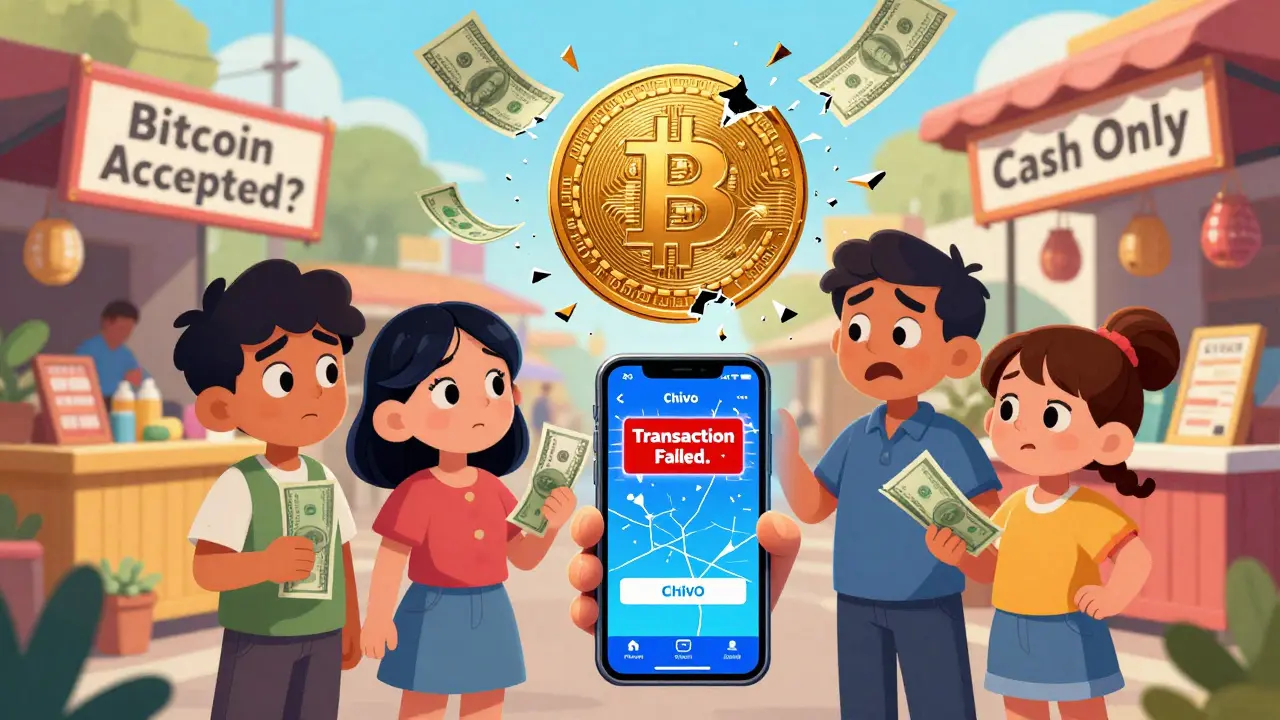
Chivo wasn’t built by a startup. It was built by AlphaPoint, a U.S.-based fintech firm with experience in crypto infrastructure. But scaling a national wallet for 6 million people? That’s a whole different level. Within days, the app crashed. Users couldn’t log in. Transactions failed. Some people lost access to their $30. Others reported identity theft - strangers using stolen IDs to open Chivo accounts and drain funds. The government blamed internet outages. Experts blamed poor testing. The system wasn’t ready. It couldn’t handle the load. Customer service was overwhelmed. People who needed to send money to family couldn’t. The very people Chivo was meant to help got locked out.Bitcoin’s Volatility Hit Hard
Here’s the thing no one talked about enough: Bitcoin isn’t stable. At launch, Bitcoin was around $50,000. By mid-2022, it had dropped to $16,000. That meant the $30 bonus many people got was worth less than $10. Some users who converted Bitcoin to dollars to pay for groceries lost money overnight. A shop owner in San Miguel might accept Bitcoin for a $10 meal. But if Bitcoin drops 20% in a day, that $10 becomes $8 in real value. No one wants to run a business on a rollercoaster. Many businesses started refusing Bitcoin - even though it was legal tender. The government tried to fix this by creating a Bitcoin trust fund to instantly convert Bitcoin to dollars at the point of sale. But the system was clunky. Often, the conversion didn’t work. People got confused. Trust eroded.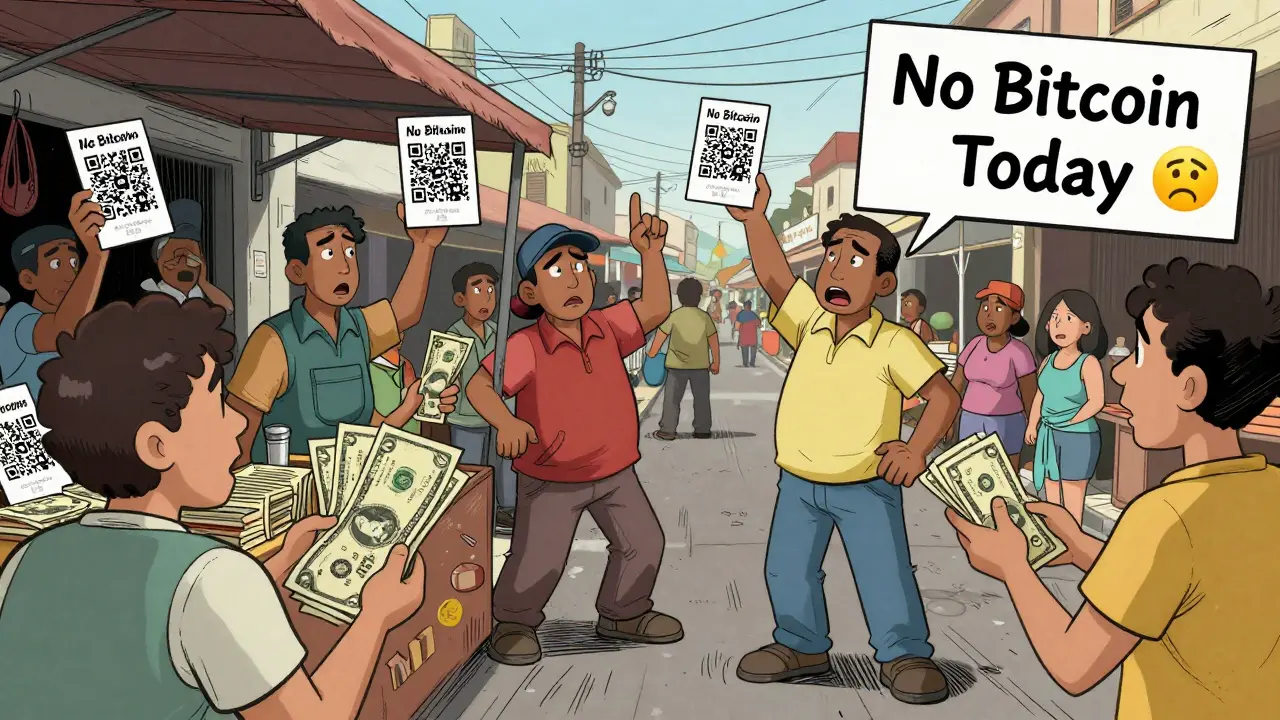
Most People Just Didn’t Get It
A 2024 survey found that 8 out of 10 Salvadorans didn’t use Bitcoin for daily transactions. Why? Because they didn’t understand it. They didn’t know how to secure their private keys. They didn’t trust something they couldn’t hold. They didn’t want to gamble their family’s money on a coin that could lose half its value in a week. The government ran TV ads, held street fairs, and trained teachers to explain Bitcoin. But you can’t force financial literacy. You can’t mandate trust. People didn’t need a government app - they needed reliability. And Bitcoin, at least in its current form, isn’t reliable for daily spending.The IMF’s Ultimatum
By late 2024, El Salvador’s economy was under strain. Inflation was rising. The peso was weak. The country needed a $1.4 billion loan from the International Monetary Fund (IMF). The IMF’s condition? Stop treating Bitcoin as legal tender. It wasn’t about ideology. It was about risk. The IMF said holding Bitcoin on the government’s balance sheet was a financial danger. They pointed to the price swings, the lack of regulatory oversight, and the potential for capital flight. In January 2025, El Salvador officially removed Bitcoin’s legal tender status. It didn’t ban Bitcoin. It just stopped forcing businesses to accept it. The Chivo wallet didn’t disappear - but its role changed. The government stopped funding it. Public sector use ended. By July 2025, all government-owned Bitcoin in Chivo was moved out.
What’s Left Now?
Chivo still exists. People can still use it. But it’s no longer the national project it once was. The $30 incentive is gone. The government no longer promotes it. The app still works - but it’s just another wallet now, competing with PayPal, Wise, and local banks. The government didn’t give up on crypto. In March 2025, it bought more Bitcoin, bringing its total reserve to 6,102 coins - worth about $500 million. It also passed the Digital Assets Issuance Act (LEAD), creating a new regulator, the National Commission of Digital Assets (CNAD), to oversee private crypto businesses. El Salvador is no longer trying to turn everyone into a Bitcoin user. It’s now trying to become a hub for crypto companies - attracting startups, developers, and investors who want to build on crypto infrastructure, without forcing it on citizens.Lessons Learned
The Chivo experiment didn’t fail because Bitcoin is bad. It failed because the rollout ignored human behavior. You can’t force people to adopt technology they don’t understand. You can’t solve poverty with a wallet. You can’t stabilize an economy with a volatile asset - not without safeguards, education, and time. But it wasn’t a total loss. Chivo proved one thing: people in El Salvador want faster, cheaper ways to move money. And they’re willing to try new tools if they’re simple, reliable, and safe. The real win? The world is watching. Countries from Nigeria to Argentina are now studying what happened. Some are considering CBDCs - central bank digital currencies - instead of Bitcoin. Others are building private-sector wallets with better UX and stronger security. El Salvador didn’t change the world by making Bitcoin legal tender. It changed the world by showing how hard it is to do.What Happens Next?
The future of crypto in El Salvador isn’t about every citizen using Chivo. It’s about private companies using the legal framework built under LEAD to offer better crypto services. Think of it like this: instead of forcing everyone to drive electric cars, the government built the charging stations and let the market decide who wants to use them. Chivo’s legacy isn’t in its usage stats. It’s in the doors it opened. It proved that a small country can lead a global financial experiment - even if it doesn’t work perfectly. And sometimes, that’s more valuable than success.Is Chivo wallet still active in 2025?
Yes, Chivo wallet is still active, but it no longer has government backing or promotion. Users can still download and use it to send and receive Bitcoin and U.S. dollars, but the $30 incentive is gone, and the government no longer uses it for public transactions. It now operates as a private fintech app, competing with other wallets like PayPal and Wise.
Why did El Salvador remove Bitcoin as legal tender?
El Salvador removed Bitcoin’s legal tender status in January 2025 after agreeing to conditions from the International Monetary Fund (IMF) for a $1.4 billion loan. The IMF cited Bitcoin’s extreme price volatility, lack of regulatory oversight, and risks to financial stability as reasons. The government agreed to stop requiring businesses to accept Bitcoin and to wind down public sector use of the Chivo wallet by July 2025.
Did Chivo wallet help reduce remittance fees?
For the small percentage of users who actively used Chivo for remittances, yes - it cut fees from 10% down to zero. But since most Salvadorans didn’t use the app regularly, the overall impact on remittance costs was limited. Traditional services like Western Union still dominate because they’re familiar and reliable, even if they’re more expensive.
How many people actually used Chivo wallet regularly?
About 46% of Salvadorans downloaded the app at launch, but a 2024 survey showed only about 20% used it regularly for transactions. Most people downloaded it for the $30 bonus and then stopped. The gap between download numbers and actual usage was one of the biggest signs that the policy didn’t match real behavior.
Is Bitcoin still legal in El Salvador?
Yes, Bitcoin is still legal to own, trade, and use in El Salvador. But it is no longer legal tender - meaning businesses are not required to accept it as payment for goods and services. The government still holds Bitcoin in its Strategic Reserve and supports private crypto businesses through the National Commission of Digital Assets (CNAD).
What happened to the $30 given to Chivo users?
The $30 was a one-time incentive to encourage downloads. It was deposited in Bitcoin and automatically converted to U.S. dollars if users didn’t use it. Many users cashed out immediately, especially when Bitcoin’s price dropped. The government stopped funding the incentive in 2022, and no new deposits have been made since.
Did Chivo wallet improve financial inclusion?
It had potential, but it didn’t deliver. While 70% of Salvadorans were unbanked, Chivo didn’t solve the root problems - lack of trust, low digital literacy, and unstable currency value. Many people who downloaded the app didn’t understand how to use Bitcoin safely. True financial inclusion requires education, stability, and consistent access - none of which Chivo fully provided.

22 Comments
Bitcoin isn't the problem. The problem is treating finance like a tech demo. You don't fix poverty with a wallet. You fix it with stability, education, and trust. Chivo was a beautiful idea built on sand.
El Salvador didn't fail because of Bitcoin. They failed because they confused symbolism with substance.
Let’s be clear: this was a Marxist crypto fantasy wrapped in neoliberal branding. The IMF was right to demand withdrawal. Sovereignty isn’t about forcing citizens into speculative digital gambling-it’s about protecting their purchasing power. This wasn’t innovation. It was economic malpractice.
And now the world watches as another ‘disruptive’ nation learns that markets don’t care about your ideology.
I get why people are skeptical-but let’s not throw the baby out with the bathwater. The real win here? El Salvador proved that millions of unbanked people *want* faster, cheaper money. That’s huge.
The Chivo app failed as a Bitcoin tool, but it succeeded as a wake-up call. Now private companies are stepping in with better UX, better security, and no forced incentives. That’s how real adoption happens-not by decree, but by delight.
Think of it like the early days of smartphones. Nobody used them at first. But once they just worked? Everyone jumped on board. Chivo was the first iPhone that crashed every time you tried to call. But the signal was there.
So many people missed the point. It wasn’t about Bitcoin. It was about dignity.
Imagine being told every time you send money to your mom: ‘Here’s $100, but we’re taking $10 just for the privilege.’ That’s not finance. That’s exploitation.
Chivo didn’t fix everything-but it gave people a glimpse of what freedom could look like. Even if they didn’t use it, they saw it. And that changes everything.
Also, 🤝
Oh sweet mercy, the government gave out $30 in Bitcoin and people didn’t turn into crypto bros? Shocking.
Next they’ll tell me people don’t like paying 10% to send money to their families. What a twist.
So let me get this straight-El Salvador tried to fix remittance fees by making their currency as volatile as a TikTok trend? Brilliant.
Next up: mandatory NFTs for school lunches and Dogecoin pensions. Truly, the future is now.
THIS WAS A COORDINATED ATTACK BY THE IMF AND WALL STREET TO DESTROY A SOVEREIGN NATION’S ECONOMIC INDEPENDENCE!!
Chivo was working perfectly until the U.S. hacked the blockchain nodes through satellite interference! The $30 bonus was a tracking mechanism to monitor every Salvadoran’s spending habits! The real story? The U.S. military wanted control over the Bitcoin reserves to fund covert ops in Central America!!
They didn’t remove Bitcoin because it was volatile-they removed it because it was TOO SUCCESSFUL!!
WHO BENEFITS??
THEY’RE COMING FOR YOUR CURRENCY NEXT!!
so like… the whole thing was a disaster? yeah. no duh. i mean, who thought giving free bitcoin to people who dont know what a private key is was a good idea?
and then the app crashed and people lost their 30 bucks? lol. classic.
now the gov is still hoarding bitcoin like it’s a magic spell. dumb. so dumb. the only thing saved here is the narrative that ‘we tried’
poor people just want to buy rice without losing 20% in a day. not a crypto lottery ticket.
Man, I remember downloading Chivo just to get the $30. Used it once. Sent $1 to my cousin. Then my phone died. Never got the notification. When I checked a week later, it said ‘transaction failed’ but my Bitcoin was gone.
Called customer service. Got a bot. Then an automated email that said ‘thank you for your patience.’
So I cashed out the rest of my bonus to USD. Lost $8 because the price dropped. Never used it again.
Western Union? Annoying. Expensive. But it works. Always. I’ll take that over a government app that thinks ‘Bitcoin’ is a feature, not a whole financial system.
Also, I’m still mad about the 30 bucks. That was my coffee money.
What’s interesting isn’t that Chivo failed-it’s that so many people tried it at all.
There’s a quiet resilience in a country where people, despite all the chaos, still showed up for something new. Even if it was just for the free money.
That hunger for better options? That’s the real legacy. Not the app. Not the Bitcoin. But the fact that millions were willing to step into the unknown.
That’s the spark. Everything else is just noise.
the whole thing was a vibe check fail. nobody cared about bitcoin. they cared about getting money to their moms without getting ripped off.
chivo didn’t fix that. it just made it weirder.
now the gov’s just trying to be the dubai of crypto. like, cool. but don’t ask me to use it. i’m good with paypal.
Bitcoin as legal tender was never about economics. It was about performance art. The government wanted to be the first. The world wanted to see the crash. We got both.
It’s like handing out rocket ships to people who can’t ride bicycles. The rocket ship is real. The bicycles are broken. But you don’t fix transportation by giving out rockets.
Also, the IMF was right. But they’re also the same people who told Greece to cut pensions and call it reform. So take their approval with a grain of salt.
And also, the $30 was a social experiment. We all knew it. We just didn’t admit it.
One must observe, with the utmost intellectual rigor, that the Chivo initiative represented not merely a policy misstep, but a profound epistemological rupture between technocratic idealism and the lived reality of monetary phenomenology among the Global South’s economically marginalized.
By conflating cryptographic infrastructure with socioeconomic emancipation, the Salvadoran state committed a category error of staggering proportions-mistaking the instrument for the end, the medium for the message.
One might posit that the true failure lay not in Bitcoin’s volatility, but in the absence of a hermeneutic framework capable of translating digital asset theory into vernacular financial praxis.
Furthermore, the IMF’s intervention, while ostensibly paternalistic, may be interpreted as a necessary corrective to the romanticization of decentralized finance as a panacea for structural underdevelopment.
It is, therefore, not merely a question of adoption metrics, but of ontological alignment between technology and culture.
And one must also note, with a certain melancholic elegance, that the $30 incentive, though seemingly trivial, functioned as a symbolic currency of hope-its devaluation mirroring the collapse of utopian technopolitics in the face of human inertia.
Perhaps the only authentic legacy of Chivo is its failure: a monument to the impossibility of engineering trust.
And yet, one cannot help but admire the audacity of the attempt.
I don’t get the outrage. People downloaded the app for free money. That’s not failure-that’s human nature.
Would you use a wallet you don’t understand just because the government says so? I wouldn’t.
Chivo didn’t need to be perfect. It just needed to work once. And it didn’t.
So people went back to Western Union. Smart move.
It’s funny how everyone talks about Bitcoin like it’s the villain. But the real villain was the assumption that technology alone can fix deep, generational problems.
You can’t fix financial exclusion by giving people a tool they don’t trust. You fix it by listening to them. By building with them. By making it safe, simple, and slow.
Chivo moved too fast. The people didn’t move with it.
And now? The real innovation isn’t the wallet. It’s the quiet work of local fintechs trying to build something that actually lasts. That’s the future.
Not the hype. Not the headlines. Just good, steady, human-centered design.
El Salvador was trying to break free from the dollar empire. The U.S. didn’t like that. So they used the IMF to choke it. Bitcoin was just the excuse.
They don’t care if people suffer from high remittance fees. They care if a small country dares to build its own financial system.
Chivo was a threat. That’s why it died.
The truth is buried under ‘volatility’ and ‘regulation.’ But we know what really happened.
Chivo’s real lesson? People don’t need to understand Bitcoin to benefit from cheaper transfers.
What they need is a system that works like cash: instant, reliable, no drama.
CBDCs might be the answer-not because they’re crypto, but because they’re controlled by central banks with real oversight.
El Salvador didn’t need Bitcoin. They needed a better dollar.
And now they’re building it. Quietly. Smartly.
They just had to fail first.
i still have the chivo app on my phone. never used it after the first week. but i keep it because it reminds me of that time when my whole country felt like maybe… just maybe… something could change.
it didn’t. but i’m glad we tried.
also i think i lost my 30 bucks but honestly it was just for coffee so whatever lol
Let’s not romanticize the failure, nor demonize the ambition.
El Salvador didn’t set out to make citizens into crypto traders. They set out to give dignity to the remittance economy.
The tools were wrong. The timing was rushed. The education was insufficient.
But the intention? Pure.
And sometimes, that’s enough to change the world-even if it takes a decade to get it right.
Other nations are watching. Learning. Adapting.
Chivo didn’t fail because Bitcoin is flawed.
It failed because we forgot that technology serves people-not the other way around.
It’s not that Bitcoin is bad. It’s that human beings are bad at using it.
Most people don’t want to manage keys. They don’t want to watch charts. They just want to pay their bills.
Chivo was trying to solve a human problem with a technical solution.
And that’s like trying to fix a broken heart with a wrench.
It’s not the tool’s fault. It’s the mismatch.
The real innovation? The fact that people still talk about it.
That’s the sign of a movement, not a mistake.
What a disgrace. A sovereign nation, seduced by the siren song of speculative digital nonsense, abandoned sound monetary policy for a glittering illusion.
The IMF’s intervention was not an infringement-it was a moral obligation.
El Salvador did not merely mismanage its economy; it exposed its populace to systemic financial risk under the guise of progress.
One must ask: what kind of leadership mistakes the volatility of a decentralized asset for the stability of a nation?
And now, in the aftermath, we are told to admire the ‘courage’ of the attempt?
Courage without wisdom is recklessness.
And recklessness, when it endangers the livelihoods of millions, is not heroic-it is criminal.
Wait, so you’re telling me people didn’t use Chivo because they didn’t understand Bitcoin? That’s the whole point. Nobody understands Bitcoin. That’s why it’s so risky.
And now the government’s still holding 6k coins like it’s a lucky charm?
Bro, just sell it. Buy hospitals.