
- 20 May 2026
- Elara Crowthorne
- 0
The Real Problem with Crypto Payment Testing
When you are building a checkout flow that accepts Bitcoin or stablecoins, the stakes feel higher than they do for standard credit card processing. You cannot just swipe a test card number and be done with it. In the world of crypto payments, a single misplaced decimal point in an invoice amount can result in lost funds, and a failed webhook signature verification can leave your order management system stuck in limbo forever.
This is why the sandbox environment matters so much. A sandbox is not just a nice-to-have feature; it is the safety net that allows developers to simulate real on-chain transactions without moving actual value. However, not all sandboxes are created equal. Some mimic the production experience so closely that integration feels like a formality, while others introduce quirks that only reveal themselves when you go live. The question isn't just whether a provider offers a test mode-it is whether that test mode actually prepares you for the realities of blockchain settlement, wallet connectivity, and asynchronous confirmation events.
What Makes a Sandbox Reliable?
To judge if a sandbox "actually works," you need to look at four specific criteria. First, does the test environment mirror the production API endpoints and schemas exactly? If you have to rewrite your code logic to switch from test to live, the sandbox has failed its primary purpose. Second, does it support the full lifecycle of a transaction, including refunds, expirations, and dispute-like scenarios? Third, how realistic is the user experience? Does it force you to use a testnet wallet, or does it abstract away the blockchain entirely? Finally, what kind of tooling does the provider offer? Command-line interfaces (CLIs) and robust SDKs make testing significantly faster than manual dashboard clicks.
Let's break down the major players in the space to see how their environments hold up against these standards.
Coinbase Developer Platform: High Fidelity for Stablecoins
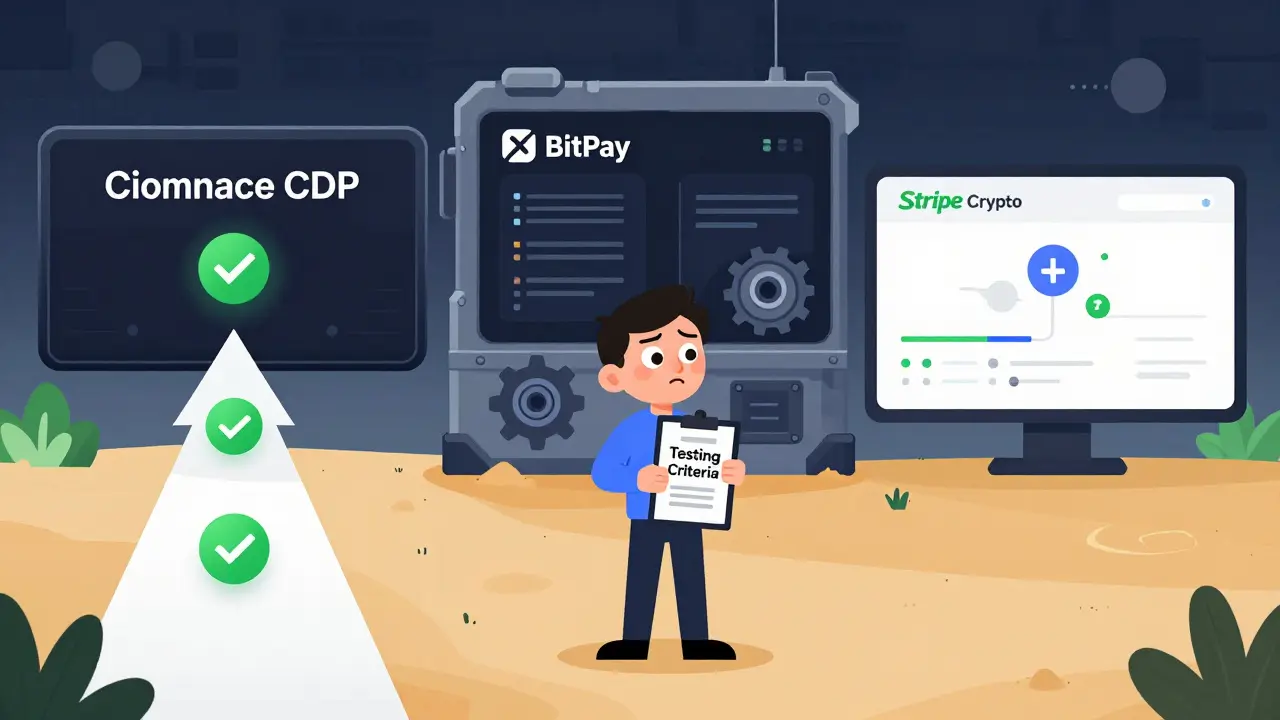
Coinbase Developer Platform (CDP) currently stands out for merchants focusing on USDC payments via Layer 2 networks like Base. Their sandbox environment is designed as a safe, isolated space that mirrors production functionality using simulated data. The technical setup is straightforward: the same API keys used for production work in the sandbox, and the request bodies remain identical. The only change is adding a `/sandbox` path segment to the base URL.
What makes this environment particularly effective is its emphasis on end-to-end flows. Coinbase explicitly recommends using the Base Sepolia testnet alongside a testnet wallet. This means you can simulate the actual user journey: creating a checkout, opening the hosted URL, connecting a wallet, approving the transfer, and receiving a `checkout.payment.success` webhook. Because you are interacting with a real testnet block explorer, you get a sense of latency and confirmation times that pure simulations miss. Data retention in the sandbox is set to 30 days before auto-purge, which keeps your local development logs clean. For teams building complex accounting integrations, this level of fidelity reduces the risk of "it worked in test" bugs when handling refunds or expired checkouts.
BitPay: The Veteran Invoice Engine
BitPay has been around since 2011, and their test environment reflects their long history in merchant services. Located at `test.bitpay.com`, this sandbox allows you to create invoices using a test API token without any on-chain settlement. The REST architecture, JWT-based authentication, and webhook callbacks (known as IPN notifications) behave identically to the production environment.
BitPay’s sandbox is excellent for testing backend logic. It handles invoice creation, status transitions (new, paid, confirmed, complete), and expiration seamlessly. Rate limits and default invoice lifetimes match production settings, allowing you to measure performance accurately. However, the user-facing side is less polished compared to newer competitors. While BitPay supports some testnet wallets, many standard wallets do not support testnet coins by default, which can lead to discrepancies in QR codes or UI elements during testing. If your primary concern is ensuring your server correctly parses invoice statuses and triggers fulfillment actions, BitPay’s sandbox is highly reliable. If you need to test the nuance of a customer struggling to connect a mobile wallet, you might find the simulation too abstract.
Stripe Crypto Test Mode: Unified but Abstracted
Stripe re-entered the crypto space in 2024 with support for USDC on Solana and Ethereum. Their approach leverages their existing, highly regarded test mode infrastructure. There is no separate hostname; instead, you simply use `sk_test_` and `pk_test_` keys. This unification is a massive advantage for developers already embedded in the Stripe ecosystem.
The Stripe CLI tools (`stripe listen` and `stripe trigger`) allow you to simulate lifecycle events like `payment_intent.succeeded` locally without touching a browser. This is incredibly fast for iterating on business logic. However, because Stripe abstracts the blockchain entirely, you never interact with a wallet or see a transaction hash. For custodial flows where the customer pays via a hosted checkout page managed by Stripe, this abstraction is fine. But for merchants who want to understand how on-chain confirmations affect their database state, or those integrating self-custodial wallets, the lack of on-chain visibility in the sandbox can be a blind spot. You are testing the plumbing, but not the water source.

CoinGate and Lightspark: Niche Strengths
CoinGate offers a dedicated sandbox API at `api-sandbox.coingate.com`. It mimics production behavior well for backend integration, supporting order creation and callback URLs. Exchange rates in the sandbox are based on cached market data, which helps test pricing logic. However, documentation regarding testnet wallet usage is sparse. It works great for HTTP-level validation but leaves the UX layer to your own imagination.
On the other end of the spectrum, Lightspark provides a specialized sandbox for the Lightning Network. Since Lightning payments involve complex routing and liquidity dynamics, their simulator allows developers to test edge cases like failed routes, partial payments, and timeouts without risking real BTC. This is invaluable for enterprise-grade implementations requiring high-performance micropayments, though it requires a deeper understanding of Bitcoin infrastructure than standard gateway integrations.
A Different Approach: TxNod's Sandbox Experience
While the giants focus on simulating fiat-like transactions, newer gateways are addressing the specific needs of indie developers and solo founders. TxNod, for example, takes a different approach to sandboxing by removing the friction of hardware wallet onboarding during testing. Instead of forcing you to plug in a Ledger or Trezor device just to generate test keys, TxNod auto-provisions testnet extended public keys (xpubs) for sandbox projects.
This design choice significantly reduces the time-to-first-payment for developers. You can spin up a sandbox project in roughly 30 seconds, drive the integration loop through API calls, and observe real signed webhook events with `mode: "sandbox"`. The structure remains identical to production-meaning the TypeScript SDK still independently re-derives addresses and verifies signatures-but the operational overhead is removed. For vibe-coders and solo operators who want to validate their webhook handlers and address derivation logic without managing faucet funds or testnet bridges, this streamlined process offers a distinct advantage. It proves that a sandbox doesn't need to simulate every possible failure mode to be useful; sometimes, removing barriers to entry is the most productive feature.
| Provider | Key Mechanism | Wallet Interaction | Best For |
|---|---|---|---|
| Coinbase CDP | Sandbox URL path | Real testnet (Base Sepolia) | End-to-end UX & Stablecoins |
| BitPay | Dedicated test domain | Limited/Simulated | Backend Invoice Logic |
| Stripe | Test Keys | None (Abstracted) | Business Logic & Webhooks |
| CoinGate | Sandbox API Endpoint | Minimal Documentation | HTTP Integration Validation |
| Lightspark | Virtual Nodes | Simulated Lightning | Lightning Edge Cases |
| TxNod | Auto-provisioned xpubs | Not required for sandbox | Rapid Solo Founder Iteration |
Common Pitfalls in Sandbox Testing
Even with a robust sandbox, developers often run into predictable issues. One common mistake is assuming testnets behave exactly like mainnets. Ethereum testnets, for instance, can be slower or more congested than expected, causing perceived failures in timeout logic. Another frequent error involves webhook configuration. If your endpoint returns a non-2xx status code, the gateway will retry indefinitely, flooding your logs. Always ensure your handler responds quickly, even if the background processing takes longer.
Additionally, clock synchronization is critical. APIs relying on HMAC signatures or JWT tokens often fail if your server's clock skews by more than a few seconds. Always implement constant-time verification for signatures and log request IDs to debug mismatches. Before launching, rehearse failure scenarios: what happens when an invoice expires? What happens when a payment is reverted due to a chain reorganization? A good sandbox lets you trigger these states manually, giving you confidence that your system won't crash under real-world conditions.
Do I need real cryptocurrency to test my payment integration?
No. Most modern crypto payment gateways provide a sandbox or test mode that simulates transactions without moving real funds. Environments like Coinbase CDP, BitPay, and Stripe allow you to use testnet coins or fully simulated data to validate your API integrations, webhooks, and frontend checkout flows safely.
How do I know if a sandbox accurately reflects production?
Look for three things: identical API endpoints (often distinguished only by a URL path or key prefix), consistent response schemas, and support for the full transaction lifecycle including refunds and errors. Providers like Coinbase and Stripe maintain high parity between test and live environments, minimizing integration drift.
Why would I choose a gateway with auto-provisioned test keys?
Auto-provisioned keys, such as those offered by TxNod, remove the friction of setting up hardware wallets or finding testnet faucets during development. This allows solo founders and developers to spin up a testing environment in seconds, focusing immediately on code logic rather than infrastructure setup.
Can I test Lightning Network payments in a sandbox?
Yes, specialized providers like Lightspark offer sandbox environments specifically designed for the Lightning Network. These simulators allow you to test complex scenarios like route failures and liquidity constraints without risking real Bitcoin on the mainnet.
What are the biggest risks of skipping sandbox testing?
Skipping sandbox testing can lead to incorrect invoice amounts, failed webhook verifications, and broken fulfillment workflows. In crypto, transactions are final and irreversible. Without testing edge cases like expirations or network delays, you risk losing revenue or confusing customers with incomplete orders.
