

- 29 Nov 2025
- Elara Crowthorne
- 14
FinCEN Compliance Cost Estimator
How Much Will Compliance Cost You?
Estimate your annual compliance costs based on your business model and operational scale.
All numbers are estimated ranges based on current regulations and industry benchmarks.
Your Estimated Annual Compliance Costs
Compliance Requirements
If you're running a cryptocurrency exchange in the U.S., FinCEN registration isn't optional-it's the bare minimum. Missing this step doesn't just risk fines. It could shut your business down overnight. And it's not just about filling out a form. FinCEN expects you to build a full compliance system that tracks every dollar, every user, and every suspicious transaction. This isn't 2015 anymore. The rules are clearer, the penalties are steeper, and the agencies are watching closer than ever.
Who Exactly Needs to Register?
Not every crypto business needs to register with FinCEN. But if your platform lets users trade cryptocurrency for U.S. dollars, euros, or other fiat currencies-or even swap one crypto for another-you're almost certainly a Money Services Business (MSB). That includes:- Centralized exchanges like Coinbase or Kraken-style platforms
- Custodial wallet providers holding users’ private keys
- Crypto payment processors that convert crypto to fiat for merchants
- Any service that moves value on behalf of customers, even if you don’t hold funds
It doesn’t matter if you’re small, new, or claim you’re just a "tech company." If you’re transmitting value that substitutes for currency, FinCEN considers you a money transmitter. Even if you block third-party deposits or restrict internal transfers, you still need to register. There’s no loophole for "non-custodial" if you’re facilitating trades.
FinCEN Registration Is Not a License
This trips up a lot of people. FinCEN doesn’t give you a license. You don’t get a certificate you can hang on the wall. You register. That means you’re entering a system where you’re legally obligated to follow strict rules-forever. The registration itself is free, but the real cost comes from what you have to do after you submit the form.Once registered, you must maintain:
- A written Anti-Money Laundering (AML) program approved by your compliance officer
- Customer Identification Programs (CIP) that verify every user’s identity
- Recordkeeping for all transactions over $3,000, stored for five years
- Suspicious Activity Reports (SARs) filed within 30 days of detecting red flags
- Employee training on AML procedures and ongoing monitoring
FinCEN can audit you at any time. If your records are incomplete or your SARs are late, you’re looking at civil penalties up to $1 million per violation-or criminal charges if negligence is proven. In 2023, FinCEN fined a U.S.-based exchange $60 million for failing to file SARs on millions of transactions linked to darknet markets.
The State Layer: It Gets Even Harder
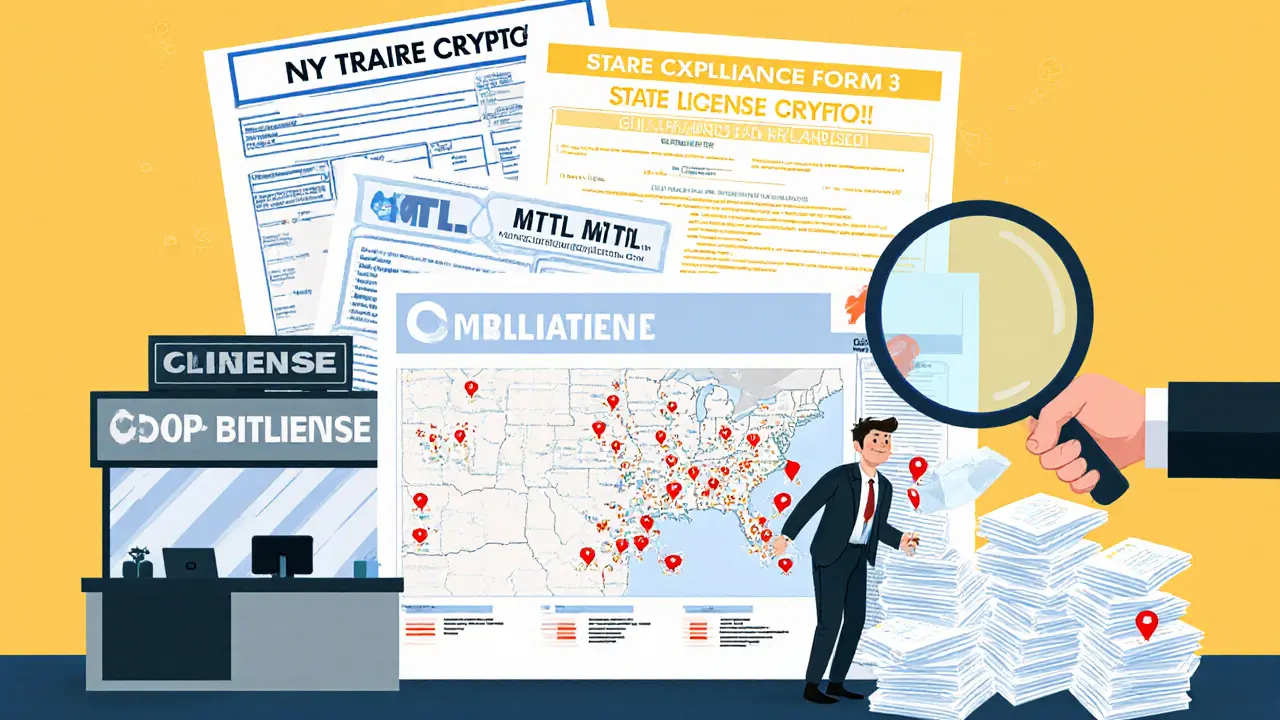
FinCEN is federal. But every state has its own rules. You can’t just register with FinCEN and assume you’re legal everywhere. In 47 states, you need a Money Transmitter License (MTL). That means applying separately in each state-paying fees, submitting financial statements, bonding, background checks, and waiting months for approval.New York is the toughest. You need a BitLicense, which adds another 12-18 months and $50,000+ in legal and compliance costs. California, Texas, and Florida each have their own versions of MTLs with unique reporting formats. If you serve users in 20 states, you’re managing 20 different applications, renewals, and compliance checklists.
Many smaller exchanges avoid this mess by partnering with licensed Money Transmitters. Instead of getting their own licenses, they route transactions through a company that already has them. This is called the "white-label" model. But even then, you’re still responsible for your own AML controls. You can’t outsource compliance.
What FinCEN Actually Watches For
FinCEN doesn’t care if your platform is fast or has a pretty interface. They care about three things:- Who your users are - Do you know their real names, addresses, and IDs? Or are you letting people sign up with fake documents?
- Where the money comes from - Are funds coming from high-risk jurisdictions? Are you ignoring transactions linked to mixers or tumblers?
- What you do when something looks wrong - Did you file a SAR when a user sent $50,000 in Bitcoin to a known darknet vendor? Or did you ignore it?
Since 2023, FinCEN has been cracking down on mixing services-tools that obscure the trail of crypto transactions. If your platform allows users to connect to mixers or doesn’t block them, you’re at high risk. FinCEN now treats CVC (convertible virtual currency) as a monetary instrument under the Bank Secrecy Act. That means the same rules that apply to cash transfers apply to Bitcoin and Ethereum.
Other Agencies Are Watching Too
FinCEN isn’t the only player. The SEC will come after you if you’re trading tokens they classify as securities-like many DeFi tokens or utility tokens that act like investments. The CFTC watches for fraud and market manipulation in crypto commodities like Bitcoin and Litecoin. The OCC regulates banks that custody crypto assets. If your exchange partners with a bank, that bank is also under scrutiny.One exchange in 2024 got hit with a $120 million fine-not from FinCEN, but from the SEC-for offering unregistered token sales. They thought they were only dealing with crypto, but the SEC saw securities. That’s the danger: you can be compliant with FinCEN and still be violating another agency’s rules.
Costs You Can’t Ignore
Let’s break down what real compliance costs:- FinCEN registration: Free (but requires a BSA E-Filing account)
- State MTLs: $5,000-$50,000 per state, depending on bonding and fees
- KYC/AML software: $10,000-$50,000/year for platforms like Sumsub, Jumio, or Trulioo
- Compliance officer: $80,000-$150,000/year salary (must be full-time)
- Legal counsel: $15,000-$40,000/year for ongoing advice
- Transaction monitoring systems: $20,000-$100,000/year
For a small exchange serving 10,000 users across five states, annual compliance costs can easily hit $300,000. That’s before marketing, development, or server costs. Many startups fail because they underestimated this. You can’t build a crypto exchange like a Shopify store. Compliance is part of your product.
What Happens If You Don’t Register?
The consequences are brutal:- Bank accounts frozen-your payment processors will cut you off
- App stores remove your app (iOS/Android)
- Customers withdraw funds and leave
- FinCEN can freeze your assets
- You can be criminally charged for willful non-compliance
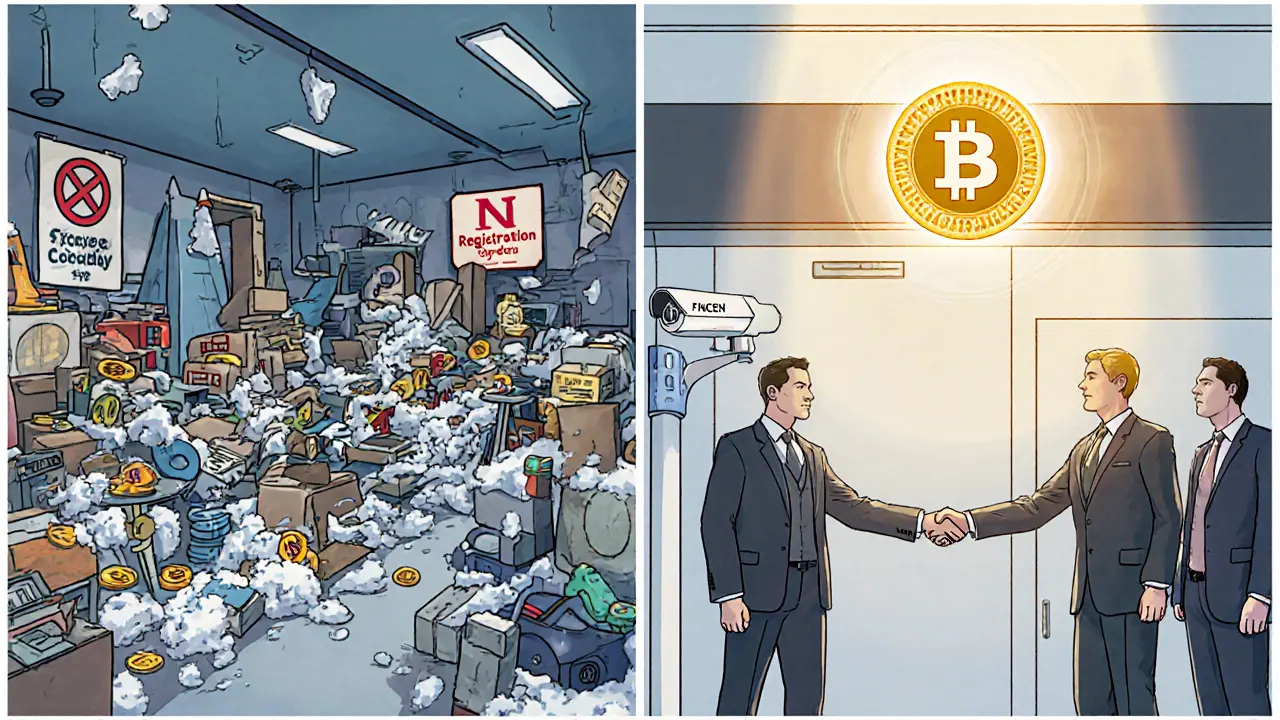
In 2023, a crypto exchange based in Texas operated for 18 months without registering. They had 80,000 users. FinCEN shut them down, seized their servers, and referred the founders to the DOJ. Two were later convicted of operating an unlicensed money transmitting business. One got 18 months in federal prison.
How to Get It Right
If you’re starting out:- Confirm your business model triggers MSB status
- Build your AML program with a compliance consultant who’s handled FinCEN filings
- Choose your first 1-3 states to apply for MTLs
- Implement KYC and transaction monitoring before launch
- File your FinCEN MSB registration (Form 107) through the BSA E-Filing system
- Train every employee-yes, even your customer support team
- Review your compliance program every 6 months
Don’t wait until you have 10,000 users. Do it before your first deposit. FinCEN doesn’t care about your growth. They care about your controls.
What’s Next?
The U.S. government is moving toward more unified crypto rules. There’s talk of a federal crypto license that could replace state-by-state MTLs. But as of 2025, that’s still just a proposal. Until then, you’re stuck in a patchwork of federal and state rules that change constantly.FinCEN’s 2024 guidance clarified that even non-custodial exchanges must report transactions over $10,000 if they involve unhosted wallets. That’s a huge shift. It means if your platform lets users send crypto directly to their own wallets-and that wallet is outside the U.S.-you might still have to report it.
Compliance isn’t a cost center anymore. It’s your competitive edge. Exchanges with strong AML programs attract institutional investors. Banks trust them. Users feel safer. The ones cutting corners? They disappear.
Do I need to register with FinCEN if I only trade crypto-to-crypto?
Yes. If you facilitate the exchange of one cryptocurrency for another on your platform, and users are transferring value through your system, you’re considered a money transmitter under FinCEN’s 2019 guidance. Even without fiat, you’re still transmitting value that substitutes for currency. Registration is required.
How long does FinCEN registration take?
The FinCEN MSB registration form itself can be submitted in a day. But FinCEN doesn’t approve or deny it. They just acknowledge receipt. Your registration becomes active after submission. However, your AML program must be fully operational before you start processing transactions. Many businesses take 3-6 months to build out compliance systems before they file.
Can I register if I’m not based in the U.S.?
Only if you’re doing business with U.S. persons. If your platform accepts U.S. customers, even if you’re based in Canada or Singapore, you must register with FinCEN. The rule is based on who you serve, not where you’re located. If you block U.S. users entirely, you don’t need to register-but you must have strict geo-blocking in place and enforce it.
What’s the difference between FinCEN and a state MTL?
FinCEN handles federal AML and CFT rules under the Bank Secrecy Act. A state MTL gives you legal permission to operate as a money transmitter in that state. You need both. FinCEN says you can’t launder money. The state says you can’t run a business without their approval. One is about conduct. The other is about licensing.
Do I need to report every single transaction?
No. You only need to keep records for transactions over $3,000 and file Currency Transaction Reports (CTRs) for those over $10,000. But you must monitor all transactions for suspicious patterns-even small ones-and file SARs if something looks off. One $500 transfer from a known darknet address can trigger a SAR.
What if I use a third-party KYC provider?
Using a third-party KYC provider helps, but it doesn’t remove your responsibility. FinCEN holds the exchange owner accountable for the accuracy of customer data and the effectiveness of your AML program. If the provider fails and you didn’t audit their system, you’re still liable. Always verify their compliance certifications and audit their logs regularly.


14 Comments
Just ran into this while setting up our exchange in Bangalore. FinCEN’s rules are brutal, but honestly? Worth it. We got hit with a $200k compliance bill, but now our bank doesn’t freeze our accounts anymore. No more panic calls from users.
so like… is this just the government saying ‘you can’t be cool anymore’? 🥲
Yeah I think a lot of us thought crypto was supposed to be free from all this but turns out money is money no matter how you slice it
they’re not even trying to hide it anymore… this is just control. plain and simple. you think you’re building the future but they’re just turning it into a bank with more steps 😭
Ugh. Another ‘compliance’ article. Do you know how many people have written this exact same post? 47. And yet, here we are. Still. Reading. Again. The fact that this is still news in 2025 is the real tragedy.
Look, I get the fear. But this isn’t the end of crypto-it’s the beginning of legitimacy. The ones who survive this are the ones who actually care about users, not just profits. If you’re building something real, compliance isn’t a tax-it’s a badge of trust.
Let’s be real-this whole FinCEN thing is just a distraction. The real threat is the SEC. They’ve been quietly reclassifying every DeFi token as a security since 2022. You can be 100% FinCEN compliant and still get nailed for selling unregistered securities. And don’t even get me started on the OCC’s new bank custody rules-they’re basically forcing every exchange to partner with JPMorgan or die. This isn’t regulation. It’s consolidation. Big Finance is eating the crypto space alive, and they’re using ‘compliance’ as the shovel.
you think this is about money laundering? nah. they’re building the surveillance state one KYC form at a time. they want to know every wallet you touch, every coin you move. soon they’ll be freezing accounts for ‘suspicious behavior’ like buying ETH after a protest. this isn’t regulation-it’s digital redlining. and the worst part? most people are fine with it. they just want to trade. they don’t see the trap. but i do. i see it.
Why do people keep pretending this is fair? You spend $300k to follow rules that change every quarter, while some guy in the Philippines runs a Telegram bot with 500k users and zero compliance. The system is rigged. And we’re just the suckers playing by the rules.
It is imperative to underscore that regulatory adherence is not an obstacle to innovation; rather, it is the foundational architecture upon which sustainable, user-centric financial ecosystems are constructed. The imperative for rigorous KYC/AML protocols is not merely a legal obligation-it is a moral commitment to financial integrity.
i get why people are mad but honestly if you want to operate in the us you gotta play by the rules. i’ve seen too many startups get wrecked because they thought they could skip compliance. it’s not about trust, it’s about survival. and yeah, it’s expensive-but so is prison
THIS. THIS RIGHT HERE. I’ve been screaming this for years. You can’t build a crypto exchange like a side hustle. You need a compliance officer who actually understands the Bank Secrecy Act-not some intern who learned it from a YouTube video. If you’re not ready to spend six figures on this, don’t start. Save your money. Build something else.
biggest thing people miss-state licenses aren’t just paperwork. they’re relationships. you need to talk to regulators, go to meetings, send updates. it’s not a checklist. it’s a conversation. and if you treat it like a chore, they’ll shut you down faster than you can say ‘unlicensed money transmitter’
usa thinks it owns the world with its rules. we in india dont care. we run p2p with no paperwork. if you want to play in the usa then pay the toll. but dont act like this is justice. its just american imperialism with a compliance form