- 1 Dec 2025
- Elara Crowthorne
- 0
GMX Leverage Calculator
GMX Arbitrum isn’t just another crypto exchange. It’s a fully decentralized platform where you trade perpetual futures with up to 100x leverage-without giving up control of your funds. No KYC. No middleman. No risk of exchange collapse like FTX. If you’ve ever wanted the speed and leverage of Binance or Bybit but with true self-custody, GMX on Arbitrum is one of the few places that actually delivers it.
How GMX Works on Arbitrum
GMX operates as a decentralized perpetual exchange built specifically for Arbitrum and Avalanche. Unlike centralized exchanges that match your orders with other users, GMX uses a unique liquidity pool model. When you open a trade, you’re not betting against another trader-you’re trading against a pool of funds locked in by liquidity providers. This eliminates the need for order books and drastically reduces slippage, even on large trades. The Arbitrum network makes this possible. With transaction fees as low as $0.05 and block finality under one second, GMX can handle high-frequency trading that would be impossible on Ethereum mainnet. This is why GMX accounts for nearly half of Arbitrum’s total locked value (TVL) as of mid-2025. It’s not just popular-it’s foundational to the network’s growth. The platform runs two versions: V1 and V2 (called "Synthetics"). V2, launched in early 2023, fixed major issues from earlier market crashes. It introduced better liquidation protections, reduced price impact, and made trades nearly immune to temporary price spikes. Today, V2 is the default experience. You don’t need to choose-it’s automatic.Trading Features That Stand Out
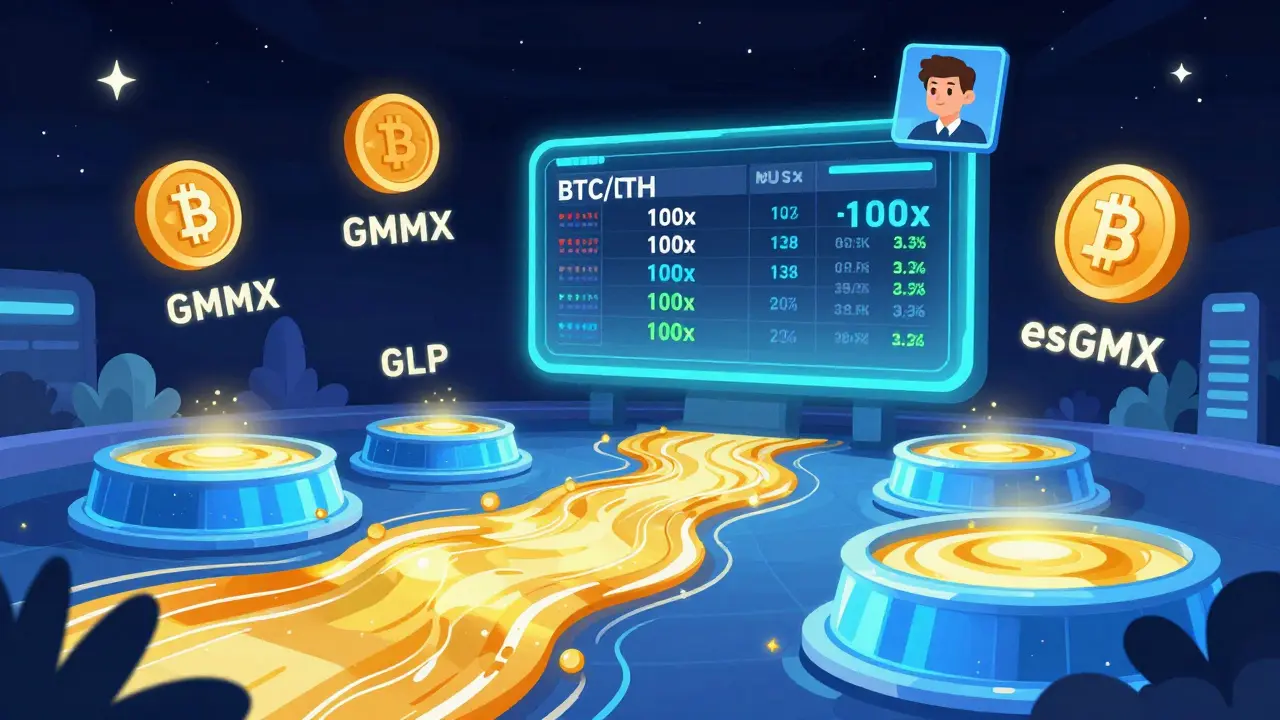
GMX gives you access to 100x leverage on major assets like BTC, ETH, AVAX, ARB, and SOL. That’s the same leverage you’d find on centralized exchanges-but here, your funds never leave your wallet. You don’t deposit into GMX. You connect your MetaMask or WalletConnect wallet, and trade directly from there. The price feed is pulled from multiple sources, not just one exchange. This prevents manipulation and reduces false liquidations during flash crashes. If Bitcoin drops 5% in 30 seconds on Binance but stays flat on Coinbase and Kraken, GMX won’t liquidate you. It sees the bigger picture. You can also trade with zero price impact on most trade sizes. That means if you buy $10,000 worth of ETH, the price doesn’t move for you. This is rare in DeFi and usually only found in centralized exchanges with massive order books. GMX achieves this through deep liquidity pools funded by users who stake GLP tokens.The Three-Token Ecosystem: GMX, GLP, and esGMX
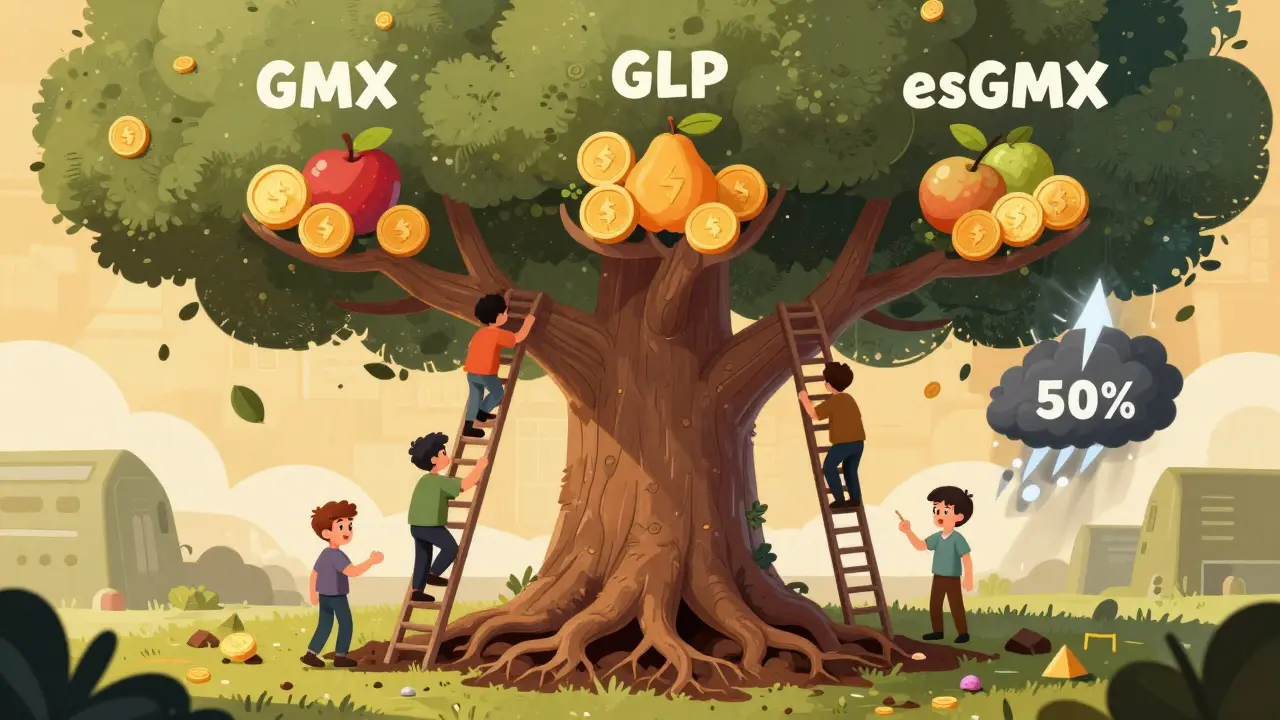
GMX’s token model is complex, but it’s also its biggest strength. There are three tokens you need to understand:- GMX is the governance token. Hold it to vote on protocol changes, like fee adjustments or new asset listings.
- GLP is the liquidity provider token. When you deposit ETH, BTC, or other assets into the GMX pool, you get GLP in return. In exchange, you earn a share of all trading fees generated on the platform.
- esGMX is a reward token you earn by staking GMX. It’s not tradeable, but it accumulates value over time and can be exchanged for GMX or ETH at a later date.

How GMX Compares to dYdX, Hyperliquid, and MUX
GMX isn’t the only decentralized perpetual exchange. dYdX, Hyperliquid, and MUX are its main rivals. Here’s how they stack up:| Feature | GMX (Arbitrum) | dYdX | Hyperliquid | MUX |
|---|---|---|---|---|
| Leverage Max | 100x | 20x | 50x | 50x |
| Asset Selection | 8-10 major cryptos | 12+ cryptos | 15+ cryptos | 6 cryptos |
| Fee Distribution | 80% to stakers | None | None | 50% to stakers |
| Price Impact | Minimal on most trades | High on large trades | Low | High |
| KYC Required | No | No | No | No |
| TVL (Arbitrum) | $1.8B | $220M | $1.1B | $85M |
Who Is GMX For?
GMX isn’t for everyone. It’s built for traders who understand leverage, liquidation risk, and DeFi mechanics. If you’re new to crypto, you might get burned. High leverage can wipe out your position fast-even with protections. But if you’ve traded on centralized exchanges before and are tired of trusting them with your money, GMX is the upgrade. You get:- Same leverage, same speed, same assets
- No withdrawal delays or account freezes
- Real revenue sharing-your trades earn you ETH
- No KYC, no identity checks, no censorship
Weaknesses and Risks
GMX isn’t perfect. Here are the real downsides:- Too many tokens-GMX, GLP, esGMX. It’s confusing. Many users don’t understand how they interact, leading to missed rewards.
- Limited asset selection-No memecoins, no small-cap altcoins. If you trade Shiba Inu or Dogecoin, you’re out of luck.
- No mobile app-You have to use a browser. No native iOS or Android app yet.
- Regulatory risk-No KYC means it could be blocked in some countries. The U.S. SEC hasn’t targeted GMX yet, but that could change.
- Complex liquidation mechanics-Even with protections, a 50x leveraged position can still be wiped out in a 2% move if you’re not careful.
How to Get Started
You don’t need to sign up. You don’t need to verify your email. Here’s how to start trading on GMX (Arbitrum):- Install MetaMask or WalletConnect.
- Buy ETH and bridge it to Arbitrum using the official Arbitrum Bridge or a service like Synapse or Orbiter.
- Go to gmx.io and connect your wallet.
- Deposit ETH, USDC, or another supported asset into the GLP pool to earn fees, or skip this step and trade directly.
- Select your pair (e.g., BTC/ETH), choose leverage (5x-100x), and place your order.
Final Verdict
GMX on Arbitrum is the most mature decentralized perpetual exchange in crypto. It’s not just a trading platform-it’s a revenue-generating protocol that pays its users. The combination of low fees, deep liquidity, high leverage, and profit-sharing makes it unmatched. If you’re a serious DeFi trader who wants to avoid centralized exchange risks, GMX is the best option on the market. It’s not for beginners. It’s not for casual traders. But if you understand leverage, want to earn passive income from your trades, and value self-custody above all else-this is where you belong.It’s not just a platform. It’s a community-owned financial system-and it’s growing.
Is GMX safe to use?
GMX is non-custodial, meaning your funds never leave your wallet. The smart contracts have been audited and have a $5 million bug bounty program. No exchange has ever been hacked on GMX. However, high leverage trading carries inherent risk-your position can be liquidated if the market moves against you. Always use stop-losses and never risk more than you can afford to lose.
Can I trade altcoins on GMX?
Only major cryptocurrencies are supported: BTC, ETH, AVAX, ARB, SOL, DOT, LINK, and a few others. You cannot trade memecoins like Dogecoin or Shiba Inu. GMX focuses on liquidity and stability, so it avoids low-volume, volatile assets.
How do I earn rewards on GMX?
There are two ways: Stake GMX tokens to earn ETH and esGMX, or provide liquidity by depositing assets into the GLP pool to earn a share of all trading fees. GLP stakers also get bonus rewards from Arbitrum’s incentive program. APY ranges from 15% to 30%, depending on trading volume and market conditions.
Do I need to do KYC to use GMX?
No. GMX requires no identity verification. You only need a Web3 wallet like MetaMask. This makes it popular in regions with strict crypto regulations, but also increases regulatory risk in the long term.
What’s the difference between GMX and GLP?
GMX is the governance token-you use it to vote and earn staking rewards. GLP is the liquidity token-you deposit assets like ETH or USDC to receive GLP, and in return, you earn trading fees from the platform. You can hold both at the same time.
Can I withdraw my funds anytime?
Yes. Since GMX is non-custodial, you control your funds at all times. You can withdraw from the GLP pool or close your positions anytime. However, there’s a 30-day cooldown if you unstake GMX tokens before the lock-up period ends.