

- 13 Jun 2026
- Elara Crowthorne
- 0
Launching a cryptocurrency exchange without the proper paperwork is like building a skyscraper on sand. It might look impressive for a moment, but it will collapse under the first regulatory storm. In 2026, the era of wild west crypto operations is officially over. Regulators are watching closely, and the cost of non-compliance isn't just a fine-it's the shutdown of your entire business.
If you are planning to launch a platform where users trade crypto for fiat currency or even swap one digital asset for another, you need a crypto exchange license. This isn't a single document you grab from a website. It is a complex web of federal registrations and state-by-state permits that vary wildly depending on where you operate and what services you offer.
Quick Takeaways: What You Need to Know
- FinCEN Registration is mandatory for almost all US-based crypto businesses as an MSB.
- You likely need a Money Transmitter License (MTL) in every state where you have customers if you handle fiat-to-crypto transactions.
- New York requires a specialized BitLicense, which is stricter and more expensive than standard MTLs.
- Capital requirements can range from $250,000 to $500,000+ depending on the state.
- The process takes 12 to 24 months and costs between $50,000 and $150,000+ in legal and application fees.
Understanding the Regulatory Landscape
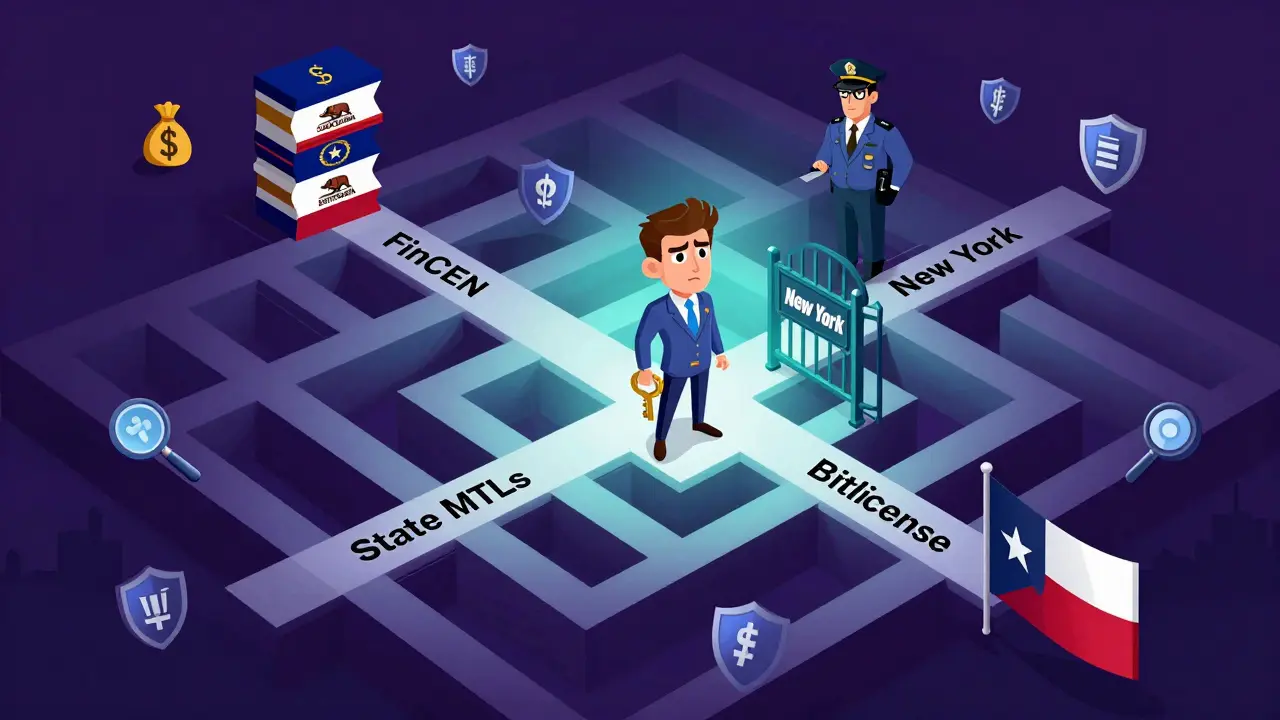
To navigate this maze, you first need to understand who is watching. The United States uses a dual-level system. At the top, you have federal agencies. At the bottom, you have individual state regulators. You must satisfy both.
At the federal level, the key player is the Financial Crimes Enforcement Network (FinCEN). Under the Bank Secrecy Act, any business involved in money transmission-including crypto exchanges, wallet providers, and certain broker-dealers-must register as a Money Service Business (MSB). This is your baseline requirement. Without FinCEN registration, you are operating illegally at the federal level. Your job here is to implement robust Anti-Money Laundering (AML) and Countering the Financing of Terrorism (CFT) programs. You aren't just checking boxes; you are actively monitoring transactions for suspicious activity.
However, FinCEN registration alone doesn't let you do business with customers in specific states. That’s where state regulators come in. If you accept USD deposits to buy Bitcoin, you are acting as a money transmitter. Most states require a Money Transmitter License (MTL) for this activity. Think of the MTL as your local permit to move money around. Each state has its own rules, fees, and capital requirements. There is no "national" MTL. If you want to serve customers in California, Texas, and New York, you need three separate licenses.
Federal Requirements: The FinCEN Baseline
Let's start with the federal floor. Registering with FinCEN is relatively straightforward compared to state licensing, but it carries heavy ongoing obligations. You must designate a Compliance Officer responsible for overseeing your AML program. This person needs real authority within your company, not just a title on a resume.
Your compliance program must include:
- Know Your Customer (KYC) Procedures: You must verify the identity of every user. This means collecting government-issued IDs, proof of address, and sometimes biometric data. In 2026, regulators expect digital-first verification methods that are secure and efficient.
- Transaction Monitoring: Automated systems must flag unusual patterns. For example, if a new account immediately moves large sums of crypto through multiple wallets, your system should alert human analysts.
- Suspicious Activity Reports (SARs): If you detect potential money laundering, you must file a SAR with FinCEN. Failure to file when required is a serious crime.
- Recordkeeping: You must keep detailed records of all transactions and customer information for at least five years.
For some businesses, other federal agencies step in. If you list tokens that are deemed securities, the Securities and Exchange Commission (SEC) and the Financial Industry Regulatory Authority (FINRA) will regulate you. If you deal in crypto derivatives like futures or options, the Commodity Futures Trading Commission (CFTC) and the National Futures Association (NFA) take charge. These layers add significant complexity and cost.
State-by-State Licensing: The Real Challenge
This is where most startups stumble. Obtaining an MTL in one state is manageable. Doing it in 30+ states is a massive operational undertaking. Here is how the major jurisdictions stack up in 2026.
| State | License Type | Min. Capital Requirement | Key Characteristics |
|---|---|---|---|
| New York | BitLicense | $500,000+ | Highly restrictive, extensive background checks, ongoing audits, high renewal fees ($50k+). |
| California | MTL | $250,000 - $1,000,000 | Large market, strict consumer protection laws, high insurance requirements. |
| Texas | MTL | $100,000 - $500,000 | Business-friendly, but requires detailed operational plans and strong AML controls. |
| Illinois | Exempt* | N/A | Exempts entities dealing exclusively in digital currency from MTL requirements, but FinCEN registration still needed. |
| Delaware | MTL / Digital Asset Dealer | $100,000 | Often used for corporate structuring, faster processing times, lower costs. |
*Note: Illinois exemptions can change. Always consult current state statutes.
New York: The BitLicense Hurdle
New York stands apart with its BitLicense. Issued by the New York State Department of Financial Services (NYDFS), this is widely considered the toughest license to get. It applies to any business interacting with NY residents. The application is exhaustive. You need to provide detailed organizational charts, physical security protocols for storing private keys, and evidence of financial stability. The minimum capital requirement is often cited around $500,000, but many applicants find they need more to demonstrate solvency. The annual renewal fee alone exceeds $50,000. Many startups choose to block New York users initially because the cost and time investment are prohibitive.
California: High Stakes, High Rewards
California is the largest consumer market in the US. Getting an MTL here is expensive and rigorous. The Department of Financial Protection and Innovation (DFPI) demands proof of financial stability, often requiring net worth statements showing at least $250,000 to $1,000,000 depending on the scale of operations. They also scrutinize your cybersecurity measures heavily. Given the size of the CA market, this license is essential for serious growth, but it comes with a price tag.
Strategic Approaches: Delaware and Wyoming
Many companies start with Delaware or Wyoming. Delaware offers a streamlined process for incorporating and obtaining a money transmitter license, making it a good entry point. Wyoming was one of the first states to pass specific digital asset laws, creating a clearer legal framework for crypto businesses. While these licenses don't automatically allow you to operate nationwide, they provide a solid foundation and can help establish banking relationships.
The Application Process: Step-by-Step
Getting licensed isn't just about filling out forms. It's about proving you are a trustworthy, stable, and compliant business. Here is the typical workflow.
- Corporate Structuring: Set up your legal entity. Ensure your bylaws and operating agreements reflect your commitment to compliance. Define clear roles for directors and officers.
- Business Plan Development: Write a comprehensive plan detailing your services, target market, revenue model, and risk management strategies. Regulators want to see that you understand the risks of the crypto industry.
- AML/KYC Program Design: Draft your policies and procedures. Specify how you will verify identities, monitor transactions, and report suspicious activities. Use technology partners who specialize in crypto compliance.
- Capital Preparation: Secure the necessary funds. You'll need to show bank statements and audited financials if requested. Have enough cash flow to cover initial losses and operational costs.
- Insurance Acquisition: Obtain errors and omissions (E&O) insurance and cyber liability insurance. Some states require specific coverage amounts.
- Application Submission: Submit applications to FinCEN and relevant state regulators. Pay the fees. Be prepared for back-and-forth communication with examiners.
- Background Checks: All principals, owners, and key employees will undergo thorough background checks. Any past legal issues, even minor ones, can delay or derail your application.
- Audits and Inspections: Expect regulators to audit your systems before granting the license. They may test your KYC processes and review your transaction logs.
Costs and Timeline: Managing Expectations
Be realistic about resources. A single state MTL application can cost $10,000 to $50,000 in legal fees, consultant charges, and filing fees. Add in the capital requirements, and you're looking at hundreds of thousands of dollars. If you pursue licenses in 10 states, multiply those costs significantly.
Time is another factor. FinCEN registration can take a few weeks to a few months. State MTLs typically take 6 to 12 months per state. The BitLicense can take 12 to 24 months. Plan your launch accordingly. You cannot legally transact with users in a jurisdiction until you have the approved license in hand.
Onshore vs. Offshore: Making the Right Choice
Some founders consider offshore jurisdictions like Malta, Estonia, or the British Virgin Islands. These places often offer faster licensing and lower capital requirements. However, there are trade-offs. An offshore license does not protect you from US enforcement if you serve US customers. In fact, it can make things worse, as regulators may view offshore structures as attempts to evade oversight.
If your primary market is the United States, an onshore license is non-negotiable. It builds trust with users, banks, and institutional partners. Banks are hesitant to open accounts for unlicensed or offshore-only crypto businesses due to de-risking pressures. Having a US license signals legitimacy and reduces friction in establishing banking relationships.
Ongoing Compliance: The Work Never Stops
Getting the license is just the beginning. Regulators expect continuous adherence to rules. You must file regular reports, renew licenses annually, and update your AML programs as new threats emerge. The regulatory landscape in 2026 is dynamic. New guidance from FinCEN or SEC can change overnight. Stay informed. Hire a dedicated compliance team or partner with a specialized legal firm. Treat compliance as a core business function, not an afterthought.
Remember, the goal isn't just to avoid penalties. It's to build a sustainable, trusted platform. Users are increasingly aware of regulatory status. A licensed exchange commands higher fees and attracts more volume because people feel safer depositing their funds. In the long run, compliance is your competitive advantage.
Do I need a license if I only trade crypto for crypto?
Yes. Even if you don't touch fiat currency, you are likely still considered a Money Service Business (MSB) under FinCEN rules and must register. Additionally, many states require an MTL for crypto-to-crypto exchanges if they facilitate the transfer of value. Check specific state regulations, but assume you need a license unless explicitly exempted.
How much does it cost to get a crypto exchange license in the US?
Costs vary widely. Federal FinCEN registration is relatively cheap (under $1,000). However, state MTLs involve legal fees, application fees, and capital requirements. Expect to spend $50,000 to $150,000+ for initial setup across several states, plus millions in capital reserves depending on the jurisdictions.
Can I operate a crypto exchange without a license?
Technically, yes, but it is illegal and highly risky. Operating without a license exposes you to severe fines, criminal charges, and seizure of assets. It also prevents you from opening bank accounts and partnering with legitimate payment processors. The regulatory crackdown in 2026 makes this path untenable for any serious business.
What is the difference between a BitLicense and an MTL?
An MTL is a general money transmitter license issued by most states. A BitLicense is a specialized license issued only by New York. It is stricter, more expensive, and covers a broader range of virtual currency activities. You need a BitLicense to operate in New York, while an MTL suffices for most other states.
How long does the licensing process take?
FinCEN registration can take 1-3 months. State MTLs typically take 6-12 months per state. The New York BitLicense can take 12-24 months. Overall, plan for 12-24 months to be fully licensed in major markets.
Do I need a license if I am based outside the US?
If you serve US customers, yes. US regulators assert jurisdiction over foreign entities targeting US persons. You will likely need to register with FinCEN and obtain state licenses. Ignoring this can lead to blocking of US IP addresses being insufficient; active enforcement actions can occur.
What happens if my license application is denied?
You can usually appeal the decision or reapply after addressing the regulator's concerns. Common reasons for denial include inadequate AML programs, lack of financial stability, or problematic background checks. Consult with legal experts to understand the specific grounds for denial and improve your application.
