
- 12 Jun 2026
- Elara Crowthorne
- 0
Imagine buying a high-performance computer to mine Bitcoin in your apartment in Al-Wafra. The fans roar, the electricity meter spins wildly, and you start seeing profits. Then, one day, the Ministry of Interior knocks on your door. They aren't there to chat about hash rates. They are there to confiscate your equipment, slap you with a fine that could wipe out your savings, and potentially throw you in jail. This isn't a hypothetical nightmare scenario; it is the daily reality for anyone trying to navigate Kuwait banking and crypto mining ban restrictions.
Kuwait stands as an outlier in the Gulf Cooperation Council (GCC). While neighbors like the UAE and Bahrain build regulatory sandboxes to attract blockchain innovation, Kuwait has drawn a hard line in the sand. Since July 2023, the country has enforced an absolute prohibition on all cryptocurrency activities. If you are living in Kuwait, visiting for business, or considering investing in the region, understanding these rules is not optional-it is essential for protecting your assets and your freedom.
The Regulatory Hammer: Who Said No and Why?
To understand why Kuwait is so strict, we have to look at who is pulling the strings. This wasn't a decision made by a single department. On July 17, 2023, a coordinated strike was launched by four major authorities:
- Central Bank of Kuwait (CBK): Issued circulars forbidding local banks from facilitating any crypto transactions.
- Capital Markets Authority (CMA): Banned investment in digital assets and prohibited issuing licenses for virtual asset services.
- Insurance Regulatory Unit: Prevented insurance companies from covering crypto-related risks.
- Ministry of Commerce and Industry: Blocked businesses from using crypto for payments or trade.
The driving force behind this unity is Anti-Money Laundering (AML) and Countering the Financing of Terrorism (CFT) compliance. Specifically, Kuwait is implementing Recommendation 15 of the Financial Action Task Force (FATF) standards. The FATF is the global money laundering watchdog, and Kuwait wants a clean bill of health. By banning crypto entirely, they remove the ambiguity. There is no "gray area" for regulators to worry about. As Dr. Abdulhadi Al-Khouri from the Kuwait Institute for Scientific Research noted in early 2025, this precautionary approach aligns with the country’s conservative financial philosophy.
Crypto Mining: The Power Grid Crisis
If trading crypto is illegal, mining it is treated even more harshly because it threatens physical infrastructure. Kuwait relies heavily on oil for energy production. Running energy-intensive mining rigs strains the national grid, leading to power outages in residential and commercial areas.
The enforcement here is technical and aggressive. The Ministry of Electricity and Water uses monitoring systems to detect abnormal power consumption patterns. In May 2025, reports surfaced of over 1,000 suspected mining locations identified nationwide. In neighborhoods like Al-Wafra, inspectors found homes consuming up to 20 times more electricity than a typical residence. When they show up, they don't just ask you to stop. They seize the hardware.
| Violation Type | Maximum Fine | Potential Jail Time | Enforcement Body |
|---|---|---|---|
| Illegal Mining Operation | 50,000 KD (~$164,000 USD) | Up to 5 years | Ministry of Interior / Ministry of Electricity |
| Bank Facilitating Crypto Transfer | $8.2 million (aggregate sector fines in 2024) | N/A (Corporate penalties) | Central Bank of Kuwait |
| P2P Fraud/Scams | Varies by fraud severity | Variable | Ministry of Interior Cyber Crime Unit |
Note the jump in fines. Under Article 12 of the 2025 Financial Technology Amendment Law, the maximum fine for crypto mining skyrocketed from 10,000 KD to 50,000 KD. That is a massive deterrent. The government is sending a clear message: the cost of breaking the law far outweighs the potential profit from mining.
The Banking Blockade: Can You Move Money?
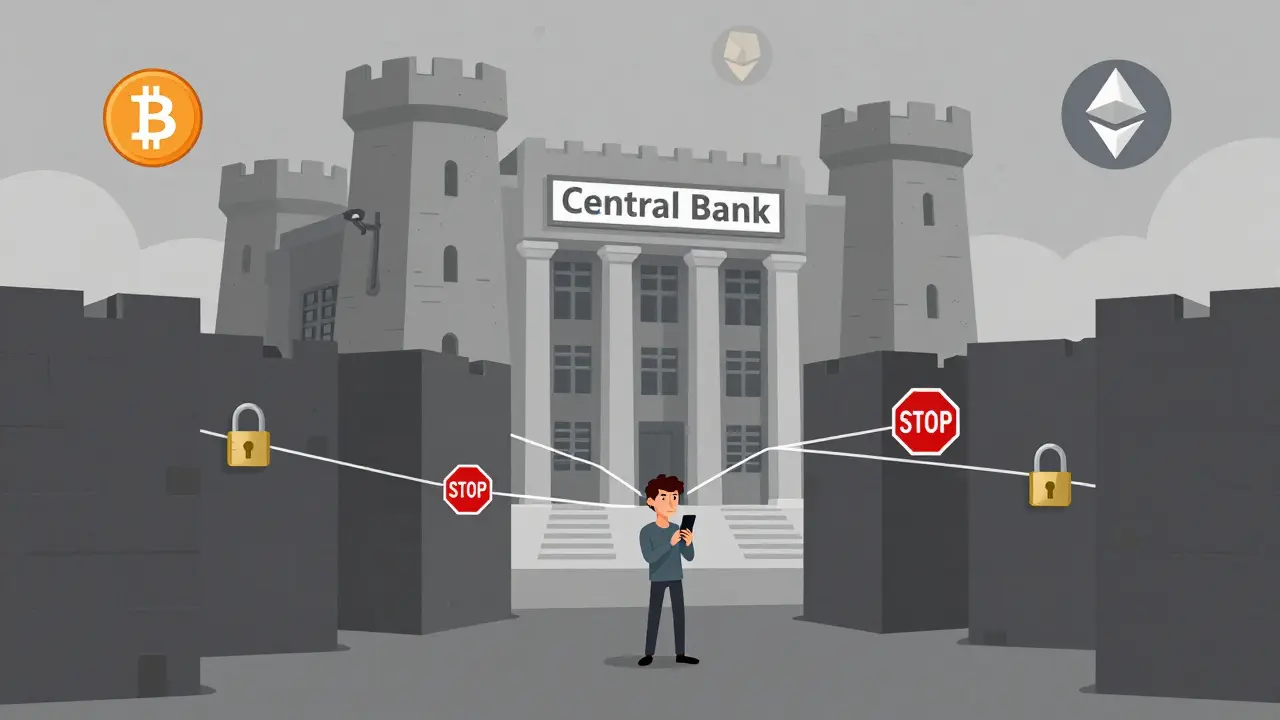
You might think, "I won't mine. I'll just buy Bitcoin on an international exchange and hold it." Here is where the banking sector becomes your biggest obstacle. The Central Bank of Kuwait has explicitly forbidden all local banks, financing companies, and exchange companies from trading in cryptocurrencies or facilitating related transactions.
This means you cannot transfer money from your National Bank of Kuwait account to Binance, Coinbase, or Kraken. If you try, the transaction will likely be blocked. Worse, if you receive funds from a known crypto exchange into your local bank account, your account can be frozen. Users on forums report having multiple accounts frozen since 2023 simply for receiving withdrawals from overseas platforms.
In May 2025, the crackdown tightened further. The CBK directed telecommunications providers to block access to 137 international crypto exchanges. This measure affects an estimated 92% of Kuwaiti crypto users. So, not only can't you move the money legally, but accessing the platforms themselves has become technically difficult without using workarounds that carry their own risks.
Kuwait vs. The GCC: A Tale of Two Approaches
To appreciate how extreme Kuwait's stance is, you have to look next door. The Gulf region is split into two camps: those embracing crypto and those banning it.
| Country | Regulatory Stance | Key Development | User Base Estimate |
|---|---|---|---|
| Kuwait | Absolute Prohibition | No licenses issued; heavy fines & telecom blocks | ~45,000 (Underground) |
| UAE | Pro-Innovation | Dubai VARA established; 250+ licensed firms | 1.2 million active users |
| Bahrain | Licensed Framework | 12 VASP licenses issued by March 2025 | Growing steadily |
| Saudi Arabia | Sandbox Approach | 7 specialized firms approved under SAMA sandbox | Significant institutional interest |
| Qatar | Softening | Digital asset framework expected Q2 2025 | Emerging |
The economic impact of this divergence is staggering. Between 2023 and 2025, Kuwait forfeited an estimated $1.2 billion in potential blockchain-related investments. Meanwhile, the UAE's blockchain sector generated 15,000 jobs and contributed $2.1 billion to its GDP in 2024 alone. Critics, like Dr. Noura Al Dhaheri from Khalifa University, argue that Kuwait's ban creates a "regulatory vacuum" that drives activity underground, actually increasing financial risks rather than reducing them. However, the Kuwaiti government prioritizes stability over growth in this specific sector.

The Underground Market: Risks and Realities
Bans rarely kill demand; they just drive it underground. In Kuwait, the crypto community has moved to Telegram groups and peer-to-peer (P2P) networks. A popular Telegram group with over 3,500 members facilitates trades outside the banking system. But this comes with severe risks.
Without legal recourse, scams thrive. In January 2025, residents lost approximately $40 million to a fraudulent token called "Bitcoin Kuwait." Because the activity is illegal, victims cannot easily go to the police for help without incriminating themselves. Social media sentiment analysis shows 67% negative feedback regarding the ban, with users complaining about missed investment opportunities and technological stagnation. Yet, some business owners defend the ban, citing protection from the volatile scams that plague less regulated markets.
What Comes Next? Future Outlook
Is there any hope for change? Not anytime soon. Predictions from the Carnegie Endowment suggest Kuwait may develop a limited framework for *blockchain technology* (excluding cryptocurrencies) by 2027. This means supply chain tracking or secure data storage might eventually be allowed, but buying Bitcoin remains off-limits. Any liberalization of actual crypto trading is unlikely before 2030.
The International Monetary Fund (IMF) noted in its 2025 Financial Stability Report that while Kuwait's approach mitigates short-term financial risks, it increases long-term opportunity costs. The country is betting on stability, but it is paying a price in innovation and global competitiveness.
Can I legally own Bitcoin in Kuwait?
Technically, yes, you can possess the private keys to Bitcoin stored on a personal wallet or hardware device. However, all activities surrounding it-buying, selling, trading, mining, or using it for payment-are strictly prohibited. The ban targets the *activity* and *financial facilitation*, not necessarily the static possession of the digital file itself, though acquiring it through local channels is impossible.
Will my bank account be closed if I use crypto?
It is highly risky. The Central Bank of Kuwait requires banks to monitor for crypto-related transactions. If your account receives funds from a known exchange or shows patterns consistent with P2P crypto trading, the bank may freeze your account pending investigation. Multiple user reports confirm accounts being frozen since 2023 for such reasons.
Why is Kuwait banning crypto when neighbors like UAE allow it?
Kuwait prioritizes strict Anti-Money Laundering (AML) compliance and adherence to FATF Recommendation 15. Unlike the UAE, which seeks to become a global fintech hub, Kuwait adopts a conservative financial philosophy. They view the volatility and anonymity of crypto as a threat to financial stability and national security, preferring total prohibition over complex regulation.
What happens if I get caught mining crypto?
The consequences are severe. Under the 2025 Financial Technology Amendment Law, you face fines up to 50,000 KD (approx. $164,000 USD) and potential prison sentences of up to 5 years. Additionally, the Ministry of Electricity will confiscate your mining hardware, and you may be liable for the excess electricity consumed.
Are there any exceptions for blockchain technology?
Currently, the ban focuses on cryptocurrencies and virtual assets. However, experts predict Kuwait may introduce a separate regulatory framework for non-crypto blockchain applications (like enterprise data management) by 2027. For now, any project involving tokens or speculative assets is prohibited.
