- 9 Jun 2026
- Elara Crowthorne
- 0
Imagine you open a new restaurant. You have no customers, so you offer free meals to anyone who sits at your tables. Suddenly, the place is packed. But once the free food stops, everyone leaves. This is the core dilemma of Liquidity Mining Token Emissions, which are systematic distributions of cryptocurrency tokens to users who provide liquidity to decentralized finance (DeFi) protocols. They are the engine that started the DeFi boom, but they can also be a trap if you don't understand how they work.
In 2026, the game has changed. The wild west days of 1,000% APRs that collapsed overnight are mostly behind us. Today, protocols use sophisticated math to keep your money safe while paying you rewards. If you want to earn yield without losing your principal to 'mercenary capital' traps, you need to know what these emissions really are, where they come from, and how to spot a sustainable model versus a death spiral.
The Origin Story: Solving the Chicken-and-Egg Problem
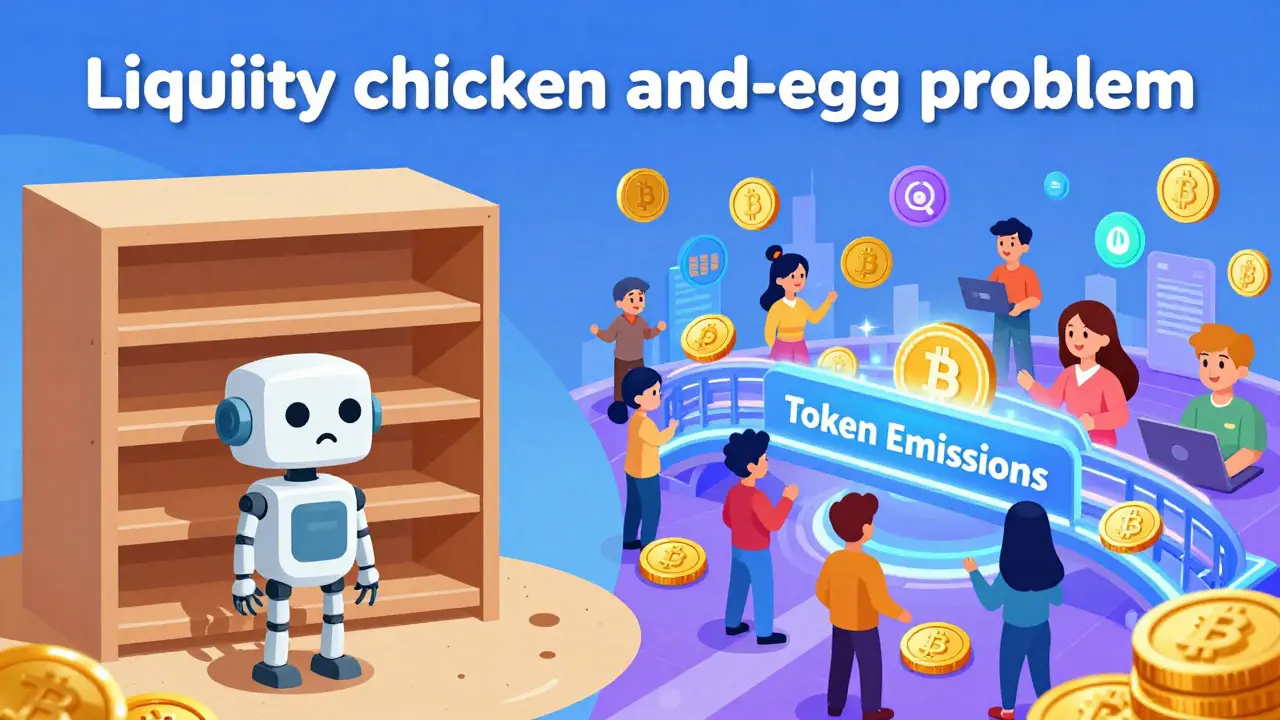
Decentralized exchanges like Uniswap or lending platforms like Aave need two things to function: borrowers/traders and liquidity (the actual crypto assets). But here’s the catch-no one wants to trade on an empty exchange, and no one wants to lock their money in an exchange with no traders. This is known as the 'liquidity chicken-and-egg problem.'
The breakthrough came on June 15, 2020, when Compound launched its COMP token. Instead of selling tokens to investors, they gave them away to users who lent and borrowed. Specifically, 42% of the total supply was allocated to liquidity providers through emission schedules. It worked instantly. Ethereum’s DeFi ecosystem distributed over $12.7 billion in token emissions between 2020 and 2025. This model proved that you could bootstrap a market by paying people to be the market makers.
However, early models were crude. They often used linear vesting or fixed rates that didn’t account for market volatility. This led to massive inflation and price crashes. Today, we look back at those early days as a learning phase for what has become a complex financial instrument.
How Token Emissions Actually Work
At its heart, a token emission is just code releasing new coins into existence. But not all releases are equal. When you deposit funds into a pool, smart contracts track your share and distribute tokens accordingly. Here are the three main ways this happens in modern DeFi:
- Linear Vesting: Tokens are released at a steady rate over time. For example, Uniswap’s initial distribution involved a 4-year vesting period for 400 million UNI tokens. This prevents immediate dumping by recipients.
- Decay Curves: The reward rate drops over time to encourage early adoption and reduce long-term inflation. SushiSwap famously halved its emissions every two weeks. This creates urgency but can lead to rapid liquidity migration if the drop is too steep.
- Zone-Based Reduction: More complex models, like EarnPark’s K(z) model, decline emissions based on specific zones or performance metrics. This allows protocols to adjust dynamically based on Total Value Locked (TVL) targets.
Most protocols allocate 30-50% of their total token supply to community and liquidity providers. The emission rate is usually measured in tokens per block or as an Annual Percentage Rate (APR). In Q2 2025, standard APRs ranged from 5% to over 1,000% during initial launches, though sustainable yields typically settle between 10-40%.
The Hidden Costs: Impermanent Loss and Inflation
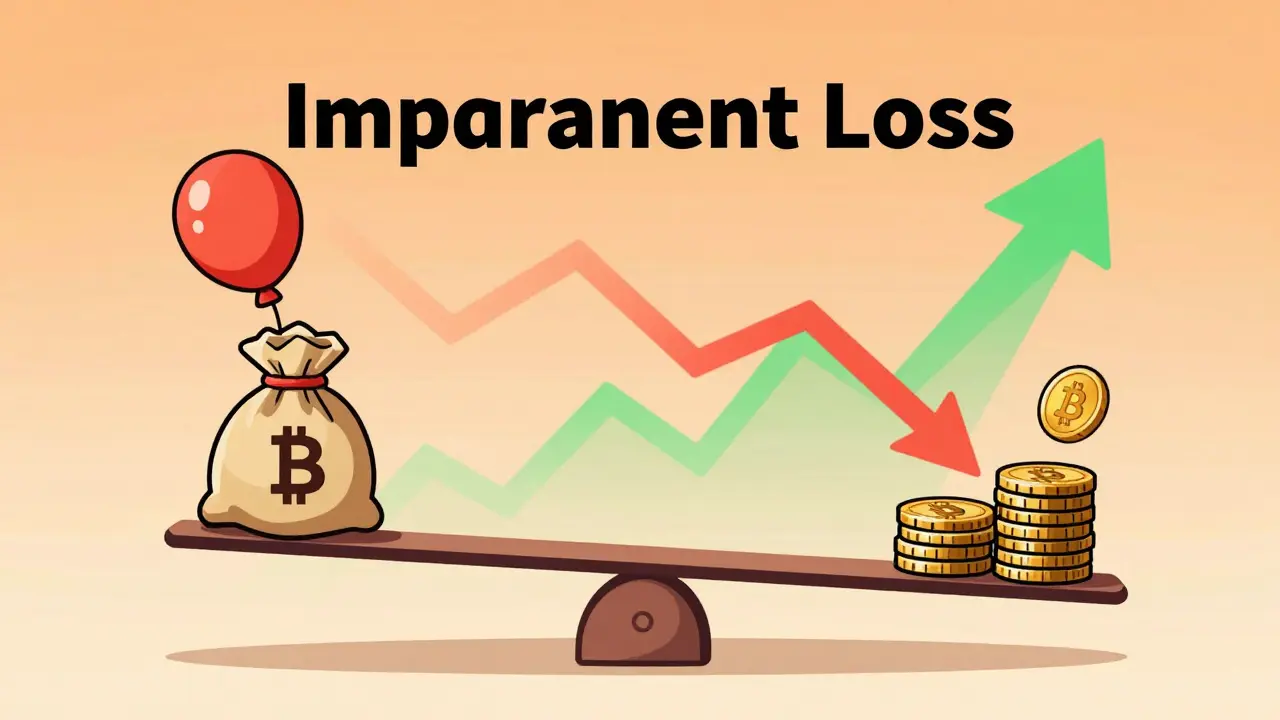
You might see a 50% APR and think it’s free money. It isn’t. The biggest risk in liquidity mining is Impermanent Loss, which is a temporary reduction in value compared to holding the assets separately, caused by price divergence in a liquidity pool. When you provide liquidity to a pair (like ETH/USDC), you hold both assets. If ETH’s price skyrockets, the automated market maker (AMM) sells your ETH to buy more USDC to maintain the ratio. You end up with less ETH than if you had just held it in your wallet.
Data shows impermanent loss exposure varies wildly:
- Stablecoin Pairs: 5-15% loss potential during significant market moves.
- Volatile Pairs: 20-50% loss potential during 10-20% price swings.
Then there’s the inflation factor. If a protocol emits tokens faster than demand grows, the token price crashes. Curve Finance experienced 9.3% annual inflation before implementing veTokenomics. If your token reward is worth 10% less each month due to inflation, your real yield is negative. This is why understanding the tokenomics is just as important as checking the APR.
veTokenomics: The Game Changer
To fix the issues of mercenary capital (users who leave as soon as a better offer appears), many protocols adopted veTokenomics, which is a governance model where users lock tokens for a period to receive voting rights and increased emission rewards. Curve Finance pioneered this with its CRV token. By locking CRV, users get veCRV, which allows them to vote on where emission rewards go. This aligns interests: voters want to direct rewards to pools that generate fees, ensuring sustainability.
Research from Delphi Digital in Q1 2025 showed that protocols using veTokenomics demonstrated 32% higher liquidity retention and 27% more stable token prices compared to standard emission models. Yearn Finance’s yveCRV model, offering 40-60% APY with vote-escrowed emissions, became a gold standard for aligned incentives. Users praised it for creating genuine alignment between the protocol’s success and their own returns.
| Model Type | Liquidity Retention | Token Price Stability | Best For |
|---|---|---|---|
| Standard Linear | Low (25-40%) | Low | New protocol bootstrapping |
| Decay Curve | Medium | Medium | Short-term growth spurts |
| veTokenomics | High (70-85%) | High | Mature, fee-generating protocols |
| Hybrid (Burn + Emit) | High | Very High | Long-term sustainability |
Avoiding the Death Spiral
A 'death spiral' occurs when high emissions cause token devaluation, forcing the protocol to increase emissions even further to attract liquidity. This happened tragically with Terra’s MIR protocol, which offered 1,200% APR. When the emissions ended in Q4 2024, the token collapsed, and users reported 98.7% portfolio losses. Greeks.live documented in 2025 that monthly inflation exceeding 10% is a major red flag for this scenario.
To avoid this, look for protocols with burn mechanisms. Vitalik Buterin highlighted in February 2025 that combining emissions with burns (like Ethereum’s EIP-1559) creates deflationary pressure during high activity. Protocols like Frax decreased annual inflation from 12% to 3.5% while growing TVL by 220% by expanding utility rather than just printing tokens.
Practical Steps for Safe Participation
If you decide to participate in liquidity mining, follow this three-phase approach to protect your capital:
- Evaluate Tokenomics: Check the total supply, initial circulation, and team/investor shares. Use tools like Token Unlocks to see future unlock schedules. Avoid projects where insiders hold more than 20% without long vesting periods.
- Strategic Allocation: Never put more than 5-15% of your portfolio into a single emission strategy. Messari’s 2025 DeFi Handbook advises strict limits to mitigate black-swan events.
- Active Management: Track emission decay curves. If a protocol halves its rewards, calculate if the remaining APR still covers your impermanent loss risk. Rotate positions proactively, don’t wait until the yield vanishes.
Documentation quality matters. Stick to protocols like Aave and Compound, which maintain 95%+ complete documentation. Newer protocols often hide critical emission details, leading to miscalculated risks.
The Future: From Emissions to Revenue Sharing
By mid-2026, the industry is shifting toward 'value-capture mechanisms.' Electric Capital’s 2025 report predicts that successful protocols will correlate token rewards directly with generated revenue. Currently, only 12% of top 100 protocols meet the threshold of having a revenue-to-emission ratio above 0.5. The goal is to move from subsidizing liquidity with printed tokens to sharing actual trading fees.
Regulatory scrutiny is also tightening. The EU’s MiCA framework, effective January 2025, requires full disclosure of emission schedules. The SEC has targeted several protocols for unregistered securities offerings. This means transparency will increase, benefiting serious participants and filtering out scams.
What is the difference between liquidity mining and staking?
Staking involves locking tokens to secure a network (Proof of Stake) and earning rewards from transaction fees or issuance. Liquidity mining involves providing pairs of assets to a decentralized exchange or lending pool to facilitate trades or loans, earning rewards in the form of protocol-specific tokens. Staking is generally lower risk regarding impermanent loss, while liquidity mining offers higher potential yields but carries significant price divergence risks.
Is impermanent loss permanent?
It is called 'impermanent' because if the asset prices return to their original ratio when you deposited, the loss disappears. However, if you withdraw while prices are diverged, the loss becomes permanent. Additionally, if the token you received as a reward loses value, the net result can be a permanent loss even if the underlying assets recover.
How do I calculate if a liquidity mining APR is worth it?
You must subtract the estimated impermanent loss from the gross APR. For volatile pairs, assume a conservative IL of 10-20% annually. If the APR is 30%, your net yield might only be 10-20%. Also, factor in the token's historical volatility and inflation rate. A high APR on a hyper-inflating token may result in zero real gain.
What is veTokenomics and why is it popular?
veTokenomics stands for vote-escrowed tokenomics. Users lock tokens for a set period to receive governance power and boosted rewards. It is popular because it aligns long-term holders with the protocol's success, reducing short-term speculation and improving liquidity retention by up to 32% compared to non-locked models.
Are liquidity mining emissions legal in 2026?
Legality depends on your jurisdiction. In the EU, MiCA regulations require clear disclosure of emission schedules. In the US, the SEC has pursued actions against protocols deemed to be issuing unregistered securities. Always check local regulations and consider whether the token has utility beyond speculation to assess regulatory risk.