- 26 Feb 2026
- Elara Crowthorne
- 23
The SyncSwap (Linea) crypto exchange isn’t another flashy DeFi platform promising moonshots. It’s a quiet, technically solid decentralized exchange built specifically for the Linea blockchain - a zkEVM rollup from Consensys designed to bring Ethereum’s security and smart contract compatibility with near-instant finality and near-zero fees. But here’s the catch: as of February 2026, it’s barely moving. Trading volume? $0.00 across all pairs. Liquidity? Barely there. If you’re looking for a busy, high-volume DEX, this isn’t it. But if you’re curious about where the next wave of Ethereum scaling might take us, SyncSwap (Linea) is worth understanding - even if you don’t trade on it yet.
What Is SyncSwap (Linea)?
SyncSwap started on zkSync Era as one of the most popular decentralized exchanges in the zk-rollup space. It wasn’t the first, but it became the largest, with over $8 billion in total trades and a TVL that once peaked above $80 million. Its secret? Zero-knowledge rollup technology. Unlike Optimism or Arbitrum, which rely on a 7-day challenge period to verify transactions, SyncSwap uses cryptographic proofs to confirm trades instantly. That means faster trades, lower gas fees, and no waiting around for finality.
SyncSwap (Linea) is the same protocol, just deployed on Linea - a zkEVM network that’s part of Consensys’ push to bring Ethereum-like experiences with better scalability. Linea itself is still growing. It has its own token (LINEA), and projects are slowly building on it. SyncSwap was one of the first major DEXes to launch there, hoping to anchor liquidity and attract traders. But adoption hasn’t caught up.
How SyncSwap (Linea) Works
Using SyncSwap (Linea) is familiar if you’ve used Uniswap or SushiSwap. You connect your wallet - MetaMask, Rabby, or any EVM-compatible one - and swap tokens directly from your account. No KYC. No central server. Just smart contracts doing the work.
The key difference lies under the hood. Linea’s zkEVM means every trade is verified using a zero-knowledge proof. This isn’t just faster - it’s more secure. There’s no window where a malicious actor could exploit a delayed challenge period. Transactions are settled as soon as they’re included in a block. For users, this translates to near-instant swaps and gas fees that often cost less than $0.01.
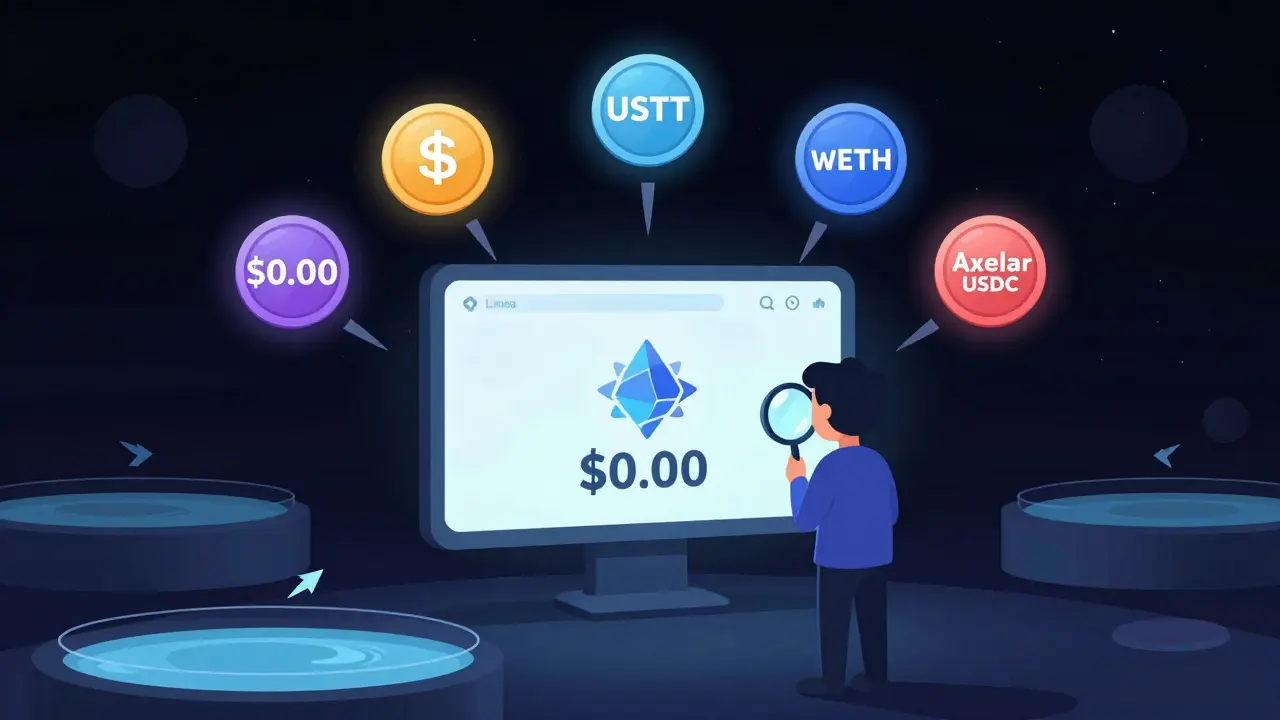
SyncSwap (Linea) currently supports five cryptocurrencies: USDC, USDT, wETH, STONE3, and Axelar USDC. But here’s where it gets odd. All trading pairs show $0.00 in 24-hour volume. Even the USDT/USDC pair - the most stable and widely traded in DeFi - has zero activity. That doesn’t mean the platform is broken. It means no one’s using it yet.
Why SyncSwap (Linea) Matters
SyncSwap on zkSync Era proved that a zk-rollup DEX can handle serious volume. It’s not a prototype. It’s a production system that’s processed billions in trades. The architecture works. So why does Linea’s version sit idle?
It’s a classic chicken-and-egg problem. Liquidity providers won’t deposit funds unless there’s trading activity. Traders won’t come unless there’s deep liquidity. SyncSwap (Linea) is stuck in the middle. There’s no incentive program pushing users to deposit stablecoins. No airdrops. No farming rewards. Just the raw protocol.
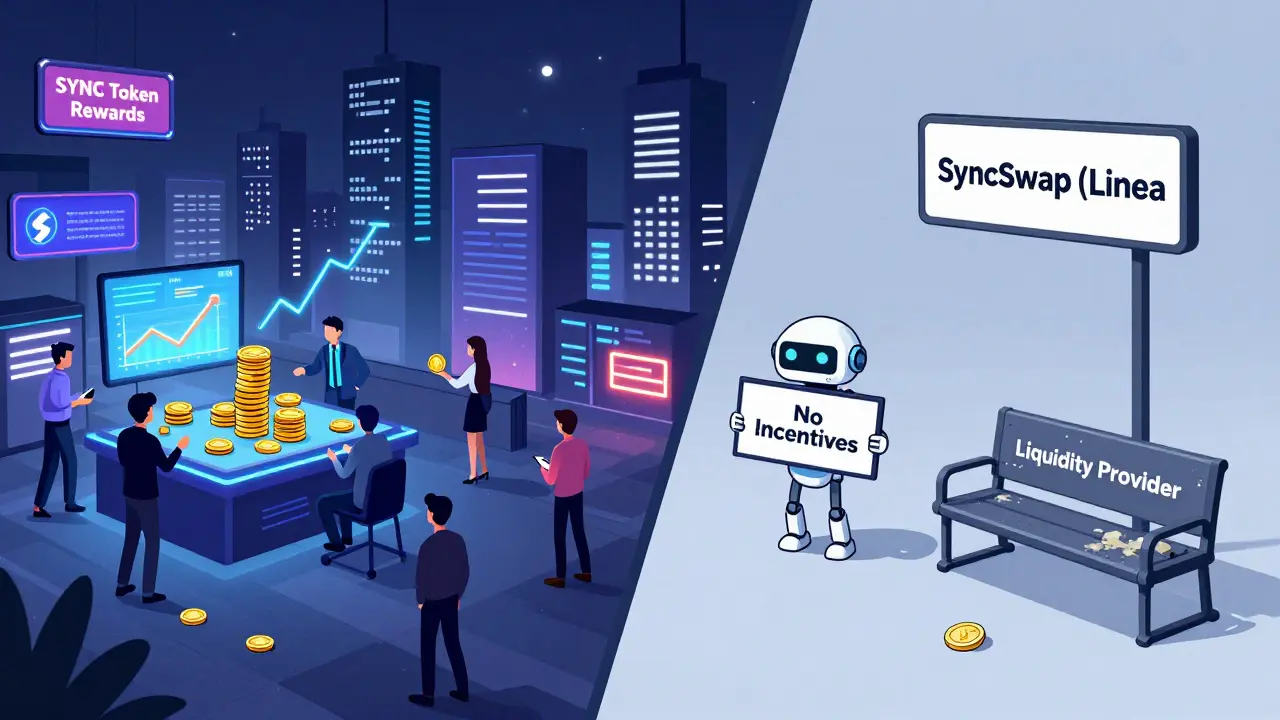
Compare that to SyncSwap on zkSync Era, where users earned SYNC tokens for providing liquidity. That drove massive growth. On Linea? Nothing. That’s the biggest flaw. Without token incentives, there’s no reason for early adopters to take the risk.
Still, the tech is sound. If Linea’s ecosystem grows - if more DeFi apps, lending protocols, and yield strategies launch on it - SyncSwap could become the go-to DEX for stablecoin swaps. It’s already optimized for that use case. Low slippage, fast execution, low fees. It’s perfect for users who want to move between USDC and USDT without paying $5 in gas.
SyncSwap (Linea) vs. Other DEXes on Linea
Right now, there aren’t many DEXes on Linea. The network is still young. SyncSwap is one of the first. The only real alternative is a smaller, less-tested AMM called LineaSwap, which has even less liquidity and no proven track record.
Here’s how SyncSwap (Linea) stacks up against other DEXes in the broader zk-rollup space:
| Network | 24h Volume | TVL | Trading Pairs | Token Incentives |
|---|---|---|---|---|
| SyncSwap (zkSync Era) | $120M+ | $78M | 25+ | Yes (SYNC) |
| SyncSwap (Linea) | $0.00 | Unknown | 5 | No |
| SyncSwap (Scroll) | $85M | $65M | 20+ | Yes (SYNC) |
| Uniswap v3 (Arbitrum) | $1.2B | $2.1B | 100+ | No |
| Curve (Optimism) | $400M | $1.8B | 30+ | No |
The table shows something clear: SyncSwap thrives where there are token rewards. On Linea, without them, it’s a ghost town. Even Curve and Uniswap, which don’t give out tokens, have massive liquidity because they’re on networks with established user bases. Linea doesn’t have that yet.
Who Should Use SyncSwap (Linea)?
Right now, the answer is: almost no one.
If you’re a trader looking for volume, avoid it. You’ll get slippage, failed trades, or no fills at all. If you’re a liquidity provider, don’t deposit funds unless you’re willing to wait months for activity to pick up. There’s no guarantee you’ll earn anything back.
But if you’re an early adopter who believes in Linea’s long-term potential - and you’re okay with low liquidity for now - then SyncSwap (Linea) is one of the cleanest, most secure platforms to test the waters. It’s low-risk because you’re not losing money to high fees or buggy contracts. You’re just waiting.
It’s also worth watching if you’re interested in stablecoin trading. SyncSwap’s architecture is optimized for swaps between USDC, USDT, and other pegged assets. If Linea becomes a hub for stablecoin flows - say, from institutional users or cross-chain bridges - SyncSwap could be the engine that powers it.
The Future of SyncSwap (Linea)
SyncSwap’s team has proven they can build a top-tier DEX. Their success on zkSync Era and Scroll isn’t luck. It’s engineering. The problem with Linea isn’t the tech - it’s timing.
Linea is still in its early days. The network has launched its own token, and projects are starting to appear. But most are still in testing. No major DeFi protocols have fully migrated. Without that critical mass, SyncSwap can’t grow.
The next 6-12 months will be critical. If Linea gains traction - if more wallets support it, if bridges bring in users from Ethereum, if airdrops start rewarding activity - then SyncSwap (Linea) could explode. A single incentive program could turn $0.00 volume into $10 million overnight.
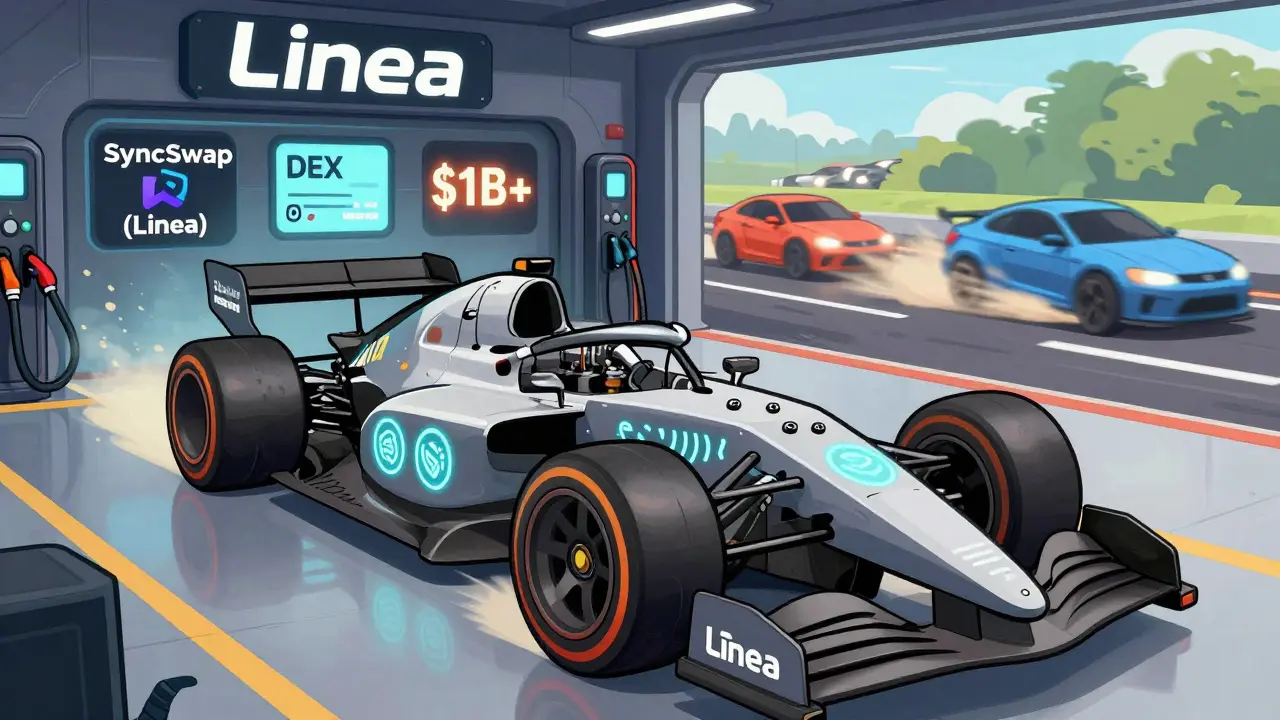
For now, it’s a waiting game. SyncSwap (Linea) is like a race car parked in a garage. The engine is perfect. The tires are new. But no one’s started the engine yet.
How to Use SyncSwap (Linea) (If You Still Want To)
Here’s the bare-minimum guide if you’re curious:
- Install a wallet that supports Linea: MetaMask is the most common. Add the Linea network manually using the RPC details from Linea’s official site.
- Get some Linea ETH (LETH) for gas. You can bridge from Ethereum or use a faucet if available.
- Go to app.syncswap.finance and connect your wallet.
- Select a pair: USDC/USDT, wETH/STONE3, or Axelar USDC/USDC.
- Swap. If the trade goes through, congratulations. If not, you’re not alone.
Don’t expect to move more than $100 at a time. Slippage could be high. Execution might fail. There’s no customer support. You’re on your own.
Final Verdict
SyncSwap (Linea) isn’t a failed project. It’s a pre-launch experiment. The underlying technology is proven. The team has a track record. The network has potential. But right now, it’s a ghost.
If you’re looking for a working DEX with real volume, go to Uniswap on Arbitrum or Curve on Optimism. They’re busy. They’re reliable. They’ve been tested.
If you’re a believer in zk-rollups and think Linea will be the next big thing - and you’re okay with zero returns for now - then SyncSwap (Linea) is one of the few places you can stake your faith. It’s not a trade. It’s a bet.
And in crypto, sometimes the best moves are the ones you make before anyone else is even looking.



23 Comments