
- 14 Apr 2026
- Elara Crowthorne
- 17
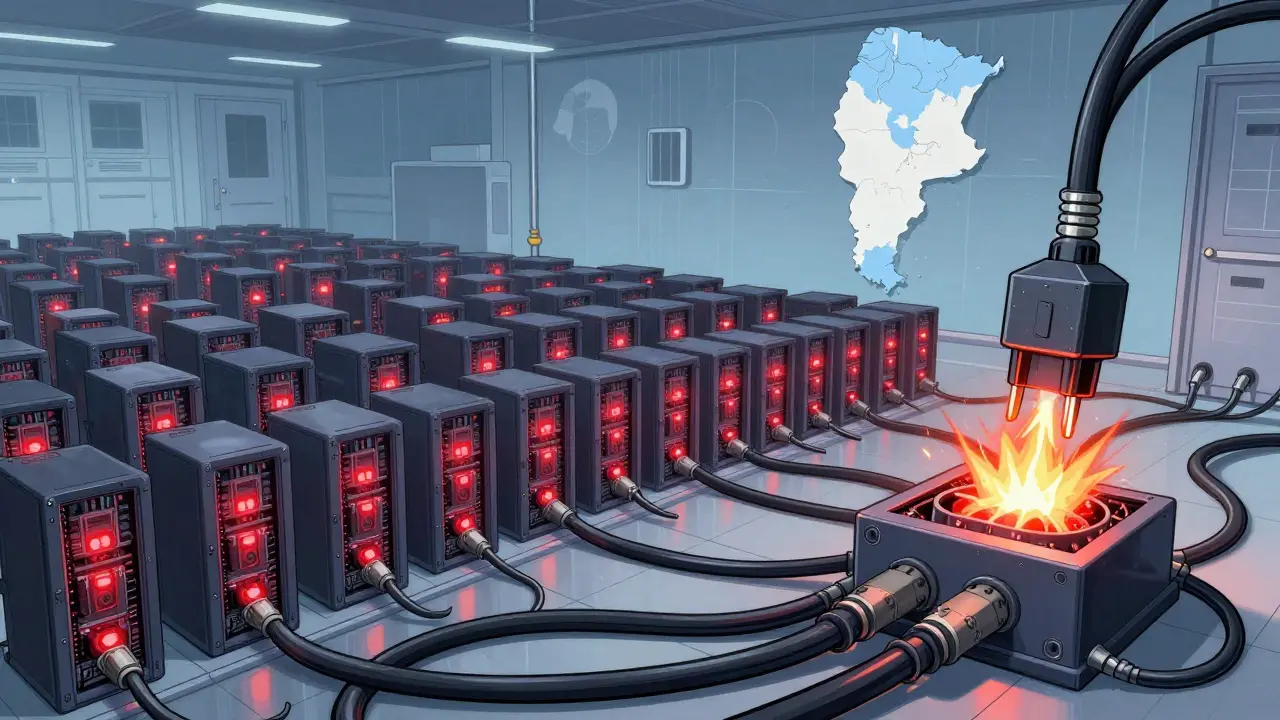
Imagine a single digital network consuming as much electricity as the entire country of Argentina. It sounds like a sci-fi dystopia, but that is the reality for Proof of Work is a consensus mechanism used by blockchains to validate transactions and secure the network by requiring miners to solve complex mathematical puzzles. While it's the bedrock of the most famous cryptocurrency, it's also the reason the industry is facing a massive sustainability crisis.
Why Proof of Work Eats So Much Power
The problem isn't a glitch; it's a feature. In a Proof of Work (PoW) system, miners compete in a global race. To win the right to add a new block to the chain and claim a reward, they need the most computational muscle. This leads to an "arms race" where miners buy thousands of specialized machines called ASICs (Application-Specific Integrated Circuits), which run 24/7 at maximum capacity.
Because the network adjusts its difficulty to keep blocks coming at a steady pace, the more people mine, the harder the puzzles become. This creates a cycle of endless energy demand. According to data analyzed by Bitwave, Bitcoin alone consumes about 112.06 TWh of electricity annually. To put that in perspective, a single Bitcoin transaction can require 707 kWh-that's roughly eleven times more energy than an equivalent transaction on a modern, efficient network.
The Carbon Footprint and Global Health
Electricity doesn't just vanish; it's generated, often by burning fossil fuels. This translates into a massive carbon footprint. Research shows that Bitcoin produces approximately 62 metric tons of carbon dioxide emissions every year. When you're pumping that much CO2 into the atmosphere, you're not just talking about "digital trends"-you're talking about real-world climate change.
It goes beyond just the air we breathe. Academic studies published in PubMed have linked the industrial scale of PoW mining to broader environmental health impacts. When mining farms pop up in regions with lax regulations, they often rely on cheap, dirty coal power, leading to localized pollution that affects the health of nearby communities. The sheer scale of these operations can strain local power grids, sometimes leading to electricity price hikes for regular people living in the same area.
The Great Shift: Proof of Work vs. Proof of Stake
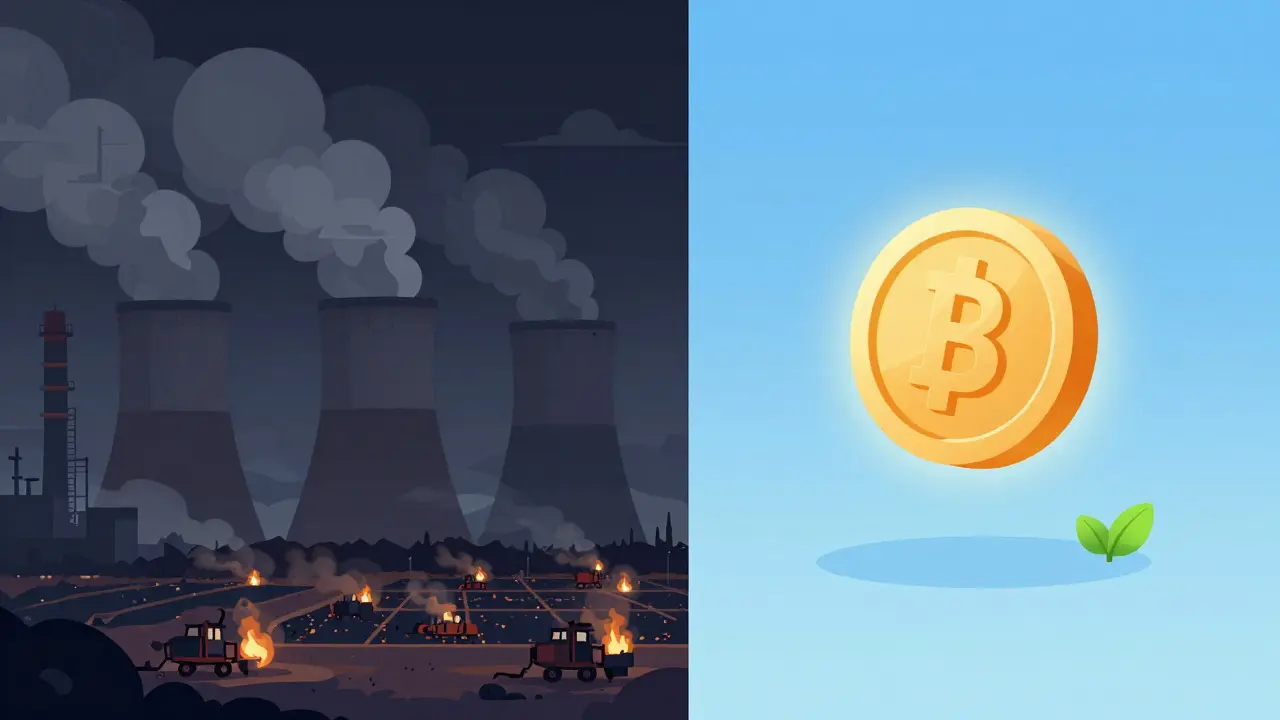
If PoW is a gas-guzzling V8 engine, Proof of Stake (PoS) is a high-efficiency electric motor. Instead of using electricity to "work," PoS users "stake" their own coins to secure the network. There is no race, no specialized hardware, and no massive power draw.
The most famous example of this shift was the Ethereum Merge in September 2022. Ethereum transitioned from PoW to PoS, and the results were staggering. The Ethereum Foundation reported a 99.95% drop in energy consumption, crashing from a demand of 8.5GW to less than 85MW. It's the difference between powering a city and powering a small neighborhood.
| Attribute | Proof of Work (e.g., Bitcoin) | Proof of Stake (e.g., Ethereum 2.0) |
|---|---|---|
| Annual Electricity Use | ~112.06 TWh | ~0.01 TWh |
| Annual CO2 Emissions | ~62 Mt CO2 | ~0.01 Mt CO2 |
| Hardware Requirement | High-power ASICs | Standard Server/PC |
| Energy Profile | Constant 24/7 demand | Low, stable demand |

The Renewable Energy Debate
You'll often hear miners argue that they use "green energy." While some operations relocate to places with cheap hydro or wind power, this doesn't solve the core issue. This is called "geographic arbitrage." If a mining farm takes up a massive amount of renewable energy in a region, that's energy that could have been used to power homes, hospitals, or schools. This is known as the opportunity cost.
Furthermore, wind and solar are intermittent-the sun doesn't always shine, and the wind doesn't always blow. But PoW mining requires a constant, 24/7 flow of power to stay competitive. This means that even "green" mines often have to rely on a dirty grid backup to keep their machines from shutting down, canceling out a lot of the environmental benefits.

Regulation and the Corporate Exodus
Governments are starting to lose patience. The OECD has recommended mandatory environmental impact assessments for crypto-assets, and some countries have gone as far as banning PoW mining entirely to protect their energy grids. This isn't just a legal headache; it's a business risk.
Big companies are noticing. In 2021, Tesla stopped accepting Bitcoin payments specifically citing the environmental concerns of its mining process. Today, most institutional investors follow ESG (Environmental, Social, and Governance) criteria. If a project doesn't meet these sustainability standards, it simply doesn't get the funding. This is pushing the entire industry toward alternatives like Proof of Authority or hybrid models that prioritize the planet over raw computing power.
Can We Actually Fix This?
Is there a way to save PoW? Some initiatives are trying. The Giving Block created TGB Green to offset carbon, and platforms like Gemini have implemented offset programs for transactions. While these are helpful, they are essentially "band-aids" on a systemic problem. Offsetting a ton of carbon is good, but not producing that ton of carbon in the first place is better.
The real solution lies in protocol evolution. While Bitcoin's community is famously resistant to change, the rest of the blockchain world has largely moved on. The future of the industry isn't in who has the biggest computer, but in who can provide the most value with the smallest footprint.
Does every cryptocurrency use Proof of Work?
No. While Bitcoin uses PoW, many other cryptocurrencies use Proof of Stake (PoS) or other variations. Ethereum, the second largest blockchain, switched to PoS in 2022 to reduce its energy use by over 99%.
Why can't Bitcoin just switch to Proof of Stake?
Bitcoin is highly decentralized and its community values the security and "hardness" that PoW provides. Switching would require a massive consensus among miners and node operators, and many believe PoW is the only way to ensure the network remains truly censorship-resistant.
Is mining with renewable energy a complete solution?
Not entirely. Even if a mine uses 100% solar power, it consumes energy that could be used for other societal needs (opportunity cost). Additionally, because mining requires 24/7 power and solar is intermittent, many mines still rely on fossil-fuel grids during the night.
What are the health risks associated with PoW mining?
The primary health risks are indirect. Large-scale mining operations often rely on coal-fired power plants, which release pollutants and greenhouse gases that contribute to respiratory issues and overall environmental degradation in the surrounding areas.
What is the 'Ethereum Merge' in simple terms?
The Merge was a technical upgrade where Ethereum moved from a Proof of Work system (mining with hardware) to a Proof of Stake system (validating with coins). This effectively eliminated the need for energy-hungry mining rigs.



17 Comments
this is just mid tbh. whoever wrote this is tryharding way too much for basic info. just boring.
Oh, please. The sheer audacity of focusing on the carbon footprint of a global revolution while ignoring the inefficiency of legacy banking systems is truly laughable. I suppose it's easier to target digital assets than to comprehend the actual socioeconomic shifts happening in the East. It is simply quaint how the West clings to these primitive environmental arguments to suppress the rise of decentralized finance. Truly a masterclass in selective outrage.
It is quite an eye-opening piece. We really need to encourage the community to explore these sustainable alternatives while keeping the spirit of innovation alive. Great way to start a conversation on the matter!
LITERALLY NO ONE CARES about your little energy charts!! Its basicly common sense that tech evolvs and these ASICS are just a step in the ladder. People act like we're burning the whole planet for a coin lol. Its so dramatic and honestly just embarrassing to see this level of panic over some electricity usage!!
The moral imperative here is clear: we cannot prioritize digital wealth over the sanctity of our earthly existence. 🌿 Is the pursuit of a decentralized ledger worth the desecration of the atmospheric balance? One must ponder if our greed has finally outpaced our wisdom. We are merely architects of our own demise if we continue to ignore the screams of the biosphere for the sake of a virtual token. 🧘♂️
The point about geographic arbitrage is a strong one. Using renewables for mining when those resources could stabilize a local grid is a real issue that often gets glossed over in the 'green mining' marketing campaigns. We need a more honest accounting of energy displacement.
Totally agree with the push for PoS! 🚀 The efficiency gains are just mind-blowing. We've got to lead the way toward a greener future for everyone! 🌍✨ Let's keep pushing for better tech! 💪
Imagine thinking PoS is actually secure. It's a joke. PoW is the only way to ensure true decentralization and security. Anyone who thinks otherwise just hasn't read enough whitepapers. The energy cost is a small price for an unhackable global system. Deal with it.
I appreciate the detailed comparison table. It makes the scale of the difference much easier to visualize without having to dig through the text.
i think its lavely that we are trying to fix things. maybe we can just find a way for everyone to be happy without hurting the planet too much. just a thought
the irony of the whole thing is that we're creating these digital utopias while the physical world is literally melting under the heat of the hardware used to maintain them, which is kinda poetic in a dark way if u think about it too long, and honestly its just a reflection of how humanity always prioritizes the abstract over the concrete until the concrete starts falling on our heads, but hey, that is just how the world turns i guess, just a big cycle of greed and oopsies.
makes sense.
This is an absolute wake-up call! ⚡️ We cannot let the glitz of crypto blind us to the devastation of our gorgeous ecosystems. It is high time we demand a kaleidoscopic shift toward truly sustainable tech that doesn't treat our atmosphere like a trash can! Let's ignite a revolution for the planet! 🔥
From a technical standpoint, the hash rate's correlation with energy consumption is a known trade-off in PoW architectures. The transition to PoS effectively eliminates the need for computational waste by replacing physical work with economic stakes. It's a fascinating shift in the consensus layer's game theory.
I am in complete agreement with the sentiment that protocol evolution is the most viable path forward. It is truly inspiring to see how the industry can pivot when presented with clear environmental data. I believe that through collaboration and a shared vision of sustainability, we can redefine the digital economy for the better of all mankind.
It is utterly reprehensible that we continue to tolerate such an egregious assault upon our natural environment in the name of financial speculation. The sheer magnitude of this waste is not merely a technical flaw but a profound moral failure of the highest order. I find it absolutely abhorrent that such practices are allowed to persist while the world burns. Truly a catastrophe!
I'm sure there's a middle ground here. While the numbers are scary, the shift toward renewables is happening. I'm hopeful that the industry will eventually find its balance without needing total bans.