
- 23 Mar 2026
- Elara Crowthorne
- 19
Minter HUB (HUB) is a cross-chain cryptocurrency token built to move value between different blockchains without relying on centralized intermediaries. Unlike most tokens that live on just one network, HUB operates across multiple chains - including Minter, Ethereum, and Binance Smart Chain - acting as a bridge that connects them. Its purpose is simple: let users send assets from one blockchain to another quickly and without needing to use third-party exchanges or wrapped tokens.
How Minter HUB Works
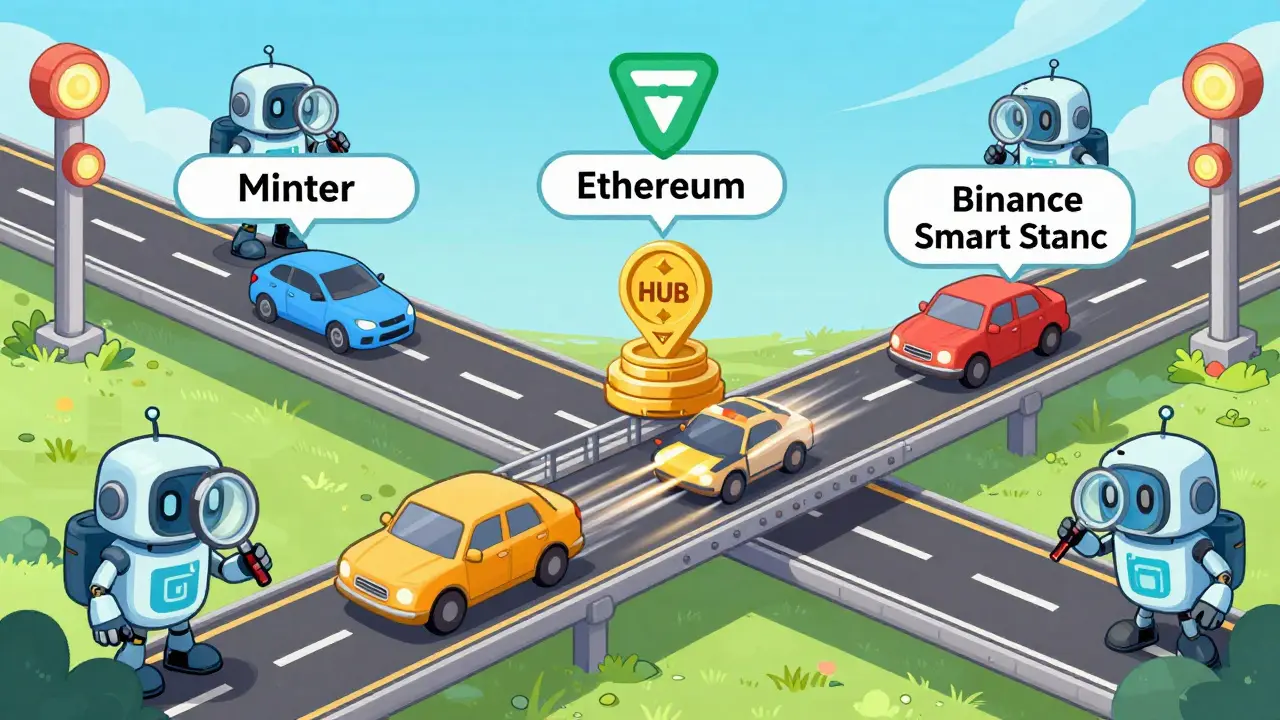
Minter HUB doesn’t just sit on a blockchain - it runs its own network. Think of it like a custom-built highway that links different road systems. This highway is maintained by a group of validators called oracles. These oracles are not controlled by one company. Instead, they’re distributed nodes that watch all connected blockchains and confirm transactions when users move assets between them.
When you send HUB from Ethereum to Minter, the oracle network locks your HUB on Ethereum, then releases an equivalent amount on Minter. The same thing happens in reverse. This process is automated using smart contracts that don’t require changes to existing code. That means developers can plug in HUB into their DeFi apps without rewriting their smart contracts - a big deal for builders who already use Ethereum tools.
Transactions between chains usually take between 20 and 60 seconds. That’s fast, but not the fastest. What makes it slower than other bridges is the cost. Every time an oracle signs off on a transfer, it pays a fee on Ethereum. On top of that, Minter HUB charges a 1% service fee for every cross-chain operation. For users moving large amounts, that adds up quickly.
Supply and Tokenomics
Minter HUB has a fixed maximum supply of 1,000,000 tokens. No more will ever be created. This is intentional. The creators designed HUB to be scarce, hoping that as more people use the bridge, demand would push the price up. There are no inflationary emissions, no staking rewards, and no mining. The only way HUB enters circulation is through initial distribution, and the only way it leaves is through burning - which can only happen if the oracle network votes to do so.
This deflationary model is rare in crypto. Most tokens have flexible supplies, but HUB’s rigidity makes it unique. It’s not designed to be a speculative asset like many others. Its value comes from utility: if the bridge gets used often, HUB becomes essential. If not, it sits idle.
Where You Can Trade HUB
Here’s the problem: you can’t buy HUB on Coinbase, Binance, or Kraken. It’s not listed on any major centralized exchange. The only place where HUB is actively traded is PancakeSwap, a decentralized exchange on Binance Smart Chain. There are only two trading pairs available: HUB/BNB and HUB/USDT.
That’s it.
According to CoinPaprika, the 24-hour trading volume on PancakeSwap was under $0.40 at the time of last update. That’s extremely low. For comparison, popular cross-chain bridges like Polygon Bridge move billions in volume daily. HUB’s volume is barely noticeable.
Market data is all over the place. DigitalCoinPrice says HUB once hit $216.59, then dropped to $7.19 in early 2024. LiveCoinWatch reports a recent high of $0.56. Bitget shows zero circulating supply but still lists a $1.1 million fully diluted market cap. These contradictions aren’t just confusing - they’re a red flag. It suggests either extreme illiquidity, data manipulation, or both.

Price Predictions: Realistic or Wishful Thinking?
You’ll find websites claiming HUB will hit $28.61 by 2030 or $40.61 by 2031. These numbers sound impressive. But they’re based on historical price spikes that likely came from low-volume pumps - not real adoption.
For example, the $216.59 all-time high happened when trading volume was under $100. That’s not a sign of strong demand. That’s a pump driven by a handful of wallets. When volume stays low, prices can swing wildly based on one large trade. Predictions that assume this trend will continue ignore the reality of the market: HUB has no real user base, no major partnerships, and no marketing.
The 2026 projection of $2.61-$3.15 is more plausible - but only if the Minter team makes major improvements. Right now, HUB is stuck.
Who Is HUB For?
HUB isn’t for casual investors. It’s not for people who want to buy and hold. It’s for a very specific group: developers building cross-chain DeFi apps on Minter, Ethereum, or BSC who need a native token to fuel transfers between them.
For regular users, HUB offers no advantage over other bridges. If you want to move ETH to BSC, you can use the official Binance Bridge, Polygon Bridge, or LayerZero - all of which are cheaper, faster, and have more liquidity. HUB doesn’t compete well here.
Even within the Minter ecosystem, adoption is minimal. Most users stick to the native Minter coin (BIP) for transactions. HUB is an afterthought.
Competition and Challenges
The cross-chain bridge space is crowded. Projects like LayerZero, Axelar, and Chainlink CCIP have raised hundreds of millions in funding. They have teams of engineers, marketing departments, and partnerships with major DeFi protocols. Minter HUB has none of that.
Its 1% fee is a major barrier. Most bridges charge under 0.1%. Some, like Arbitrum Bridge, charge nothing. Why would anyone pay 10x more for a slower, less liquid option?
There’s also no transparency. The Minter team hasn’t released a roadmap in over a year. No updates. No blog posts. No Twitter threads. The project appears to be running on autopilot.

Is Minter HUB Worth It?
Right now? No.
If you’re looking to invest, HUB is too risky. The market data is unreliable. The liquidity is nonexistent. The team is silent. The competition is overwhelming.
If you’re a developer trying to build a cross-chain app and you’re already deep in the Minter ecosystem, then HUB might be useful - but even then, you’re better off using a more established bridge with better documentation and community support.
HUB has a smart idea: a native token for cross-chain transfers. But execution is broken. Without more exchanges, lower fees, active development, and clear communication, it will remain a footnote in crypto history - a token with a good concept that never found its audience.
How to Buy Minter HUB (If You Must)
If you still want to try it, here’s how:
- Get BNB or USDT in a wallet like MetaMask or Trust Wallet.
- Connect your wallet to PancakeSwap (only place HUB trades).
- Search for HUB and swap your BNB or USDT for it.
- Store it in your wallet - don’t leave it on the exchange.
Don’t invest more than you’re willing to lose. There’s no safety net here.
Future Outlook
Minter HUB’s future depends on one thing: adoption. If the team can get listed on even one major DEX besides PancakeSwap, if they reduce the 1% fee, if they start publishing updates - then maybe, just maybe, it could grow.
But as of March 2026, it’s not growing. It’s barely moving. And in crypto, if you’re not moving forward, you’re falling behind.

19 Comments
Minter HUB's concept is actually pretty clever-native cross-chain liquidity without wrapped assets. The real issue isn't the tech, it's the execution. No marketing, no liquidity, no updates. It’s like building a Ferrari and leaving it in a garage with the keys in the ignition.
Developers who need to bridge between Minter, Ethereum, and BSC could’ve used this. But without documentation, support, or even a Discord server, who’s gonna risk their smart contract on it?
The 1% fee is a death sentence. In a space where LayerZero charges zip and Axelar charges 0.05%, this is laughable. And the trading volume? $0.40? That’s not a market-it’s a ghost town with a sign that says ‘HUB: Coming Soon (Maybe).’
This isn’t innovation. It’s negligence dressed up as blockchain. The team’s silence speaks volumes. No roadmap? No transparency? No accountability? They’re not building a bridge-they’re building a pyramid scheme with a whitepaper.
And the price predictions? $216? That’s not a chart-it’s a scammer’s fantasy. People who bought at that peak are probably still waiting for their money to come back. Don’t be one of them.
From a technical standpoint, the oracle-based atomic swap mechanism is elegant-leveraging smart contracts without forking existing chains is non-trivial. However, the tokenomics lack dynamic utility triggers. No staking, no governance, no burn events beyond oracle consensus? That’s a static asset in a dynamic ecosystem.
Moreover, the absence of liquidity pools beyond PancakeSwap renders it functionally inert. In DeFi, liquidity is not optional-it’s existential.
Bro this token is a joke. $0.40 volume? You’re telling me people are paying 1% to move coins through this thing when they can use Binance Bridge for free? The team’s been MIA for a year. No updates. No tweets. No blog. Not even a Reddit post.
This isn’t crypto-it’s a graveyard with a website. If you’re still holding HUB, you’re not an investor-you’re a martyr for bad ideas.
It’s a shame. The idea had potential. If the team had focused on developer outreach, even just a simple GitHub repo with clear examples, people might’ve built on it. But silence kills innovation faster than any bear market.
hubbys so cringe lol
I appreciate the technical depth in this breakdown. The oracle model is genuinely interesting, and the fixed supply is rare in a space full of inflationary tokens. But you’re right-the lack of adoption isn’t just a problem, it’s a death sentence.
For developers, the real question isn’t whether HUB works-it’s whether anyone will ever use the app you build with it.
I’ve been watching HUB for months. It’s heartbreaking. I remember when Minter had real promise-simple, fast, low-fee transactions. But HUB? It feels like a forgotten child of the ecosystem.
What if they just lowered the fee to 0.1%? What if they partnered with one DeFi protocol? Even one? It could’ve sparked something.
Now? It’s just a ticker on a dead DEX.
Who owns the oracles? Who controls the multisig? If the Minter team can vote to burn HUB, then this isn’t decentralized-it’s a honeypot. They could drain liquidity any time, burn the supply, and vanish.
And don’t even get me started on the market cap numbers. $1.1M fully diluted? With zero circulating supply? That’s not crypto fraud-that’s a federal crime waiting to happen.
This isn’t a bridge. It’s a trapdoor.
Oh sweet Jesus. Another ‘innovative’ token with no liquidity, no team, and a 1% fee. Congrats, HUB-you’ve achieved peak crypto cringe.
Next up: ‘MetaSocks’-the NFT that lets you wear socks in the metaverse. I’ll be first in line.
Let me break this down. HUB has a technically sound architecture: atomic swaps via distributed oracles, no wrapped assets, cross-chain native liquidity. That’s rare. It’s actually impressive.
The problem isn’t the tech-it’s the community. No one knows about it. No one talks about it. No one builds with it. The team’s silence is deafening.
Compare this to LayerZero: they had a $100M raise, a full marketing team, developer grants, and live documentation. HUB has a website and a single DEX pair.
It’s not that HUB is bad. It’s that it’s invisible. And in crypto, invisible means dead.
Everyone’s acting like HUB is some forgotten gem. Nah. It’s a dead project with fake price data. That $216 peak? Probably a bot pump. The volume is lower than my dog’s daily pee count.
And the 1% fee? That’s not a fee-it’s a robbery. You’re better off manually transferring assets and paying gas twice than using this thing.
It’s sad to see such a clean concept collapse under poor execution. The bridge design is elegant-no wrapped tokens, direct atomic swaps. That’s what cross-chain should look like.
But without community engagement, transparency, or even a single update in over a year, it’s impossible to trust. Crypto isn’t just about code-it’s about people.
Maybe if they’d shared a roadmap, even a rough one, people would’ve given them a chance.
Look, I’m not here to dunk on HUB. But let’s be real-this isn’t DeFi. It’s a meme with a whitepaper. $0.40 volume? A 1% fee? And you’re telling me devs should build on this?
Bro, I’d rather use a USB cable to transfer crypto than this.
There’s a real opportunity here. Cross-chain bridges are messy. Most rely on wrapped assets that add complexity. HUB avoids that. That’s huge.
But adoption requires trust. And trust requires communication. A monthly update. A Twitter thread. A Discord AMA. Something. Anything.
Instead, they ghosted. And now? They’re just another cautionary tale.
imagine paying 1% to move coins when u can just use binance for free lmao
It’s a shame. The architecture is actually smart. Oracles watching chains, atomic swaps, no wrapped tokens-this is how cross-chain should work.
But crypto doesn’t reward smart ideas. It rewards visibility. And HUB? It’s invisible. No marketing. No updates. No community.
Good tech + bad execution = dead project.
I’ve been using Minter for years. BIP is my go-to. But HUB? I tried it once. The interface was clunky, the bridge took 90 seconds, and the fee was insane.
I’ve moved over 100 ETH through Polygon and Axelar. Never once paid 1%.
HUB isn’t broken-it’s irrelevant.