

- 25 Jun 2026
- Elara Crowthorne
- 24
Trying to navigate the world of cryptocurrency in Abu Dhabi? It can feel like walking through a maze with moving walls. If you are looking at the Abu Dhabi Global Market (ADGM), it is a financial free zone in Abu Dhabi that operates under English common law and provides a specialized regulatory framework for digital assets. This is not just another government department; it is a distinct jurisdiction designed to compete with global hubs like Singapore and London. But here is the catch: the rules changed significantly in mid-2025. If you are still using old advice from 2023 or early 2024, you might be breaking the law without knowing it.
The core issue isn't just about whether you can hold Bitcoin. It’s about how you interact with it-trading, custodizing, issuing tokens, or managing funds. The Financial Services Regulatory Authority (FSRA) within ADGM has tightened the screws, specifically banning certain types of high-risk assets while opening doors for institutional-grade operations. Let's break down exactly what this means for your business or investment strategy in 2026.
How ADGM Classifies Digital Assets
Before you apply for anything, you need to understand how the regulator sees your product. The FSRA doesn't treat all "crypto" the same way. They look at the economic substance of the token. If a digital token looks like a security, acts like a security, and sounds like a security, it is regulated as a security.
This classification drives everything else. Here is how the buckets work:
aturally:- Digital Securities: Any token representing an ownership interest, debt, or right to profits is treated as a traditional security. This means standard securities laws apply, including disclosure requirements and investor suitability checks.
- Derivatives: If you are trading contracts based on the price of a digital asset (like futures or options), these are regulated as derivatives. You need specific authorization to offer these instruments.
- Fund Units: If you manage a collective investment scheme where investors pool money to buy digital assets, those units are regulated like traditional mutual fund shares.
- Virtual Asset Service Providers (VASPs): This covers exchanges, custody providers, and advisors who handle non-security tokens. These entities need a Virtual Asset License.
Why does this matter? Because mixing these up leads to rejection. A startup trying to launch a utility token that actually functions as an investment contract will get flagged immediately. The FSRA expects clear delineation between different types of digital assets and their regulatory treatment.
The Big 2025 Ban: What Is Now Prohibited?
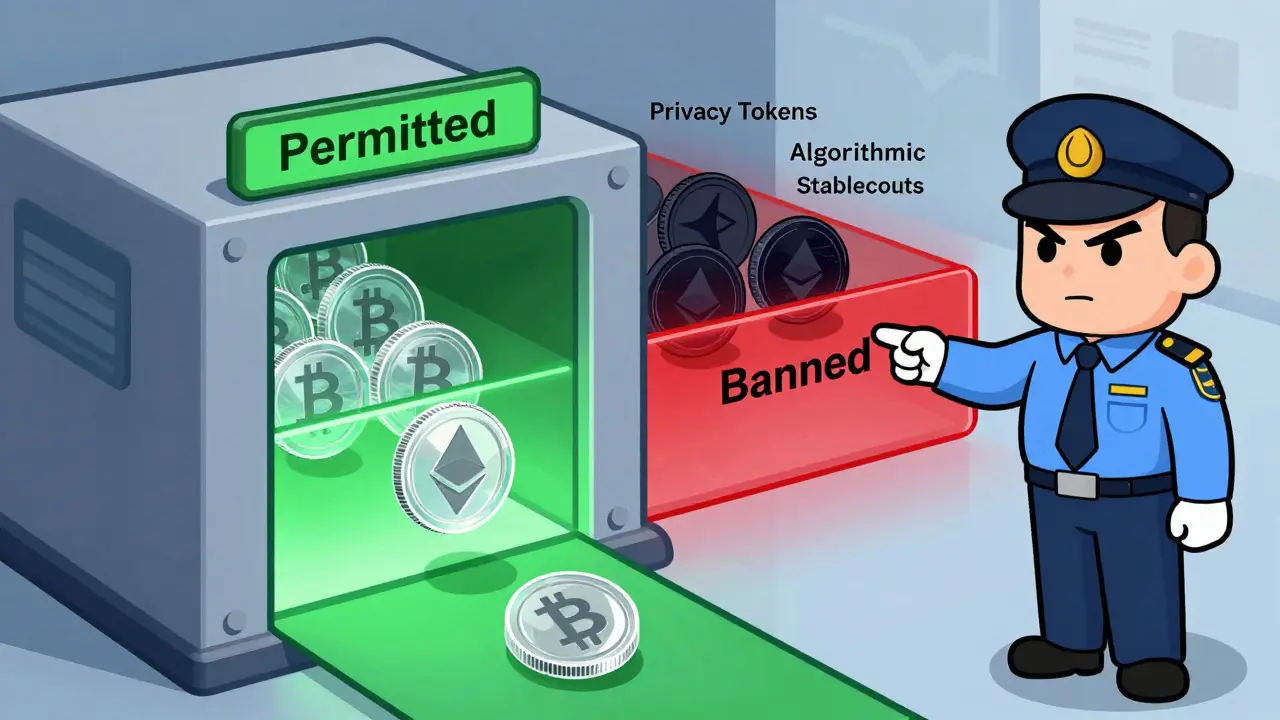
If there is one headline you need to remember from the recent regulatory updates, it is this: privacy tokens and algorithmic stablecoins are now explicitly prohibited in ADGM.
These changes came into force on June 10, 2025, following the implementation of the Digital Asset Updates. The FSRA made this move to align with global trends toward transparency and financial stability. Let's look at why these two categories were targeted.
Privacy Tokens are cryptocurrencies designed to obscure transaction details, such as Monero or Zcash. While privacy is a valid concern for individuals, regulators view these tools as high-risk for money laundering and illicit finance. By banning them, ADGM signals that it prioritizes Know Your Customer (KYC) and Anti-Money Laundering (AML) compliance over anonymous transactions. If your business model relies on facilitating trades in these coins, you cannot operate legally in ADGM.
Algorithmic Stablecoins are pegged to fiat currencies but rely on complex algorithms rather than full reserve backing to maintain their value. After several high-profile collapses in previous years, regulators lost trust in this mechanism. The ban ensures that any stablecoin operating in ADGM must have transparent, auditable reserves. This protects investors from sudden de-pegs that could wipe out portfolios overnight.
This prohibition is absolute. There are no loopholes for "experimental" use cases. If you are building a DeFi protocol that uses algorithmic stablecoins as collateral, you need to pivot your technology before seeking licensure.
| Asset Type | Regulatory Status | Key Reason |
|---|---|---|
| Bitcoin, Ethereum | Permitted (as Virtual Assets) | Transparent ledgers, established market presence |
| Monero, Zcash | Prohibited | Lack of transaction transparency poses AML risks |
| Fiat-Backed Stablecoins (e.g., USDC) | Permitted (with strict reserve audits) | Full reserve backing ensures stability |
| Algorithmic Stablecoins | Prohibited | High risk of collapse due to lack of tangible reserves |
| Security Tokens | Permitted (regulated as securities) | Aligns with existing capital markets laws |
ADGM vs. VARA: Which Jurisdiction Fits You?
Newcomers to the UAE often confuse ADGM with Dubai's Virtual Assets Regulatory Authority (VARA). They are both legitimate regulators, but they serve very different audiences. Choosing the wrong one can cost you months of wasted application time.
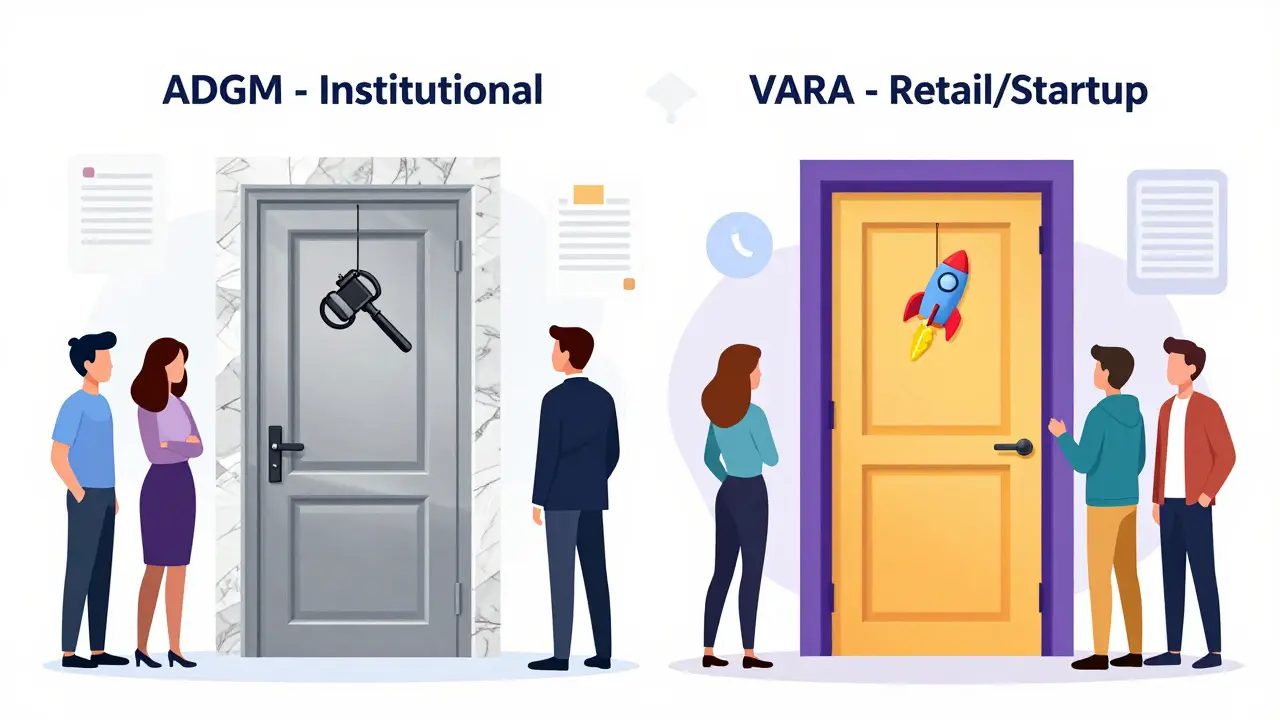
ADGM (Abu Dhabi) is built for institutional players. It operates under English Common Law, which feels familiar to banks, hedge funds, and family offices from Europe and North America. The focus here is on sophisticated investors, structured products, and institutional-grade custody. If you are a large bank wanting to offer crypto custody services to wealthy clients, ADGM is likely your best bet.
VARA (Dubai) is more retail-friendly and broader in scope. It handles everything from small crypto exchanges serving individual traders to NFT marketplaces. VARA’s approach is faster-moving and often seen as more agile for startups targeting mass adoption.
Here is a quick decision tree:
- Do you target retail customers directly? → Look at VARA.
- Do you deal with institutional clients, family offices, or other financial institutions? → Look at ADGM.
- Is your product a complex derivative or a securitized real-world asset? → ADGM’s legal framework is better suited.
- Are you a small startup with limited compliance budget? → VARA might be less resource-intensive initially, though ADGM offers clearer long-term scalability for institutional growth.
Remember, ADGM is a free zone. Your license allows you to operate within ADGM and with clients outside the UAE. However, if you want to serve retail clients inside mainland UAE, you may still face restrictions depending on federal laws enforced by the Securities and Commodities Authority (SCA).
The Licensing Process: What to Expect in 2026
Getting licensed in ADGM is not a fill-in-the-blank form exercise. It is a rigorous assessment of your entire business model. The FSRA Authorisation Team evaluates applications based on financial soundness, operational capability, governance, and risk management.
Here is the step-by-step reality of the process:
- Pre-application Discussion: Do not skip this. Meet with the FSRA team early. Present your business plan and ask hard questions. This helps align expectations before you spend thousands on legal fees.
- Regulatory Plan Submission: You must submit a detailed document outlining your planned activities, internal controls, and resources. This includes your AML/CFT policies, cybersecurity protocols, and client onboarding procedures.
- Fit and Proper Assessments: Every director, shareholder, and key manager undergoes background checks. The FSRA wants to ensure everyone involved has a clean record and sufficient experience.
- Capital Requirements: Depending on your activity, you will need to prove you have enough capital to absorb losses. Institutional custody licenses require significantly higher capital than simple advisory services.
- Cybersecurity Compliance: As of July 2025, new Cyber Risk Management Framework requirements are in effect. You must demonstrate robust defenses against hacking, data breaches, and system failures. The deadline for full compliance was October 2025, so any new applicant in 2026 must already meet these standards.
The timeline varies. Simple advisory licenses might take 3-6 months. Complex exchange or custody licenses can take 9-12 months or longer. Budget accordingly.
Cybersecurity: The New Non-Negotiable
In the past, cybersecurity was a technical detail. In ADGM today, it is a regulatory pillar. The FSRA announced its Cyber Risk Management Framework on July 29, 2025, giving firms six months to comply. For anyone applying in 2026, this is baseline expectation.
You need to show that you have:
- A dedicated Chief Information Security Officer (CISO) or equivalent role.
- Regular penetration testing and vulnerability assessments.
- Incident response plans that are tested quarterly.
- Multi-signature wallets and cold storage solutions for asset custody.
- Employee training programs focused on phishing and social engineering threats.
Failure to meet these standards will result in immediate rejection or revocation of your license. The FSRA views cyber risk as existential for digital asset firms. One breach can undermine confidence in the entire ecosystem.
Future Outlook: What’s Coming Next?
Regulation never stands still. As we move through 2026, ADGM is actively consulting on new areas. Keep an eye on:
- Fiat-Referenced Token Regulations: Proposals are expanding the scope of regulated activities to include more specific custody and payment services for tokens pegged to fiat currencies.
- DeFi Protocols: While DeFi remains largely unregulated globally, ADGM is exploring ways to bring decentralized autonomous organizations (DAOs) under some level of oversight, particularly if they interact with traditional finance.
- Cross-Border Recognition: ADGM is working on agreements with other jurisdictions to recognize each other’s licenses, making it easier for firms to operate internationally.
The trend is clear: ADGM is doubling down on being a safe haven for institutional capital. If you are building something risky, opaque, or aimed at unsophisticated retail investors, you will find the doors closing. If you are bringing professional-grade infrastructure, transparency, and security, the opportunities are significant.
Can I trade Bitcoin personally in ADGM?
Yes, personal trading of permitted cryptocurrencies like Bitcoin and Ethereum is allowed. However, if you provide trading services to others, run an exchange, or offer custody for other people's assets, you need a license from the FSRA. Personal investing does not require a license, but you must use licensed platforms to ensure compliance.
What happens if I hold privacy coins like Monero?
Holding privacy coins for personal use is not explicitly criminalized for individuals, but you cannot trade, exchange, or provide services related to them in ADGM. Licensed entities are prohibited from dealing in privacy tokens. Attempting to facilitate transactions involving these coins could lead to severe penalties for businesses.
How much does it cost to get an ADGM crypto license?
The cost varies widely based on the type of license. Application fees start around $5,000-$10,000, but annual regulatory fees can range from $20,000 to over $100,000 for larger institutions. You must also budget for legal counsel, compliance officers, and cybersecurity infrastructure, which can easily add hundreds of thousands in setup costs.
Is ADGM better than Dubai VARA for startups?
Not necessarily. ADGM is geared toward institutional and sophisticated investor products, requiring higher capital and more extensive compliance frameworks. VARA in Dubai is often more accessible for early-stage startups targeting retail users. Choose ADGM if you are building B2B infrastructure or serving high-net-worth clients.
When do the new cybersecurity rules fully apply?
The FSRA announced the Cyber Risk Management Framework in July 2025, with a compliance deadline of October 2025. For any new applicants in 2026, these standards are mandatory from day one. You must demonstrate full adherence to these protocols during your application process.

24 Comments
Look, I don't care about your fancy Abu Dhabi free zones. The real issue is that foreign regulators are trying to stifle American innovation again. You think ADGM is so special? It's just another playground for elites who want to hide their money from Uncle Sam. We need to bring this tech back to the US where it belongs, not let some sheikh dictate how we handle digital assets. This whole 'common law' angle is just a smokescreen for bypassing our own robust financial systems.
The ban on privacy coins is a fascinating philosophical paradox. They claim it is for security, yet they demand total transparency in a world that values opacity. It is like burning books to prevent bad ideas. The algorithmic stablecoin prohibition is merely the death of an idea whose time had passed, really. We mourn the potential, but we celebrate the reality of control. Money is power, and power demands visibility.
This is exactly why America leads and others follow. You see this mess in the Middle East? Confusing rules, shifting sands. In the US, we have clarity. If you can't comply with our standards, you shouldn't be in business. ADGM is playing catch-up while we set the pace. Don't get lost in their jargon. Stick to what works. Real wealth is built on solid ground, not regulatory arbitrage.
You all are missing the point entirely. This isn't about regulation; it is about control. The FSRA doesn't care about your security. They care about their fees. Every new rule is another layer of bureaucracy designed to bleed you dry before you even start. And don't get me started on the cybersecurity requirements. It is just a pretext to hire more consultants. Typical.
I actually find the distinction between ADGM and VARA quite interesting :) It shows how different cultures approach finance. Abu Dhabi wants the institutional polish, while Dubai embraces the chaotic energy of retail. Both have merit. It is like comparing a symphony orchestra to a jazz club. One is structured, the other is spontaneous. Depending on your vibe, either could work. Just do your homework!
Let us be clear: the average retail trader has no place in ADGM. This jurisdiction is curated for sophistication, not for the masses clutching their Monero like a security blanket. The jargon here exists because the concepts are complex. If you cannot grasp the difference between a VASP and a securities offering, perhaps you should stick to saving bonds. Elitism is not a bug; it is a feature of stability.
Ugh. Another long read about crypto laws. Why do I care? I just want to buy my coffee with Bitcoin without filling out a novel. These regulations are killing the spirit of innovation. It is exhausting. I am done reading this garbage. Just tell me if I can keep my coins or not. Short answer please.
It is okay to feel overwhelmed by these changes. The landscape is shifting rapidly. Remember that compliance is just a step toward greater trust. Take it one day at a time. You are doing great by seeking information. Knowledge is power. Stay positive and focused on your goals.
Hey everyone! Great breakdown here. The cybersecurity part is huge. 🚀 If you are building in ADGM, make sure your CISO is top-notch. It is not just a checkbox. It is your shield. Let us crush those compliance hurdles together. Who else is applying this year? Drop a comment below! 💪
One must consider the implications of the ban on privacy tokens with extreme prejudice. Is it not somewhat intrusive that the state demands such visibility into one’s financial affairs? 😠 Yet, the alternative is chaos. We must balance liberty with order. The FSRA seems to have chosen order. A bold, albeit authoritarian, stance. What say you? 🤔
i think the comparison to singapore is spot on but abudhabi has its own flavor. the english common law thing is a big deal for lawyers from london. makes everything feel familiar. less stress when you know the legal framework. good move by them.
We should look at this as an opportunity for global cooperation. ADGM and VARA show that different models can coexist. It is not about who is better, but who fits your needs. Peace and prosperity come from understanding these nuances. Let us support each other in navigating these complex waters. No need for aggression here.
If you are a startup, listen up. VARA might be easier initially, but ADGM scales better for B2B. Do not rush into ADGM unless you have the capital. It is a marathon, not a sprint. Keep it simple. Focus on your product first. Compliance comes later. Or rather, compliance enables the product. Think carefully.
The regulatory plan submission is not a mere formality; it is a comprehensive audit of your soul, financially speaking. You must demonstrate absolute adherence to AML/CFT protocols. Any deviation is unacceptable. The FSRA will scrutinize every detail. Prepare yourself for intense questioning. There is no room for error. Precision is paramount.
They banned privacy coins because they can't track the money laundering. But guess what? The banks launder billions openly. Now they want to stop the little guys using Monero. It is all about control. The deep state doesn't want anonymous transactions. Watch the news. Connect the dots. They are coming for your financial freedom next.
Stop complaining and start complying! This is your chance to build something legitimate. ADGM is serious business. If you can't handle the heat, get out of the kitchen. Embrace the regulations. They are there to protect you. Be aggressive in your compliance strategy. Win big. Do not let fear stop you. Go get that license!
I just find it hilarious that people still think algorithmic stablecoins are viable. They collapsed once, they will collapse again. It is basic economics. You cannot create value out of thin air with code. ADGM did the right thing banning them. Protecting investors is moral imperative. Anyone who argues otherwise is either ignorant or malicious. Stay safe.
It is important to note that the licensing process is not merely a bureaucratic hurdle but a rigorous assessment of your entire operational integrity, encompassing everything from your internal controls to your risk management frameworks, which must be meticulously documented and presented to the FSRA Authorisation Team in a manner that demonstrates your unwavering commitment to regulatory compliance and financial soundness.
Just observing the trend here. Institutional money loves predictability. ADGM gives them that. Retail likes speed. VARA gives them that. Simple as that. No need to overcomplicate it. The market sorts itself out. Relax and watch the dust settle. Interesting times ahead.
The vocabulary used in this post is adequate, though simplistic. The concept of 'economic substance' is key. If you do not understand tokenomics, you do not belong in ADGM. It is a shame so many amateurs clutter the space. True professionals know the difference between a utility token and a security. Read more. Learn faster. Stop wasting everyone's time.
Hey folks! The cyber security part is no joke. 🔒 Make sure you have cold storage. Multi-sig wallets are a must. Don't skimp on this. Your reputation is on the line. Let us stay safe and secure out there. Good luck with the applications! :)
so i tried to apply and it was super confusing. lots of forms. they asked for my ciso resume. i dont have one. maybe ill try vara instead. seems easier. hope it works out. typos happen lol.
What is the core philosophy behind the ban on privacy tokens? Is it purely pragmatic, or does it reflect a deeper societal shift towards surveillance? Consider the trade-offs. Transparency vs. Privacy. Which value do you prioritize? Reflect on this as you navigate the new framework. Understanding the 'why' helps with the 'how'. Keep asking questions.
The timeline varies significantly depending on complexity. Simple advisory licenses might take 3-6 months. Complex exchange licenses can take 9-12 months. Plan accordingly. Budget wisely. Do not rush. Patience is a virtue. Success takes time. Enjoy the journey. It is worth it.