

- 1 Jun 2026
- Elara Crowthorne
- 0
Imagine launching a cryptocurrency exchange or a stablecoin project. In many countries, you’re guessing what the rules are. You might be banned outright. Or worse, you launch, and six months later, regulators shut you down because you missed a technicality in a vague law. Now imagine doing the same thing in Switzerland. The rules are written down. They’ve been tested since 2016. And thousands of companies have already walked this path successfully.
As we move through 2026, Switzerland remains the gold standard for Swiss crypto-friendly framework adoption. It’s not just about being "friendly" in a casual sense. It’s about having a precise, enforceable legal structure that tells you exactly what you can do, how to protect your customers, and how to pay your taxes. If you are looking to establish a serious digital asset business, understanding this ecosystem is non-negotiable.
The Core Regulator: FINMA and Its Role
At the heart of everything is the Swiss Financial Market Supervisory Authority, commonly known as FINMA. This agency doesn't just watch from the sidelines; it actively governs all matters regarding virtual currency regulation and digital asset services. Unlike some jurisdictions where multiple agencies fight over who owns crypto oversight, FINMA has clear authority.
FINMA operates on a principle-based methodology. This means they look at the economic function of your token or service rather than just its label. They use a 'substance over form' doctrine. For example, if you call your token a "utility coin" but it functions exactly like a security by promising profits based on the efforts of others, FINMA will treat it as a security. This approach prevents loopholes and ensures that consumer protections apply regardless of marketing spin.
This clarity has attracted over 1,000 blockchain and cryptocurrency-based businesses to set up operations within Swiss borders. Major projects like Ethereum, Solana, and Tezos established their foundations here. Why? Because they needed certainty. When you know the regulator expects X, Y, and Z, you can build your compliance infrastructure with confidence instead of fear.
Navigating the Four License Categories
You cannot operate a crypto business in Switzerland without a license. The system is structured into four distinct categories, each tied to registering a Swiss company (either an AG or GmbH). Choosing the right one depends entirely on your business model.
| License Type | Primary Use Case | Key Restrictions/Limits | Difficulty to Obtain |
|---|---|---|---|
| Fintech License | Exchanges, custodians accepting deposits | Max CHF 100 million in public deposits/crypto assets. No interest payments allowed. | Moderate (Streamlined pathway) |
| Exchange License | Operating a trading platform | Strict market integrity rules, real-time reporting requirements. | High |
| Investment Fund License | Managing pooled crypto investment funds | Heavy capital requirements, strict asset segregation. | Very High |
| Banking License | Full banking services including lending | Highest capital reserves, comprehensive prudential supervision. | Extremely High |
The fintech license is often the starting point for new entrants. As of late 2024, only five companies held these specific licenses under direct FINMA supervision, highlighting its exclusivity despite being the "most accessible" option. It allows firms to accept public deposits up to CHF 100 million. However, there is a catch: you cannot invest these funds, and you cannot pay interest on them. This keeps the risk low for depositors and simplifies the regulatory burden for the firm. If your business involves lending out those deposits or creating complex financial derivatives, you need to look at the higher-tier licenses.
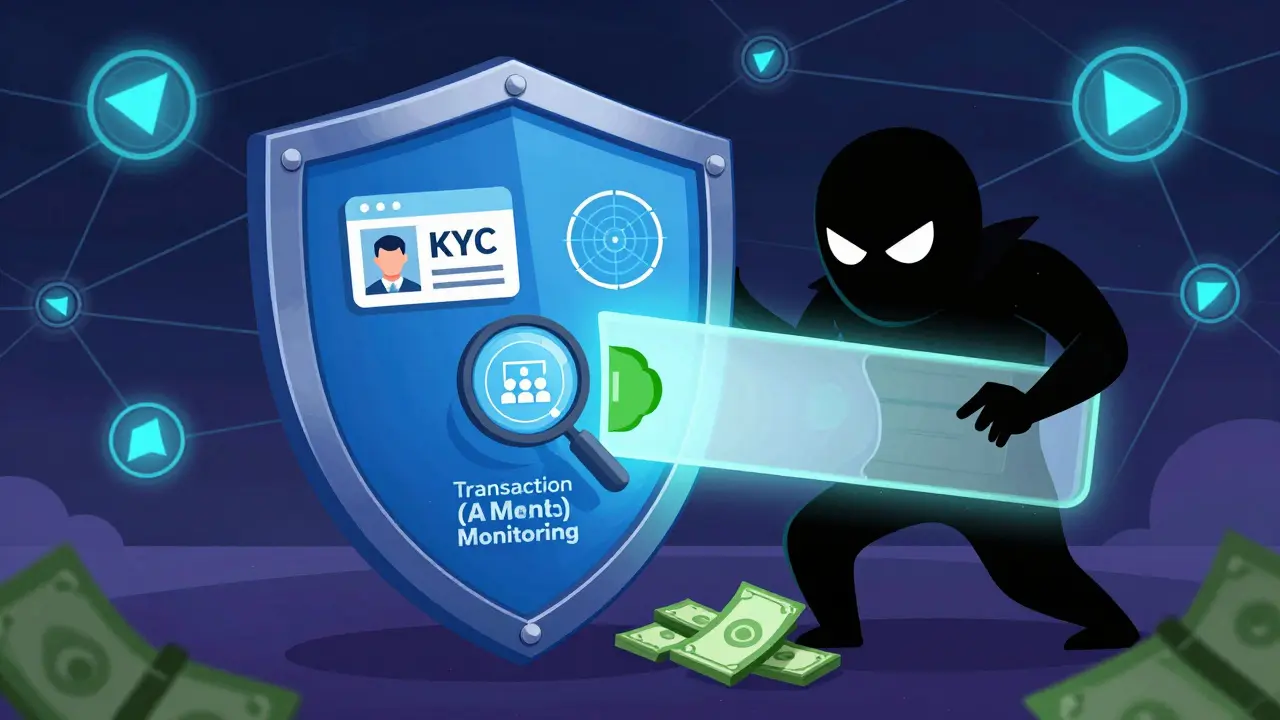
The Non-Negotiable: Anti-Money Laundering (AMLA) Compliance
Getting a license is step one. Staying licensed requires strict adherence to the Federal Anti-Money Laundering Act (AMLA). Switzerland was among the first nations to apply comprehensive AML regulations to blockchain service providers. The FATF acknowledged Switzerland's AMLA as a good framework back in 2016, and the country has only tightened its grip since then.
Your obligations include:
- Know-Your-Customer (KYC): You must verify the identity of every client. No anonymous wallets for institutional clients.
- Beneficial Owner Identification: You need to know who ultimately controls the funds, piercing through corporate structures if necessary.
- Transaction Monitoring: Continuous surveillance of transaction patterns to detect anomalies.
- Suspicious Activity Reporting: If you suspect money laundering, you must report it to the Money Laundering Reporting Office Switzerland (MROS).
One critical detail is the Travel Rule. In August 2019, FINMA issued guidance that actually went beyond the recommendations of the Financial Action Task Force. Article 10 of the Anti-Money Laundering Ordinance requires you to transmit information about originators and beneficiaries with payment orders. This applies specifically to financial services based on blockchain technology. If you send crypto to another VASP (Virtual Asset Service Provider), you must attach the sender and receiver data. Failure to do so can result in severe penalties or loss of license.
Stablecoins: A High-Risk Zone
If your business involves stablecoins, tread carefully. FINMA published specific guidance in 2024 highlighting the increased risks of money laundering, terrorist financing, and sanctions circumvention associated with these assets. Currently, there is no single "stablecoin law" in Switzerland. Instead, FINMA applies its existing supervisory approach for blockchain-based tokens.
Many issuers try to bypass banking laws by using default guarantees from traditional banks. Essentially, the bank promises to back the stablecoin 1:1. However, FINMA warns that this creates systemic risks for both the stablecoin holders and the guaranteeing banks. Depending on the structure, your stablecoin initiative might trigger licensing obligations under either the Swiss Banking Act or the Swiss Collective Investment Schemes Act. You cannot assume a stablecoin is just a "payment token." It often falls under stricter securities or banking regulations.
Tax Advantages and Business Climate
Why choose Switzerland over Singapore or Dubai? Partly it’s the reputation, but largely it’s the tax regime. As of April 2025, Switzerland notably lacks any digital service tax or specific blockchain-focused tax legislation. This provides significant financial advantages. While corporate income tax still applies, the absence of punitive levies targeting crypto transactions specifically makes cash flow management easier for startups.
Furthermore, Switzerland is neither an EU nor an EEA member. This means it maintains regulatory independence. The European Union has implemented MiCA (Markets in Crypto-Assets Regulation), which establishes unified rules across the EEA. Switzerland does not follow MiCA directly. However, if your Swiss company provides services to EU-based customers, you must comply with MiCA requirements for those specific interactions. This creates a dual compliance framework. You manage Swiss regulations for your local operations and MiCA for your EU clientele. It’s complex, but it offers flexibility that pure EU members don’t have.
Looking Ahead: 2026 Regulatory Shifts
The landscape isn't static. With implementation scheduled for January 2026, the Basel Committee on Banking Supervision's global prudential standards for cryptoasset exposures are coming into effect. This will require Swiss banks to classify cryptoassets into conservative prudential treatment groups. For crypto businesses, this means traditional banks will be even more cautious about holding your assets or providing fiat on-ramps. You may find it harder to open corporate bank accounts unless your compliance record is impeccable. The era of easy integration between traditional finance and crypto in Switzerland is ending; the era of rigorous, verified partnership is beginning.
Do I need a physical office in Switzerland to get a crypto license?
Yes. To obtain a FINMA license, you must register a Swiss entity, typically an AG (Aktiengesellschaft) or GmbH (Gesellschaft mit beschränkter Haftung). This requires a registered address in Switzerland, a board of directors with a majority of residents, and actual operational presence. You cannot hold a Swiss crypto license remotely from abroad.
How long does it take to get a Swiss crypto license?
The process is thorough. For a fintech license, expect the review to take several months, often ranging from 6 to 12 months depending on the complexity of your business model and the completeness of your application. FINMA conducts deep dives into your IT security, compliance procedures, and financial stability before granting approval.
Is Switzerland better than the EU for crypto businesses?
It depends on your target market. If you serve primarily EU customers, MiCA provides a single passport to operate across 27 countries, which is efficient. However, Switzerland offers greater regulatory flexibility, no digital service tax, and a faster-moving innovation culture. Many large firms maintain a Swiss HQ for R&D and global strategy while using an EU subsidiary for customer-facing activities in Europe.
What happens if my stablecoin loses its peg?
Under Swiss law, if your stablecoin triggers licensing obligations under the Banking Act, you are subject to strict reserve requirements and liquidity tests. If it loses its peg, you face immediate scrutiny from FINMA. You must demonstrate that your backing assets are sufficient and liquid to restore stability. Failure to do so can lead to license revocation and legal action for misleading investors.
Can DeFi protocols operate in Switzerland?
Decentralized Finance (DeFi) faces challenges. FINMA regulates entities, not code. If your DeFi protocol has a central team, foundation, or identifiable controllers, those entities are likely subject to regulation. Fully decentralized protocols with no central control exist in a gray area, but if they offer services to Swiss residents, FINMA may pursue the developers or node operators if they determine a central decision-making body exists.
