- 20 Jul 2026
- Elara Crowthorne
- 0
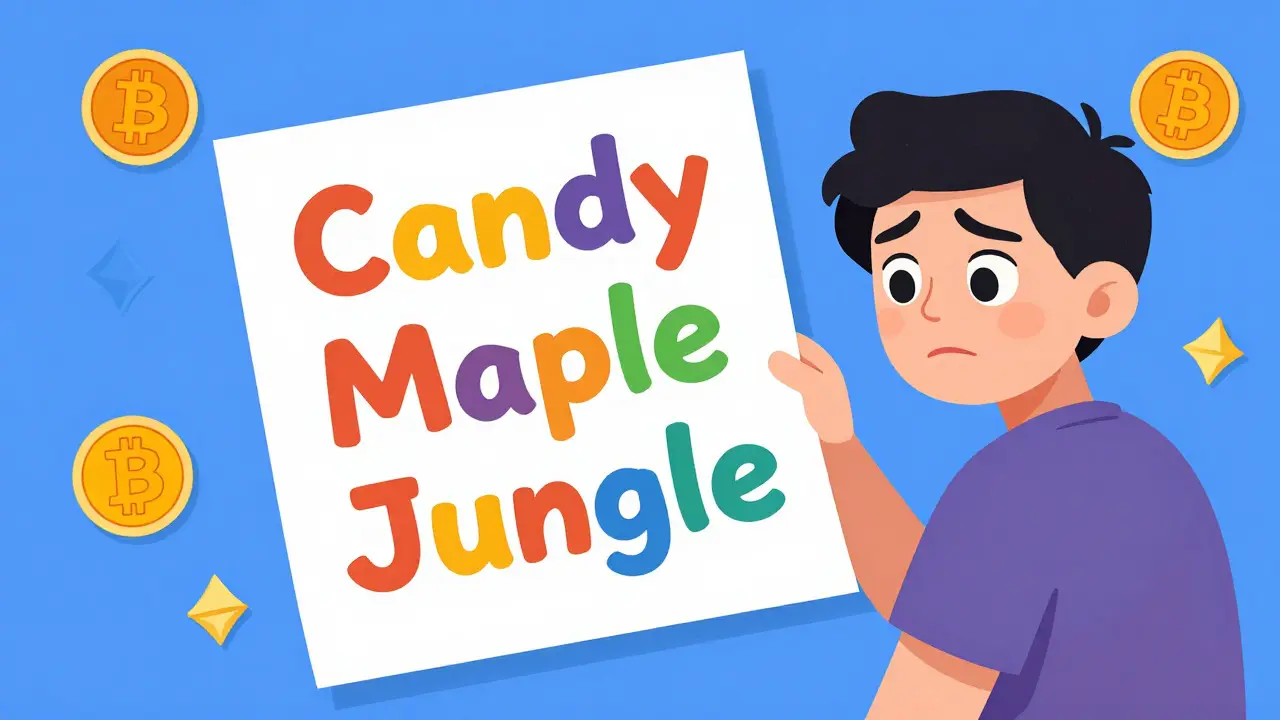
You’ve just bought your first Bitcoin or Ethereum. You set up a new wallet, and suddenly, the screen asks you to write down twelve random words. "Candy," "Maple," "Jungle"... it looks like a game of Scrabble gone wrong. But here’s the hard truth: those words are worth more than your house. Lose them, and your money vanishes forever. Give them away, and someone else gets rich while you get nothing.
This sequence is called a seed phrase. It is the single most important thing in your entire crypto journey. It isn’t just a password; it is the master key to your digital life. If you don’t understand how it works, you aren’t really owning your cryptocurrency-you’re just renting space on someone else’s server with a risky lease.
How Does a Seed Phrase Actually Work?
To get why seed phrases matter, you have to look under the hood of blockchain technology. In the early days of Bitcoin, every time you wanted to receive money, you generated a unique pair of keys: a public address (like your bank account number) and a private key (like your PIN). If you had ten addresses, you needed ten private keys. Managing that was a nightmare. One lost piece of paper meant one lost chunk of money.
In 2013, developers Marek Palatinus and Pavol Rusnak introduced a solution called BIP-39, which is a standard for generating human-readable mnemonic seeds from entropy. This standard changed everything. Instead of managing dozens of private keys, you now generate one master seed. This seed uses a mathematical formula to create an infinite number of private keys and addresses. All they need is that original list of words.
The process starts with randomness. Your device generates random bits of data (entropy). It then adds a checksum-a small error-checking code-to ensure you didn’t mistype anything later. Finally, it maps these bits to a specific list of 2,048 English words. That’s where your 12 or 24 words come from. They aren’t random gibberish; they are a compressed, readable version of complex cryptographic math.
Think of it like this: A private key unlocks one specific door. A seed phrase unlocks the entire building, including every room that hasn’t been built yet. This system allows wallets to be "hierarchical deterministic" (HD), meaning your wallet can automatically generate new addresses for privacy without you doing any extra work.
Seed Phrase vs. Private Key: What’s the Difference?
People often confuse these two terms, but the distinction is critical for your security strategy.
| Feature | Seed Phrase (Mnemonic) | Private Key |
|---|---|---|
| Format | 12-24 common words | 64-character hexadecimal string |
| Scope | Masters all accounts in the wallet | Controls only one specific address |
| Usability | Easy to write down and read | Hard to memorize, prone to typos |
| Risk if Lost | Total loss of all funds in that wallet | Loss of funds only in that specific address |
| Risk if Stolen | Thief drains all derived accounts | Thief steals funds from one address |
If you lose a private key, you might still recover other funds in your wallet using your seed phrase. But if you lose your seed phrase, the game is over. Conversely, if a hacker steals a private key, they only get what’s in that one pocket. If they steal your seed phrase, they empty your entire wallet ecosystem instantly.
Why Do Some Phrases Have 12 Words and Others 24?
You’ll usually see 12-word or 24-word phrases. The difference comes down to entropy, which is just a fancy word for unpredictability or randomness.
- 12 Words: Provides 128 bits of entropy. This means there are $2^{128}$ possible combinations. For context, cracking this via brute force would take longer than the age of the universe with current technology. This is sufficient for 99% of users.
- 24 Words: Provides 256 bits of entropy ($2^{256}$ combinations). This offers double the theoretical security margin.
Does a 24-word phrase mean you’re twice as safe? Not exactly. Since 12 words are already computationally unbreakable today, the extra length mainly protects against future advances in computing power, such as quantum computers. However, longer phrases are harder to write down correctly. Typos happen. And in crypto, a typo doesn’t just give you an error message-it sends your money to a black hole.
Most hardware wallets, like Ledger or Trezor, let you choose during setup. For most people, 12 words are fine. If you’re storing millions of dollars, go for 24.
The Golden Rules of Storing Your Seed Phrase
Here is where most people fail. The technology is secure, but human behavior is not. According to security firms, the majority of crypto losses aren’t due to blockchain hacks-they’re due to user error involving seed phrases.
Rule 1: Never digitize it. Do not take a photo of it. Do not save it in a text file on your computer. Do not store it in your cloud notes (Google Drive, iCloud, Evernote). If your computer is hacked, or if the cloud provider has a breach, your seed phrase is exposed. Hackers use bots that scan social media and cloud leaks for recognizable BIP-39 words. If they find "Candy Maple Jungle" in a tweet, they drain your wallet before you even notice.
Rule 2: Write it down physically. Use pen and paper. Better yet, use archival-quality materials. Paper burns, fades, and rots. Fire, floods, and termites are real threats. Many serious investors use metal backup solutions, like steel plates or aluminum cards, that can withstand temperatures up to 2,750°F. Brands like Billfodl or Cryptotag offer engraving tools so you can punch the words into metal. Yes, it costs around $150-$200, but compared to losing $50,000 in a house fire, it’s cheap insurance.
Rule 3: Split it up. Don’t keep all copies in one place. Keep one copy in a home safe, another in a safety deposit box at the bank, and maybe give a copy to a trusted family member. If your house burns down, you still have access. If the bank freezes your assets, you still have the home copy.
Rule 4: Beware of scams. This cannot be overstated: No legitimate support team will ever ask for your seed phrase. If a website pops up saying "Verify your wallet by entering your 12 words," close the tab immediately. It is a scam. Period. Even customer support for Ledger or Coinbase will never ask for this.
Common Mistakes That Cost People Millions
We see the same stories repeat on forums like Reddit’s r/CryptoCurrency. Here are the top ways people mess up:
- The "Digital Screenshot": Users take a photo of their seed phrase to "keep it safe" on their phone. Then, malware on their phone uploads that photo to the cloud. Boom. Drained.
- The Wrong Order: Seed phrases are sensitive to order. "Apple Banana" is different from "Banana Apple." Writing them down out of sequence makes recovery impossible.
- Ignoring the Passphrase: Some wallets offer an optional 25th word (a passphrase). This acts as a hidden layer. If you forget this passphrase, your seed phrase alone won’t work. It’s great for security, but terrible for memory. Only use this if you’re disciplined about recording it separately.
- Using Online Generators: Never use a website to generate your seed phrase. Use a hardware wallet or a trusted, open-source software wallet installed offline. Online generators can be rigged to send your coins to the developer.
A report from Kaspersky highlighted a specific scam where fraudsters post fake "wallet support" videos on YouTube. Viewers comment their seed phrases asking for help. Within hours, bots scrape those comments and drain the wallets. Total losses in one incident exceeded $1.2 million. Don’t be that statistic.
What Happens If You Lose It?
Let’s say you threw away the paper. Or your dog ate it. Or you just forgot where you hid it. Can you get it back?
Short answer: No.
There is no central authority. There is no "Forgot Password" button. The blockchain doesn’t know who you are. It only knows the math. Without the seed phrase, the mathematical link between you and your funds is broken forever. Approximately 20% of all Bitcoin ever mined is estimated to be permanently lost because owners lost their keys or seed phrases. That’s roughly $160 billion sitting in digital purgatory.
Recovery services exist, but they are expensive and only work if you have partial information (like a damaged paper where some words are faded). They can’t conjure a seed phrase out of thin air. So, treat your seed phrase like the deed to your house. You wouldn’t throw the deed in the trash, right?
Future-Proofing: Beyond BIP-39
While BIP-39 is the industry standard, it’s not perfect. Critics point out that it lacks standardized support for all altcoins and can be vulnerable if weak passphrases are used. Newer standards are emerging to address these issues.
SLIP-0039 is a newer standard that allows seed phrases to be split into multiple shares. Imagine splitting your seed phrase into five parts, where you only need three of them to recover your wallet. You can give one part to your spouse, one to your lawyer, and keep three yourself. If you die, your family combines their parts to access the funds. This is called Shamir’s Secret Sharing, and it solves the "single point of failure" problem.
As quantum computing advances, experts predict that current encryption methods might become vulnerable by the late 2020s or 2030s. While BIP-39 is currently safe, the industry is already researching quantum-resistant algorithms. For now, sticking to established hardware wallets and proper physical storage is your best bet.
Can I memorize my seed phrase instead of writing it down?
Technically, yes, but it is highly discouraged. Human memory is fallible. Under stress (like trying to recover a wallet after a disaster), you might forget a word or mix up the order. Experts recommend physical backups because they are immutable. If you do memorize it, verify it weekly by restoring it to a test wallet to ensure you haven’t forgotten anything.
Is it safe to store my seed phrase in a safety deposit box?
Yes, a bank safety deposit box is one of the safest places for physical storage. However, consider accessibility. If you die, your heirs may need legal documents to access the box. Combining a safety deposit box with a trusted family member holding a copy ensures redundancy.
What should I do if I suspect my seed phrase has been compromised?
Move your funds immediately. Create a brand new wallet with a fresh seed phrase, transfer all your crypto to the new addresses, and abandon the old wallet. Treat the old seed phrase as dirty laundry-burn it or shred it securely.
Do I need a new seed phrase for every cryptocurrency?
No. Thanks to hierarchical deterministic (HD) wallets, one seed phrase can generate addresses for Bitcoin, Ethereum, Litecoin, and hundreds of other coins. Each coin uses a different "derivation path" from the same master seed. Just make sure your wallet software supports the specific coins you hold.
Can I change my seed phrase?
Not directly. To get a new seed phrase, you must create a new wallet. You then transfer your funds from the old wallet (old seed) to the new wallet (new seed). Once the transfer is confirmed, you can safely discard the old seed phrase.