
- 18 Sep 2026
- Elara Crowthorne
- 0
Imagine you have $1,000 in stablecoins. Normally, you’d put that money into a liquidity pool and earn maybe 5% to 10% APY. But what if you could turn that $1,000 into $7,000 of working capital without selling your original asset? That’s the core promise of Alpaca Finance, a protocol that lets you borrow against your collateral to amplify your farming rewards.
But here’s the catch: leverage cuts both ways. While it can multiply your gains, it also multiplies your risk. If the market dips even slightly, your position might get wiped out entirely. This article breaks down exactly how Alpaca Finance operates as a decentralized lending protocol on BNB Chain, why traders use it, and whether it still makes sense for you in today’s market landscape.
The Core Concept: Leveraged Yield Farming
Most people understand simple yield farming: you provide two tokens to a liquidity pool, receive LP (Liquidity Provider) tokens, and stake those to earn rewards. It’s safe, but slow. Alpaca Finance changes this by introducing a borrowing layer on top of standard farming.
Here’s how it works in practice:
- Lending: You deposit assets like USDT or BNB into the protocol. Borrowers take these assets from your pool, and you earn interest paid by them.
- Borrowing: You want to farm a specific pair, say CAKE-BNB. You deposit some collateral, then borrow more CAKE and BNB from other users on the platform.
- Farming: You combine your own funds with the borrowed funds to create a larger LP position. You then stake this larger position to earn higher rewards.
The key metric here is leverage. On Alpaca, you can typically go up to 7x. So, for every $1 you put in, you control $7 worth of assets in the pool. Your rewards are calculated on the full $7, not just your initial $1. However, you must pay interest on the $6 you borrowed. If the farming rewards exceed the interest cost, you profit. If they don’t, or if the price of the underlying assets drops too much, you lose money.
How ALPACA Token Fits In
The ALPACA token isn’t just a speculative asset; it’s the engine of the protocol. It serves three main functions:
- Governance: Holders vote on proposals regarding fee structures, new markets, and treasury usage.
- Utility: Users can stake ALPACA to earn a share of the protocol’s revenue. This creates a direct link between the platform’s success and token value.
- Buyback and Burn: A portion of the fees generated by liquidations and borrowing is used to buy ALPACA from the open market and burn it. This reduces supply over time, potentially supporting the price.
As of mid-2024 data, there were roughly 151 million ALPACA tokens in circulation out of a maximum cap of 188 million. The circulating supply is relatively high compared to the max, meaning inflationary pressure has largely settled. The market cap hovers around $800k-$900k, which classifies it as a micro-cap asset. This means it’s highly volatile-small trades can move the price significantly.
Why Choose Alpaca Over Competitors?
If you’re already using Venus Protocol or PancakeSwap, why bother with Alpaca? The answer lies in automation and specific features tailored for farmers.
| Feature | Alpaca Finance | Venus Protocol | PancakeSwap V3 |
|---|---|---|---|
| Primary Focus | Leveraged Yield Farming | General Lending/Borrowing | DEX Trading & Simple Farming |
| Max Leverage | Up to 7x | Up to 10x (but manual management) | N/A (No native leverage) |
| Auto-Compounding | Yes, built-in | No, requires external vaults | No, manual claiming |
| Single-Token Deposit | Yes, auto-splits to LP | No, requires exact pairs | No, requires exact pairs |
| Complexity | Moderate-High | Low-Moderate | Low |
The standout feature is the single-token deposit. Usually, to farm a CAKE-BNB pair, you need both CAKE and BNB in equal value. Alpaca allows you to deposit just BNB. The protocol automatically swaps half of it to CAKE and forms the LP token for you. This saves you from managing multiple wallets or paying extra swap fees manually.
Another big draw is auto-compounding. In traditional farming, you claim rewards, sell them, buy more LP tokens, and re-stake. Each step costs gas fees and time. Alpaca automates this loop, reinvesting rewards back into your position continuously. For small balances, this efficiency boost can be the difference between profit and loss due to transaction costs.
The Risks: Liquidation and Impermanent Loss
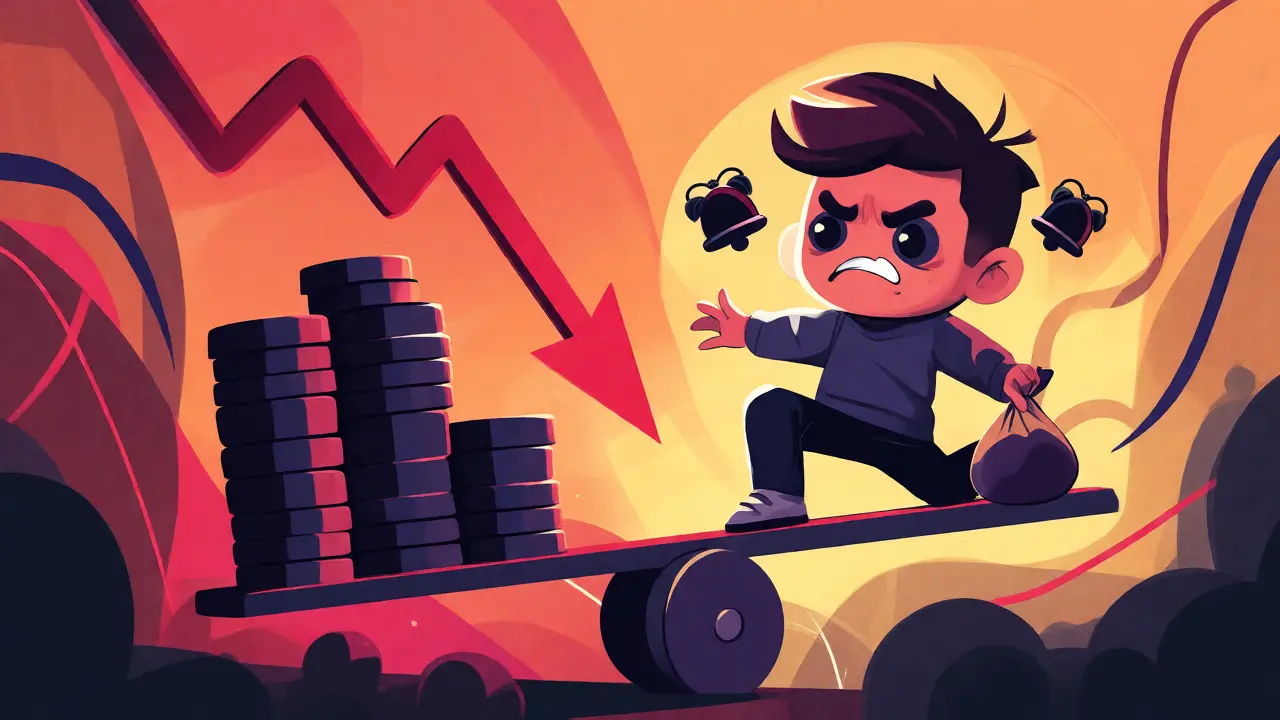
Leverage is dangerous. Let’s look at a real-world scenario. You open a 5x leveraged position on ETH-BNB. You put in $1,000, controlling $5,000 worth of assets. If the price of ETH drops by 10%, your total position value drops by $500. Since you only put in $1,000, you’ve lost 50% of your equity. If it drops another 10%, you’re nearly wiped out.
This triggers a liquidation. When your health factor (a ratio of your collateral to your debt) falls below a critical threshold, Alpaca’s bots automatically sell your collateral to repay the loan. They charge a penalty fee for this service. During the May 2021 crash, Alpaca saw over $30 million in liquidations in a single event. Many users who didn’t monitor their positions closely got caught out.
Additionally, you face impermanent loss amplified by leverage. If one asset in the pair skyrockets while the other stagnates, the value of your LP tokens relative to holding the assets separately decreases. With 7x leverage, this effect is magnified sevenfold. You need high farming yields to offset both the borrowing interest and the amplified impermanent loss.

Getting Started: Practical Steps
Ready to try it? Here’s what you need before jumping in:
- Wallet: MetaMask or Trust Wallet connected to BNB Chain.
- Gas Fees: Keep BNB in your wallet for transactions. Gas spikes during volatility can make small trades expensive.
- Knowledge: Understand what a "Health Factor" is. Aim to keep it above 1.5 to avoid sudden liquidations.
The user interface is generally rated well for clarity, but the learning curve isn’t zero. New users often spend 8-12 hours figuring out the nuances of selecting the right pools and monitoring their positions. Don’t start with your life savings. Test with a small amount to understand how the auto-compounding and liquidation alerts work in real-time.
Current Status and Future Outlook
As of late 2024 and early 2025, Alpaca Finance remains a niche player. Its Total Value Locked (TVL) has decreased from its highs, reflecting broader market cooling and competition from newer protocols. However, it maintains a loyal community, particularly in Southeast Asia where BNB Chain adoption is strong.
The team has been working on V2 upgrades, including better liquidation mechanics and plans for multi-chain expansion to networks like Polygon and Avalanche. This diversification is crucial because relying solely on BNB Chain exposes the protocol to regulatory risks associated with Binance. If regulations tighten on BNB Chain, Alpaca needs alternatives.
Price predictions vary wildly. Some algorithms suggest modest growth if the bull run continues, while others warn of further consolidation. Given its low market cap, ALPACA is a high-risk, high-reward play. It’s not a "set and forget" investment like Bitcoin. It requires active management and a tolerance for significant price swings.
Is Alpaca Finance safe to use?
Alpaca Finance has undergone multiple audits by firms like PeckShield and SlowMist. The smart contracts are generally considered secure. However, "safe" doesn't mean "risk-free." The primary risk isn't a hack, but user error leading to liquidation. Always check the latest audit reports on their official GitHub or website before depositing large sums.
Can I lose all my money on Alpaca Finance?
Yes, especially when using high leverage. If the market moves sharply against your position, you can be liquidated, losing your entire collateral plus a penalty fee. Even without leverage, you can suffer losses from impermanent loss if the prices of the paired assets diverge significantly. Never invest more than you can afford to lose completely.
How does Alpaca Finance make money?
The protocol generates revenue through several channels: interest paid by borrowers, fees charged during liquidations, and trading fees from swaps executed within the platform. A percentage of these revenues is used to buy back and burn ALPACA tokens, while the rest goes to the treasury and stakers.
Do I need to hold ALPACA to use the platform?
No, you do not need to hold ALPACA to lend or borrow. You can interact with the protocol using stablecoins or major assets like BNB and ETH. Holding ALPACA is optional and primarily beneficial if you want to participate in governance or earn additional yield through staking.
What happens if I withdraw my funds before maturity?
For flexible deposits, you can withdraw anytime, though you may forfeit accrued rewards depending on the timing. For fixed-term products, withdrawing early usually incurs a penalty fee, reducing your principal return. Always check the specific terms of the product you are entering.
