
- 3 Aug 2026
- Elara Crowthorne
- 0
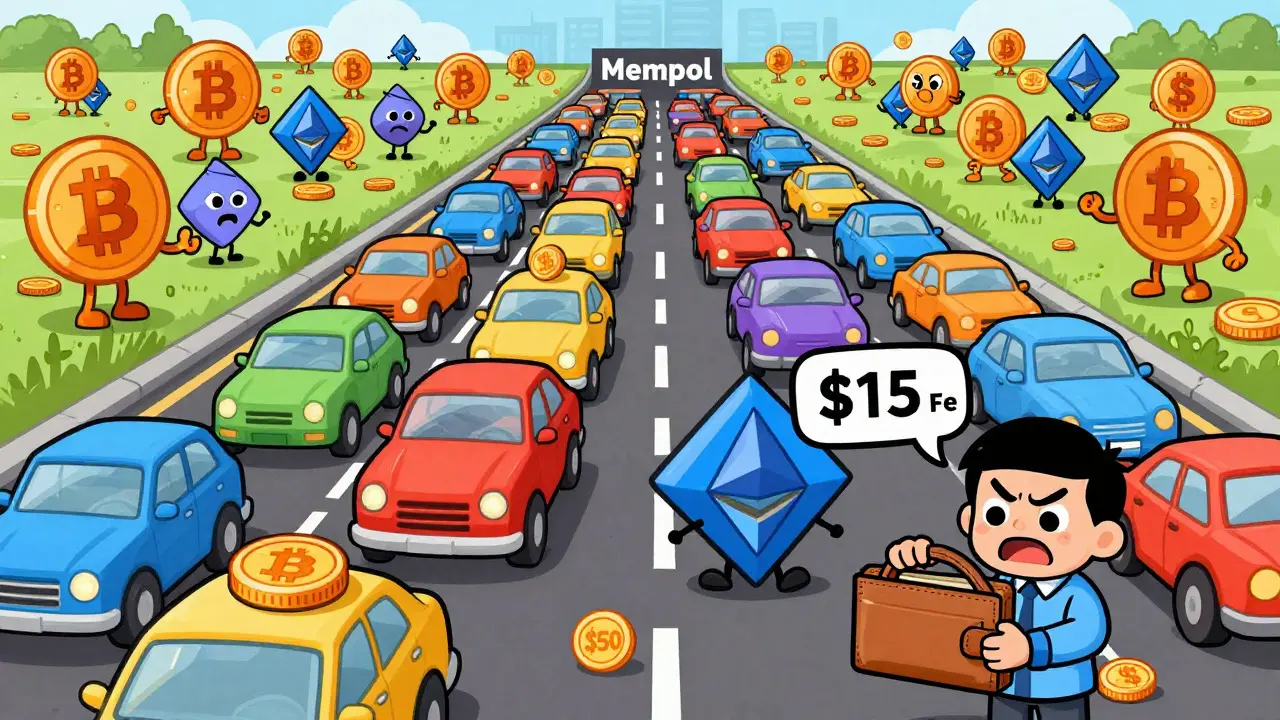
Imagine paying $15 in fees just to send $50 worth of Bitcoin. It sounds ridiculous, right? Yet, this is exactly what happened to user u/BlockchainTrader89 during the market rally in March 2025. You aren't being scammed; you are simply hitting a wall created by how blockchains work. Cryptocurrency transaction fees are the costs paid to miners or validators to process and secure transactions on a blockchain network. They are not fixed prices set by a bank. Instead, they fluctuate wildly based on supply and demand for space on the blockchain.
If you have ever wondered why your transfer cost pennies one day and dollars the next, you need to look under the hood. The fee landscape changed significantly in 2025 as networks scaled and stablecoin usage exploded. Understanding these factors isn't just for developers; it’s essential for anyone holding digital assets who wants to keep their money instead of giving it all to the network.
The Core Driver: Network Congestion and Block Space
The single biggest factor affecting your fee is simple math: too many people trying to use the road at once. This is called network congestion. Think of a blockchain like a highway with a limited number of lanes (blocks). Every few minutes, a new block opens up. If only ten cars want to enter, everyone gets in cheaply. If ten thousand cars show up, they start bidding against each other for the remaining spots.
This creates an auction mechanism known as the mempool, which is a waiting area for unconfirmed transactions. When the mempool grows rapidly-often due to market rallies or high trading volume-users must increase their fee bids to get prioritized. According to KuCoin's January 2025 analysis, this congestion is arguably the most significant driver of high fees. During the April 2025 market surge, 28% of Bitcoin transactions took over two hours to confirm because users were unwilling or unable to pay the inflated rates demanded by the congested network.
Why does this happen? Because block size is limited. Bitcoin, for example, has strict limits on how much data can fit into a block. When demand outstrips this capacity, the price per byte goes up exponentially. It’s not personal; it’s basic economics applied to code.
How Different Blockchains Calculate Costs
Not all cryptocurrencies charge fees the same way. The method depends entirely on the architecture of the specific blockchain. Knowing which model your asset uses helps you predict when costs will rise.
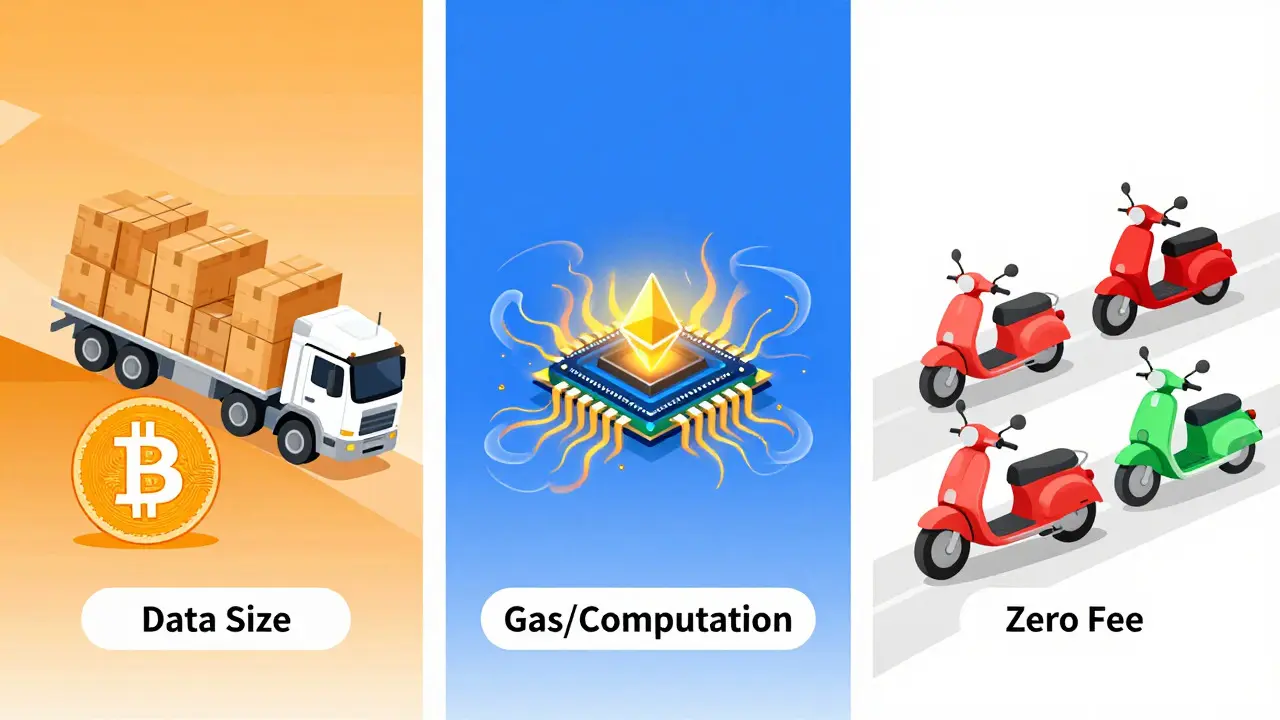
| Cryptocurrency | Fee Model | Key Determinant | Typical Cost Range (2025) |
|---|---|---|---|
| Bitcoin | Satoshis per Byte (Sat/vB) | Transaction Data Size & Congestion | $0.50 - $20+ (varies heavily) |
| Ethereum | Gas (Gwei) | Computational Complexity & Demand | $1 - $50+ (spikes during DeFi activity) |
| Tron | Delegated Proof of Stake (DPoS) | Resource Bandwidth/Energy | <$0.01 (often free for small transfers) |
| IOTA | Fee-less Architecture | N/A (No miners/validators) | $0.00 |
Bitcoin: Paying for Data, Not Value
Bitcoin’s fee structure is unique because it doesn’t care about the dollar value of your transaction. Sending $1 or $1 million costs the same if the transaction size is identical. The formula is straightforward: Total Fee = Transaction Size (Bytes) × Fee Rate (Sat/Byte).
The "size" comes from the complexity of the transaction. Specifically, it depends on the number of inputs (Unspent Transaction Outputs or UTXOs) and outputs. If you try to aggregate many small Bitcoin holdings into one large transfer, you are creating a massive data payload. This increases the byte count, which directly multiplies your total fee. This is why Bitcoin users often consolidate funds regularly-to keep future transaction sizes small and cheap.
Ethereum: Paying for Computation
Ethereum uses a system called Gas. Here, you are paying for the computational power required to execute your transaction. Simple transfers require less gas than complex interactions with smart contracts, such as swapping tokens on a decentralized exchange (DEX).
In 2025, Ethereum fees remain highly volatile. BitGo’s February 2025 overview notes that fees spike dramatically during surges in DeFi activity. If thousands of people are trying to lend, borrow, or trade simultaneously, the network demand skyrockets, pushing the Gwei price up. Unlike Bitcoin, where size matters, on Ethereum, complexity and timing matter most.
Low-Fee Alternatives: Tron and IOTA
For users frustrated by Bitcoin and Ethereum costs, alternative networks offer different solutions. Tron utilizes a Delegated Proof of Stake (DPoS) consensus mechanism. This allows for extremely high throughput and fees often under $0.01. In fact, many USDT transfers on Tron are effectively free for the user if they hold enough TRX tokens to cover bandwidth. NOWPayments’ March 2025 report highlights that 87% of respondents chose Tron specifically for these low costs.
Then there is IOTA. IOTA eliminates fees entirely. Its unique architecture involves no miners or validators, meaning there is no competition for block space. As confirmed by TRM Labs in August 2025, IOTA’s transaction fees are zero. This makes it ideal for microtransactions and Internet of Things (IoT) devices that need to communicate frequently without worrying about cost accumulation.
Hidden Costs: Exchange Withdrawal Fees vs. Network Fees
Here is where many users get burned. There is a difference between the network fee (paid to the blockchain) and the withdrawal fee (charged by your exchange).
When you withdraw crypto from a centralized exchange like Coinbase or Binance, the platform often applies a fixed withdrawal fee. For example, an exchange might charge a flat 0.0005 BTC to withdraw Bitcoin, regardless of current network conditions. Sometimes this covers the real network cost; sometimes it doesn’t. BitGo warns that some exchanges apply fixed fees that may not reflect real-time network costs, leading to confusion. You might think you are paying a premium for speed, but you are actually just paying the exchange’s markup.
Always check the explorer (like Blockstream.info for Bitcoin or Etherscan for Ethereum) to see the actual network rate before assuming the exchange fee is fair. In May 2025, Trustpilot reviews revealed that 68% of negative feedback regarding crypto platforms cited unexpected or opaque fee structures.

Strategies to Reduce Your Transaction Fees
You don’t have to accept high fees as inevitable. By understanding the mechanics, you can save significant amounts. Kyrrex’s February 2025 analysis showed that users who optimized their timing saved an average of 43% on transaction costs compared to those who didn't.
- Time Your Transactions: Network congestion is cyclical. Bitcoin fees are typically lowest during off-peak hours, often Tuesday through Thursday mornings in UTC time. Reddit discussions in r/Bitcoin noted a 62% average fee reduction during these periods compared to peak weekend times. Avoid sending transactions during major market rallies or news events.
- Use Layer-2 Solutions: For Bitcoin, consider using the Lightning Network for small payments. For Ethereum, use Layer-2 rollups like Arbitrum or Optimism. These process transactions off the main chain and settle them later, drastically reducing costs.
- Consolidate Inputs: If you hold Bitcoin in many small UTXOs, combine them into fewer, larger UTXOs when fees are low. This reduces the data size of future transactions.
- Choose the Right Chain for Stablecoins: If you are moving USDT or USDC, avoid Ethereum mainnet unless necessary. Use Tron or Polygon. BVNK’s June 2025 guide notes that businesses using Tron for USDT transfers achieved 99.7% lower fees compared to Ethereum.
- Monitor the Mempool: Use tools like mempool.space to visualize current congestion. If the mempool is full, wait. Patience pays off.
The Future of Fees in 2026 and Beyond
The landscape is shifting. With stablecoin transaction volume reaching over USD 4 trillion in the first half of 2025 (an 83% increase year-over-year), the pressure to keep fees low is immense. TRM Labs reports that this growth is driving adoption of low-fee networks. We are seeing a clear trend toward fee abstraction, where applications cover the user fees, making transactions feel "free" to the end-user while maintaining network security in the background.
However, challenges remain. Without further scaling solutions, Bitcoin’s base layer could increasingly exclude small transactions during bull markets. The industry is responding with hybrid approaches, combining the security of major chains with the efficiency of alternative consensus mechanisms. For the average user, the key takeaway is diversification: don't rely on a single blockchain for all your needs. Match the tool to the job.
Why are my crypto transaction fees so high today?
High fees are usually caused by network congestion. When many users try to transact at the same time, the available block space fills up quickly. Users then bid up the fees to get their transactions processed faster. This is common during market rallies or weekends when trading volume spikes.
Does the amount of crypto I send affect the fee?
Generally, no. On networks like Bitcoin and Ethereum, the fee is based on the data size (bytes) or computational complexity (gas) of the transaction, not the monetary value. Sending $10 costs the same as sending $10,000 if the transaction structure is identical.
What is the cheapest cryptocurrency to send?
Networks like IOTA offer completely fee-less transactions. Tron and Nano also have extremely low fees, often under $0.01. For stablecoins like USDT, Tron is widely considered the most cost-effective option in 2025, offering near-zero costs for most transfers.
How can I lower my Bitcoin transaction fees?
You can lower fees by timing your transactions during off-peak hours (typically weekday mornings UTC), consolidating small UTXOs to reduce transaction size, and using the Lightning Network for small payments. Always monitor the mempool to avoid sending transactions during peak congestion.
Is there a difference between network fees and exchange fees?
Yes. Network fees go to miners or validators to secure the blockchain. Exchange fees are charges imposed by platforms like Coinbase or Binance to cover their operational costs and profit margins. Exchange fees are often fixed and may not reflect the actual current network cost.
