
- 9 Aug 2026
- Elara Crowthorne
- 0
Imagine a world where you get paid in cryptocurrency just for sharing your health data or booking a video call with a doctor. That was the bold promise of MDsquare, a project that tried to merge telemedicine with blockchain technology back in 2018. If you stumbled upon the ticker symbol TMED on a chart today, you might be wondering: Is this dead? Is it a hidden gem? Or is it a total scam?
The short answer is complicated. MDsquare is an Ethereum-based healthcare ecosystem designed to connect patients and doctors via remote consultations while rewarding them with tokens. However, as we navigate through 2026, the reality on the ground looks very different from the hype of its launch. The token exists, but trading volume is practically non-existent, and the platform’s active user base remains a mystery. Let’s break down exactly what MDsquare is, how its economy was supposed to work, and whether there is any life left in this project.
The Core Concept: Telemedicine Meets Blockchain
To understand MDsquare, you have to look at the problem it tried to solve. Before the pandemic made Zoom calls with doctors normal, cross-border healthcare was a logistical nightmare. Language barriers, fragmented medical records, and high costs kept many people from accessing quality care abroad. A South Korean team launched MDsquare to fix this using two main pillars: a telemedicine app and a blockchain-backed economy.
The platform aimed to create a "virtuous economic circle." Here is how they envisioned it working:
- Patients upload their health data from wearable devices or manually enter medical history. In return, they earn TMED tokens.
- Doctors provide remote video consultations, monitoring services, and medical content. They get paid in TMED tokens.
- Device Makers integrate their IoT health sensors with the platform, earning rewards when users track data.
- Hospitals accept TMED for offline bills, bridging the digital token world with physical healthcare infrastructure.
The idea was to use the Ethereum blockchain to secure these transactions and ensure that health data couldn't be tampered with. By putting everything on a public ledger, they promised transparency and security that centralized servers couldn't match.
Tokenomics: The TMED and MD Points System
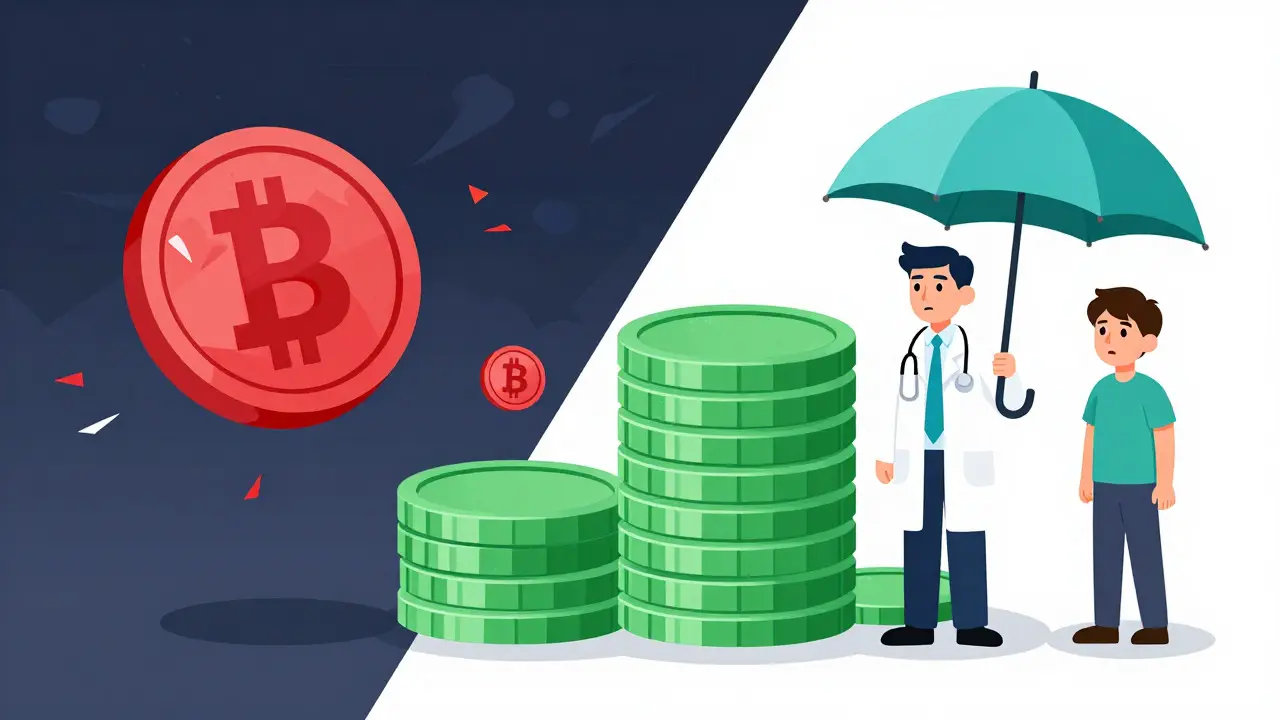
One of the most unique aspects of MDsquare’s design was its dual-token system. Most crypto projects rely solely on their native coin for payments, which creates a massive headache when prices swing wildly. If a doctor charges $50 for a consultation, and the token price drops by 20% an hour later, the doctor loses money. MDsquare tried to solve this with MD Points (MDP).
Here is the breakdown of the economics:
| Component | Function | Volatility Risk | Source of Value |
|---|---|---|---|
| TMED Token | Rewards for data sharing, speculation, external trading | High (Crypto market dependent) | Market demand, utility within app |
| MD Points (MDP) | Paying for actual medical services | None (Fixed USD rate) | Fiat currency backing |
Users could buy MD Points directly with US Dollars or other fiat currencies at a fixed rate. These points were then used to pay doctors. This meant the cost of a consultation remained stable regardless of what happened to the crypto market. Meanwhile, the TMED token served as the reward mechanism. You earned TMED for contributing data, but you spent MDP for services. You could also exchange your earned TMED for MDP if you wanted to use your rewards to pay for care.
The total supply of TMED is fixed at 28 billion tokens. There is no hard cap beyond this number, meaning no new tokens can be minted. This scarcity was intended to drive value up as more people joined the network. However, as we will see, liquidity has been a major issue.
Current Market Status in 2026
If you are looking to buy TMED right now, you need to proceed with extreme caution. The market data for MDsquare in 2026 paints a picture of a dormant or highly illiquid asset. Major trackers like CoinMarketCap often list the circulating supply as 0 TMED and the trading volume as $0 USD. This doesn't necessarily mean the token doesn't exist; it usually means there are no significant trades happening on major exchanges to register a price.
Other aggregators tell a slightly different, yet still concerning, story. Sites like P2P.Army might show a micro-price around $0.000009 with tiny daily volumes under $1,000. Bitget lists the fully diluted market cap at roughly $168,000, ranking it outside the top 7,000 cryptocurrencies. For context, being ranked #7048 puts TMED in the realm of obscure, low-cap assets that lack institutional interest.
Why is the volume so low? Several factors contribute to this:
- Lack of Exchange Listings: Many smaller tokens get delisted from major platforms if they fail to meet minimum liquidity or development milestones. Without easy access on big exchanges, retail investors can't buy in easily.
- Regulatory Uncertainty: Healthcare crypto faces strict scrutiny. Regulators worry about patient privacy (HIPAA/GDPR compliance) and whether the token counts as a security. This scares off large players.
- Competition: Traditional telemedicine giants (like Teladoc) and newer Web3 health projects have captured most of the attention, leaving niche projects like MDsquare behind.
Technical Architecture and Security
From a technical standpoint, TMED is an ERC-20 token on the Ethereum network. This means it uses the same standard as thousands of other tokens, making it compatible with wallets like MetaMask or Ledger. It relies on Ethereum’s consensus mechanism for security, which is robust, though transaction fees (gas) can be high during peak times.
The whitepaper highlights features like AI-powered chatbots, 24/7 language interpretation, and integration with IoT health devices. While these are impressive concepts, the challenge lies in execution. Integrating real-world medical devices with a blockchain backend requires complex APIs and rigorous testing. There is little public evidence of widespread API adoption or major hospital partnerships as of 2026. Most blockchain telemedicine projects struggle to move from "concept" to "clinical deployment" because hospitals are notoriously slow to adopt new tech due to liability concerns.

Risks and Red Flags
Before allocating any funds to TMED, consider these critical risks:
- Liquidity Trap: Even if you buy TMED, selling it might be difficult. Low volume means you could face wide bid-ask spreads, losing value instantly upon entry or exit.
- Development Stagnation: Social media activity for MDsquare peaked around 2018-2019. Recent updates are sparse. In crypto, silence often signals abandonment.
- Regulatory Compliance: Handling health data is heavily regulated. If MDsquare hasn’t achieved clear HIPAA or GDPR certification, major healthcare providers won’t touch it.
- Speculative Nature: With a circulating supply near zero on some trackers, the price action is driven by speculation rather than utility. This makes it highly volatile and unpredictable.
Is MDsquare Still Relevant?
The concept behind MDsquare-using blockchain to incentivize health data sharing-is still valid. Academic papers and industry reports from 2025 continue to explore how decentralized ledgers can improve telehealth security and patient autonomy. However, execution is everything. Big tech companies and established healthcare networks are building similar solutions with deeper pockets and clearer regulatory paths.
For the average user, MDsquare currently serves more as a historical example of early blockchain healthcare experiments than a functional tool. If you hold TMED from the ICO days, you might hope for a revival, but the odds are stacked against it. If you are considering buying in, treat it as a high-risk speculative bet, not an investment in a growing ecosystem.
The future of healthcare crypto likely belongs to projects that have secured real-world hospital partnerships, achieved regulatory compliance, and demonstrated consistent daily active users. As of now, MDsquare has yet to prove it can deliver on those fronts.
Can I still buy TMED tokens?
Technically yes, but it is difficult. TMED is an ERC-20 token, so it may be available on small decentralized exchanges (DEXs) or lesser-known centralized platforms. However, major exchanges like Coinbase or Binance do not prominently list it. Be prepared for low liquidity, meaning you might not find enough buyers to sell your tokens later without crashing the price.
What is the difference between TMED and MD Points?
TMED is the volatile cryptocurrency token used for rewards and speculation. MD Points (MDP) are a stable, fiat-backed currency used specifically to pay for medical services within the app. This dual system was designed to protect doctors and patients from crypto price swings when paying for actual healthcare.
Is MDsquare a scam?
It is not necessarily a "scam" in the sense of a fake project, as it launched with a whitepaper, a team, and initial press coverage. However, it suffers from the common crypto fate of failing to gain traction. With near-zero trading volume and limited recent development updates, it carries high risk of being effectively abandoned or irrelevant.
How does MDsquare store health data?
The platform claims to use the Ethereum blockchain to log transactions and verify data integrity. However, detailed medical records are likely stored off-chain (in encrypted databases) for privacy and speed, with only hashes or pointers stored on the blockchain. Specific encryption standards and audit reports are not widely publicized.
What is the total supply of TMED?
The total supply of TMED is fixed at 28 billion tokens. This number has not changed since the project's inception. The circulating supply is often reported as 0 or negligible on major trackers, indicating that most tokens are either locked, held by early investors, or simply not being traded actively.