- 8 Aug 2026
- Elara Crowthorne
- 0
Remember the hum? The deafening, jet-engine roar of graphics cards spinning at maximum speed in your basement or garage? For years, that noise was the soundtrack of cryptocurrency. It was the sound of money being made, one block at a time. But then, on September 15, 2022, the noise stopped. Not because the servers crashed, but because the entire engine of Ethereum is the world's second-largest blockchain network that transitioned from energy-intensive mining to an efficient staking model changed overnight.
This wasn't a glitch. It was "The Merge." In a single moment, Ethereum switched from Proof of Work (PoW) to Proof of Stake (PoS). If you were holding a GPU rig expecting to mine ETH, you were suddenly holding expensive paperweights. If you were just watching, you witnessed the biggest technological pivot in digital asset history. Today, in 2026, looking back at this shift isn't just about nostalgia for hardware; it's about understanding how we moved from burning electricity to locking up capital. Let's break down what actually happened, why it matters to your wallet, and how you can participate now without buying a single fan.
The End of the Hardware Arms Race
To understand the shift, you have to look at what came before. Under the old Proof of Work system, miners competed to solve complex mathematical puzzles. The first one to solve it got to add the next block to the blockchain and claim the reward. This required massive computational power. You needed specialized Graphics Processing Units (GPUs), cooling systems, and enough cheap electricity to keep the lights on.
It was a race. And like any race, only the fastest-and usually the richest-winners took home the prize. Individual hobbyists struggled against industrial-scale mining farms. The barrier to entry skyrocketed. A competitive mining rig could cost anywhere from $2,000 to $10,000, plus monthly electricity bills that often exceeded $300. If your local utility rates spiked, your profits vanished instantly.
Proof of Work is a consensus mechanism where validators compete using computational power to secure the network and validate transactions worked, sure. Bitcoin still uses it. But for Ethereum, which aimed to be a global computer for decentralized applications, the inefficiency was a bottleneck. The network couldn't scale easily, and the environmental impact drew heavy criticism. The solution wasn't better GPUs; it was a different way of thinking entirely.
How Proof of Stake Actually Works
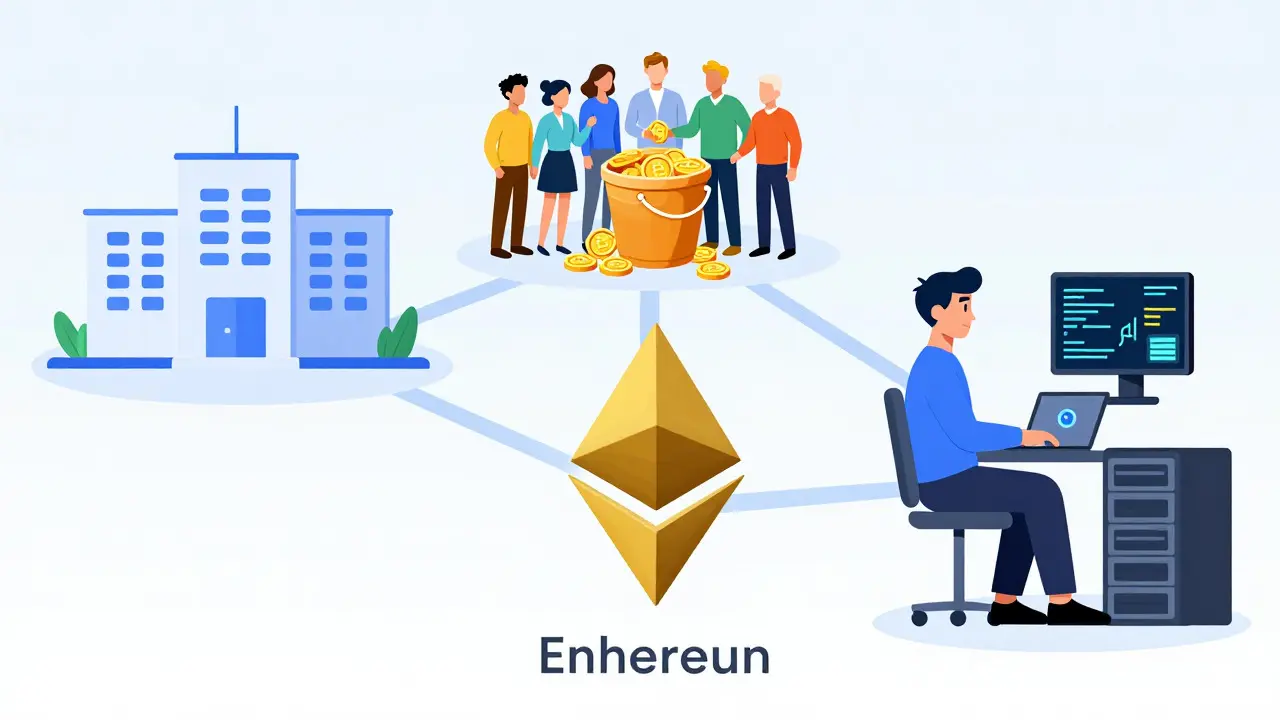
Enter Proof of Stake. Instead of spending energy to prove you did work, you put up collateral to prove you have skin in the game. In this system, validators replace miners. To become a validator, you don't buy a supercomputer. You lock up Ether (ETH).
Think of it like a security deposit. If you act honestly and keep your node online, you earn rewards. If you try to cheat or go offline for too long, you lose part of your deposit-a penalty known as "slashing." This aligns everyone's incentives with the health of the network. There is no competition to solve a puzzle; there is only cooperation to maintain truth.
Proof of Stake is a consensus mechanism where validators are chosen to create blocks based on the amount of cryptocurrency they hold and are willing to lock up as collateral drastically changes the economics. The energy consumption of the Ethereum network dropped by over 99% after The Merge. That’s not a typo. Ninety-nine percent. The network went from consuming as much energy as some small countries to less than a large household appliance.
Staking vs. Mining: The Real Numbers
If you’re trying to decide whether to invest in crypto infrastructure today, the comparison is stark. Let’s look at the practical differences between the old mining days and the current staking reality.
| Feature | Mining (Proof of Work) | Staking (Proof of Stake) |
|---|---|---|
| Primary Requirement | Hardware (GPUs/ASICs) | Cryptocurrency (ETH) |
| Upfront Cost | d>$2,000 - $10,000+ for rigs | 32 ETH for solo validation (~$80k-$120k) or fractions via pools |
| Ongoing Costs | High electricity ($200-$500/mo), cooling, maintenance | Minimal electricity (home server costs ~$5-$10/mo) |
| Noise & Heat | Loud, generates significant heat | Silent, low heat output |
| Entry Barrier | Technical hardware setup, physical space | Financial capital, basic tech knowledge for solo |
| Reward Predictability | Volatile, depends on difficulty and hash rate | Stable APY (typically 4-7%) |
Notice the shift in risk. In mining, your risk was operational: a broken fan, a price hike in electricity, or a new ASIC chip making your GPUs obsolete. In staking, your risk is financial and technical: the value of ETH dropping, or your validator node going offline and getting slashed. For most people, the latter is easier to manage than hauling heavy metal boxes into their living room.

How to Start Staking Without Breaking the Bank
You might be thinking, "Okay, I want to stake, but I don't have 32 ETH." That’s the minimum requirement to run a solo validator node directly on the network. Good news: you don't need to go solo to participate. The ecosystem has evolved to offer three main paths, each with different trade-offs.
- Centralized Exchange Staking: This is the easiest route. Platforms like Coinbase, Binance, Kraken, or Gemini allow you to click a button and stake your ETH. They handle the validator nodes, the uptime, and the technical headaches. You get a cut of the rewards, minus their fee. It’s simple, but you’re trusting a third party with your keys. As of 2025, these platforms typically offer yields between 3.5% and 6.5% APY.
- Staking Pools: Services like Lido or Rocket Pool let you pool your ETH with others. You can start with as little as 0.01 ETH. The pool aggregates funds to meet the 32 ETH threshold and runs validators collectively. You receive a token representing your share of the staked ETH. This offers more decentralization than exchanges but still involves smart contract risk.
- Solo Staking: If you have 32 ETH and some technical know-how, you can run your own node. This requires a reliable internet connection, a modest PC (even a Raspberry Pi can work if configured right), and Linux command-line skills. You keep all the rewards and contribute most directly to network decentralization. However, you are responsible for every outage and update. One mistake can lead to slashing.
For beginners, exchange staking or reputable pools are the best starting points. You learn the mechanics of locking assets and earning yield without needing a degree in network engineering.
The Risks Nobody Talks About Enough
Staking isn't free money. It comes with specific risks that differ from just holding ETH in a wallet. First, there's liquidity risk. When you stake, your ETH is locked. While Ethereum introduced withdrawal queues in later upgrades, you can't instantly sell your staked ETH if the market crashes tomorrow. You have to wait for the queue to process, which can take days or weeks depending on network congestion.
Second, there's slashing risk. If you run a solo validator and your node behaves maliciously-or even just suffers from severe downtime due to poor internet-you can be penalized. The protocol burns part of your 32 ETH stake. For pooled stakers, this risk is diluted, but it still exists. Always check the track record of the staking provider or pool you choose.
Third, there's regulatory uncertainty. Governments are still figuring out how to classify staking rewards. Are they income? Capital gains? The answer varies by country. Keep detailed records of your deposits and rewards. Tools like CoinLedger help automate this, but the responsibility is yours.
What Happened to the Miners?
When The Merge happened, millions of dollars worth of GPU mining rigs became useless for Ethereum. Some miners sold their equipment at a loss. Others pivoted. Many shifted to mining other Proof of Work coins like Ravencoin or Ethereum Classic (ETC). Some invested in ASICs for Bitcoin mining, though that market is incredibly saturated and dominated by large farms.
But the broader lesson here is about sustainability. The crypto industry faced immense pressure to reduce its carbon footprint. By moving to PoS, Ethereum didn't just save energy; it saved itself from potential bans in environmentally conscious jurisdictions. This move paved the way for institutional adoption. Pension funds and corporations are far more likely to invest in a green blockchain than one that consumes megawatts of power for no clear ecological benefit.
Looking Ahead: The Future of Consensus
As we move through 2026, the trend is clear. Newer blockchains like Solana, Cardano, and Polkadot were built on Proof of Stake from day one. Even Bitcoin Layer-2 solutions are exploring staking-like mechanisms for security. The era of burning resources to secure data is fading. The future is about efficiency, accessibility, and capital allocation.
For you, the user, this means lower fees and faster transactions. With sharding updates rolling out, Ethereum will process thousands of transactions per second, further reducing the cost of interacting with DeFi apps. Your staked ETH isn't just sitting there; it's securing a network that becomes more useful every year.
Whether you're a former miner looking for a quieter life or a new investor seeking passive income, the shift from mining to staking is an opportunity. You don't need a warehouse full of fans. You just need a bit of ETH and a willingness to lock it up. The noise is gone, but the rewards remain.
Can I still mine Ethereum with my GPU?
No. Since The Merge in September 2022, Ethereum no longer supports mining. The network exclusively uses Proof of Stake. Your GPU can still be used to mine other cryptocurrencies like Ethereum Classic or Ravencoin, but it cannot earn ETH rewards anymore.
How much ETH do I need to start staking?
To run a solo validator node, you need exactly 32 ETH. However, you can start staking with much less by using staking pools or centralized exchanges, where minimums can be as low as 0.01 ETH or even less, depending on the platform.
Is staking safer than holding ETH in a wallet?
Staking introduces new risks like slashing and liquidity locks, while holding in a wallet carries theft risk if private keys are compromised. Generally, staking on a reputable exchange or pool is considered safe for average users, but always diversify and use strong security practices for your accounts.
What happens if my validator goes offline?
If your solo validator goes offline for short periods, you miss out on rewards but aren't penalized heavily. However, prolonged downtime or faulty behavior can trigger "slashing," where a portion of your 32 ETH stake is burned as a penalty. Using a stable internet connection and reliable hardware mitigates this risk.
How does staking affect Ethereum's energy consumption?
Staking reduced Ethereum's energy consumption by over 99%. Instead of thousands of powerful computers competing globally, validators run on standard hardware with minimal power draw, making the network significantly more environmentally friendly.