

- 21 Apr 2026
- Elara Crowthorne
- 24
Ever wonder why you can send digital money across the world in minutes without a bank confirming who you are? It feels like magic, but it is actually math. Specifically, it is a complex layer of cryptocurrency encryption that makes it impossible for someone to just "copy and paste" your coins into their own wallet. Without these mathematical guards, the entire idea of decentralized money would collapse in seconds.
| Feature | Traditional Banking | Cryptocurrency |
|---|---|---|
| Verification | Centralized (Bank Staff/Systems) | Decentralized (Math/Code) |
| Trust Model | Institutional Trust | Cryptographic Proof |
| Control | Bank manages your keys/access | You hold the private keys |
| Immutability | Records can be edited by admin | Virtually impossible to change |
The Secret Sauce: Asymmetric Encryption
Most of us are used to symmetric encryption-think of a house key. You use the same key to lock the door and unlock it. If you want someone else to get in, you have to give them a copy of that exact key. In the world of crypto, that would be a nightmare because you'd have to share your secret password every time you wanted to receive money.
Instead, crypto uses Asymmetric Encryption, a system that uses a pair of related keys-a public key and a private key-to secure data. Think of your public key like your email address; you can give it to anyone so they can send you messages (or coins). Your private key is like the password to that email account. Only the person with the private key can "unlock" the funds associated with that public address.
To make this work, networks like Bitcoin rely on Elliptic Curve Cryptography (ECC), a powerful mathematical approach that creates secure key pairs using the algebraic structure of elliptic curves. The brilliance of ECC is that it provides incredibly high security with relatively small key sizes, making transactions fast enough for global use without sacrificing safety.
Digital Signatures: Proving You Own the Coins
If you tell a network, "I am sending 1 BTC to Sarah," how does the network know it is actually you and not a hacker who found your public address? This is where digital signatures come in. A digital signature isn't a picture of your handwriting; it is a piece of mathematical evidence.
When you initiate a transaction, your wallet uses your private key to "sign" the transaction data. This process creates a unique signature that proves two things: you have the private key for those funds, and the transaction details haven't been tampered with. This ensures non-repudiation, meaning you can't later claim you didn't send the money, and it prevents third parties from changing the recipient's address mid-flight.
SHA-256 and the Art of Hashing
While keys handle ownership, SHA-256, the Secure Hash Algorithm 256-bit, which turns any input into a unique 64-character string, handles the integrity of the network. Hashing is a one-way street. You can turn a book into a hash, but you can't turn a hash back into a book.
In Bitcoin, this algorithm is used to create the Proof-of-Work, a consensus mechanism requiring miners to solve complex mathematical puzzles to validate blocks, system. Miners compete to find a specific hash value, and the winner gets to add the next block of transactions to the chain. This makes attacking the network incredibly expensive because a hacker would need more computing power than the rest of the network combined to rewrite history.

The Merkle Tree: Keeping the Ledger Lean
Imagine if every person on the network had to download every single transaction ever made just to verify one payment. The system would crash. To solve this, blockchain uses something called Merkle Trees, a data structure that organizes hashes into a tree-like shape to allow efficient verification of large datasets.
Essentially, the network hashes pairs of transactions, then hashes those hashes, and keeps going until only one single hash remains at the top-the Merkle Root. This root acts as a "fingerprint" for the entire block. If a single comma in a transaction from ten years ago was changed, the Merkle Root would change completely, instantly alerting the network that the data has been tampered with.
Adding Extra Layers with Multi-Signature Wallets
For individuals, one private key is enough. But for a company managing millions of dollars, relying on one person with one key is a huge risk. What if that person loses the key or goes rogue? This is why Multi-signature (Multi-sig), a security configuration that requires multiple private keys to authorize a single transaction, setups are used.
A "2-of-3" multi-sig wallet, for example, requires two out of three designated people to sign off on a transaction before the funds can move. This creates a system of checks and balances, mirroring how corporate bank accounts often require two signatures on a check, but doing it through pure mathematics instead of a bank manager's approval.
The Reality of Key Management
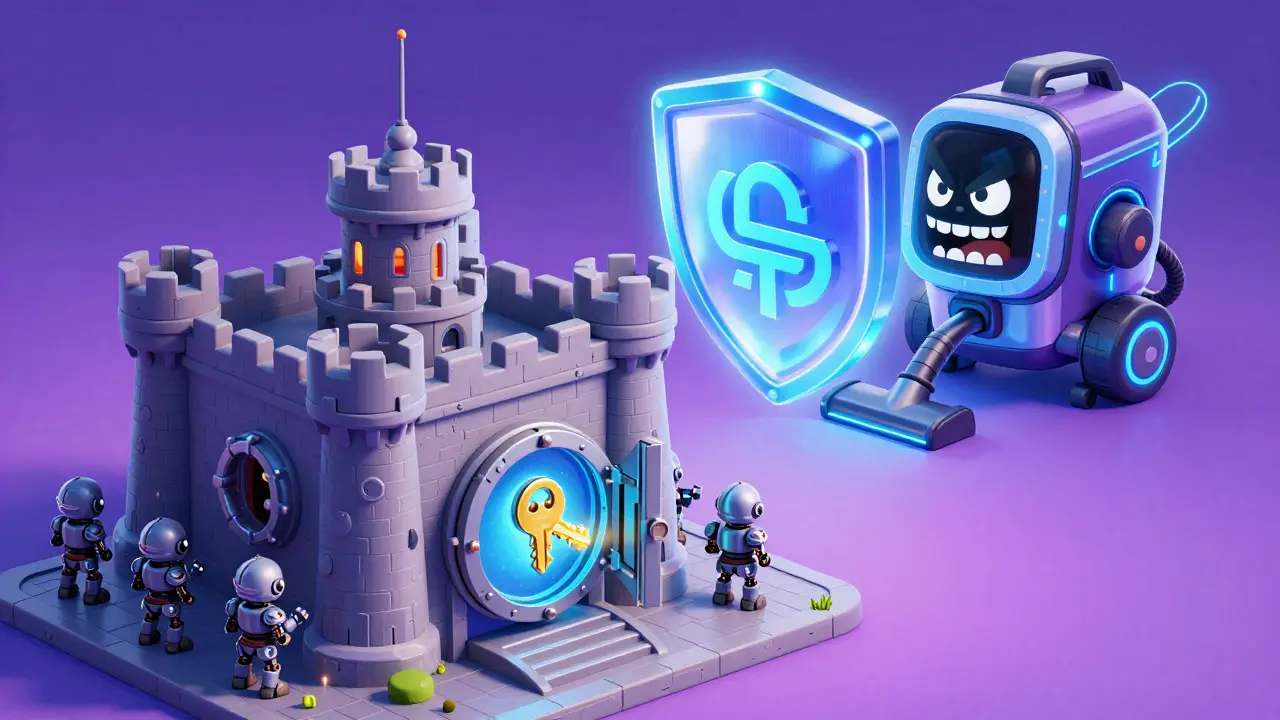
Here is the catch: the same math that keeps hackers out also keeps you out if you lose your keys. In traditional banking, if you lose your password, you call the bank, show your ID, and they reset it. In cryptocurrency, there is no "Forgot Password" button.
Because the network is decentralized, no one holds a master key. If your private key is gone, the coins associated with that public address are effectively locked in a vault forever. This is why hardware wallets-devices that keep your private keys offline-are so popular. They remove the risk of a hacker stealing your key via a phishing link or malware on your computer.
The Future: Quantum Threats and Resistance
You might have heard about quantum computers. These machines are theoretically capable of solving the math behind Elliptic Curve Cryptography much faster than current computers. If a powerful enough quantum computer existed, it could derive a private key from a public key, essentially breaking the lock on every wallet.
Developers are already working on post-quantum cryptography. These are new mathematical puzzles that even a quantum computer would struggle to solve. While we aren't there yet, the evolution from SHA-256 and ECC to quantum-resistant algorithms is the next great frontier in blockchain security.
Is cryptocurrency encryption the same as a password?
Not exactly. A password is something you use to log into a service. A private key in crypto is the actual mathematical tool used to sign a transaction. While you might use a password to unlock your wallet software, the private key is what actually moves the money on the blockchain.
Can a hacker guess my private key?
Mathematically, it's nearly impossible. A private key is a number between 1 and 2^256. To give you an idea of the scale, there are more possible private keys than there are atoms in the known universe. The odds of guessing one are effectively zero.
What happens if I share my public key?
Nothing bad. Your public key is designed to be shared. It's how people know where to send your funds. As long as your private key remains secret, your funds are secure regardless of who has your public address.
Does every coin use SHA-256?
No. While Bitcoin uses SHA-256, other networks use different algorithms. For example, Ethereum uses Keccak-256. Each network chooses a hashing function that balances security with the speed and energy requirements of their specific consensus model.
Are multi-sig wallets safer for everyone?
They are safer for those who want shared control or extra protection. However, they add complexity. If you set up a 2-of-3 wallet and lose two of the keys, you lose your funds. For a regular user, a simple hardware wallet is usually the best balance of security and ease.

24 Comments
Everyone acts like ECC is some magical shield but let's be real, if you can't even manage a seed phrase without losing it, the math doesn't matter. It's honestly exhausting how people ignore the human failure point in all this technical jargon. I've seen so many people cry over lost wallets because they thought they were 'secure' only to realize they are the weakest link in their own security chain.
The concept of asymmetric encryption is definitely the bedrock here. For anyone starting out, just remember that your public key is like your mailbox-anyone can put mail in, but only you have the key to open it and take the mail out. It's a great way to visualize the flow of data without getting bogged down in the elliptic curves part.
who cares about the math when the whole system is just a giant casino anyway
It is wonderful to see these concepts explained so simply. In my experience, breaking down the barriers to technical knowledge helps everyone feel more included in the digital economy, regardless of where they are from.
The prose here is quaint, yet it glosses over the sheer elegance of the SHA-256 avalanche effect. 🙄 One barely scratches the surface of how a single bit change cascades into a completely different hash. Truly a pedestrian explanation for such a magnificent piece of computational art. 💅
Basically it's just a big puzzle. If you have the right key, you win. If you don't, you're out of luck.
We treat these private keys like digital souls, tethered to our wealth by a string of numbers. Isn't it a wild paradox that we trust a cold, unfeeling algorithm more than we trust our own governments? It's a beautifully absurd way to organize society.
I would like to emphasize that utilizing a hardware wallet is the most prudent course of action for any serious investor. While the mathematics of the blockchain are robust, the environment of a standard personal computer is fraught with vulnerabilities that can compromise a private key.
The quantum thing is just the start. They probably already have the tech to break this and they're just waiting for the right moment to wipe everyone's wallets to bring us back to a barter system. Wake up!
Love the breakdown! 🚀 It's so cool how the Merkle tree keeps things efficient. Imagine the lag if we didn't have that! 🌟 Great vibes overall!
The implementation of Multi-sig is quite sophisticated. It ensures that no single point of failure exists within an organizational structure. :)
The idea of immutability is fascinating when you think about the linearity of time and how we've finally created a way to record a 'truth' that cannot be altered by the powerful. It creates a digital archaeology where every transaction is a fossil, perfectly preserved in a layer of cryptographic stone, allowing us to observe the movement of value without the distortion of human editing or institutional scrubbing.
Oh, absolutely, because nothing says "decentralized" like trusting a handful of developers to implement post-quantum cryptography perfectly without leaving a single backdoor for the agencies. I'm sure the transition to these new algorithms will be a seamless, totally non-chaotic experience for everyone involved, especially since we're just dealing with the foundational layer of global finance, right? Just purely delightful.
people think they're safe with their little keys but it's all a scam anyway lol :)
The way you described the Merkle root as a fingerprint is just brilliant. such a vivid way to explain a complex data structure
Simple and clear. Nice work.
Those multi-sig wallets are a total game changer for peace of mind! 🌈 Just imagining the chaos of one lost key is enough to make me want a backup. Keep it secure everyone! ✨
STOP! Before anyone does anything, please, I beg you, write your seed phrases on actual paper and hide them in a safe! I have seen too many people lose their entire life savings because they took a photo of their key and it got synced to a hacked cloud account! It is absolutely heartbreaking!
that sounds so scary losing everything just because of a password
I'm totally on board with the move to quantum resistance! Let's get ahead of the curve and make this stuff even more bulletproof!
the comparison to the house key is lazy but it works for the average person i guess
The narrative of "security" is a facade. The real question is who controls the software that generates these keys. If the library is compromised at the root, the asymmetric encryption is just a theatrical performance for the masses.
It is interesting to note that different coins use different hashing algorithms to balance speed and security.
Oh my goodness, the thought of a quantom computer just unlocking everything is truly terrifyng!! I hope the developres can fix it before it's too late for us all!!