- 18 May 2026
- Elara Crowthorne
- 0
There is a massive misunderstanding happening right now in the crypto space. You might have seen social media posts or ads claiming that "Shrimp Paste" is a revolutionary new cryptocurrency. Here is the hard truth: there is no official cryptocurrency named 'Shrimp Paste.'
If you are looking to buy a coin called "Shrimp Paste," you are likely being misled. The term "SHRIMP" in the crypto world refers to several different, unrelated tokens that share the same ticker symbol but operate on completely different blockchains. None of them are associated with the traditional Southeast Asian condiment known as shrimp paste (or *belacan*/*bagoong*). This confusion isn't an accident; it's a common tactic used by bad actors to trick retail investors who aren't paying close attention.
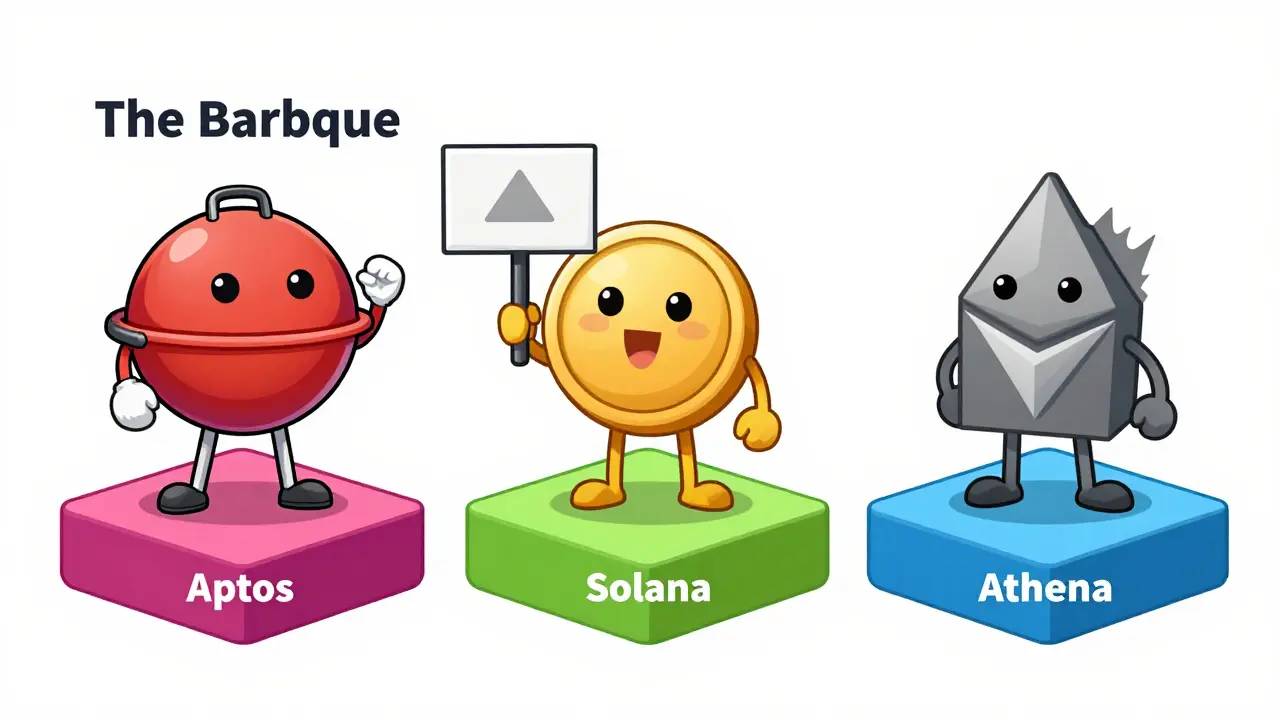
The Three Different SHRIMP Tokens
To understand what you are actually looking at, we need to separate the three distinct entities currently using the SHRIMP name. They are not interchangeable, and they do not work together. Confusing them can lead to significant financial loss.
Aptos SHRIMP is a community-focused token launched by the Aptomingos team on the Aptos blockchain. It was designed to be an engaging token for the Aptos ecosystem with a charitable angle. The project uses a unique mechanism called "The Barbecue," which burns a percentage of your tokens if you don't participate in specific community goals. While the idea sounds fun, the execution has been criticized for lacking transparency. Reserve allocations are triggered when burn thresholds are met, but users have reported vague updates regarding these charitable subgoals.
Smithii SHRIMP is a utility token on the Solana blockchain created via the Smithii platform. Smithii allows users to launch their own tokens for a fee (around $100). SHRIMP serves as both a demonstration project and a utility token within this ecosystem. Because it runs on Solana, transactions are fast (2,400-4,000 TPS) and cheap. However, the token itself has little intrinsic value outside of demonstrating how easy it is to create a token. Many users report issues with liquidity pools draining shortly after creation.
Shrimp.Finance SHRIMP is an ERC-20 token on the Ethereum network with contract address 0x38c4102d11893351ced7ef187fcf43d33eb1abe6. This token has historically shown extreme volatility. It once hit an all-time high of $16.97, only to crash to fractions of a cent. As of late 2025 data, it trades with negligible volume (often less than $2 per day). This lack of liquidity makes it incredibly dangerous; you might buy it easily, but selling it could be impossible without crashing the price further.
| Feature | Aptos SHRIMP | Smithii SHRIMP | Shrimp.Finance SHRIMP |
|---|---|---|---|
| Blockchain | Aptos | Solana | Ethereum |
| Primary Purpose | Community Engagement / Charity | Platform Demo / Utility | Speculative Trading |
| Liquidity Risk | High | Very High | Extreme |
| Developer Activity | Low (Infrequent Updates) | Moderate (Platform Focus) | None (Abandoned) |
| Market Cap Status | Microcap (<$500k) | Microcap (<$500k) | Microcap (<$250k) |
Why "Shrimp Paste" is a Red Flag
You might wonder why anyone would use the name "Shrimp Paste." In many cultures, shrimp paste is a pungent, strong-smelling ingredient. Using such a mundane, non-tech-related name for a cryptocurrency is highly unusual. Legitimate projects usually choose names that reflect technology, finance, or brand identity (like Bitcoin, Ethereum, or Solana).
This naming strategy is often a hallmark of "meme coins" or scams designed to stand out through absurdity rather than utility. When a project lacks a clear technological innovation or business model, creators sometimes use funny or confusing names to attract attention on social media. The goal is to get people talking about the name, not the product. By the time you realize there is no actual "Shrimp Paste" coin, the early promoters may have already sold their holdings, leaving you with worthless tokens.
Furthermore, the duplication of the "SHRIMP" ticker across multiple blockchains is a deliberate confusion hazard. According to industry analysis from firms like TRM Labs, identical tickers across different chains have increased significantly as a method to exploit retail investor inattention. If you search for "SHRIMP" on a decentralized exchange, you might accidentally buy the wrong version, which could be worth nothing.
Risks of Investing in Microcap SHRIMP Tokens
All three SHRIMP variants fall into the category of "microcap" cryptocurrencies. This means they have extremely low market capitalizations, typically under $500,000. Investing in these assets carries risks that far exceed those of major cryptocurrencies.
- Liquidity Traps: With daily trading volumes often below $10,000 (and sometimes below $10), it is nearly impossible to sell large amounts of tokens without drastically lowering the price. For example, Shrimp.Finance SHRIMP has recorded 24-hour volumes as low as $1.90. If you try to sell $100 worth, you might drop the price by 50% instantly.
- Price Manipulation: Low liquidity makes these tokens susceptible to "pump and dump" schemes. A single large buyer can spike the price, attracting followers, before selling everything off. Data suggests that over 97% of tokens with such low volumes experience extreme manipulation.
- Abandonment: Many microcap projects are abandoned quickly. Aptos SHRIMP’s GitHub repository shows minimal activity, and Shrimp.Finance SHRIMP has had no verifiable development updates since 2022. Without active developers, bugs cannot be fixed, and promises cannot be kept.
- Scam Potential: The ease of creating tokens on platforms like Smithii means anyone can launch a coin. There is no vetting process. You are trusting anonymous developers with your money. Reports from user communities highlight cases where liquidity pools were drained overnight, leaving holders with zero value.
How to Verify What You Are Buying
If you still decide to explore these tokens despite the warnings, you must take extreme precautions. Never trust a link sent to you via DM on Telegram, Discord, or Twitter. These are almost always phishing attempts.
- Check the Contract Address: Always copy the exact contract address from a reputable source like CoinGecko or CoinMarketCap. Do not search by name alone. For Shrimp.Finance SHRIMP, the address is
0x38c4102d11893351ced7ef187fcf43d33eb1abe6. For Aptos SHRIMP, verify the account address on the Aptos Explorer. - Analyze Liquidity: Look at the 24-hour trading volume. If it is under $10,000, consider it extremely high risk. Use tools like DEX Screener to see if the liquidity is locked. If liquidity is not locked, the developers can remove it at any time.
- Review Holder Distribution: Check if one wallet holds a huge percentage of the supply. If the top 10 wallets hold more than 50% of the tokens, the project is likely controlled by a few individuals who can manipulate the price.
- Ignore Price Predictions: Websites predicting that SHRIMP will reach $2.50 or higher are not based on fundamental analysis. These are speculative guesses designed to encourage buying. No credible analyst supports long-term viability for these specific tokens.
Conclusion: Proceed with Extreme Caution
The concept of a "Shrimp Paste" crypto coin does not exist in the legitimate financial sense. Instead, you are facing a cluster of three distinct, high-risk microcap tokens that share a confusing name. Whether it is the charity-focused Aptos SHRIMP, the demo-based Smithii SHRIMP, or the speculative Shrimp.Finance SHRIMP, all three exhibit signs of poor liquidity, low developer commitment, and high vulnerability to manipulation.
For most investors, the safest course of action is to avoid these tokens entirely. The potential for total loss is significantly higher than the potential for gain. If you are interested in the Aptos or Solana ecosystems, look for established projects with transparent teams, locked liquidity, and real-world utility. Do not let the novelty of a name like "Shrimp" distract you from the fundamental risks involved.
Is there a cryptocurrency officially called Shrimp Paste?
No. There is no verified cryptocurrency officially named "Shrimp Paste." The term likely stems from confusion with tokens using the ticker "SHRIMP," such as Aptos SHRIMP, Smithii SHRIMP, or Shrimp.Finance SHRIMP. None of these are related to the food ingredient.
Which blockchain does the SHRIMP token run on?
It depends on which token you mean. Aptos SHRIMP runs on the Aptos blockchain. Smithii SHRIMP runs on Solana. Shrimp.Finance SHRIMP runs on Ethereum. They are completely separate projects.
Is investing in SHRIMP tokens safe?
No, it is considered extremely high risk. All SHRIMP variants are microcaps with very low liquidity, meaning you may not be able to sell your tokens. Additionally, there is a high risk of price manipulation and project abandonment.
What is the "Barbecue" mechanism in Aptos SHRIMP?
The "Barbecue" is a burn mechanism where a percentage of tokens is burned if holders do not participate in specific community goals. While intended to drive engagement, critics note that the reserve management and charitable outcomes have been opaque and inconsistent.
Can I buy SHRIMP on major exchanges like Binance or Coinbase?
Generally, no. These tokens are primarily traded on decentralized exchanges (DEXs) like Liquidswap (for Aptos) or Raydium (for Solana), or obscure centralized platforms. They are not listed on major tier-1 exchanges due to their low market cap and high risk profile.
Why are there so many different SHRIMP tokens?
The proliferation of tokens with the same ticker symbol is a common issue in crypto. On platforms like Smithii, anyone can create a token with any name. This leads to confusion and is often exploited by scammers to trick investors into buying the wrong asset.