

- 21 Mar 2026
- Elara Crowthorne
- 15
Since January 1, 2025, Russia has enforced one of the most detailed cryptocurrency tax systems in the world. If you’re holding, trading, or mining crypto in Russia, you’re now legally required to report it - and pay taxes. This isn’t a gray area anymore. The rules are clear, strict, and fully active. The government didn’t just tweak the old system. They built a new one from scratch with Federal Law No. 418-FZ, signed in November 2024. And since then, the Federal Tax Service has been actively monitoring wallets, demanding reports, and collecting penalties.
How Crypto Income Is Taxed for Individuals
If you’re a Russian resident and you made money from crypto - whether through trading, selling, or staking - that income is now treated like any other. The tax rate depends on how much you earned in a year. If your total cryptocurrency gains are under 2.4 million rubles (about $32,653 at the 2025 exchange rate), you pay 13%. That’s the same rate as regular salary income. But if you hit over that amount, the rate jumps to 15%. There’s no exemption for long-term holdings. Even if you bought Bitcoin in 2020 and sold it in 2025, you still owe tax. The old rule that let you avoid tax after three years of ownership? Gone.
The tricky part? You have to combine your crypto gains with any securities trading income. So if you sold stocks and crypto in the same year, both are added together to determine your tax bracket. This means a small crypto profit could push your total income into the higher 15% bracket, even if your salary alone would’ve kept you at 13%.
Non-residents face an even steeper rate: 30%. That’s flat, no exceptions. If you’re not officially living in Russia but sold crypto while in the country - or if your wallet is registered under a Russian IP - you’re still on the hook. The government doesn’t care where you live. They care where the transaction happened.
Corporate Crypto Taxes and Mining Restrictions
For businesses, the rules are even harsher. Any company mining crypto or selling digital assets must pay a 25% profit tax. That’s higher than the standard corporate tax rate of 20%. And here’s the catch: you can’t use any of the simplified tax systems anymore. No USN, no AUSN, no ESHN. You’re forced into the full OSNO system, which means full accounting, quarterly reports, and audits. This has pushed many small mining outfits out of business.
Mining isn’t just taxed - it’s banned in some places. In Dagestan, Chechnya, and the self-proclaimed Donetsk and Luhansk People’s Republics, mining is completely prohibited until 2031. In Siberian regions like Irkutsk Oblast, Buryatia, and Zabaykalsky Krai, mining is only allowed during certain months when energy demand is low. In winter, when heating needs spike, mining rigs have to shut down. This isn’t a suggestion. It’s a legal order enforced by regional authorities.
The government’s reasoning? Energy conservation. Russia’s power grid is stretched thin in remote regions, and crypto mining uses massive amounts of electricity. The state doesn’t want foreign investors or local miners draining power from homes and hospitals.
How to Calculate Your Taxable Gain
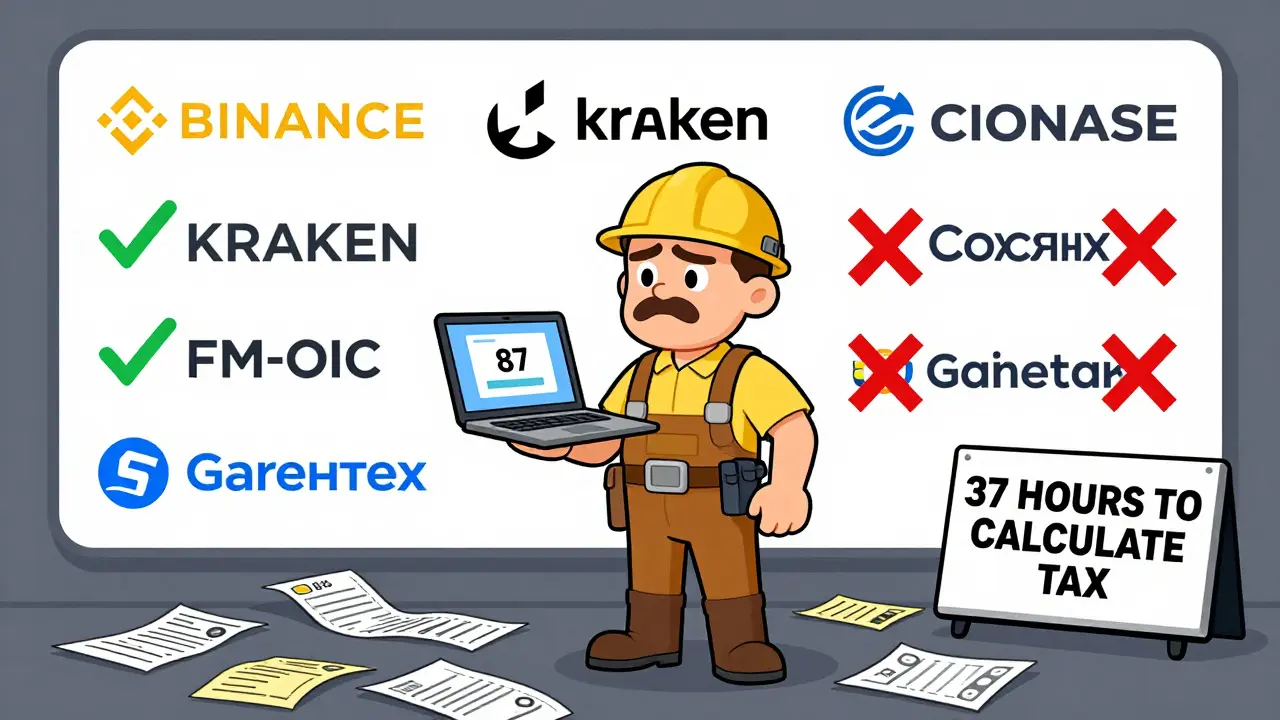
It’s not enough to just know your profit. You have to prove it. The law requires you to use market prices from specific foreign exchanges. Not any exchange. Only those with:
- Daily trading volume over 100 billion rubles ($1.36 billion)
- At least three years of publicly available price history
That means you can’t use local Russian exchanges like Garantex or Binance RU - they don’t qualify. You can’t use CoinMarketCap or CoinGecko either. You have to pull data from exchanges like Binance, Kraken, or Coinbase - and only from their official API feeds. If you bought Bitcoin on Binance and sold it on Kraken, you have to use the price from both exchanges at the exact time of each transaction. No estimates. No averages.
One miner in Novosibirsk spent 37 hours in January 2025 just calculating his tax liability. He had 87 transactions across three wallets and two exchanges. He didn’t have receipts. He didn’t have logs. He had to go back to email confirmations, blockchain explorers, and exchange history downloads. That’s not unusual. Accounting firms say 89% of their clients needed two to three weeks of training just to handle crypto tax calculations.

Reporting Requirements and Penalties
You must file a report every quarter - even if you didn’t make any money. The form is called the Declaration of Income from Digital Assets. It asks for:
- Wallet addresses
- Transaction IDs
- Exchange used
- Timestamp and price in rubles
- Profit or loss per transaction
Miss a deadline? You’re looking at a fine of up to 40,000 rubles ($545). Fail to pay taxes? The penalty is 15% to 40% of what you owe, plus daily interest. And the FTS has access to blockchain analytics tools. They can trace transactions across wallets. They’ve already matched over 12,000 wallet addresses to taxpayer IDs since January 2025.
There’s also a reporting threshold: 600,000 rubles ($8,163) in annual transaction volume. If you traded or transferred more than that - even if you broke even - you’re required to file. That’s low. Most retail investors don’t realize they’ve hit it. A survey of 1,200 users on RuTracker forums found that 68% had no idea they were required to report until they got a letter from the tax office.
What’s Missing: No Deductions, No Loss Carryforwards
One of the biggest complaints from users? You can’t deduct expenses. Miners can’t write off electricity bills, hardware costs, or cooling systems. Traders can’t deduct exchange fees or gas fees. There’s no way to offset losses from one trade against gains from another. If you lost 500,000 rubles on Ethereum but made 700,000 on Bitcoin, you still pay tax on the full 700,000. The 500,000 loss? Irrelevant.
Compare that to countries like Germany or Canada - they allow loss carryforwards. Russia doesn’t. This makes crypto investing riskier. You’re not just betting on price. You’re betting on whether you’ll be able to pay taxes on every single profit, no matter how small.
How the Market Has Changed Since January 2025
The impact has been immediate. Domestic mining dropped 22% in the first month of 2025. The biggest drop? Irkutsk Oblast - where seasonal bans kicked in. Mining farms shut down overnight. Some operators moved to Kazakhstan. Others went underground.
At the same time, retail users are leaving. The Association of Cryptocurrency and Blockchain Enterprises estimates that 38% of users shifted to peer-to-peer (P2P) platforms to avoid reporting. They’re using Telegram bots, cash trades, and local meetups to bypass the system. But here’s the irony: P2P trades still count as taxable income. The FTS has been tracking those transactions too.
On the flip side, institutional interest is rising. Forty-seven banks, investment firms, and asset managers have registered as official crypto service providers since January 2025. They’re using the law as a signal: Russia is serious about regulation. That means more compliance, more transparency, and more legitimacy - but also more paperwork and higher costs.
What’s Coming in 2026
The government isn’t done. In April 2025, the Central Bank announced a pilot program for the digital ruble - a state-backed digital currency - to start distributing welfare payments in October 2025. That could mean crypto and digital rubles will be tracked together in the future.
The State Duma will debate changes to the law on July 17, 2025. One major issue: the 600,000 ruble reporting threshold. Many users have dozens of tiny transactions - a $50 trade here, a $30 gift there. Adding them all up to hit the limit feels unfair. There’s pressure to change it to a net profit threshold instead.
But for now, the rules stay. The tax is real. The reporting is mandatory. And the penalties are waiting.
Do I have to pay tax on crypto if I didn’t sell it?
No. You only owe tax when you realize a gain - meaning you sold, traded, or exchanged crypto for rubles, goods, or services. Holding Bitcoin or Ethereum without selling doesn’t trigger tax. But if you swapped Bitcoin for Ethereum, that’s considered a taxable event. The government treats crypto-to-crypto trades as sales.
Can I use Russian exchanges to calculate my tax?
No. Russian exchanges like Garantex or Bybit RU don’t meet the legal requirements. The law demands data from foreign exchanges with over 100 billion rubles in daily volume and three years of public history. That means Binance, Kraken, Coinbase, and a few others. You must use their official API or transaction history to prove your prices. Using local exchange data could lead to audit penalties.
What happens if I don’t report my crypto income?
The Federal Tax Service has tools to trace blockchain transactions. If you’re caught, you’ll face penalties of 15% to 40% of the unpaid tax, plus daily interest. You could also get fined up to 40,000 rubles for failing to file quarterly reports. In extreme cases, the FTS may freeze bank accounts or block access to financial services. There’s no statute of limitations - they can come after you years later.
Can I deduct mining equipment or electricity costs?
No. Russia’s tax law does not allow any deductions for mining expenses - not hardware, not electricity, not cooling systems. Even if you spent 1 million rubles on rigs, you can’t reduce your taxable income by that amount. This is one of the harshest aspects of the law compared to other countries.
Is staking crypto taxable in Russia?
Yes. Staking rewards are treated as income when you receive them. If you earned 10,000 rubles in ETH staking rewards in January, that’s taxable income for the year. You must record the ruble value at the time you received it. The same applies to airdrops, yield farming, and liquidity mining. Any form of passive crypto income is taxable.
What Should You Do Now?
Start keeping records - today. If you’ve traded crypto since January 2025, go back and download every transaction history. Save wallet addresses, timestamps, and exchange rates. Use a spreadsheet. Don’t rely on memory. The FTS doesn’t care how hard it was - they just want proof.
If you’re a miner, check if you’re in a banned region. If you are, you have no legal option to continue. If you’re not, prepare for seasonal shutdowns and track your energy use.
And if you’re unsure? Talk to a tax professional who’s handled crypto before. Most accountants still don’t know how to do it. But the ones who do - they’re the ones who’ve taken the 287-page guide from the Russian Association of Certified Accountants and studied it line by line. Don’t guess. Don’t wait. The deadline for 2025 filings is April 30, 2026. You have less than a month to get ready.

15 Comments