- 17 Apr 2026
- Elara Crowthorne
- 25
If you're trading digital assets in Taiwan, you've probably noticed that the rules feel like they're written in a language only a handful of people understand. For years, the government has treated crypto as a "virtual commodity" rather than actual money. But as prices swing wildly and adoption grows, the Ministry of Finance the government body responsible for the fiscal policy and tax collection in Taiwan is tightening the leash. Navigating cryptocurrency taxation in Taiwan isn't just about paying a bill; it's about avoiding a legal headache in a system that is currently shifting from a "gray area" to a strictly regulated environment.
| Tax Type | Typical Rate | Who Pays? | Key Condition |
|---|---|---|---|
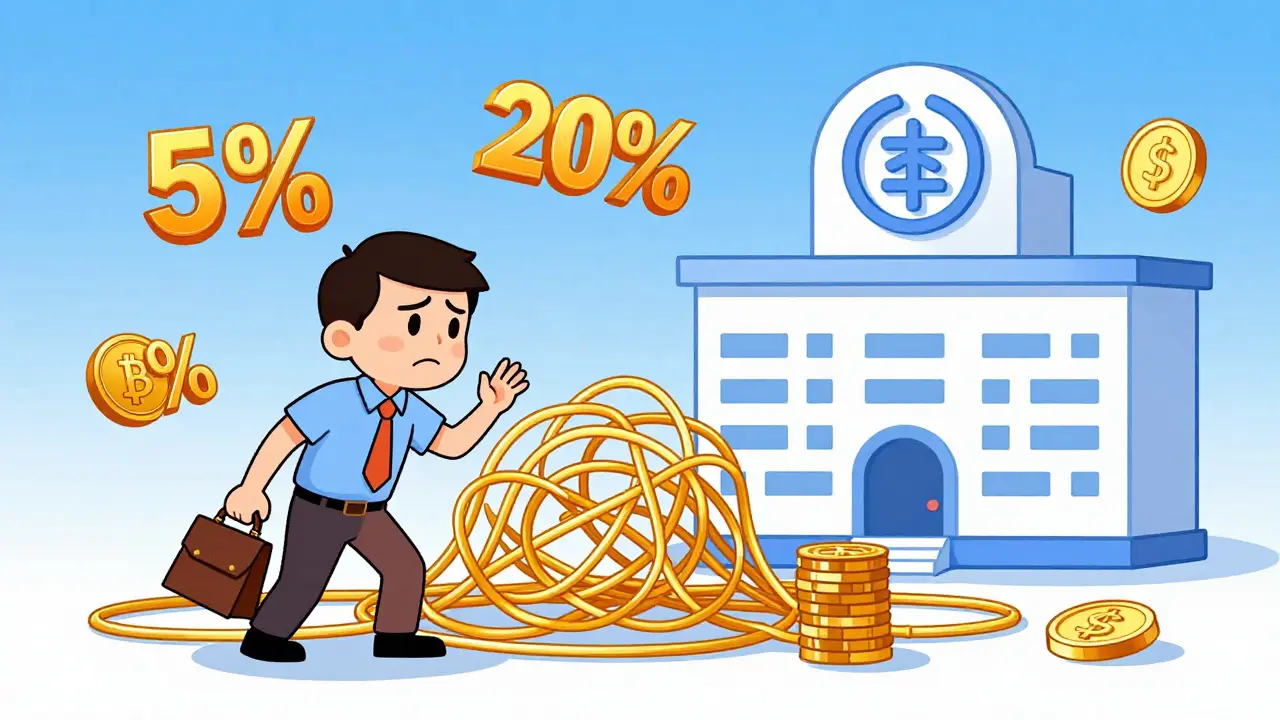
| Business Tax (VAT) | 5% | Businesses & Active Traders | Revenue over NT$40,000/month |
| Income Tax | ~20% | Individual Traders | Based on net trading gains |
The Business Tax Maze: VAT and Revenue
In Taiwan, the business tax system-basically a Value Added Tax (VAT)-applies to crypto because the government views these assets as goods. If you are a business entity selling crypto on a local platform, you are looking at a mandatory 5% VAT on your revenue. But what if you're just an individual? That's where it gets interesting. Most casual traders can breathe a sigh of relief if their monthly sales stay under NT$40,000 (roughly US$1,300). This is a de minimis exemption, meaning you don't need to register or pay that 5% unless you cross that threshold.
For those operating from abroad, the rules change based on who is buying. If a foreign entity sells crypto only to other Taiwanese businesses, the buyer handles the tax. However, if that foreign seller starts selling to Taiwanese individuals, they are required to register and pay that same 5% VAT, provided they exceed the monthly limit. It's a complex web, and while some claim that VAT doesn't apply because crypto isn't legal tender, the Financial Supervisory Commission the primary regulatory body for financial markets and institutions in Taiwan and the tax authorities generally disagree.
Calculating Income Tax and the Documentation Trap
Beyond the 5% revenue tax, there is the matter of income tax. Traders typically face an income tax rate of around 20% on their activities. The real problem here isn't the rate, but the math. Taiwan hasn't created a specific "crypto tax law," so they use general income tax rules. This creates a massive documentation gap.
Imagine you bought Bitcoin years ago on a defunct exchange and now you're selling it on BitoPro a leading regulated cryptocurrency exchange operating in Taiwan. If you can't produce a receipt or a record of your initial purchase cost, the tax authorities may struggle to determine your actual profit. In the worst-case scenario, this could lead to your entire sale being viewed as taxable income rather than just the gain. This is why keeping a meticulous ledger of every trade, regardless of the platform, is no longer optional-it's a survival strategy.

The Shift Toward Real-Name Verification
The era of anonymous trading in Taiwan is effectively over. To fight money laundering, the government has pushed Virtual Asset Service Providers entities that provide cryptocurrency exchange, transfer, or custody services (VASPs) to adopt full real-name verification. This isn't just a security feature; it's a data pipeline for the tax office. By linking your identity to your wallet, the Ministry of Finance can now see exactly who is making a profit.
As of 2024, VASPs must complete a formal Anti-Money Laundering (AML) registration. This move aligns Taiwan with the global standards set by the Financial Action Task Force an intergovernmental organization that sets global standards for combating money laundering and terrorist financing (FATF). If you use platforms like MaiCoin one of Taiwan's largest crypto platforms offering mobile wallet services or Binance a global cryptocurrency exchange used by Taiwanese traders for advanced tools, expect your KYC (Know Your Customer) data to be the foundation of your future tax reports.
Security Tokens and the Legal Gray Area
Not all crypto is treated the same. The FSC has been clear: if a digital asset has security-like properties, it is classified as a "security" under the Securities and Exchange Act the primary legislation governing the issuance and trading of securities in Taiwan. This means the sale and offering of such tokens are subject to much stricter regulations than a simple Bitcoin trade. If you're launching a project or trading security tokens, you're stepping out of the "commodity" world and into a heavily regulated legal framework.
Even with these rules, some legal ambiguity remains. For instance, the Taiwan High Court previously ruled that Bitcoin doesn't constitute "payments" or "funds" under the Banking Act the law regulating the operations and licensing of banks and financial institutions in Taiwan. This means you can't necessarily be sued for "illegal deposit-taking" just for holding Bitcoin. However, other courts have been less lenient, and some businesses have still been prosecuted for violating banking laws when virtual assets were involved. It's a tug-of-war between the judiciary and the regulators.

What's Next? The 2024 Policy Review
If you think the rules are strict now, wait until the latest reviews are finalized. Following the market surge in late 2024, the Ministry of Finance pledged to review and potentially overhaul how cryptocurrency gains are taxed. The goal is to move away from applying old, general laws to a new technology and instead create a comprehensive, dedicated tax framework for digital assets.
This review is likely to result in mandatory tax reporting forms specifically for crypto. Instead of trying to fit your trades into a general income category, you'll probably have a dedicated section of your tax return for virtual assets. The timeline is still a bit fuzzy, but the direction is clear: more transparency, more reporting, and fewer loopholes.
Do I have to pay tax if I only hold crypto and don't sell?
Generally, no. In Taiwan, taxation is triggered by a "realization event," such as selling your crypto for TWD or trading one cryptocurrency for another. Simply holding assets in a wallet is not a taxable event.
What is the NT$40,000 exemption exactly?
This is a monthly revenue threshold for the 5% Business Tax (VAT). If your total monthly sales of cryptocurrency are below NT$40,000, you typically don't need to register for business tax or pay the 5% VAT on those specific transactions.
Are all cryptocurrencies taxed the same in Taiwan?
No. Most are treated as virtual commodities. However, if a token is classified as a "security" by the FSC, it falls under the Securities and Exchange Act, which carries different legal and reporting requirements.
What happens if I can't prove how much I originally paid for my crypto?
This is a major practical risk. If you cannot provide documentation for the cost basis, the tax authorities may have difficulty calculating your actual gain, which could lead to disputes or a higher tax burden based on the total sale price.
Does using a foreign exchange like Binance exempt me from Taiwan taxes?
Absolutely not. Tax liability is based on your residency and the location of the taxpayer. Regardless of where the exchange is headquartered, if you are a tax resident of Taiwan, your gains are subject to local income tax laws.
Next Steps for Traders
If you're currently active in the market, don't wait for an audit to get your house in order. Start by exporting all your trade histories from platforms like BitoPro and Binance into a single spreadsheet. If you've used multiple wallets, use a portfolio tracker to establish a clear cost basis for your holdings.
For high-volume traders, it's time to consult a local tax professional who understands the distinction between "virtual commodities" and "securities." As the Ministry of Finance moves toward a more structured reporting system, having a professional audit your records now will save you from massive penalties later. If you're operating a business that involves crypto, ensure your VASP registration is up to date with the FSC to avoid operating in a legal vacuum.

25 Comments
The regulatory arbitrage here is fascinating. We are seeing a classic shift toward institutionalization where the VASP framework is basically just a conduit for the tax authorities to implement a more robust KYC/AML stack. It is essentially the death of the 'wild west' era of digital assets in East Asia.
Keep those records safe everyone!
Oh great, another government pretending they care about 'investor protection' while they just figure out how to slice a bigger piece of the pie. Truly a masterclass in bureaucratic efficiency.
This is exactly how they track us. First it is a 'guide' then it is mandatory real-name verification, and before you know it, your wallet is linked to your biometric ID. The Ministry of Finance isn't just collecting taxes; they are building a surveillance state using crypto as the bait. Wake up people, this is a trap to centralize control over the only decentralized asset left.
Why is everyone acting surprised? Taiwan is just following the global trend. Honestly, the tax structure in India is far more aggressive and we handle it. If you are making money, you pay. It is that simple. Stop whining about 'gray areas' and just comply with the law like any decent citizen should.
It is a profound tragedy that the essence of financial liberation is being shackled by the mundane greed of the state. We must ask ourselves if the pursuit of profit is worth the surrender of our digital autonomy. 😔
The distinction between a 'virtual commodity' and a 'security' is incredibly thin here. If the FSC decides a token is a security, does that retroactively change the tax obligation for historical trades? That seems like a legal nightmare waiting to happen.
Export your CSVs now!!! Don't wait!!!
Honestly, it's not as bad as it looks! Just start a simple spreadsheet and you'll be fine. Most of us are just casual holders anyway, so as long as you aren't doing high-frequency trading, you can totally manage this.
Lmao imagine actually thinking the govt is going to be 'fair' with the documentation gap. They'll just take the whole amount and laugh at you.
I've seen a lot of people struggle with the cost-basis calculation when moving between exchanges. If you've lost your old records, try using a tool like Koinly or CoinTracker to sync with the blockchain; it's often the only way to prove your initial investment to the authorities.
I really think it's great that they are moving toward a dedicated tax framework because the old general laws are just too vague for something as volatile as crypto. If they create a specific form, it actually removes a lot of the guesswork for the average person. Plus, having a clear set of rules usually invites more institutional investment, which generally helps the price of the assets we're all holding anyway. Just keep your head up and stay organized!
totally agree with getting a professional for the high volume stuff it just saves so much stress in the long run
Regardless of the 'gray area,' the responsibility lies with the taxpayer. You cannot claim ignorance of the law as a defense when the Ministry of Finance starts issuing penalties. Get your documentation in order now or face the consequences.
I wonder if the VAT exemption for individuals under 40k TWD is actually enforced or if it's just a way to get people to self-report their totals without actually paying.
It is truly lamentable that some of you seek to evade your civic duties. One must possess the moral fortitude to contribute to the state that provides the very infrastructure allowing these trades to occur. Tax evasion is not a 'hack,' it is a moral failing of the highest order.
The sheer audacity of this tax regime is absolutely breathtaking! It's a carnivorous feast where the government waits for the bulls to run and then swoops in to devour the gains with a 20% appetite. I am positively reeling from the injustice of it all!
its all a scam anyway... the government just wants the keys to your cold wallet so they can freeze everything when the 'great reset' happens lol.
Think of this as a growing pain for a new financial era! 🌟 When we move from chaos to structure, it actually gives the technology more legitimacy in the eyes of the world. Let's stay positive and help each other navigate the rules! 😊
It's really quite a journey for Taiwan to go from treating crypto as a weird commodity to a full-blown regulated asset class. I think it's a great learning opportunity for other countries in the region to see how to balance innovation with regulation. If we all just share our experiences and help the newbies, we can make this transition smooth for everyone involved. Just take it one step at a time and don't let the jargon intimidate you!
typical gov'ment overreach... they'll use the FATF guidelines as a shield to hide their own incompetence. its all just a way to funnel money into some black-hole project while the real traders get shafted by 'securities' laws that dont even apply to deflacionary assets. absolute joke.
This guide is an absolute travesty of simplicity. The nuance of the legal struggle between the High Court and the FSC is barely touched upon. I am exhausted by the lack of depth in these summaries!
America would never let this kind of sloppy 'gray area' happen because we have the strongest legal system in the world... unlike these people who just make up rules as they go along. its embarrassing how they handle their finances over there and honestly its why theyll never compete with us!!
I'm cautiously optimistic that the 2024 review will actually clarify the cost-basis issue. It doesn't make sense to tax the entire sale price just because a 2017 exchange went bust. That would be an insane precedent to set.
Listen, the point is that the law is the law. Whether it is in Taiwan or anywhere else, stop pretending that 'decentralization' means you get to keep 100% of your winnings while using a state-backed currency to spend them. Be real for once.