
- 8 May 2026
- Elara Crowthorne
- 14
Buying a coin and holding it is one thing. Buying a coin, watching the chart, and selling it moments later because you saw a pattern is another entirely. This second approach is called spot trading, which is the immediate purchase and sale of digital assets at current market prices where you own the underlying asset directly. Unlike futures or derivatives, where you might be betting on price movements without owning the asset, spot trading means the coins are yours. You can withdraw them, store them in your wallet, or sell them instantly.
If you are looking to move beyond passive investing and start actively managing your portfolio, understanding how spot trading works is essential. It is the backbone of the crypto market. Whether you want to capture quick gains during a volatile week or adjust your holdings based on news cycles, spot trading gives you direct control. But with that control comes complexity. You need to know which platforms to trust, how to read the charts, and most importantly, how not to lose your money when the market turns against you.
Choosing the Right Exchange Platform
The first step in spot trading is selecting a platform that matches your needs. Not all exchanges are created equal. Some cater to beginners with simple interfaces, while others offer advanced tools for day traders. In 2026, security and regulatory compliance are non-negotiable factors. You want an exchange that has a proven track record, preferably over five to ten years, and clear transparency about how they store user funds.
| Exchange | Best For | Security Features | Fees (Typical) |
|---|---|---|---|
| Coinbase | Beginners & Institutional Access | Highly regulated, insured custodial storage | Higher spread fees, lower maker fees |
| Kraken | Advanced Traders & Privacy | Strong reputation, cold storage majority | Competitive tiered fees |
| Gemini | US-Based Security Focus | Regulatory compliant, joint venture with NYSE | Moderate fees, high minimums for some features |
| eToro | Social Trading & Copying | Multi-jurisdiction regulation | Spread-based pricing |
When evaluating these platforms, look at their trading volume. High volume means liquidity, which ensures you can buy or sell large amounts without slippage-the difference between the expected price and the executed price. Also, check the available trading pairs. If you only want to trade Bitcoin (BTC) and Ethereum (ETH), any major exchange will suffice. But if you are interested in altcoins, you need a platform with a wide selection.
Setting Up Your Account and Funding It
Once you have chosen an exchange, the next step is identity verification. This process, known as Know Your Customer (KYC), requires you to provide personal information such as your full name, address, email, and often a government-issued ID. In the US, this may include providing your Social Security Number. While this feels intrusive, it protects your account from fraud and ensures regulatory compliance.
After verification, you need to deposit fiat currency-government-issued money like US dollars, Euros, or New Zealand dollars. Most exchanges allow bank transfers, credit cards, or debit cards. Bank transfers are usually cheaper but take longer, while card deposits are instant but come with higher fees. Once your fiat is in your account, you are ready to trade. Remember, you do not need to buy whole coins. Cryptocurrencies are divisible. You can buy $10 worth of Bitcoin, even if one BTC costs tens of thousands of dollars.
Understanding Technical Analysis Basics
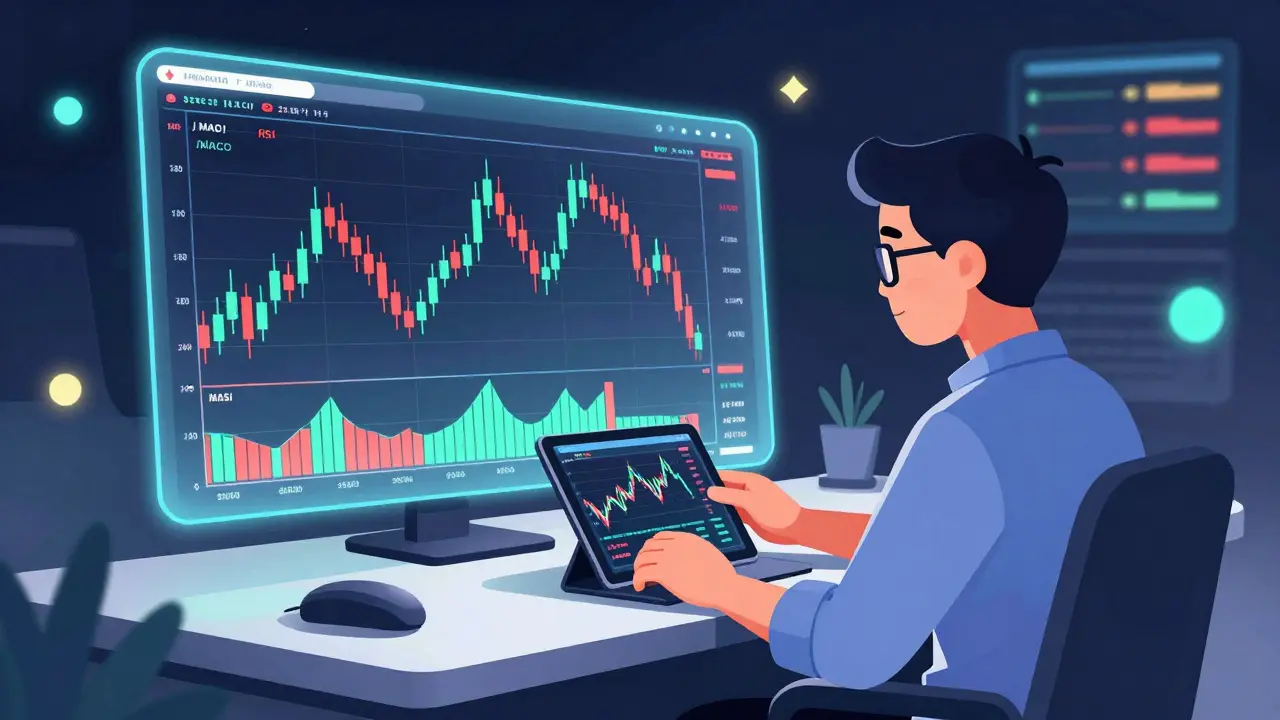
Spot trading relies heavily on timing. To improve your odds, you need to understand technical analysis. This involves studying price charts to identify patterns and trends. The most common tool is the candlestick chart, which shows the open, high, low, and close prices for a specific period.
Three key indicators can help you make informed decisions:
- Volume Analysis: Volume shows how much activity is happening behind the scenes. If the price is rising and volume is increasing, the trend is strong. If the price rises but volume drops, the trend might be weakening.
- Relative Strength Index (RSI): RSI measures whether an asset is overbought or oversold. An RSI above 70 suggests the asset might be overvalued and due for a correction downward. An RSI below 30 suggests it might be undervalued and poised for a bounce.
- Moving Average Convergence Divergence (MACD): MACD helps identify changes in momentum. When the MACD line crosses above the signal line, it’s often a bullish signal. When it crosses below, it’s bearish.
You should also pay attention to moving averages, such as the 50-day and 200-day moving averages. These smooth out price data to show the general direction of the trend. Bollinger Bands can help identify volatility; when the bands squeeze together, a big move is often coming.
Selecting Time Frames and Strategies
Your trading strategy depends largely on the time frame you choose to analyze. Active traders often use 15-minute, 1-hour, or 4-hour charts. Shorter time frames allow you to catch quick price movements, which is ideal for day trading. However, they require more attention and faster decision-making.
Longer time frames, like daily or weekly charts, are better for swing trading, where you hold positions for several days or weeks to capture larger trends. Key psychological price levels, such as round numbers ($85,000, $91,000, or $100,000 for Bitcoin), often act as support or resistance zones. Traders watch these levels closely because many algorithms and human traders react to them.
Momentum trading focuses on riding strong price moves in either direction. Swing trading tries to capture intermediate swings within a broader trend. Both strategies require discipline. Without a plan, you are just gambling.
Risk Management: Protecting Your Capital
This is the most critical part of spot trading. The crypto market is notoriously volatile. Prices can swing 10% or more in a single day. To survive, you must manage risk aggressively.
Professional traders follow a golden rule: never risk more than 1-2% of your total capital on a single trade. If you have $10,000 in your account, your maximum loss on any given trade should be $100 to $200. This ensures that a string of losses won’t wipe out your account.
Use stop-loss orders. A stop-loss automatically sells your position if the price drops to a certain level, limiting your downside. Conversely, use take-profit orders to lock in gains when the price reaches your target. Setting these orders beforehand removes emotion from the equation. Emotional trading leads to panic selling or greedy holding, both of which are costly mistakes.
Storage Options: Hot vs. Cold Wallets
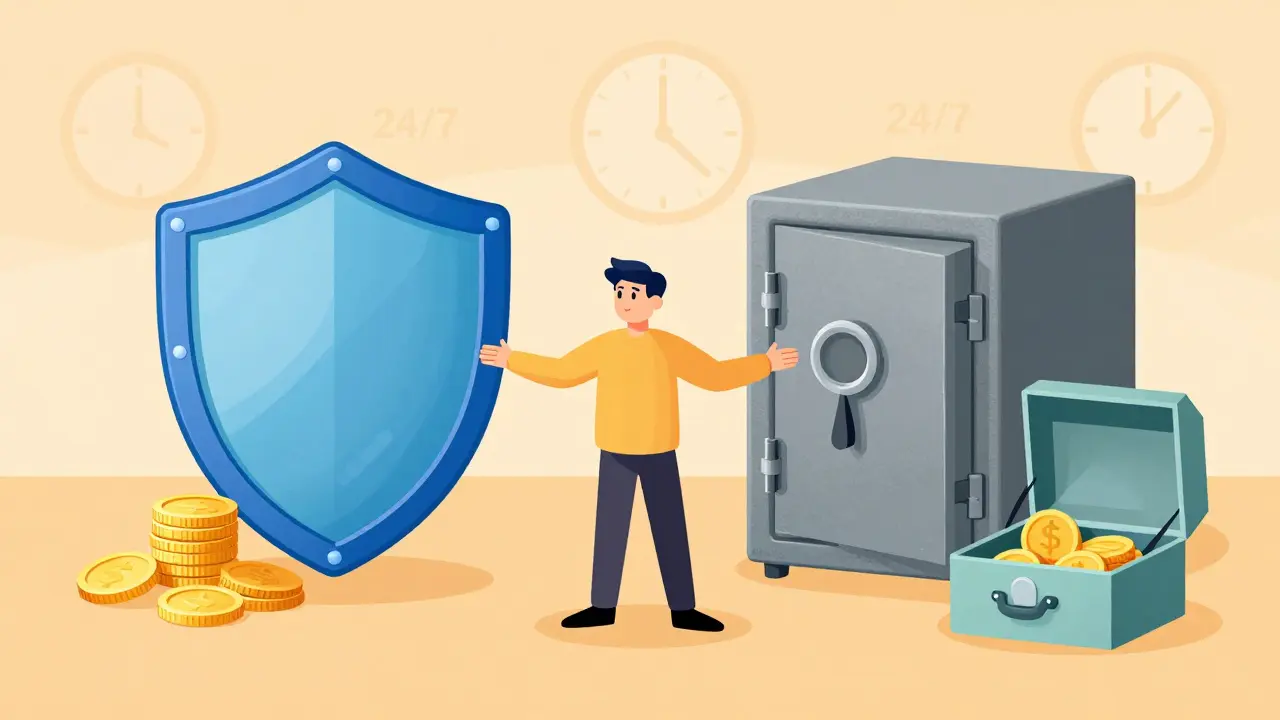
When you spot trade on an exchange, your coins are stored in the exchange’s hot wallet-a digital wallet connected to the internet. This is convenient for trading but carries security risks. If the exchange is hacked, your funds could be compromised. While major exchanges like Coinbase and Kraken have robust security measures, relying solely on them is risky.
For long-term holdings, consider transferring your crypto to a cold wallet, which is offline storage. Hardware wallets like Ledger or Trezor provide enhanced security because they are not connected to the internet. However, cold wallets are less convenient for active trading since you need to transfer funds back to the exchange to sell. For frequent spot traders, keeping smaller amounts on the exchange for trading and larger amounts in cold storage is a balanced approach.
Market Hours and Volatility
Unlike traditional stock markets that operate during set hours, cryptocurrency markets run 24/7. This offers flexibility-you can trade at night, on weekends, or while traveling. But it also means prices can change dramatically when you are sleeping. News events, regulatory announcements, or whale movements can trigger sudden spikes or crashes at any hour.
This constant activity requires vigilance. If you are using tight stop-losses, ensure your exchange allows them to execute regardless of market conditions. Slippage can occur during high volatility, meaning your stop-loss might execute at a worse price than intended. Understanding this dynamic helps you set realistic expectations for your trades.
Long-Term vs. Active Trading Approaches
Not everyone needs to be an active day trader. Many investors prefer dollar-cost averaging (DCA), where they invest a fixed amount at regular intervals, regardless of price. This strategy reduces the impact of volatility and builds a position over time. It is less stressful and often yields better results for those who lack the time to monitor charts constantly.
Alternatively, you can gain indirect exposure through crypto-related stocks or ETFs. Companies like MicroStrategy (MSTR) hold significant amounts of Bitcoin on their balance sheets. Crypto ETFs offer diversified exposure to the industry without the hassle of managing private keys. These options suit investors who want crypto exposure but prefer traditional financial instruments.
What is the minimum amount needed to start spot trading?
There is no strict minimum, but most exchanges allow you to start with as little as $10 to $20. However, consider transaction fees. If you trade very small amounts, fees can eat into your profits significantly. Starting with enough capital to absorb minor losses and fees is wise.
Is spot trading safer than futures trading?
Yes, generally. In spot trading, you own the asset, so its value cannot go below zero unless the project fails completely. In futures trading, leverage can lead to liquidation, where you lose your entire margin if the market moves against you. Spot trading eliminates the risk of leveraged liquidation.
How do I avoid getting scammed on crypto exchanges?
Stick to reputable, well-known exchanges with a long history. Avoid platforms promising unrealistic returns or offering obscure tokens with no audit trail. Enable two-factor authentication (2FA) on your account, and never share your private keys or seed phrases with anyone. Legitimate exchanges will never ask for this information.
Can I spot trade without technical analysis?
You can, but it is akin to guessing. Without technical analysis, you lack objective data to inform your entry and exit points. While fundamental analysis (evaluating the project’s technology and team) is important for long-term holds, technical analysis is crucial for timing short-term trades effectively.
What are the tax implications of spot trading?
In most jurisdictions, including the US and New Zealand, every trade is a taxable event. Selling crypto for profit triggers capital gains tax. Keeping detailed records of all transactions, including dates, amounts, and prices, is essential for accurate tax reporting. Consult a local tax professional for specific advice.

14 Comments
It is refreshing to see a guide that prioritizes security and regulatory compliance over the usual hype. Many newcomers overlook the importance of KYC procedures, viewing them merely as bureaucratic hurdles rather than essential safeguards against fraud. The distinction between spot trading and futures is particularly well articulated here. Understanding that you own the underlying asset provides a psychological safety net that leverage simply cannot offer. I would encourage readers to pay close attention to the section on risk management. The 1-2% rule is not just a suggestion; it is the difference between surviving a bear market and being wiped out entirely.
typical mainstream propaganda designed to keep you poor and compliant. you think following these rules will make you rich? absolutely not. the market is rigged by institutions who manipulate volume and price action using algorithms that your little rsi indicator cant even detect. you are playing checkers while they play 4d chess. stop-losses are just liquidity magnets for whales. they know where everyone puts their stops because its basic behavioral economics. if you really want to win you need to ignore all this technical analysis garbage and focus on narrative control and sentiment manipulation. but sure keep buying high and selling low like a good little sheep
i feel like we are missing the point entirely. crypto is supposed to be about freedom and decentralization yet here we are talking about kyc and regulated exchanges. it feels so contradictory doesn't it. maybe the real lesson is that nothing lasts forever and every system eventually becomes what it sought to destroy. i just watch from the sidelines now. it's safer that way. less drama in my life
Let me get this straight... you're telling people to trust Coinbase and Kraken with their life savings?! Are you kidding me right now?! These platforms have been hacked before! They freeze accounts when it suits them! And don't get me started on the fees! It's basically a tax on stupidity! If you can't handle the risk of keeping your own keys then you shouldn't be in this space at all! Wake up sheeple!!!
hi there i just started reading about this stuff last week and its so confusing lol. i dont understand why i need to give my social security number to buy some bitcoin. isnt that kind of scary? i saw something about cold wallets but im afraid i will lose the hardware device or forget my password. maybe ill just stick to etoro for now since it seems easier. does anyone else feel overwhelmed by all these charts?
Everyone here is completely ignoring the most important factor which is liquidity depth. You can have the best chart pattern in the world but if the order book is thin you will suffer massive slippage. This is especially true for altcoins on smaller exchanges. Always check the bid-ask spread before entering a trade. Most retail traders fail because they treat crypto like a lottery ticket instead of a financial instrument. Study the order flow. Learn to read the tape. That is how you actually profit.
The moral decay of this industry is evident in how it preys on inexperienced individuals. Promising quick riches while hiding the risks behind complex jargon is unethical. People need to understand that gambling is not investing. The fact that taxes are mentioned only at the end shows the lack of responsibility these platforms have towards their users. We need stricter regulations immediately to protect the vulnerable from exploitation.
Oh look another generic article written by someone who probably lost money trying to day trade meme coins. 'Spot trading' my foot. Half of you are just bag holders waiting for a rescue mission that will never come. The market doesn't care about your feelings or your stop losses. It eats weak hands for breakfast. Enjoy your losses.
i appreciate the detailed explanation about storage options. it makes me feel more secure knowing there are ways to protect funds beyond just leaving them on an exchange. the part about hot vs cold wallets was very helpful for understanding the trade off between convenience and safety. thank you for sharing this information
You absolute muppet. Do you really think a Ledger wallet saves you from phishing scams? I've seen more people lose their seed phrases to fake support chats than actual hacks. Your precious cold storage is useless if you can't secure your own brain. Stop pretending you're safe when you're just one click away from ruin. Pathetic.
that is a harsh perspective but i suppose it highlights the importance of education alongside security tools. perhaps combining both approaches is the only real solution
yo listen up folks the game is simple but most people complicate it. you gotta trust your gut but also respect the numbers. if the chart looks ugly walk away. no shame in that. ive seen too many guys blow up their accounts chasing green candles. stay disciplined bro. keep your positions small. compound slowly. thats the secret sauce. dont let the haters get you down
this article is so boringly obvious. who needs a guide for this stuff? just google it. also ur grammar sucks. lol
The inclusion of eToro in a list of serious trading platforms is deeply concerning. While it may appeal to the masses through its copy-trading features, it fundamentally misunderstands the nature of active spot trading. True traders require direct market access and granular control over order types. Relying on social signals is a crutch for those unwilling to develop analytical rigor. One must cultivate intellectual independence to succeed in such a volatile environment.